
A complete, stage-matched guide to protecting your startup with AI-powered security tools—without spending a dollar on licenses.
Many founders searching for free AI cybersecurity tools for startups are looking for practical ways to improve security without committing to expensive enterprise platforms. This guide highlights the most effective options available today and explains how to choose the right tools based on your startup’s size, budget, and security needs.
15 Tools Tested & ranked
$0 license cost for core stack
4 Startup Stages: Pre-Seed to Series A
3-Tool MVP Stack Under 1 hour to deploy
T
TrustEra AI Editorial Team
Startup Security Practitioners · 8+ Years in Cybersecurity
We’ve deployed these tools across real startup environments—from pre-seed MVPs to Series A SaaS platforms. Every tool on this list has been run in production. Limitations are noted from experience, not documentation.
Quick Answer
Free AI cybersecurity tools for startups are security platforms that use machine learning, behavioral analytics, and automation to detect threats, scan code, monitor cloud infrastructure, and prevent attacks—without requiring enterprise-level budgets. The best options in 2025 include Wazuh (SIEM/XDR), Snyk (code security), Cloudflare (network protection), Falco (runtime security), and Semgrep (static analysis). Most startups can deploy an effective three-tool security stack in under one hour at zero cost.
📋 What’s In This Guide
- Why Startups Are Prime Cyberattack Targets
- What “AI-Powered” Actually Means
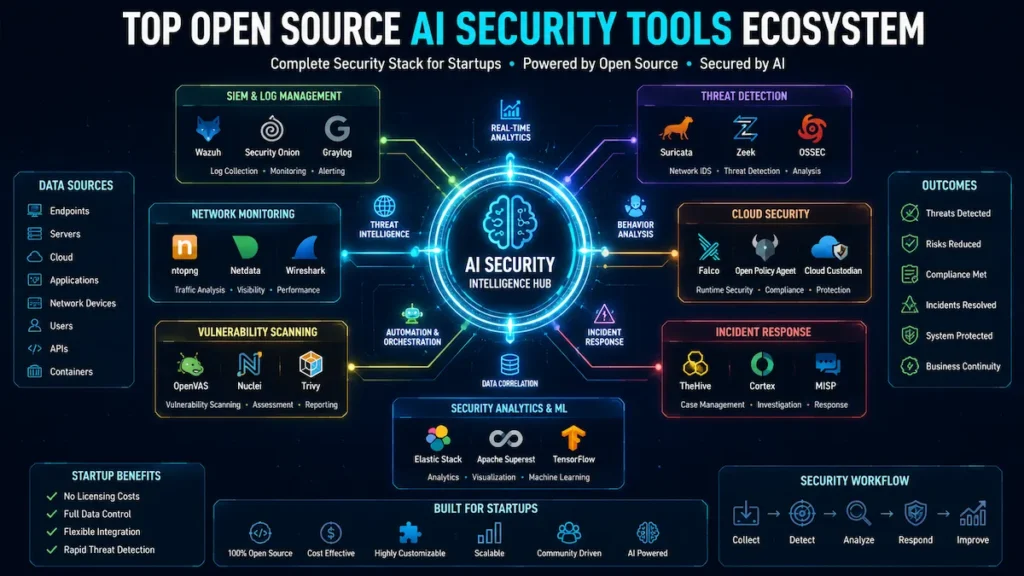
- The 15 Best Free AI Cybersecurity Tools
- Full Comparison Table
- The Minimum Viable Security Stack (3 Tools, $0)
- Stage-Based Tool Selector
- Common Mistakes Startups Make
- When to Stop Relying on Free Tools
- FAQ
Why Startups Are Prime Cyberattack Targets
Free AI cybersecurity tools for startups can help reduce risk early by identifying threats, monitoring activity, and protecting critical systems before attackers find vulnerabilities.

Most startup founders assume hackers go after big companies. They don’t. According to the 2024 Verizon Data Breach Investigations Report, 43% of cyberattacks target small businesses—and startups get hit hardest because they move fast, cut security corners, and hold valuable IP with minimal defenses.
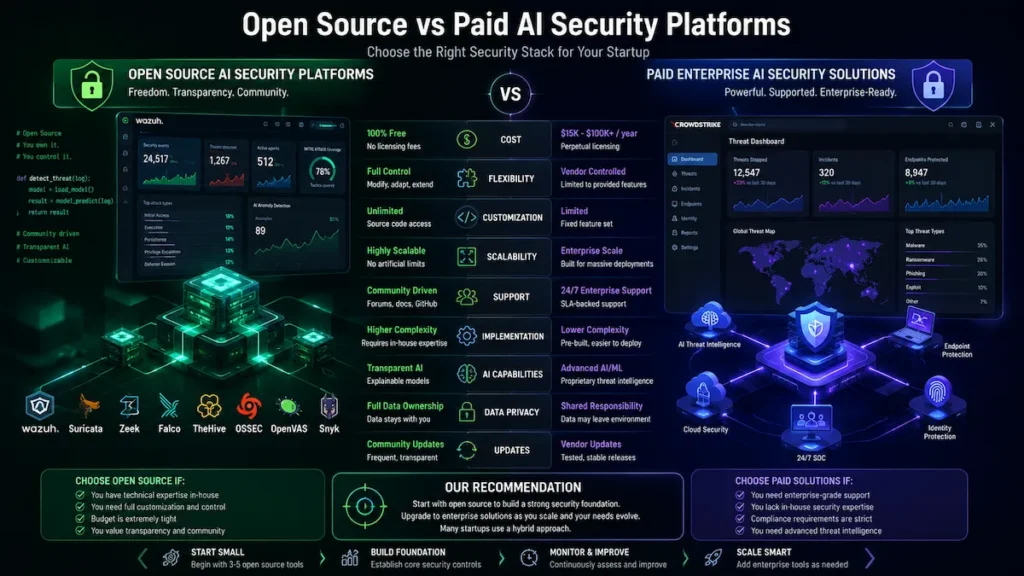
The problem isn’t awareness. Most founders know they need cybersecurity. The problem is cost. Enterprise tools like CrowdStrike or Palo Alto can run $15,000–$100,000+ per year—a budget that doesn’t exist at the pre-seed or seed stage.
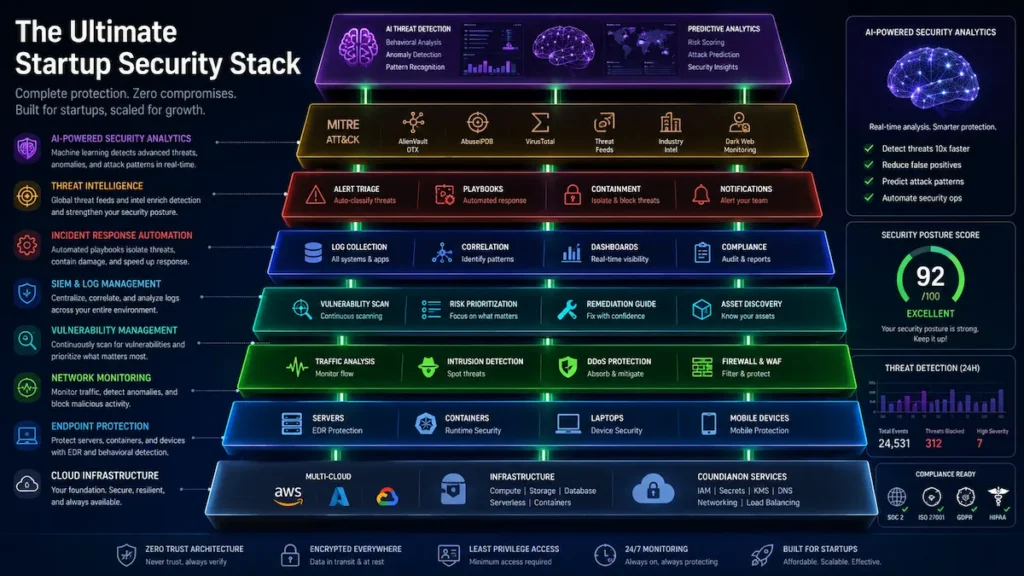
That’s where AI-powered free tools change the game. A new wave of open-source and freemium platforms has matured to the point where a startup can run a genuinely effective security posture at zero licensing cost. This guide covers the 15 best, matched to your startup stage.
If you haven’t already audited your current security posture, our startup cybersecurity checklist is the right place to start before deploying any new tooling.
What “AI-Powered” Actually Means in Cybersecurity
Understanding how free AI cybersecurity tools for startups use machine learning, behavioral analytics, and automated threat detection helps founders separate genuine security solutions from marketing hype.
Definition
An AI-powered cybersecurity tool uses machine learning, behavioral analytics, or automation to detect threats that rule-based systems miss—including zero-day attacks, insider threats, and anomalous network behavior—without requiring manual signature updates.
There are three meaningful AI capabilities in security tools:
- Behavioral anomaly detection: The system learns what “normal” looks like on your network or codebase and flags deviations—catching zero-day attacks before any signature exists.
- Automated fix suggestions: Tools like Snyk don’t just flag a vulnerable dependency—they tell you what to change and why, using AI trained on millions of codebases.
- Pattern-based static analysis: Semgrep and similar tools use ML-trained rules to detect insecure coding patterns across 30+ languages at CI/CD speed.
Not every tool in this list is fully AI-powered—some are rule-based with AI-assisted components. We’ve flagged this clearly in the comparison table.
The 15 Best Free AI Cybersecurity Tools for Startups in 2025
The best free AI cybersecurity tools for startups combine strong security capabilities, practical free tiers, and realistic deployment requirements for small teams.
1. Wazuh—Open-Source XDR + SIEM
Among the most powerful free AI cybersecurity tools for startups, Wazuh provides enterprise-level visibility, compliance monitoring, and threat detection without licensing costs.
100% FreeAI: Behavioral Setup: Hard
Wazuh is an open-source Extended Detection and Response (XDR) and SIEM platform. It aggregates logs from all your servers, endpoints, and cloud workloads, then applies behavioral analysis mapped to the MITRE ATT&CK framework to flag real threats in real time. File integrity monitoring, vulnerability detection, compliance reporting (SOC 2, PCI-DSS, HIPAA), and cloud workload protection—all in one platform, for free.
Free Limit
Unlimited
Best Stage
Seed+
Best For
Compliance + monitoring
⚡ Real-World Note
Setting up Wazuh agents across 10+ servers takes 2–3 hours. The most common mistake is leaving the default alert threshold in place—you’ll get flooded with low-severity alerts and start ignoring everything, including real threats. Tune your ruleset in week two, not two months in.
⚠ Limitation
Requires a Linux server to run the manager. Not suitable for non-technical founders without a DevOps engineer. If you’re pursuing SOC 2, pair this with our guide on SOC 2 compliance tools for AI startups.
2. Snyk — Code & Dependency Security
Snyk is one of the most developer-friendly free AI cybersecurity tools for startups because it integrates directly into software development workflows.
Free (limited) AI: Fix Suggestions Setup: Easy
Snyk scans your codebase, open-source dependencies, containers, and infrastructure-as-code for known vulnerabilities. Its AI layer goes further than flagging—it suggests specific code fixes, telling you exactly what to change and why. Integrates directly into GitHub, GitLab, or Bitbucket and runs on every pull request.
Free Limit
200 tests/month
Best Stage
All stages
Best For
Dev teams shipping daily
⚡ Real-World Note
Snyk’s AI fix suggestions are accurate about 70% of the time. Always test auto-fixes in staging—in complex dependency chains, a fix for one package can break another. Snyk + Semgrep together cover OWASP Top 10 comprehensively for most SaaS codebases.
⚠ Limitation
200 tests/month disappear fast on active monorepos. Container scanning and license compliance require a paid plan.
3. Cloudflare Free Tier — Network & DDoS Protection
Cloudflare remains one of the most widely adopted free AI cybersecurity tools for startups seeking affordable network protection and DDoS mitigation.
Free Tier AI: ML Traffic Analysis Setup: Easy
Cloudflare’s free tier sits your web app behind a globally distributed network that absorbs DDoS attacks, filters malicious traffic via ML models, and provides a basic Web Application Firewall (WAF), SSL, and bot detection. Setup is 15 minutes—change your DNS nameservers, and Cloudflare handles the rest automatically.
Free Limit
Basic WAF + DDoS
Best Stage
All stages
Best For
Any web-facing startup
⚡ Real-World Note
The free tier blocks most volumetric DDoS attacks effectively. Sophisticated Layer 7 attacks require the Pro plan ($20/month). Check your Cloudflare analytics monthly—it surfaces attack patterns and bot probing before anything reaches your app. See how it stacks up against alternatives in our Cloudflare vs. competitors comparison.
⚠ Limitation
Advanced WAF custom rules and rate limiting require paid plans. Free tier analytics are limited for diagnosing specific attack vectors.
4. Semgrep—Static Code Analysis
Semgrep is frequently recommended among free AI cybersecurity tools for startups that want to improve secure software development practices.
Free (OSS) AI: Pattern ML MLSetup: Easy
Semgrep is a fast static analysis tool that catches security vulnerabilities, hardcoded secrets, and insecure API usage across 30+ languages. It integrates into CI/CD pipelines in minutes. The free community ruleset covers the OWASP Top 10 effectively, and rules are human-readable—making custom policies actually accessible to engineering teams without security backgrounds.
Free Limit
OSS rules free
Best Stage
All stages
Best For
Engineering-led startups
⚠ Limitation
Cross-file analysis and team management features require the paid tier. The free tier is excellent for CI/CD checks on small to medium-sized codebases.
5. Falco—Cloud-Native Runtime Security
For containerized environments, Falco stands out among free AI cybersecurity tools for startups focused on runtime threat detection.
100% FreeAI: Behavioral Detection Setup: Hard
Falco is a CNCF project that monitors the runtime behavior of containers and Kubernetes workloads. It detects unexpected behavior—a container spawning a shell, reading sensitive files, or making outbound calls it shouldn’t—using behavioral detection rules. It catches what Snyk and Semgrep can’t: active exploitation inside containers that passed all pre-deployment scans.
Free Limit
Unlimited
Best Stage
Seed+/K8s teams
Best For
Kubernetes workloads
⚡ Real-World Note
Build separate Falco rule profiles for dev, staging, and production. A rule firing 200 times daily in dev will be ignored in production—and that’s exactly when attackers strike. Pair Falco with AI network security monitoring for full coverage.
⚠ Limitation
Not useful for startups not yet running containerized workloads. Requires meaningful Kubernetes expertise to tune properly.
6. Prowler—Cloud Security Posture Management
Prowler is one of the most valuable free AI cybersecurity tools for startups operating in AWS, Azure, or Google Cloud environments.
100% FreeAI: Policy-Based Setup: Easy
Prowler audits your AWS, GCP, or Azure environment against hundreds of security best practices and compliance benchmarks—CIS, SOC 2, HIPAA, and GDPR. Cloud misconfigurations (public S3 buckets, over-permissioned IAM roles, security groups open to 0.0.0.0/0) cause a massive percentage of startup breaches. Running Prowler monthly takes 30 minutes and can prevent a career-ending incident. If you’re also managing GDPR obligations, review our GDPR compliance tools guide alongside this.
Free Limit
Unlimited
Best Stage
All stages (cloud)
Best For
AWS / GCP / Azure teams
⚠ Limitation
CLI-only. If you’re clicking around in the AWS console rather than using IaC, Prowler will miss those configurations. Invest in IaC first.
7. Checkov—Infrastructure-as-Code Security
Checkov deserves consideration among free AI cybersecurity tools for startups because it helps prevent cloud security mistakes before deployment.
100% FreeAI: Policy-as-Code Setup: Easy
Checkov scans Terraform, CloudFormation, Kubernetes manifests, and other IaC files for misconfigurations before they’re deployed. It checks against 1,000+ built-in policies covering CIS, SOC 2, and PCI-DSS, flagging publicly accessible S3 buckets, unencrypted databases, or overly permissive IAM roles directly in your code—before they become live infrastructure.
Free Limit
Unlimited
Best Stage
All stages
Best For
Terraform / CloudFormation
⚡ Real-World Note
The first Checkov run returns 30–50 findings. Don’t panic—suppress what you’ve consciously accepted as risk, fix the rest, and set a clean baseline. From there, keep the CI gate clean on every PR.
8. Suricata—Network Intrusion Detection
Suricata strengthens free AI cybersecurity tools for startups by providing real-time network monitoring and intrusion detection capabilities.
100% FreeAI: Rule-Based Setup: Medium
Suricata is a high-performance IDS/IPS that monitors all network traffic against threat intelligence rule sets in real time. It integrates well with Wazuh, enabling log correlation across both network and host-level events for a unified view of threats. Start in detection-only mode before enabling blocking—IPS mode can drop legitimate traffic if misconfigured.
Free Limit
Unlimited
Best Stage
Seed+ (self-hosted infra)
Best For
Network monitoring
9. OpenVAS — Vulnerability Scanning
Many startups include OpenVAS in their free AI cybersecurity tools for startups stack because it offers comprehensive vulnerability scanning capabilities.
100% FreeSetup: Medium
OpenVAS via Greenbone Community Edition is one of the most comprehensive free vulnerability scanners available. It scans your entire infrastructure—servers, firewalls, databases, and services—and produces severity-ranked vulnerability reports. Schedule scans during off-peak hours; a full AWS environment scan can take 2–4 hours and generates network noise that can trigger alerts in other tools.
Free Limit
Unlimited
Best Stage
Seed+ (compliance)
Best For
Compliance audits
10. Elastic Security — SIEM + EDR
Elastic Security extends the capabilities of free AI cybersecurity tools for startups by combining security analytics with endpoint monitoring.
Free (Basic) AI: ML Anomaly Setup: Hard
Elastic Security combines SIEM and EDR capabilities with ML-based anomaly detection. For teams already using the Elastic stack for logging, adding security coverage is low-friction and high-value—the ML models detect insider threats and unusual data access patterns without manual rule writing.
Free Limit
Basic license
Best Stage
Series A+
Best For
Elastic-stack teams
11. TheHive—Incident Response Platform
TheHive complements other free AI cybersecurity tools for startups by helping teams organize and manage security incidents efficiently.
100% FreeSetup: Medium
TheHive provides structured case management for security incidents. When Wazuh or Falco fires a real alert, TheHive lets your team create incident cases, assign tasks, document findings, and run response playbooks—preventing the coordination nightmare of managing a real breach over Slack threads. Integrates with VirusTotal and Cortex for automated IOC enrichment. For a broader incident response framework, our guide on securing a startup with AI tools covers playbook design in depth.
Free Limit
Unlimited
Best Stage
Seed+
Best For
Incident management
12. Zeek—Network Traffic Analysis
Zeek enhances free AI cybersecurity tools for startups through detailed network visibility and forensic investigation capabilities.
100% FreeSetup: Medium
Zeek is a passive network analysis framework that generates structured logs of all network activity—connections, DNS queries, HTTP requests, SSL certificates, and file transfers. Unlike Suricata’s real-time alerting, Zeek builds the forensic record you need to answer, “What happened on our network between 2 AM and 4 AM last Tuesday?” “Pair it with Elastic or Wazuh for correlation and alerting.
Free Limit
Unlimited
Best Stage
Seed+
Best For
Post-breach forensics
13. OSSEC — Host-Based Intrusion Detection
OSSEC remains a trusted option among free AI cybersecurity tools for startups that require host-level monitoring and file integrity protection.
100% FreeSetup: Medium
OSSEC monitors individual servers for file integrity changes, rootkit signatures, log tampering, and suspicious user activity. It’s best used as a lightweight host monitoring agent on critical servers—your database, payment processor, or authentication system—feeding alerts into Wazuh or Elastic for correlation. Wazuh is actually built on OSSEC’s engine.
Free Limit
Unlimited
Best Stage
Seed+
Best For
Critical server monitoring
14. Nessus Essentials — Vulnerability Assessment
Nessus Essentials is often evaluated alongside other free AI cybersecurity tools for startups due to its professional-grade vulnerability assessment engine.
Free (16 IPs) Setup: Easy
Nessus Essentials scans up to 16 IP addresses with the same engine used in the full professional version. Its reports carry immediate credibility for SOC 2 audits or enterprise customer security questionnaires—far more polished than OpenVAS output. For startups with small infrastructure footprints preparing for compliance reviews, Nessus Essentials is often the right choice over OpenVAS.
Free Limit
16 IPs
Best Stage
Pre-seed+
Best For
Compliance evidence
15. VirusTotal API — Threat Intelligence
Threat intelligence is an important component of free AI cybersecurity tools for startups, and VirusTotal provides access to one of the industry’s largest intelligence databases.
Free (rate limited) AI: Aggregated MLSet up: Easy
VirusTotal aggregates threat intelligence from 70+ antivirus engines and security vendors. The free API (500 lookups/day) lets you programmatically check files, URLs, IPs, and domains against the world’s largest malware database—essential for incident investigation and IOC enrichment workflows. Not a primary security tool, but an invaluable supporting layer in any response playbook.
Free Limit
500 lookups/day
Best Stage
All stages
Best For
Incident investigation
Full Comparison Table
This comparison of free AI cybersecurity tools for startups helps founders quickly identify which solutions match their technical requirements and growth stage.
| Tool | Category | Free Limit | AI-Powered | Setup (1–5) | Best Stage |
|---|---|---|---|---|---|
| Wazuh | XDR/SIEM | Unlimited | ✅ Behavioral | 4/5 | Seed+ |
| Snyk | Code Security | 200 tests/mo | ✅ AI fix suggestions | 1/5 | All stages |
| Cloudflare | Network/WAF | Basic WAF | ✅ ML traffic | 1/5 | All stages |
| Semgrep | SAST | OSS rules free | ✅ Pattern ML | 1/5 | All stages |
| Falco | Runtime Security | Unlimited | ✅ Behavioral | 4/5 | Seed+ / K8s |
| Prowler | CSPM | Unlimited | ⚠️ Policy-based | 2/5 | All stages |
| Chekhov | IaC Security | Unlimited | ✅ Policy-as-code | 1/5 | All stages |
| Suricata | IDS/IPS | Unlimited | ⚠️ Rule-based | 3/5 | Seed+ |
| OpenVAS | Vuln Scanner | Unlimited | ⚠️ Partial | 3/5 | Seed+ |
| Elastic Security | SIEM/EDR | Basic license | ✅ ML anomaly | 4/5 | Series A+ |
| TheHive | Incident Response | Unlimited | ⚠️ Workflow | 3/5 | Seed+ |
| Zeek | Network Analysis | Unlimited | ⚠️ Passive logging | 3/5 | Seed+ |
| OSSEC | HIDS | Unlimited | ⚠️ Rule-based | 3/5 | Seed+ |
| Nessus Essentials | Vuln Scanner | 16 IPs | ⚠️ Scan engine | 2/5 | Pre-seed+ |
| VirusTotal API | Threat Intel | 500/day | ✅ Aggregated ML | 1/5 | All stages |
The Minimum Viable Security Stack ($0, Under 1 Hour)
A carefully selected stack of free AI cybersecurity tools for startups can provide meaningful protection without adding significant operational complexity.
Quick Answer — MVP Security Stack
The three-tool combination that gives early-stage startups maximum coverage with minimum time investment: Cloudflare (network protection) + Snyk (code security) + Checkov (cloud infrastructure). Combined setup time: under 60 minutes. Combined monthly cost: $0.
The Startup MVP Security Stack
Covers the 3 most common startup attack vectors—at zero cost
☁️ Cloudflare
Network protection, DDoS, WAF
⏱ 15 min setup
🔍 Snyk
Code + dependency vulnerabilities
⏱ 10 min setup
🏗️ Checkov
IaC misconfiguration prevention
⏱ 30 min CI setup
This stack covers the three most common startup attack vectors: network-level attacks on your app, vulnerable third-party packages in your codebase, and cloud misconfigurations going live undetected. Add Wazuh as your fourth tool once you have a technical team member with 15 minutes per week to review alerts.
For a complete security strategy that goes beyond tooling, our guide on AI security tools on a startup budget covers how to build a comprehensive program around these free tools.
Stage-Based Tool Selector
Selecting free AI cybersecurity tools for startups becomes much easier when recommendations are aligned with team size, infrastructure complexity, and compliance goals.
| Stage | Team Size | Priority | Recommended Stack | Monthly Time |
|---|---|---|---|---|
| Pre-Seed | 1–3 people | Ship without getting breached | Cloudflare + Snyk + Checkov | ~2 hrs |
| Seed | 4–10 people | Add visibility + compliance groundwork | Above + Wazuh + Prowler + Semgrep | ~6 hrs |
| Series A | 11–50 people | Full coverage + SOC 2 readiness | Above + Falco + Elastic + TheHive | Part-time owner |
| Bootstrapped | Any (revenue) | High ROI, cost-conscious | Cloudflare + Wazuh + OpenVAS + Checkov | ~4 hrs |
For machine learning-based threat detection at the network level—particularly relevant at Seed and Series A—see our deep dive on machine learning intrusion detection for startups.
5 Common Mistakes Startups Make with These Tools
Even the best free AI cybersecurity tools for startups can become ineffective when they are deployed without proper ownership, monitoring, or configuration.
1. Setting up Wazuh without tuning alerts. Default configurations flood you with hundreds of daily alerts. Most teams get overwhelmed, stop reviewing, and miss real threats. Spend two hours in week two tuning suppression rules for known-good activity. After that, every alert matters.
2. Treating Snyk as a “run once” tool. New CVEs are published daily. Snyk must run on every pull request and on a scheduled daily scan of your main branch. Configure Slack notifications for high-severity findings so nothing is silently waiting in a dashboard nobody checks.
3. Using Cloudflare but never reviewing analytics. The Cloudflare dashboard shows attack patterns, aggressive bots, and geographic anomalies—information that often surfaces who’s probing your app before anything breaches. Check it monthly.
4. Installing security tools without assigning ownership. Every tool on this list needs a named owner responsible for reviewing output. A tool that fires unreviewed alerts is worse than no tool—it creates false confidence. Document the owner per tool in your team wiki.
5. Skipping the IaC scanner because “we’re moving fast.” Checkov takes 30 minutes to add to CI. The vast majority of cloud breaches that hit startups trace back to a Terraform misconfiguration that went live unreviewed. The prevention is easier than the breach.
When to Stop Relying on Free Tools
While free AI cybersecurity tools for startups offer excellent value, growing organizations eventually reach a point where paid solutions become necessary. Free tools are genuinely capable for most startups under 50 people. These are the clear signals it’s time to invest in paid platforms:
You’re handling regulated data
Customers, auditors, or investors ask for evidence of controls. Commercial platforms generate audit logs and evidence reports more efficiently than self-managed open-source tools.
You’ve had a real incident
If your current tools failed to detect it in time, that’s the clearest signal to upgrade. Don’t wait for a second breach to act.
The team exceeds 50 people
Free open-source tools require active maintenance. At this size, the operational overhead often exceeds the cost of a managed platform.
Closing enterprise customers
SOC 2 Type II, ISO 27001, or FedRAMP requirements from enterprise prospects often make commercial platforms necessary for evidence generation efficiency.
When you hit these thresholds, evaluate CrowdStrike Falcon Go, SentinelOne, or Lacework—each has startup-friendly pricing. Until then, the tools in this guide are more than capable. The CISA advisories page is also worth monitoring as your security program matures—it provides free, timely threat intelligence that contextualizes what your tools are detecting.
Frequently Asked Questions
These frequently asked questions address the most common concerns founders have when evaluating free AI cybersecurity tools for startups.
Are free AI cybersecurity tools actually good enough for startups?
Yes, for most early-stage startups. Wazuh, Snyk, Cloudflare, and Falco are deployed by engineering teams worldwide, including at large enterprises. Free tiers have real limits, but they address the most common attack vectors a startup faces. The key is using them consistently—not just installing them once and forgetting.
What is the easiest free cybersecurity tool for a non-technical founder?
Cloudflare is the best starting point. Setup takes 15 minutes, requires no ongoing configuration, and immediately protects your web application. Snyk is a close second for technical founders—it connects to GitHub in under 10 minutes and automatically scans every code push.
Can these free tools help with SOC 2 compliance?
Several do directly. Wazuh covers log management and monitoring requirements. Prowler and Checkov satisfy availability and confidentiality controls for cloud environments. Snyk supports change management controls in your SDLC. You may still need a compliance platform to aggregate evidence, but these tools generate much of the underlying record.
What is Wazuh, and is it free?
Wazuh is a 100% free, open-source security platform combining SIEM and XDR capabilities. There is no paid software version—the full feature set is available at no cost. Wazuh Inc. offers paid cloud hosting and enterprise support contracts, but the software itself has no license fees or usage limits.
How do I build a security stack with no security budget?
Start with three tools: Cloudflare (network protection), Snyk (code security), and Checkov (cloud IaC security). Each is free, each takes under an hour to deploy, and together they cover the most common startup attack vectors. As your team grows, add Wazuh for deeper visibility and Prowler for cloud auditing.
How much time does managing these tools actually take?
For a pre-seed startup using the three-tool minimum stack, expect 1–2 hours per month. Snyk and Checkov run automatically in CI and only surface alerts when high-severity issues appear. Cloudflare is essentially zero-maintenance. For the full seed-stage stack, budget 4–6 hours per month with a designated technical owner.
What cybersecurity framework should startups follow?
The NIST Cybersecurity Framework is the most widely accepted standard and maps well to the tools in this guide. Wazuh and Suricata cover the Detect function; Snyk and Checkov cover Protect; TheHive covers Respond. For startups pursuing SOC 2, the NIST framework is also a recognized reference model that auditors accept.
✅ Bottom Line
The minimum viable startup security stack costs nothing and deploys in under an hour: Cloudflare for network protection, Snyk for code security, and Checkov for cloud infrastructure. From there, add Wazuh and Prowler as your team grows. These tools cover the threats that actually breach startups—not theoretical enterprise attack scenarios. Start today, not after your Series A.