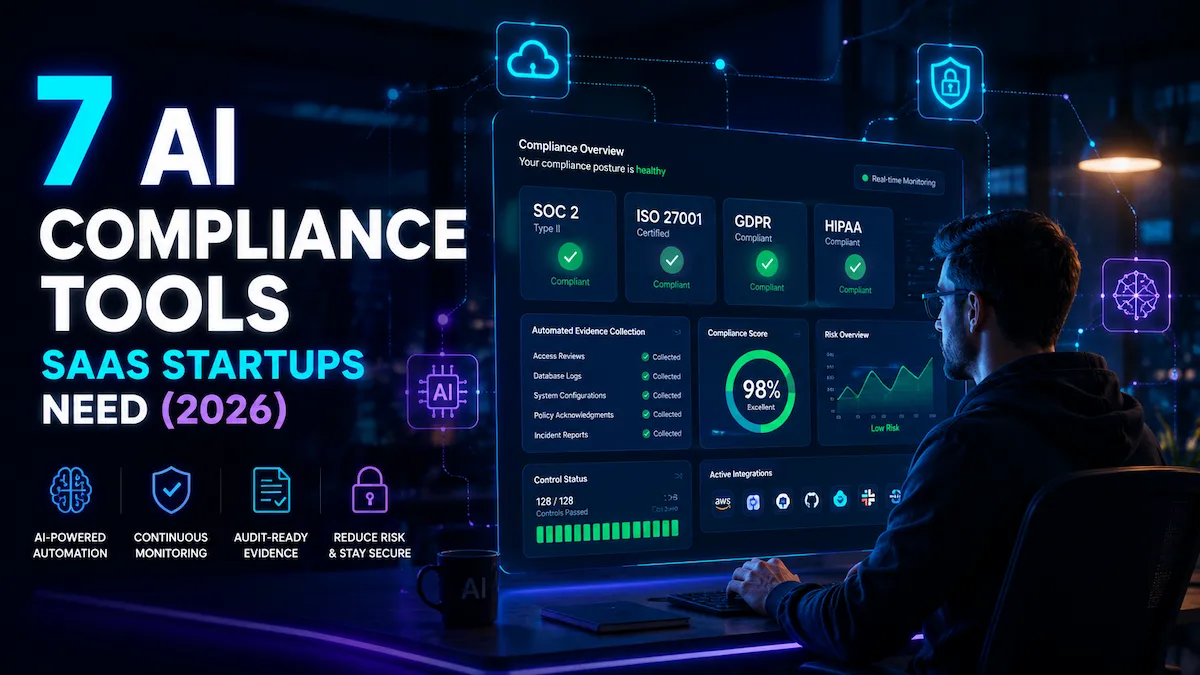
Modern AI security compliance tools for SaaS companies have fundamentally changed how startups approach SOC 2, ISO 27001, GDPR, and enterprise audit readiness.
Many SaaS startups struggle with their first compliance audit—not because their security controls are fundamentally weak, but because they lack the evidence, processes, and ownership needed to demonstrate those controls effectively. SOC 2 isn’t only a security problem. It’s also an evidence problem. And the difference between advancing a six-figure enterprise deal and losing momentum can sometimes come down to whether you can produce the right security documentation quickly.
Enterprise procurement teams don’t evaluate your product’s security based on your claims alone. They need evidence—and when you can’t provide the required documentation quickly or in the format they expect, security reviews can stall or deals can be delayed. If compliance is already showing up in your sales calls, you’re not early—you’re late.
AI security compliance tools for SaaS startups have fundamentally changed this equation. You may not need a full-time compliance team or six-figure consulting engagement to get started. The right platform automates much of your audit prep, monitors your cloud environment in real time, and generates the evidence and documentation your audit program requires—continuously, not three weeks before your audit date.
This guide covers what these platforms do, which ones are worth your money in 2026, and how to implement them without losing weeks of engineering time. The same patterns—and the same mistakes—show up repeatedly in first-time SaaS compliance implementations. You’ll find both here.
What Are AI Security Compliance Tools for SaaS Startups?
AI security compliance tools for SaaS startups automate evidence collection, continuous monitoring, risk detection, and audit preparation across modern cloud environments.
What is SOC 2 automation?
For SaaS startups, AI security compliance tools simplify SOC 2 automation by continuously collecting and organizing audit evidence from connected systems.
- Continuous evidence collection from your cloud infrastructure
- Real-time control monitoring across your entire stack
- Automated audit reporting mapped to specific framework requirements
In short: it replaces much of the manual audit preparation with a live, continuously updated evidence system that can reduce the last-minute scramble before an audit.
One clarification worth knowing: SOC 2 results in an attestation report from an independent auditor, not a formal certification. ISO 27001, by contrast, is a management-system standard that can be independently certified.
How do AI compliance tools work?
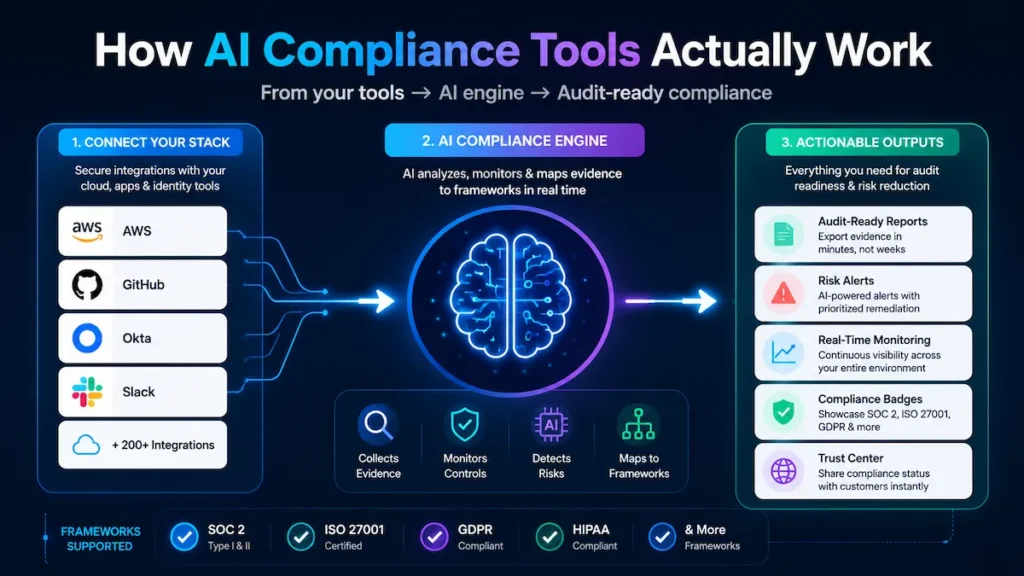
AI compliance platforms connect to cloud infrastructure and SaaS systems to collect evidence, monitor supported controls, identify potential risks, and generate audit-ready artifacts. Some platforms also use machine learning or AI-assisted analysis to prioritize findings and surface potential anomalies.
Instead of manually collecting every access log, tracking vendor reviews, and maintaining policy documentation, the platform can automate or streamline much of that work throughout the year. Some modern platforms use machine learning or AI-assisted analysis to identify anomalous activity, prioritize risks, and surface findings that may require attention.
Before evaluating any tool, it’s worth understanding what cybersecurity infrastructure a SaaS startup actually needs—because compliance tooling sits on top of a security foundation, not in place of one.
For a startup, these platforms serve three core jobs: accelerate compliance readiness, reduce the manual effort required to maintain controls and evidence, and give enterprise buyers the documentation and evidence they need to evaluate your security posture.
Do Startups Really Need SOC 2?
Short answer: if you’re selling to enterprise, often yes—and sooner than you think.
For startups selling into enterprise markets, AI security compliance tools for SaaS businesses have become essential for accelerating SOC 2 readiness and reducing procurement friction.
SOC 2 Type II is widely used by SaaS companies to provide assurance about the effectiveness of relevant controls over a defined period. In practice, many enterprise procurement teams now expect SOC 2 before signing contracts with SaaS vendors, and missing security documentation can meaningfully delay deal cycles.
When should you start compliance?
Start early enough to complete the required preparation and observation period—not just a few months before you need the report. The Type II observation period typically runs 3–12 months, depending on the auditor, engagement scope, and customer requirements, and tooling cannot eliminate the need for a real observation period.
Is SOC 2 required for SaaS?
Not legally—but commercially, SOC 2 has become a common requirement for selling into mid-market and enterprise accounts, particularly when buyers need formal assurance over a SaaS vendor’s security controls. Startups that delay compliance readiness can face longer security reviews, procurement delays, or lost opportunities when competing vendors can provide the assurance documentation buyers require.
Why SaaS Startups Fail Security Compliance
Many startups invest in AI security compliance tools for SaaS operations too late—after enterprise buyers have already started requesting audit evidence and security documentation.
Here’s what can happen during a first-time SOC 2 audit. The auditor tests evidence over the applicable observation period. Your team scrambles. Some logs were never retained. An access review process existed only as a Notion document that nobody consistently followed. Former employees may still have inappropriate production access because offboarding was informal. Gaps like these can delay the audit and require additional remediation before the engagement can be completed.
Many founders realize too late that evidence gaps and weak control execution—not simply the underlying security technology—can derail an audit. First-time audits commonly expose documentation, access-control, evidence-collection, and process gaps that need to be addressed before an organization can demonstrate that its controls are operating effectively.
The specific mistakes are often the same:
- Starting too late—compliance work begins just a few months before the audit instead of starting early enough to build and test controls over the required observation period
- Treating it as a project—rather than as a continuous operational process
- Wrong ownership model—engineers own compliance without dedicated time, clear accountability, or appropriate tooling
- Wrong framework—pursuing SOC 2 Type I when enterprise buyers actually require Type II
- Ignoring vendor risk—failing to assess vendors and subprocessors can create security, contractual, and data-protection risks that your compliance program needs to address
- Policies that don’t reflect reality—documents that sound good but don’t match actual engineering practices
A policy is not evidence by itself. Auditors need to see that the controls described in your policies are actually implemented and operating as intended. Access reviews, user provisioning and deprovisioning, vendor management, and evidence collection are areas where startups need clear ownership and consistent execution.
Before selecting any platform, run through the startup cybersecurity checklist built specifically for startup environments—it surfaces the security and operational gaps that compliance tools will need to help you monitor and document.
Why Most AI Compliance Platforms Fail Startups
Many teams adopt AI security compliance tools for SaaS compliance programs, assuming automation alone will solve audit readiness challenges. Three failure patterns show up consistently:
Failure Pattern 1: The Over-Automation Myth Automation can identify control gaps, but it does not eliminate the need for human oversight. Someone still needs to review findings, assign remediation tasks, make risk decisions, and verify that corrective actions are completed. A platform can generate the alert—the gap occurs when nobody takes responsibility for acting on it.
Failure Pattern 2: The Hidden Manual Work The first implementation still requires meaningful configuration, policy customization, integration work, and internal coordination—regardless of which platform you choose. Teams can discover this too late, particularly when an incomplete implementation creates an overly optimistic picture of audit readiness.
Failure Pattern 3: The Post-Type-I Drift Problem Some teams treat Type I readiness as the finish line, only to discover during the Type II observation period that controls have not been maintained consistently. Access reviews get missed, evidence collection breaks, policies become outdated, or control owners stop performing required tasks. The platform may still be running, but compliance requires people to act on what the platform identifies.
The tools below are genuinely powerful. But they work because of the process behind them—not instead of it.
Key Features to Look For
The best AI security compliance tools for SaaS startups combine evidence collection, continuous monitoring, risk management, and audit readiness in a way that fits the startup’s existing security and compliance processes.
Automation and Audit Readiness
AI security compliance tools for SaaS companies can automate much of the evidence-collection and audit-preparation process by continuously collecting security evidence and mapping controls to frameworks such as SOC 2 and ISO 27001.
What to look for:
- Live evidence collection that updates automatically instead of relying on periodic manual snapshots
- Direct integrations with your cloud provider, identity provider, source-code repositories, HR systems, and other systems in scope
- Control-level readiness scoring that shows which specific controls are passing, failing, or missing evidence
- Framework mapping that lets you reuse common controls across multiple compliance frameworks
- Audit-ready reporting that makes it easier to provide evidence to your auditor and enterprise customers
Common mistake: Assuming integrations are completely plug-and-play. Initial configuration can require meaningful engineering and administrative effort, particularly when connecting identity systems, cloud infrastructure, HR platforms, code repositories, and other systems that contain compliance evidence. Account for that implementation work before committing to a certification timeline.
Leading compliance platforms combine automated evidence collection with continuous control monitoring and audit-readiness workflows, but the right platform depends on your required frameworks, technology stack, budget, internal ownership, and auditor requirements.
Real-Time Monitoring
Modern AI security compliance tools for SaaS platforms can provide continuous monitoring that helps startups identify security misconfigurations, access-control issues, and compliance gaps before they become audit findings.
What to look for:
- Continuous control monitoring that identifies changes or control failures without relying solely on periodic manual reviews
- Identity and access monitoring across your identity provider and other systems that manage employee and service access
- Cloud and SaaS integrations that can identify relevant configuration and security issues across your technology stack
- Actionable alerts that clearly identify the affected control, risk, and recommended remediation
- Workflow integrations that allow important findings to be assigned and tracked through your existing ticketing or incident-management process
Common mistake: Assuming continuous monitoring means every issue will be detected automatically. Coverage depends on the integrations, controls, configuration, and capabilities supported by the platform. Review what each integration actually monitors before relying on it for a specific control.
Risk Detection and Threat Alerts
The right AI security compliance tools for SaaS startups should help teams identify, prioritize, and respond to security and compliance risks before they become audit findings or business-impacting incidents.
What to look for:
- Risk-based prioritization that ranks findings by severity, business impact, and affected controls
- Anomaly and behavioral detection where supported, rather than relying only on predefined compliance rules
- Vendor and third-party risk monitoring that complements infrastructure and access-control monitoring
- Clear remediation workflows that allow teams to assign findings, track progress, and document resolution
Common mistake: Treating every alert as equally important. Alert fatigue can cause teams to overlook genuinely significant findings. Prioritize alerts based on business impact, control requirements, and actual risk rather than simply working through the alert queue from top to bottom.
Teams looking to strengthen the detection layer alongside compliance monitoring can also explore machine learning intrusion detection for startups before configuring risk thresholds.
Policy and Documentation Automation
The best AI security compliance tools for SaaS startups can simplify policy management by providing framework-aligned templates, approval workflows, version tracking, and recurring policy reviews.
What to look for:
- Framework-aligned policy templates mapped to requirements such as SOC 2, ISO 27001, GDPR, and HIPAA, where supported
- Version control and acknowledgment tracking so you can demonstrate when policies were updated and acknowledged
- Automated review reminders that help prevent policies from becoming outdated between audits
- Customizable documentation that reflects your actual systems, processes, and security responsibilities
Biggest mistake: Deploying default templates without reading or adapting them. A startup’s incident response policy might promise a two-hour response window while its actual practice is 48 hours. An auditor can uncover that mismatch during interviews—not just through log reviews. Fix the policy or fix the practice. They have to match.
💰 How Compliance Tools Help You Close Enterprise Deals Faster
Beyond audit preparation, AI security compliance tools for SaaS companies can help reduce procurement delays and security-review friction by making compliance evidence easier to collect, organize, and share.
This is the part of compliance that directly connects security operations to revenue.
Enterprise buyers often require security documentation before completing vendor reviews. When evidence is scattered across cloud consoles, spreadsheets, policy documents, and email threads, responding to these requests can consume significant engineering, security, and legal time. A centralized compliance platform can make that process more efficient by keeping evidence, policies, control status, and remediation information organized in one place.
Security questionnaires become easier to manage. Enterprise buyers frequently send detailed security questionnaires as part of procurement. Without a compliance platform, answering these questionnaires can require significant input from engineering, security, and legal teams. Platforms such as Vanta and Drata provide questionnaire and response-management capabilities that can reduce repetitive work and help teams respond more consistently, depending on the plan and features included.
Trust centers make security information easier to access. Instead of repeatedly sending the same security documents to prospective customers, a trust center can provide controlled access to information such as security policies, compliance reports, certifications, and other approved documentation. This doesn’t eliminate procurement requirements, but it can reduce unnecessary back-and-forth and give security reviewers a clearer path to the information they need.
The revenue impact can be significant. The potential revenue impact depends on how heavily security and compliance requirements affect your sales process. Consider a hypothetical SaaS company whose enterprise prospects require security documentation before procurement can proceed. If a compliance platform helps the company respond faster, maintain current evidence, and avoid repeated manual security reviews, the operational savings can be meaningful—and the platform may pay for itself if it helps prevent even one enterprise opportunity from being delayed or lost because of an avoidable compliance gap.
Compliance isn’t just an audit requirement. For SaaS startups selling into enterprise markets, it can become part of the infrastructure that supports faster, more predictable revenue growth.
🎯 Want to see where you stand right now? Run a compliance gap analysis with your preferred platform before your next enterprise sales call. Identify your biggest control gaps early enough to address them before they become procurement blockers.
7 Powerful AI Security Compliance Tools for SaaS Startups (2026)
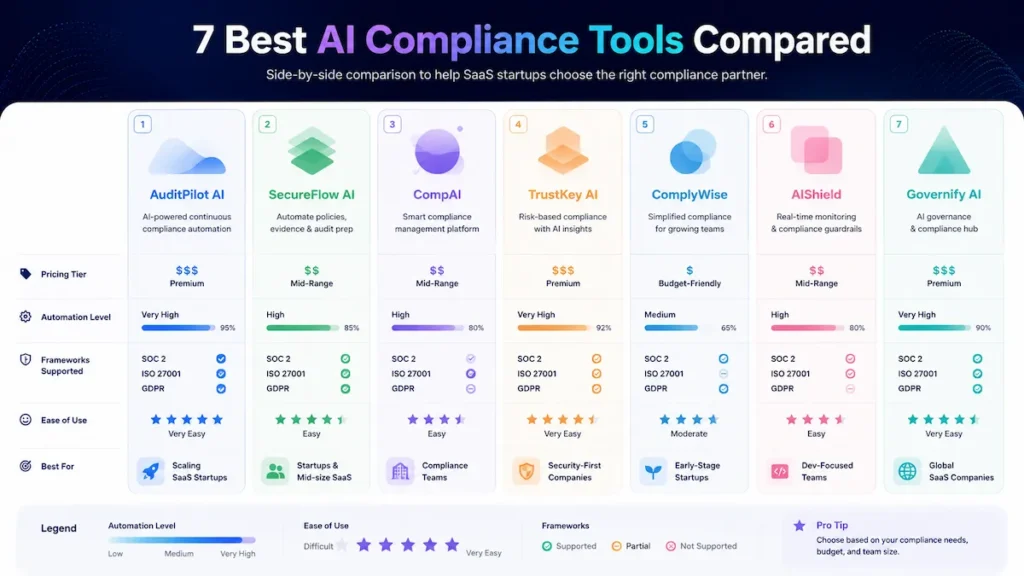
These AI security compliance tools for SaaS startups help automate compliance operations, accelerate SOC 2 readiness, and simplify ongoing audit management in 2026.
1. Vanta — Best for Fast SOC 2 Readiness and Growing Compliance Programs
Among AI security compliance tools for SaaS startups, Vanta is a strong option for companies that want to automate evidence collection, continuously monitor controls, and build an audit-ready compliance program without managing everything manually.
Vanta combines automated compliance monitoring with evidence collection, policy management, risk workflows, security questionnaire automation, and a Trust Center. Its platform currently supports hundreds of integrations across cloud, identity, code, HR, and other business systems, allowing startups to connect the systems that auditors and compliance teams rely on.
Example scenario: A 15-person SaaS team preparing for its first SOC 2 Type II engagement can connect systems such as AWS, GitHub, Google Workspace, and identity providers, automate evidence collection, monitor controls continuously, and use the platform’s readiness workflows to identify gaps that require remediation. Vanta supports both SOC 2 Type I and Type II engagements.
- Key features: Hundreds of integrations, automated evidence collection, continuous controls monitoring, policy management, security questionnaire automation, risk management, Trust Center, and cross-framework control mapping
- Pros: Broad integration ecosystem, strong automation, continuous monitoring, cross-framework support, and an established auditor and partner network
- Cons: Advanced capabilities may require higher-tier plans, pricing is customized, and organizations with highly specialized requirements may need additional configuration or implementation support
- Pricing: Custom pricing; Vanta currently directs prospective customers to request personalized pricing based on their requirements and plan.
- Best for: Seed through growth-stage SaaS companies prioritizing automated SOC 2 readiness and a scalable compliance program
- Consider another platform if: Your primary requirement is a highly specialized compliance workflow that Vanta’s standard framework and integration coverage does not address
Vanta also offers a Trust Center that allows companies to share approved security and compliance information with prospects and customers, helping reduce repetitive security-review requests.
2. Drata—Best for Multi-Framework Compliance at Scale
Drata is a strong option for Series A and Series B SaaS companies pursuing SOC 2, ISO 27001, and HIPAA simultaneously. Its multi-framework capabilities make it a practical option when compliance requirements span multiple frameworks and geographies.
- Key features: Continuous control monitoring, automated testing, multi-framework support (SOC 2, ISO 27001, HIPAA, PCI DSS, GDPR), control mapping, risk management, and risk register capabilities
- Pros: Strongest multi-framework coverage, excellent risk management AI features, high-quality audit partner network, highly responsive support team
- Cons: More complex setup than Vanta, higher price point, steeper learning curve for non-technical compliance leads
- Pricing: Custom pricing; varies by company size, frameworks, and services
- Best for: SaaS companies pursuing multiple frameworks simultaneously
- Best avoided if: You only need a straightforward SOC 2 program and prefer the simplest possible implementation.
3. Sprinto—Best for Cost-Conscious Startups with Global Compliance Needs
Sprinto is a practical option for early-stage startups pursuing SOC 2 and broader privacy and compliance requirements while operating across US and European markets. Its compliance platform combines automated control monitoring, framework support, and compliance workflows designed for growing teams.
For startups that need multiple compliance frameworks without building a large internal compliance function, Sprinto can provide a structured way to manage evidence collection, controls, policies, and ongoing compliance activities.
- Key features: Automated control monitoring, GDPR data mapping, SOC 2 and ISO 27001 support, security awareness and training management, risk management
- Pros: Startup-oriented compliance workflows, support for multiple frameworks, GDPR capabilities, and guided compliance processes
- Cons: May be less suitable for organizations requiring highly complex enterprise integrations or extensive customization
- Pricing: Custom pricing; varies by company size, frameworks, and services
- Best for: Pre-Series A and early-stage startups looking for a structured approach to SOC 2 and broader compliance requirements
- Best avoided if: You have highly complex enterprise requirements and need extensive customization or integrations beyond your current compliance scope
4. Secureframe—Best for Teams That Want Guided Compliance Support
Secureframe is designed for startups and growing companies that want a more guided approach to compliance rather than relying entirely on self-service software. Its platform combines automated evidence collection, continuous monitoring, policy management, and compliance support to help teams work through the requirements of frameworks such as SOC 2 and ISO 27001.
Example scenario: A founder-led SaaS team with limited compliance experience needs to prepare for SOC 2. Secureframe can help the team identify required controls, collect evidence, manage compliance tasks, and address gaps before the audit.
Best avoided if: Your team already has substantial compliance expertise and primarily needs a lightweight platform for automated evidence collection
Key features: Automated evidence collection, continuous monitoring, personnel security management, vendor risk management, policy management, and compliance support
Pros: Guided compliance experience, strong focus on helping teams manage compliance workflows, useful vendor risk and personnel management capabilities
Cons: May be more than a highly technical team needs if it prefers to manage compliance through a largely self-service workflow
Pricing: Custom pricing; varies by company size, frameworks, and services
Best for: Founders and teams new to SOC 2 or other compliance programs who want additional guidance throughout implementation
5. Tugboat Logic (by OneTrust)—Best for ISO 27001 Implementation
Tugboat Logic by OneTrust is designed to help organizations manage information security and compliance programs, including ISO 27001 implementation. Its approach is particularly relevant for SaaS companies that need structured risk management, policy development, control management, and audit preparation as part of an ISO 27001 certification program.
For a SaaS company expanding into European and international markets, ISO 27001 can provide a recognized framework for demonstrating that its information security management system (ISMS) is formally established and maintained.
Best avoided if: Your immediate priority is a straightforward SOC 2-only compliance program and you don’t currently need the additional structure associated with an ISO 27001-focused approach
Key features: ISO 27001 support, gap analysis, risk assessment, policy management, ISMS documentation, control management, and audit preparation workflows
Pros: Strong focus on structured information security management, risk treatment workflows, and ISO 27001-related compliance activities; backed by OneTrust’s broader governance, risk, and compliance ecosystem
Cons: May be more focused than necessary for startups whose immediate requirement is limited to SOC 2 readiness
Pricing: Custom pricing; varies by organization, requirements, and services
Best for: SaaS companies pursuing ISO 27001 certification or building a formal information security management system for international and enterprise markets
6. Thoropass (formerly Laika)—Best for the Startup-to-Enterprise Compliance Journey
Thoropass combines compliance software with audit and advisory services, making it an option for SaaS companies that want to manage compliance preparation and audit services through a more integrated provider.
Rather than using one platform for compliance preparation and separately sourcing an audit firm, companies can use Thoropass for compliance management and related audit services, depending on their requirements and engagement structure.
- Key features: Continuous compliance monitoring, multi-framework support, compliance readiness management, evidence collection, audit services, and compliance advisory
- Pros: Integrated compliance and audit services, a single provider for multiple parts of the compliance process, and support for growing companies managing ongoing compliance requirements
- Cons: May not be the best fit for organizations that already have a preferred independent audit firm or require a specific auditor based on customer or procurement requirements
- Pricing: Custom pricing; total cost varies based on compliance scope, frameworks, and audit or advisory services
- Best for: Startups that want compliance software combined with audit and advisory services from an integrated provider
- Best avoided if: Your organization already has a preferred audit firm or your enterprise customers require a specific auditor that is not part of your selected engagement
7. Strike Graph—Best for Lean Technical Teams Managing Compliance Deliberately
Strike Graph provides compliance management software designed to help organizations manage frameworks, controls, evidence, and audit preparation through a structured compliance program. Its approach can be a good fit for technically capable teams that want visibility into how their controls and compliance requirements are managed.
For a lean SaaS startup, Strike Graph can provide a centralized environment for managing compliance activities without requiring the team to build its entire compliance process from spreadsheets and disconnected documents.
- Key features: Compliance framework management, control management, evidence collection, risk management, policy management, and auditor collaboration
- Pros: Structured compliance workflows, visibility into controls and evidence, and support for managing multiple compliance requirements
- Cons: Teams should evaluate the platform’s integrations, automation capabilities, and level of support against their specific environment before choosing it
- Pricing: Custom pricing; current costs vary based on company requirements, frameworks, and services
- Best for: Technical founders and lean compliance teams that want structured control over their compliance program
- Best avoided if: Your team has very limited internal compliance resources and needs a highly guided, hands-on implementation experience
Vanta vs Drata vs Sprinto—Quick Comparison
When comparing AI security compliance tools for SaaS startups, Vanta, Drata, and Sprinto are three established options with different strengths across compliance automation, framework coverage, and startup needs.
Pricing and feature availability can change based on company size, frameworks, integrations, and services included. Confirm current pricing and specific features directly with each vendor before making a purchase decision.
This comparison focuses on the factors that typically matter most to SaaS startups evaluating a compliance platform:
| Factor | Vanta | Drata | Sprinto |
|---|---|---|---|
| Primary strength | SOC 2 and compliance automation | Multi-framework compliance | Startup-focused compliance automation |
| SOC 2 | Strong | Strong | Strong |
| ISO 27001 | Supported | Supported | Supported |
| GDPR | Supported | Supported | Supported |
| Multi-framework support | Strong | Strong | Strong |
| Evidence automation | Yes | Yes | Yes |
| Continuous monitoring | Yes | Yes | Yes |
| Trust center | Yes | Yes | Yes |
| Best suited for | Startups prioritizing streamlined compliance automation | Companies managing multiple frameworks | Startups seeking compliance automation with a strong focus on efficiency |
| Pricing | Custom/current pricing | Custom/current pricing | Custom/current pricing |
Which One Should You Choose?
Choose Vanta if your primary goal is to establish and maintain a streamlined compliance program, particularly around SOC 2, while minimizing manual evidence-collection work.
Consider Drata if your company expects to manage multiple compliance frameworks and wants a platform designed to support a broader compliance program as requirements grow.
Consider Sprinto if you’re a growing SaaS company looking for compliance automation and want to evaluate a platform with a strong focus on startup implementation and ongoing compliance management.
The right choice ultimately depends on your required frameworks, existing technology stack, internal compliance ownership, customer requirements, implementation needs, and total cost—not simply which platform has the most features.
How AI Governance Fits into Modern AI Security Compliance for SaaS
Compliance automation helps SaaS companies collect evidence, monitor controls, and prepare for frameworks such as SOC 2, ISO 27001, and GDPR. But as employees increasingly use generative AI tools, traditional compliance platforms may not provide complete visibility into how AI is being accessed and used across the organization.
This creates an important distinction: compliance automation helps demonstrate that security controls are operating, while AI governance helps organizations understand and manage how AI is being used.
A SaaS company could maintain strong access controls and pass a SOC 2 assessment while still having employees connect unapproved AI applications to business systems or submit sensitive information to external AI services. These activities can introduce security, privacy, and third-party risk that may require controls beyond traditional compliance automation.
For startups that have already established their broader AI security foundation, AI governance can provide an additional layer of visibility into AI usage, data handling, and AI-enabled integrations.
Reco AI: Shadow AI and AI Access Visibility
Reco AI focuses on AI security and access governance, including visibility into AI applications and AI-related connections within an organization’s SaaS environment.
For a startup already using a compliance automation platform, this type of capability can help answer questions that traditional compliance dashboards may not fully address: which AI applications are being used, which systems they connect to, and whether those connections have been reviewed or approved.
Cyberhaven: AI Data Security and DLP
Cyberhaven provides data security capabilities designed to help organizations monitor and protect sensitive information as it moves across applications and AI tools. Its AI security capabilities include visibility into sensitive data interactions with generative AI applications.
For SaaS companies handling customer information, proprietary source code, or other sensitive data, AI-focused data protection can complement traditional compliance monitoring by addressing the risk of sensitive information being exposed through AI tools.
Organizations dealing with GDPR obligations should evaluate these data flows as part of their broader privacy and security program. Whether a particular AI use case creates a specific GDPR obligation depends on the organization’s role, processing activities, contracts, and applicable circumstances, so legal interpretation should be reviewed with qualified counsel where necessary. Startups working through a Spanish GDPR checklist for SaaS or preparing for an AEPD inspection should also consider documenting how AI tools interact with personal and confidential data.
Nudge Security: AI Usage and OAuth Visibility
Nudge Security provides visibility into SaaS applications, employee technology usage, OAuth connections, and emerging AI applications.
This can be particularly useful for startups trying to identify previously unknown applications and connections before they become an unmanaged security or compliance issue. It complements identity and access management by providing additional visibility into how employees and applications interact with the company’s SaaS environment.
AppOmni: SaaS and AI Application Security
AppOmni specializes in SaaS Security Posture Management (SSPM), helping organizations identify security risks and misconfigurations across SaaS applications.
As platforms such as Salesforce and Microsoft 365 introduce increasingly capable AI features, SaaS security controls can become relevant to AI governance as well. Organizations should consider how permissions, integrations, configurations, and AI-enabled functionality within their business applications are managed.
Scytale: AI-Assisted GRC and Compliance
Scytale sits closer to the compliance automation side of this market. Its platform focuses on GRC and compliance management, helping organizations manage frameworks, evidence, controls, and audit-readiness activities.
For companies building an AI governance program alongside SOC 2, ISO 27001, or GDPR work, this type of platform can help connect governance processes with the broader compliance program.
Do SaaS Startups Need a Separate AI Governance Platform?
Not necessarily.
For many early-stage startups, the first priority should be establishing foundational security controls, identity management, access reviews, incident response, vendor management, and an appropriate compliance program.
AI governance becomes more important as the organization’s AI usage increases—particularly when employees use AI tools with customer information, proprietary source code, regulated data, or access to important SaaS applications.
The trigger should therefore be risk and AI usage, not simply company headcount.
A practical approach is to combine traditional compliance automation with targeted AI security controls where they are needed. Compliance platforms can help manage frameworks and audit evidence, while specialized AI security or SaaS security tools can provide additional visibility into AI applications, data exposure, OAuth connections, and AI-enabled features.
Together, these capabilities create a more complete approach to modern SaaS security: prove that your controls operate, understand how AI is being used, and manage the additional risks introduced by AI adoption.
AI Security Compliance Platform Comparison
The platforms below serve different roles within a modern SaaS security and compliance program. Compliance automation platforms focus primarily on frameworks, controls, evidence, and audit readiness, while AI security and SaaS security platforms provide additional visibility into AI usage, data exposure, applications, and integrations.
| Tool | Category | Primary Use | Best Fit | Shadow AI Visibility | Role in Compliance |
|---|---|---|---|---|---|
| Vanta | Compliance Automation | Compliance management, evidence collection, and continuous monitoring | Startups building and maintaining SOC 2 and other compliance programs | Limited | Framework and audit-readiness management |
| Drata | Compliance Automation | Multi-framework compliance and continuous control monitoring | Companies managing multiple compliance requirements | Limited | Framework, control, and evidence management |
| Sprinto | Compliance Automation | Compliance automation and control monitoring | Growing startups building structured compliance programs | Limited | Compliance and audit-readiness management |
| Scytale | GRC & Compliance Automation | GRC workflows, evidence management, and compliance automation | Organizations seeking structured compliance management and support | Limited | Governance, controls, and audit preparation |
| Reco AI | AI Security & Governance | AI application and access visibility | Organizations seeking greater visibility into AI usage and AI-related connections | Yes | Complements access and AI governance processes |
| Cyberhaven | Data Security & AI DLP | Data protection and visibility across AI applications | Organizations concerned about sensitive data exposure through AI tools | Yes, from a data-security perspective | Complements data protection and privacy controls |
| Nudge Security | SaaS & AI Discovery | SaaS discovery, OAuth visibility, and AI usage visibility | Teams seeking visibility into applications and connections across their environment | Yes | Complements SaaS, identity, and third-party risk management |
| AppOmni | SSPM | SaaS security posture management and application security | Organizations securing business-critical SaaS applications and integrations | Relevant to AI-enabled SaaS features | Complements continuous SaaS security monitoring |
No single platform replaces every other category. The right combination depends on your compliance requirements, security maturity, existing technology stack, internal ownership, budget, and how extensively your organization uses AI.
For many SaaS companies, the practical model is to use a compliance automation platform as the foundation and add specialized AI security, data protection, or SaaS security capabilities when the organization’s AI usage and risk profile justify them.
Full Platform Comparison Table
The following table provides a high-level comparison of the seven compliance platforms covered in this guide. Features, framework availability, pricing, and services can vary by plan and company requirements, so verify current details with each vendor before making a purchasing decision.
| Tool | Best For | Key Strength | SOC 2 | ISO 27001 | GDPR | Pricing | Ideal Stage |
|---|---|---|---|---|---|---|---|
| Vanta | Streamlined compliance automation | Broad integrations and automated evidence collection | Supported | Supported | Supported | Custom | Early-stage to growth |
| Drata | Multi-framework compliance | Framework and control management | Supported | Supported | Supported | Custom | Growth-stage companies |
| Sprinto | Startup-focused compliance automation | Compliance workflows and control monitoring | Supported | Supported | Supported | Custom | Early-stage to growth |
| Secureframe | Guided compliance implementation | Compliance support and automation | Supported | Supported | Supported | Custom | Early-stage companies |
| Tugboat Logic by OneTrust | ISO 27001 and broader GRC needs | ISO-focused compliance and risk management | Supported | Supported | Supported | Custom | Growth-stage organizations |
| Thoropass | Compliance and audit services | Compliance platform combined with audit services | Supported | Supported | Supported | Custom | Startups and growing companies |
| Strike Graph | Structured compliance management | Control, evidence, and compliance workflows | Supported | Supported | Supported | Custom | Lean and growing teams |
Quick Takeaways
- Vanta: A strong option for startups prioritizing streamlined compliance automation and evidence collection.
- Drata: A strong option for organizations managing multiple frameworks and more complex compliance requirements.
- Sprinto: Worth evaluating for growing startups seeking an automation-focused compliance platform.
- Secureframe: A good fit for teams that value guided implementation and compliance support.
- Tugboat Logic by OneTrust: Particularly relevant when ISO 27001 and broader GRC requirements are important.
- Thoropass: Worth considering when combining compliance software with audit services is attractive.
- Strike Graph: A potential fit for lean teams looking for structured control over their compliance program.
The best platform depends on your required frameworks, customer expectations, technology stack, internal compliance ownership, implementation resources, and total cost of ownership. Rather than selecting a platform based on a single feature or headline price, evaluate how well it fits your actual compliance program and the requirements of your target customers.
🚀 Quick Decision Guide—Don’t Overthink This
Use the following guide as a starting point when narrowing down the compliance platforms covered in this article. Your final choice should still depend on your required frameworks, customer requirements, internal resources, technology stack, and current vendor pricing.
| Your Situation | Platform to Evaluate |
|---|---|
| Want a streamlined path to SOC 2 compliance | Vanta |
| Need multiple compliance frameworks as your company grows | Drata |
| Want startup-focused compliance automation | Sprinto |
| ISO 27001 is a major requirement | Tugboat Logic by OneTrust |
| Want guided compliance implementation | Secureframe |
| Prefer compliance software combined with audit services | Thoropass |
| Want a structured compliance platform for a lean team | Strike Graph |
The Simple Rule
Don’t choose a compliance platform because it is the most popular or because a competitor uses it.
Start with the requirements your customers are actually asking for. Then evaluate each platform based on framework coverage, integrations, evidence automation, monitoring capabilities, implementation support, audit services, and total cost of ownership.
If you’re still evaluating your options, compare at least two platforms against the same requirements before signing a contract.
How to Choose the Right Platform for Your Startup
Choosing the right AI security compliance tools for SaaS teams depends on your required compliance frameworks, customer expectations, growth stage, technology stack, internal resources, and enterprise sales requirements.
Step 1—Clarify Your Framework Requirements
Start by identifying the frameworks your current and target customers actually require. Ask your sales and customer-success teams which security and compliance requirements have appeared in recent enterprise procurement processes.
Determine whether customers are asking for SOC 2, ISO 27001, GDPR-related controls, HIPAA, or another framework before comparing platforms.
The AICPA’s official SOC 2 guidance is a useful starting point for understanding SOC 2 and the role of controls and attestation.
Common mistake: Choosing a platform based primarily on brand recognition and discovering later that it does not align with the frameworks, integrations, or audit requirements your customers actually need.
Step 2—Evaluate Total Cost of Ownership
Don’t compare platforms using the software subscription alone.
Your total compliance cost can include:
- Platform subscription
- Audit or certification fees
- Implementation and configuration work
- Internal engineering and security time
- Policy development and training
- Remediation work
- Additional integrations or services
A lower software price does not necessarily mean a lower total cost. A platform that requires significantly more manual work may consume more internal resources over time.
If budget is a major consideration, review this guide on running AI security tools on a startup budget before committing to a platform.
Step 3—Assess Internal Ownership
Identify who will own the compliance program before purchasing a platform.
The platform can automate evidence collection, monitoring, reminders, and other repetitive tasks, but someone inside the organization still needs to review findings, coordinate remediation, maintain policies, and communicate with auditors.
Match the platform’s complexity to the people who will actually operate it.
.A sophisticated platform without clear ownership can quickly become another dashboard that receives little attention after implementation.
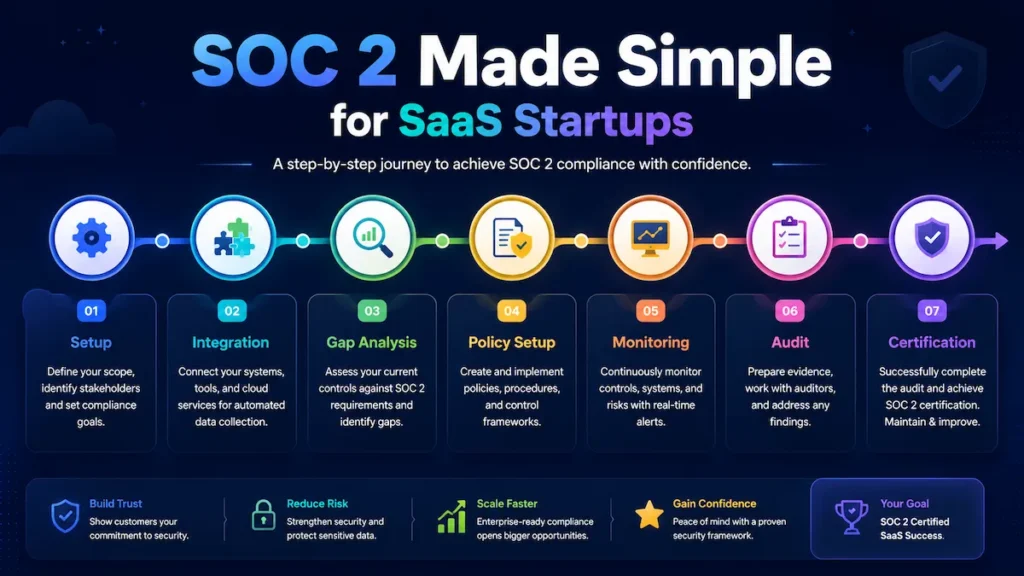
Step-by-Step Implementation Strategy
Successfully implementing AI security compliance tools for SaaS startups requires clear ownership, accurate integrations, appropriate policies, and continuous monitoring.
Step 1—Define Your Compliance Target
Let customer requirements and business objectives drive framework selection.
Determine whether your target customers require SOC 2 Type I, SOC 2 Type II, ISO 27001, or another framework before establishing your timeline.
If you are pursuing SOC 2 Type II, plan for the required observation period from the beginning. The observation period is determined by the engagement and auditor requirements and cannot simply be eliminated through software automation.
Step 2—Connect Your Infrastructure
Connect the systems that provide evidence for your compliance controls, such as:
- Cloud infrastructure such as AWS, Google Cloud, or Microsoft Azure
- Identity providers such as Okta or Google Workspace
- Source-code repositories
- HR systems
- Core SaaS applications
- Ticketing and incident-management systems
Start with the systems most relevant to your highest-priority controls.
After connecting each integration, verify that the platform is actually collecting the expected evidence rather than assuming the integration is working correctly.
Step 3—Run Your Gap Analysis
Use the platform’s readiness dashboard to identify missing evidence, failing controls, and remediation requirements.
Prioritize issues according to risk, customer impact, and audit importance rather than simply completing the easiest tasks first.
For example, resolving a critical access-control issue should generally take priority over polishing a low-risk policy document.
If you need a broader security foundation before beginning your compliance program, work through this AI security implementation guide for startups.
Step 4—Deploy and Customize Your Policy Library
Use pre-built policy templates as starting points, but customize them to reflect your organization’s actual practices.
Avoid creating policies that promise processes your team does not consistently follow.
Your policies, technical controls, and day-to-day operations should tell the same story. If a policy describes a process that does not exist in practice, an auditor may identify the discrepancy during testing or interviews.
Step 5—Assign Named Control Owners
Assign a specific person to each important control or compliance responsibility.
A team-level assignment such as “Engineering” can create ambiguity. A named owner makes it clear who is responsible for reviewing evidence, addressing findings, and maintaining the control.
Document backup ownership as well so responsibilities remain covered when someone is unavailable.
Step 6—Conduct an Internal Readiness Review
Before the formal audit or assessment, perform an internal review of your controls and evidence.
Check:
- Whether required evidence is complete
- Whether access reviews are being performed consistently
- Whether policies reflect current practices
- Whether identified risks have been addressed
- Whether control owners understand their responsibilities
- Whether incident-response and other operational procedures work as documented
A readiness dashboard is useful, but it should not be treated as a substitute for human review.
Step 7—Coordinate With Your Auditor
Choose an auditor that understands your framework, company size, industry, and engagement requirements.
If your compliance platform offers access to preferred audit partners, evaluate those options alongside other qualified auditors rather than assuming the platform’s preferred partner is automatically the best fit.
Before beginning the engagement, confirm the audit scope, evidence requirements, observation period, testing approach, deliverables, and timeline.
The goal is not simply to make the compliance platform show a high readiness score. The goal is to build a control environment that can withstand independent testing and continue operating after the audit is complete.
Benefits of AI Security Compliance Platforms
AI security compliance tools for SaaS startups can reduce manual audit preparation, improve evidence collection, accelerate compliance readiness, and provide continuous visibility across cloud and SaaS environments.
- Faster preparation: Automated evidence collection and continuous control monitoring can reduce the manual work involved in preparing for an audit. However, overall timelines still depend on your scope, organizational readiness, auditor requirements, and the type of engagement.
- Lower total cost: Automation reduces repetitive tasks such as collecting evidence, monitoring controls, maintaining documentation, and tracking remediation activities. The actual savings depend on your company’s size, technology stack, and existing compliance processes.
- Continuous audit readiness: Instead of preparing evidence shortly before an audit, the platform can continuously collect and organize evidence throughout the year, helping your team identify control gaps before they become audit problems.
- Scalable compliance: As your startup adds employees, cloud services, SaaS applications, and new compliance frameworks, automated monitoring and control mapping can make it easier to expand your compliance program without rebuilding it from scratch.
- Faster enterprise deals: A trust center can give prospects controlled access to current security documentation, certifications, policies, and other compliance information. This can reduce repetitive requests and help sales teams respond to security reviews more efficiently.
- Reduced breach risk: Continuous monitoring can identify certain misconfigurations, access-control issues, and other security risks earlier, giving teams an opportunity to investigate and remediate them before they become larger problems. The NIST Cybersecurity Framework provides a useful foundation for evaluating how security activities contribute to broader risk management—not simply whether an organization has completed individual compliance tasks.
The key benefit is not automation for its own sake. The strongest platforms help turn compliance from a periodic audit exercise into an ongoing operational process—where evidence, control monitoring, remediation, and documentation remain current throughout the year.
Common Mistakes SaaS Founders Must Avoid
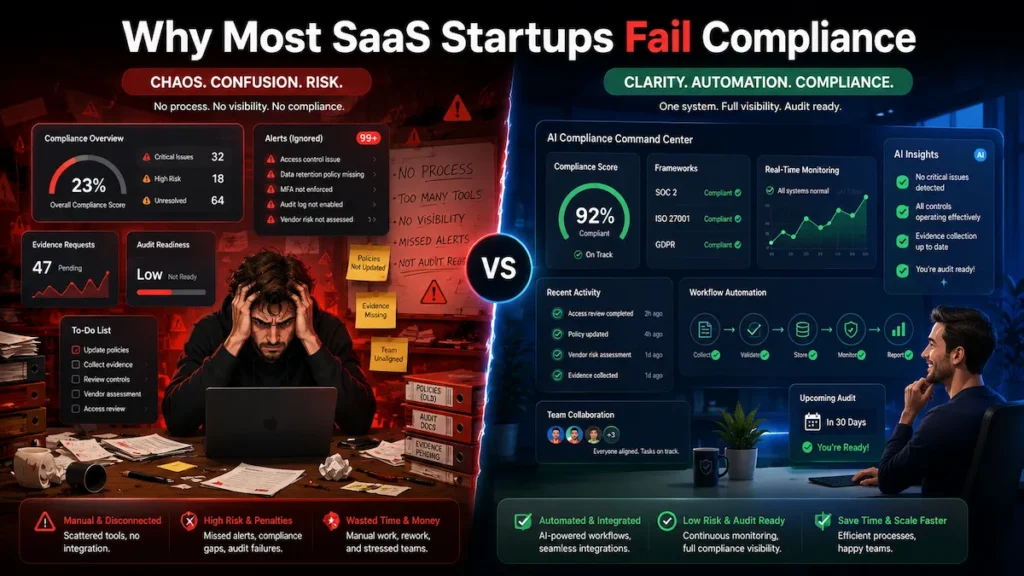
Even the best AI security compliance tools for SaaS businesses can fall short when founders underestimate ownership, implementation work, monitoring responsibilities, and the ongoing discipline required to maintain compliance.
Buying based on brand, not framework fit. Match the platform to your actual compliance requirements—not simply to the tool that is most recognizable in your founder community. Vanta, Drata, Sprinto, and other platforms can all be useful, but the right choice depends on your frameworks, technology stack, customer requirements, budget, and internal resources.
Underestimating implementation time. Compliance platforms automate many repetitive tasks, but initial implementation still requires configuration, integrations, policy customization, control ownership, and remediation. Build realistic implementation time into your compliance timeline before making commitments to prospective customers.
Ignoring vendor risk management. Your SOC 2 or ISO 27001 program does not eliminate the need to assess vendors and subprocessors that support your services. Under GDPR Article 28, organizations using processors have specific contractual and oversight responsibilities concerning processing activities, security, confidentiality, and processor obligations. The exact requirements depend on the organization’s role and circumstances, so this should not be treated as legal advice. Use your platform’s vendor-risk capabilities alongside your broader third-party risk management process.
Writing policies that don’t reflect reality. Your policies should describe processes your team actually follows. If a policy requires quarterly access reviews but your team performs them irregularly, the discrepancy can become an audit finding. Fix the policy or fix the practice—the two need to match.
Stopping at SOC 2 Type I. If your target enterprise customers expect SOC 2 Type II, plan for it from the beginning. Type II evaluates controls over a defined period, so compliance software cannot eliminate the need to operate those controls consistently throughout the required observation period.
Not owning the compliance program internally. A compliance platform can automate evidence collection and monitoring, but someone still needs to review findings, coordinate remediation, maintain policies, and communicate with auditors. Assign clear ownership before implementation begins.
For a broader view of how the best AI security tools for startups in 2026 fit into a complete security stack, see how compliance platforms complement detection, monitoring, identity, and response capabilities.
FAQs: AI Security Compliance Tools for SaaS Startups
These frequently asked questions cover the most common concerns startups have when evaluating AI security compliance tools for SaaS environments.
What is SOC 2 automation?
SOC 2 automation includes continuous evidence collection, real-time control monitoring, and automated audit reporting—replacing manual audit preparation with a live, always-updated evidence system. Vanta and Drata are the leading SOC 2 automation tools for SaaS startups in 2026.
How do AI compliance tools work?
They connect to your cloud infrastructure and SaaS systems, monitor activity in real time, detect risks using machine learning, and automatically generate audit-ready artifacts—so your compliance posture is current every day, not just before your annual audit window.
What’s the difference between SOC 2 Type I and Type II?
SOC 2 Type I is a point-in-time assessment verifying that controls are designed correctly. Type II covers an observation period, typically 3–12 months, verifying that controls operated effectively throughout that period. Enterprise buyers often expect Type II, and the required observation period needs to be planned around the auditor, engagement scope, and customer requirements.
How long does SOC 2 automation take?
Many teams can reach SOC 2 Type I readiness in roughly 60–90 days using platforms such as Vanta or Drata, depending on scope and organizational readiness. Type II requires an observation period that typically runs 3–12 months, depending on the auditor, engagement scope, and customer requirements. Budget accordingly before announcing certification timelines to prospects.
Do AI compliance tools cover GDPR as well as SOC 2?
Yes. Most major platforms include GDPR compliance features—data processing agreements, data mapping, consent management, and breach notification workflows. Sprinto’s GDPR tooling is particularly strong at the startup price point. Always verify whether GDPR coverage is included in your base plan or requires an add-on before signing.
What does compliance automation actually cost for an early-stage startup?
Budget $2,000–$10,000/year for the platform plus $10,000–$25,000 for the audit itself. The total first-year cost typically runs $15,000–$35,000 fully loaded. The cost of not being compliant—losing enterprise deals to competitors who are—is typically an order of magnitude larger.
What’s the best compliance tool specifically for ISO 27001?
Tugboat Logic (by OneTrust) has the strongest dedicated ISO 27001 tooling in the category. Drata is the best choice if you need ISO 27001 alongside SOC 2 simultaneously.
What is Shadow AI?
“Shadow AI” refers to employees using AI tools like ChatGPT, Microsoft Copilot, or Gemini without IT or security approval. This often involves customer data, source code, or business information being shared outside approved systems.
What is AI Governance?
AI governance is the process of managing how employees use AI tools across an organization. It includes monitoring AI usage, controlling AI-to-SaaS integrations, reviewing OAuth permissions, and ensuring AI use aligns with security and compliance policies.
What is SaaS Security Posture Management (SSPM)?
SaaS Security Posture Management (SSPM) continuously monitors SaaS applications for security misconfigurations, risky third-party integrations, excessive permissions, and embedded AI features that could introduce security risks.
How is AI governance different from SOC 2?
SOC 2 verifies that an organization has implemented and operates effective security controls. AI governance focuses on monitoring and controlling how AI tools are actually used within the organization. Together, they provide stronger AI security compliance.
Can compliance platforms monitor ChatGPT and Microsoft Copilot?
Most compliance automation platforms primarily focus on evidence collection, continuous control monitoring, and audit readiness rather than dedicated AI usage monitoring. Organizations that need visibility into Shadow AI, AI data flows, or AI-specific access governance often supplement them with specialized AI governance platforms.
Do startups need AI governance before SOC 2?
Not necessarily. For most startups, achieving SOC 2 readiness is the first priority. AI governance becomes increasingly important as teams begin using AI tools with customer data, proprietary code, or other sensitive business information.
What is ISO 42001?
ISO 42001 is an international standard for artificial intelligence management systems (AIMS). It helps organizations establish governance, risk management, and operational controls for the responsible development and use of AI.
Do This Today: Your 30-Minute Compliance Action Plan
You don’t need a quarter to start building your compliance program. Use the next 30 minutes to establish your direction and identify the work ahead.
Minutes 1–10: Choose your platform. Use the Quick Decision Guide above to narrow your options based on your required frameworks, company stage, budget, and internal resources. If you’re still evaluating, start with a short list rather than committing immediately to a platform.
Minutes 11–20: Start the setup process. Request a demo or begin a trial with your preferred platform. Connect your identity provider (such as Okta or Google Workspace) and primary cloud environment (such as AWS, GCP, or Azure) where supported. These integrations can begin collecting evidence and identifying control gaps, but they don’t replace the policies, processes, and human review required for an effective compliance program.
Minutes 21–30: Run your initial gap analysis. Review the platform’s readiness assessment and identify your highest-priority control gaps. Turn those findings into a compliance roadmap with a named owner, remediation deadline, and verification step for each significant gap.
Start before your customers make compliance a deal blocker. If you’re pursuing SOC 2 Type II, plan your timeline around the required observation period, auditor engagement, scope, and customer requirements. Compliance software can accelerate preparation and evidence collection, but it cannot eliminate the time required to demonstrate that controls operate effectively over the applicable period.
The goal of your first 30 minutes isn’t to become compliant. It’s to replace uncertainty with a clear starting point, an identified owner, and a realistic path to audit readiness.
Conclusion: Compliance Is Now a Revenue Strategy
AI security compliance tools for SaaS startups have become one of the most important operational investments for companies selling into enterprise and regulated markets. You don’t need a CISO, a dedicated compliance team, or six months of manual work. You need the right platform, named internal ownership, and a start date—ideally today.
Most enterprise deals that die in procurement die because a startup couldn’t produce audit artifacts fast enough—not because their product wasn’t secure enough.
Vanta or Drata for speed and scale. Sprinto if budget is the real constraint. Tugboat Logic if ISO 27001 is what your target market requires. Secureframe if you need someone to walk you through every step. Strike Graph if you want full control at the lowest cost.
The real competitive advantage isn’t just passing the audit—it’s the continuous, audit-ready security posture that lets you respond “yes, here’s our SOC 2 report and our live trust center” in the next enterprise sales call without a three-week scramble. For a complete picture of how compliance platforms fit into your broader security stack, see how the AI security tools for startups work together across detection, monitoring, and response.
Start today. The deal you’re trying to close next quarter is already asking.
If you’re building your startup security strategy from scratch, read our comprehensive guide on How to Secure a Startup with AI Tools before selecting an AI security compliance platform. It covers the foundational security controls that should be in place before pursuing SOC 2, ISO 27001, or GDPR compliance.