
According to the Verizon Data Breach Investigations Report, 46% of all reported data breaches involve small and medium-sized businesses. More alarming, the IBM Cost of a Data Breach Report puts the average breach cost for SMBs at over $3.3 million — and 60% of small businesses shut down within six months of a serious cyberattack. Yet most small teams are still relying on manual monitoring methods that were never designed to handle today’s threat volume, speed, or sophistication.
Small IT teams are being asked to defend increasingly complex environments against increasingly capable attackers — with a fraction of the staff and budget that large enterprises deploy. Rule-based alerts and manual log reviews simply cannot keep pace. That is exactly where AI network security monitoring for small teams changes the equation — delivering enterprise-grade threat detection at a scale, speed, and cost that actually works for leaner organizations.
This guide explains how AI-powered monitoring works, which platforms deserve your attention, and how your team can implement smarter cybersecurity without building a full security operations center from scratch.
Quick Summary
- AI detects threats significantly faster than any manual monitoring approach
- Reduces day-to-day workload for small IT teams through intelligent automation
- Provides 24/7 network visibility — even when your team is completely offline
- Delivers SOC-level coverage without requiring a full SOC team or budget
- Works across on-premises, cloud, and hybrid environments of any size
The Cybersecurity Challenges Small IT Teams Face
AI network security monitoring for small teams exists because the challenges facing SMB security are real, compounding, and getting worse every year. Understanding these challenges is the first step toward solving them.
Limited Security Staff and Resources
Most small businesses operate without a dedicated cybersecurity team. In practice, one or two IT generalists handle everything — configuring endpoints, managing firewalls, responding to helpdesk tickets, and managing security incidents, often all at once. That workload is unsustainable, and the coverage gaps it creates are exactly what attackers exploit.
AI network security monitoring for small teams directly addresses this resource problem by automating the detection and triage work that would otherwise require multiple analysts working in shifts. When your team is stretched thin across competing priorities, automation is not a nice-to-have — it is the only realistic path to consistent security coverage. Pairing AI monitoring with affordable cybersecurity tools built for resource-constrained teams gives your organization a defense posture that scales with your actual capacity rather than your ideal headcount.
Increasing Cyber Threats Targeting Small Businesses
The assumption that small businesses are “too small to hack” is one of the most dangerous myths in modern cybersecurity. Threat actors increasingly target SMBs precisely because their defenses are weaker and easier to breach. Ransomware campaigns, phishing attacks, business email compromise, and supply chain intrusions are all rising in frequency — and small businesses are disproportionately in the crosshairs.
AI network security monitoring for small teams provides the continuous vigilance that these evolving, multi-vector threats require. Static, perimeter-based defenses that worked a decade ago are simply not sufficient against today’s sophisticated, automated attack campaigns.
Why Manual Network Monitoring Fails
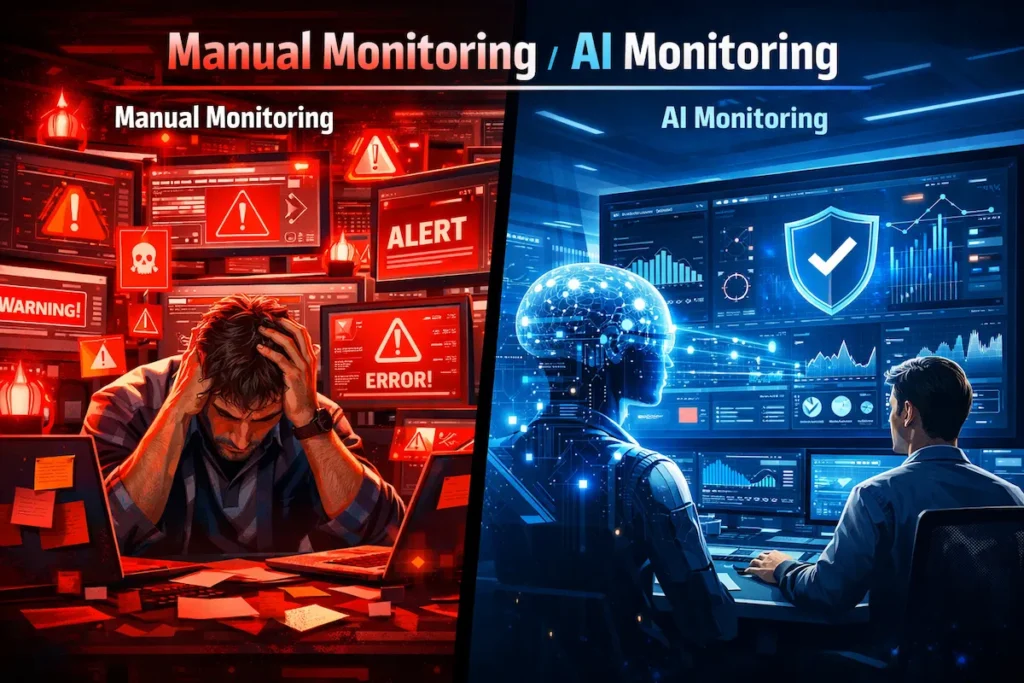
Manual network monitoring creates three compounding problems that AI monitoring is specifically engineered to solve:
- Alert fatigue: Analysts buried in thousands of raw, undifferentiated events begin triaging poorly or ignoring warnings entirely — which is itself a critical security vulnerability
- Static rules: Signature-based detection cannot identify novel attack techniques, living-off-the-land attacks, or zero-day exploits that have no established pattern
- Sheer volume: Even a modest business network generates more traffic data than any human team can meaningfully review in real time
The result is slow detection, slow response, and damage that compounds with every hour an attacker remains undetected inside your environment.
What Is AI Network Security Monitoring?
How Artificial Intelligence Analyzes Network Traffic
AI network security monitoring uses machine learning algorithms to continuously examine data flows, connection logs, protocol behaviors, and access patterns moving across your network. Rather than matching traffic against a static list of known threats, these systems build a dynamic behavioral baseline for your specific environment — learning what normal looks like for every user, device, and application over time. Any meaningful deviation from that baseline triggers immediate investigation.
This is the fundamental distinction from traditional intrusion detection systems, which only catch threats they have been explicitly taught to recognize. AI network security monitoring for small teams can surface threats it has never encountered before, simply because the behavior deviates from established norms for your environment.
Machine Learning and Behavioral Threat Detection
Machine learning models in cybersecurity are trained on large datasets containing both normal network activity and documented attack behaviors. Over time, these models develop the ability to distinguish legitimate user activity from suspicious patterns with increasing precision. Behavioral threat detection builds on this by tracking individual users, devices, and applications continuously — so when credentials are used to access sensitive files at 3 a.m. from an unrecognized location, the system immediately flags the deviation, even if the login technically passed authentication.
For a deeper look at how behavioral analytics work across deployment environments, our guide to AI-powered threat detection tools for startups covers the full technical and practical landscape in detail.
How AI Identifies Suspicious Network Activity
Modern AI security platforms layer multiple detection techniques simultaneously to achieve comprehensive coverage:
- Deep packet inspection examines the actual content of network traffic for malicious payloads or data exfiltration patterns
- Protocol anomaly detection identifies when standard protocols are being used in non-standard ways — a common indicator of command-and-control activity
- User and entity behavior analytics (UEBA) track behavioral patterns at the individual account and device level on a continuous basis
- Threat intelligence feeds provide real-time context about known malicious IP addresses, domains, and attacker infrastructure globally
Together, these layers catch threats that would bypass any single detection method operating in isolation. AI network security monitoring for small teams benefits from all of these techniques working in parallel — without requiring a team of analysts to manage each layer manually.
Why AI Network Security Monitoring Is Ideal for Small Teams
24/7 Automated Network Monitoring
AI monitoring never sleeps — and that matters enormously for small teams with no overnight staff. Many attacks are deliberately timed for off-hours: weekends, holidays, and late nights when human responders are unavailable and detection is most likely to be delayed. AI network security monitoring for small teams closes that coverage gap completely, providing continuous automated monitoring regardless of when an attack occurs. Your team wakes up to a prioritized, contextualized alert — not an active, uncontained incident.
Faster Threat Detection and Incident Response
Speed is one of the most consequential variables in determining cybersecurity outcomes. The longer a threat actor has undetected access to your network, the more damage they can inflict — encrypting systems, exfiltrating sensitive data, establishing persistence, or pivoting to connected third-party environments. AI monitoring compresses detection time from the industry average of weeks down to minutes or hours, dramatically limiting the window of exposure.
Consider this real-world scenario: a 15-person SaaS startup using AI network monitoring detected unusual outbound traffic at 2:13 a.m. on a Saturday. The AI platform automatically isolated the affected endpoint, blocked the suspicious destination IP range, and generated a complete incident report — all before any analyst came online. Manual monitoring would not have surfaced this exfiltration attempt until Monday morning at the earliest. By then, the damage would have been irreversible.
In a separate case, a retail SMB using behavioral AI monitoring detected credential misuse from a previously unseen device attempting to access the company’s financial records. The system flagged the anomaly within four minutes of the first unauthorized access attempt, allowing the team to revoke the session and initiate a password reset before any data was accessed. AI network security monitoring for small teams makes that kind of response speed achievable without a round-the-clock analyst team.
Reducing Workload for Small IT Teams
One of the most practical day-to-day benefits of AI monitoring is intelligent alert prioritization. Rather than presenting your team with thousands of raw events, AI platforms score and rank threats by severity, confidence level, and business context. Analysts focus exclusively on what matters most — not on chasing noise. This reduction in workload is not just a convenience; it is a meaningful security improvement, because every alert ignored due to fatigue is a potential missed threat.
Cybersecurity automation for small IT teams means delivering more consistent, higher-quality security outcomes with fewer people. For a broader view of how AI is transforming SMB defense postures, our AI cybersecurity tools guide for small businesses covers the full landscape of solutions available today.
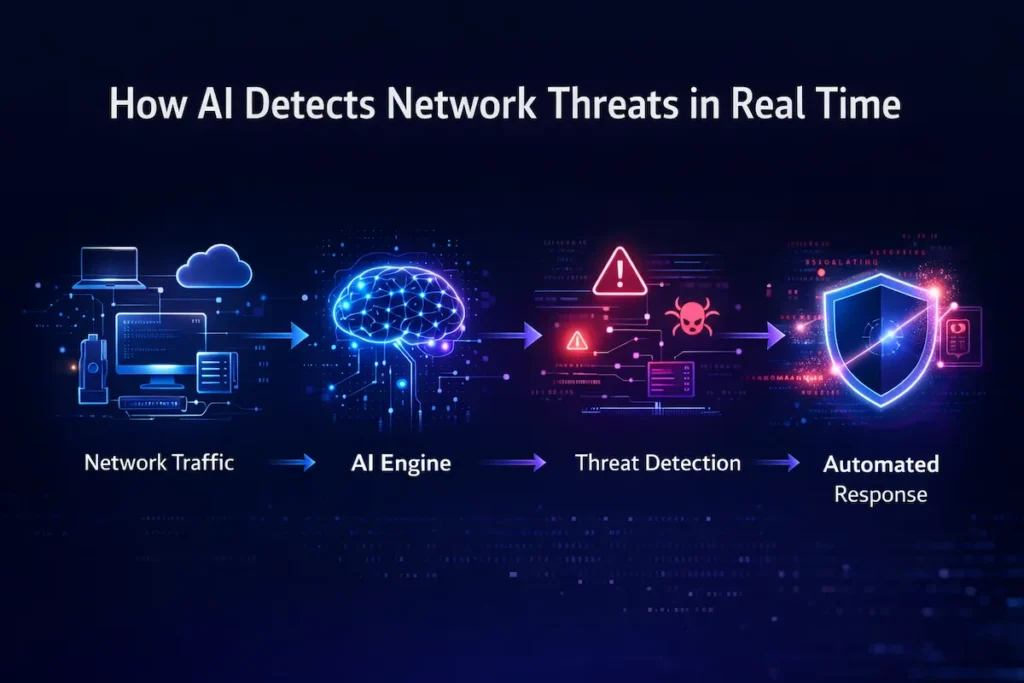
How AI Detects Cyber Threats in Real Time
Network Traffic Pattern Analysis
AI systems perform continuous network traffic monitoring, analyzing packet flows, connection metadata, and protocol behavior to identify patterns associated with malicious activity. This includes port scans used in attacker reconnaissance, lateral movement as threat actors pivot between internal systems, command-and-control communications between infected endpoints and external attacker infrastructure, and data exfiltration attempts moving unusual data volumes to unexpected external destinations.
Because machine learning models process millions of data points per second, they surface attack patterns that are completely invisible to analysts reviewing logs manually after the fact. AI network security monitoring for small teams provides this depth of continuous analysis without requiring dedicated staff to manage it in real time.
Behavior-Based Anomaly Detection
Anomaly detection is the technical foundation of modern AI security platforms. Once a system has established a behavioral baseline for your specific environment, statistically significant deviations trigger immediate investigation. This approach is particularly effective against insider threats and compromised credentials — scenarios where the attacker is already authenticated inside your perimeter and traditional perimeter-based tools provide little or no meaningful protection.
Behavior-based anomaly detection does not require prior knowledge of a specific exploit or malware variant. It evaluates only whether current behavior is consistent with established norms for that user, device, or application. AI network security monitoring for small teams uses this capability to catch threats that signature-based tools are categorically unable to detect.
Automated Security Alerts and Incident Response
When a high-confidence threat is detected, AI platforms generate detailed security alerts with full contextual information:
- What happened, on which systems, and precisely when
- Which users and devices are involved
- The probable threat category, attack stage, and severity level
- Recommended response actions ranked by priority and impact
Advanced platforms go further — automatically isolating affected endpoints, blocking suspicious IP ranges, revoking active sessions, or triggering predefined response playbooks without requiring human intervention for initial containment. For small teams where every minute of analyst time carries high opportunity cost, this level of automated response is genuinely transformative.
Best AI Network Security Monitoring Tools for Small Teams
Choosing the right platform is one of the most important decisions in your security program. AI network security monitoring for small teams is only effective if the tool genuinely matches your environment, your team’s technical capacity, and your specific threat priorities. Here is a direct, honest comparison of five leading platforms.
Darktrace — Best for unknown and novel threats Strength: Autonomous response (Antigena module) | Complexity: Medium | Pricing: Enterprise / custom quote
Vectra AI — Best for hybrid cloud and on-premises environments Strength: Attacker behavior prioritization, minimal analyst overhead | Complexity: Medium | Pricing: Subscription / custom
Cisco Secure Network Analytics — Best for Cisco infrastructure environments Strength: Encrypted traffic detection, native Cisco integration | Complexity: High | Pricing: Tiered / enterprise
ExtraHop Reveal(x) — Best for teams needing fast, low-friction deployment Strength: Real-time encrypted traffic analysis, rapid time-to-value | Complexity: Low–Medium | Pricing: Subscription / custom
IBM QRadar — Best for full SIEM plus AI correlation requirements Strength: Breadth of integrations, up to 90% alert volume reduction | Complexity: High | Pricing: Tiered / SMB options available
Darktrace uses unsupervised machine learning to build a behavioral model of every user, device, and application on your network. Its Enterprise Immune System detects deviations from established normal behavior in real time, and its Antigena autonomous response module can neutralize active threats without waiting for human approval. Choose Darktrace if your primary concern is zero-day threats, novel attack techniques, and insider risks that signature-based tools will never catch.
Vectra AI specializes in network detection and response (NDR), focusing on identifying attacker behaviors — reconnaissance, privilege escalation, lateral movement — rather than specific malware signatures. Its AI-driven prioritization surfaces only the highest-confidence, highest-impact threats, making it well suited for teams without dedicated SOC analysts managing the queue. Choose Vectra AI if you need strong hybrid cloud and on-premises coverage with minimal analyst overhead day to day.
Cisco Secure Network Analytics delivers deep network visibility by analyzing NetFlow and telemetry data across your environment. It uses behavioral modeling combined with Cisco Talos threat intelligence — one of the largest commercial threat intelligence operations in the world — to detect threats including those concealed within encrypted traffic. Choose Cisco if you are already running Cisco infrastructure and want seamless, natively integrated monitoring.
ExtraHop Reveal(x) provides cloud-native network detection using AI-powered real-time traffic analysis. Its decryption capabilities allow inspection of encrypted traffic without requiring separate decryption proxies — increasingly critical as attackers use HTTPS channels to evade detection. Reveal(x) is notably fast to deploy and operationalize. Choose ExtraHop if speed of deployment and rapid time-to-value are your highest priorities.
IBM QRadar is a mature SIEM and security analytics platform that uses AI to correlate events across endpoints, network, cloud, and applications into a single unified view. According to IBM’s security intelligence documentation, QRadar can reduce alert volumes by up to 90% through AI-driven event correlation. Scaled deployment options make it accessible for smaller organizations. Choose IBM QRadar if you need comprehensive SIEM capability alongside AI network monitoring, particularly for compliance-heavy environments.
Key Features Small Teams Should Look for in AI Security Monitoring Tools
Real-Time Threat Detection
AI network security monitoring for small teams is only valuable if detection happens fast enough to change outcomes. Any platform you evaluate must deliver genuine real-time analysis — not hourly batch processing that reviews yesterday’s threats today. Look for documented detection latency benchmarks and ask vendors for concrete, real-world examples of time-from-compromise-to-alert in live environments. Sub-minute detection should be the minimum baseline expectation for any platform under serious consideration.
Automated Alerts and Security Reports
For small teams, every manual step in the security workflow represents real cost and real delay. Your platform should automatically generate prioritized alerts with enough contextual detail that an analyst can make a fast, informed decision without manually correlating data across multiple systems. Regular automated security reporting matters equally — for demonstrating your security posture to leadership and satisfying compliance requirements without consuming significant additional analyst time.
Cloud and Hybrid Network Monitoring
Virtually every small business today operates across on-premises systems, cloud services, SaaS applications, and remote access environments simultaneously. Your AI monitoring tool must maintain full visibility across all of these surfaces without requiring separate tools for each environment. Our guide to AI cloud security solutions for startups covers how to extend monitoring coverage across multi-cloud environments without adding significant management complexity for lean teams.
Zero Trust Security Integration
Zero trust is a security architecture built on continuous verification — never trust, always verify — that treats every connection as potentially hostile until proven otherwise. AI monitoring platforms that integrate with zero trust frameworks continuously evaluate the trustworthiness of every user, device, and connection throughout each session, not just at the point of initial login. This integration is increasingly critical as distributed, cloud-first work environments make traditional perimeter-based security obsolete. AI network security monitoring for small teams works most powerfully when layered with zero trust controls. Our full breakdown of zero trust security tools for startups explains how to implement this architecture alongside your AI monitoring deployment.
Benefits of AI Network Security Monitoring for Small Businesses
AI network security monitoring for small teams delivers measurable, compounding advantages across every dimension of your security program:
- Faster threat detection means catching attacks earlier in the kill chain — before ransomware encrypts your systems, before credentials appear on dark web markets, before sensitive data leaves your environment permanently
- Reduced manual monitoring frees your IT staff to focus on proactive security improvements rather than reactive firefighting and endless log review cycles
- Improved network visibility gives your team a complete, real-time picture of every connection across your entire infrastructure — knowledge that is equally valuable for security operations, compliance reporting, and capacity planning
- Cost-efficient cybersecurity delivers the most compelling ROI case for SMBs: instead of hiring four to six dedicated security analysts, you deploy a platform providing comparable coverage at a fraction of the cost, with dramatically greater consistency
Combining AI network monitoring with strong AI endpoint security creates a layered defense covering both network-level traffic and device-level behavior simultaneously — closing the coverage gaps that sophisticated attackers actively identify and exploit.
Limitations and Risks of AI Security Monitoring
An honest evaluation of AI network security monitoring for small teams requires acknowledging genuine limitations alongside the clear benefits.
False positives are the most common operational frustration. AI systems not adequately tuned to your specific environment will flag legitimate business activity — a developer running an unusual build script late at night, a finance team member accessing systems remotely, a new cloud integration generating unfamiliar traffic signatures. Excessive false positives produce alert fatigue, which is itself a serious security vulnerability. Dedicate your first 30 to 60 days specifically to tuning, baselining, and noise reduction before enabling automated response actions.
Complexity of deployment varies significantly by platform, but even user-friendly tools require meaningful upfront investment in configuration, integration with existing systems, and staff orientation. Small teams without dedicated security expertise may find the initial deployment phase genuinely challenging without vendor support or external consulting assistance.
AI training limitations are a subtler but important consideration. Models trained primarily on large enterprise datasets may not perform optimally in smaller environments with unusual network architectures, niche line-of-business applications, or lower traffic volume. Ask vendors specifically how their models handle atypical environments and what the retraining or recalibration process looks like as your network evolves over time.
How Small Teams Can Implement AI Network Security Monitoring
A practical implementation does not require a perfect environment or a large budget. This phased approach builds your AI monitoring capability progressively without overwhelming your team or creating unmanageable complexity from the outset.
Step 1 — Map your assets and current visibility. Before deploying any new tool, document every server, endpoint, cloud service, remote access method, and third-party integration in your environment. You cannot monitor what you cannot see, and gaps in your asset inventory translate directly into gaps in your monitoring coverage.
Step 2 — Define your specific threat priorities. What does your organization fear most — ransomware, credential theft, insider threat, or data exfiltration? Your threat priorities should drive both your tool selection and the detection rules you configure first. A general-purpose approach with no defined priorities produces mediocre protection across every surface.
Step 3 — Select a tool that matches your team’s real capacity. Choose a platform your team can realistically operate, tune, and improve over time — not simply the one with the longest feature list. A powerful tool your team cannot effectively manage is less valuable than a simpler tool used consistently and well. Our startup cybersecurity software comparison can help you evaluate options against your specific environment, team size, and budget constraints.
Step 4 — Deploy in monitoring-only mode first. In the initial phase, run your AI system passively. Review every alert your team receives. Tune the platform to reduce false positives and calibrate sensitivity thresholds for your specific environment. Build genuine confidence in the system’s detections before enabling any automated containment actions. Automated response is powerful — but only when you trust the underlying detections completely.
Step 5 — Integrate with your existing security stack. Connect your AI monitoring platform to your endpoint protection, identity management system, ticketing platform, and any existing SIEM or log management tools. Each integration amplifies the value of every tool in your stack by enabling correlated, cross-platform detection that no single tool achieves independently.
Step 6 — Measure, review, and improve monthly. Track your mean time to detect (MTTD) and mean time to respond (MTTR) from the first week of deployment. Schedule monthly reviews of detection coverage, false positive rates, and response quality metrics. AI network security monitoring for small teams improves significantly with active management — it is not a configure-and-forget solution.
The Future of AI Network Security Monitoring
The trajectory of AI network security monitoring for small teams points toward capabilities that will fundamentally shift what lean security teams can accomplish over the next several years.
AI-driven SOC automation will continue reducing the reliance on human analysts for routine triage, correlation, and first-response tasks — making genuine SOC-level coverage accessible to organizations that cannot afford to staff a traditional SOC. Platforms like Darktrace’s Cyber AI Analyst already automate significant portions of the investigation workflow, producing comprehensive incident reports in seconds that would take a skilled human analyst hours to compile from raw data.
Predictive cybersecurity analytics will shift security posture from reactive to preventive — using historical attack data, real-time threat intelligence, and environmental risk modeling to identify vulnerabilities and probable attack paths before they are exploited. This evolution from detect-and-respond to anticipate-and-prevent represents the most significant near-term advancement in practical cybersecurity capability for SMBs.
Autonomous threat response — where AI systems not only detect but fully contain, remediate, and recover from threats without human intervention — is already emerging in leading platforms and will become mainstream within the next two to three years. For small teams with limited response capacity, this capability will close the last meaningful gap between SMB and enterprise-grade security operations.
Frequently Asked Questions
What is AI network security monitoring?
AI network security monitoring uses machine learning algorithms to continuously analyze network traffic, user behavior, and device activity to detect threats in real time. Unlike traditional tools that rely on known threat signatures, AI systems build a behavioral baseline for your specific environment and flag any meaningful deviation — catching both known and novel threats automatically.
Is AI cybersecurity affordable for small businesses?
Yes. Modern AI monitoring platforms offer tiered pricing and SMB-specific deployment options that make enterprise-grade security accessible without enterprise budgets. The cost of an AI monitoring platform is typically a fraction of what a data breach costs — and significantly less than hiring the equivalent human analyst team needed for the same coverage.
How fast can AI detect threats compared to manual monitoring?
AI monitoring platforms typically detect threats within minutes of anomalous activity beginning — compared to the industry average of 194 days for organizations relying on manual detection methods, according to IBM research. That speed difference is the single most important factor in determining how much damage an attack causes before it is contained.
Do small teams really need a SOC to use AI monitoring effectively?
No. AI network security monitoring for small teams is specifically designed to deliver SOC-level threat detection and response without requiring a dedicated SOC. Automated alert prioritization, contextual incident reporting, and in many platforms autonomous response capabilities mean that even a two-person IT team can maintain meaningful security coverage across a complex environment.
Conclusion
AI network security monitoring for small teams has moved from aspirational goal to practical, affordable reality. The combination of machine learning-driven detection, continuous automated monitoring, behavioral analytics, and intelligent alert prioritization gives lean IT teams the ability to defend their organizations with the consistency and coverage that previously required large, expensive security operations centers.
The threat landscape will not become easier to navigate. Attackers are becoming more capable, more automated, and more deliberate in targeting smaller organizations they know are under-resourced. But with the right AI monitoring platform, a phased implementation approach, and a commitment to continuous improvement, your small team can build a security posture that is genuinely resilient — not just compliant on paper.
Start by auditing your current network visibility this week. Identify the blind spots in your environment, define your top three threat priorities, and evaluate one AI monitoring platform against your specific needs and team capacity. The businesses that build strong AI-driven security foundations today will be significantly better positioned as threats evolve and autonomous security capabilities continue to mature.
The time to act is before an incident forces your hand — not after.
Written from practical cybersecurity implementation experience working with SMB environments and small IT teams navigating real-world security constraints.