
SOC 2 compliance tools for AI startups have become essential for companies selling into enterprise markets in 2026, especially as buyers now evaluate both traditional security controls and AI-specific governance practices before approving vendors.
The pattern is almost always the same. A security review request lands. The startup has no SOC 2 report. They scramble, send a half-finished spreadsheet, promise the report is “in progress,” and watch the deal slow to a crawl. By the time they circle back, the enterprise buyer has moved on.
Purpose-built compliance automation platforms now exist specifically to get startups through a SOC 2 type 2 audit without burning out your engineering team. But the platforms are not equal—and choosing the wrong one creates a mess that’s expensive to unwind.
This guide covers the best SOC 2 compliance tools for AI startups in 2026: what each platform actually does well, where it fails, who should never use it, and what vendor marketing won’t tell you.
Best SOC 2 Tools at a Glance
These SOC 2 compliance tools for AI startups vary significantly in automation depth, AI governance support, pricing, and audit readiness speed.
Best SOC 2 Tools at a Glance
| Tool | Best For | Starting Price (est.) | Standout Feature | AI Readiness |
|---|---|---|---|---|
| Vanta | Scaling AI startups | ~$7K–$25K+/yr | Enterprise trust center + LLM vendor risk module | Medium-High |
| Drata | Continuous monitoring | ~$8K–$20K+/yr | Real-time drift detection | Medium |
| Sprinto | Early-stage startups | ~$6K–$15K/yr | Guided task-based onboarding | Low-Medium |
| Secureframe | First-time audits | ~$12K–$18K/yr | Bundled auditor partner network | Medium |
| Thoropass | All-in-one audit delivery | Bundled w/ audit | In-house AICPA-accredited audit team | Low |
| Scytale | Founder-led compliance | ~$5K–$12K/yr | Dedicated CSM throughout the journey | Low |
| Hyperproof | Multi-framework GRC at scale | $25K–$100K+/yr | Centralized control library, cross-framework reuse | Medium |
| Scrut Automation | Compliance + cloud security in one | ~$15K–$40K/yr | Built-in DAST, agentic AI remediation | Medium |
| TryComp AI (Comp AI) | Open-source, budget-conscious teams | ~$199/mo–$10K/yr | Fully auditable AGPLv3 codebase | Medium |
| Delve | First-time speed (verify before signing) | ~$10K–$22K/yr | AI-native evidence capture—under active integrity dispute | Low (unverified) |
| AuditBoard | Enterprise GRC | $50K+/yr | Full GRC + internal audit platform | Medium |
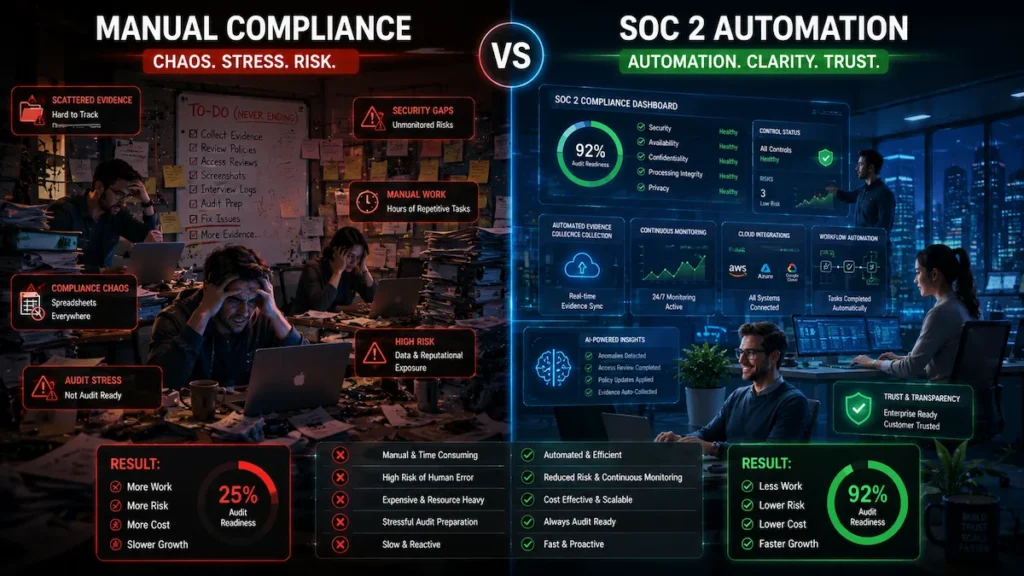
Quick Decision Guide
This quick comparison helps founders choose the right SOC 2 compliance tools for AI startups based on company stage, budget, and enterprise sales requirements.
| Your Situation | Best Tool | Why |
|---|---|---|
| Pre-Series A, no compliance experience | Sprinto | Guided task structure, fast setup, affordable |
| Seed stage, want hands-on guidance | Scytale | Managed-service feel, dedicated CSM throughout |
| First audit: want one vendor for everything | Thoropass | Platform + in-house audit combined |
| Series A, actively closing enterprise deals | Vanta | Deepest integrations, recognized trust center |
| Series A+, need real-time drift monitoring | Drata | Best continuous monitoring engine |
| Need bundled auditor access | Secureframe | Built-in vetted auditor relationships |
| Enterprise-stage, dedicated compliance team | AuditBoard | Full GRC platform—not a startup tool |
Our Ranked Picks
Our ranked list of SOC 2 compliance tools for AI startups focuses on platforms that reduce audit overhead while supporting modern AI security review expectations.
#1 Vanta—Best overall for AI startups scaling enterprise sales. Deepest integrations, strongest procurement brand recognition, most mature trust center, and the only platform with meaningful LLM vendor risk scaffolding built in.
#2 Drata—Best for continuous compliance monitoring. Edges Vanta on real-time drift detection and distributed control ownership. Similar price, different operational fit.
#3 Sprinto—Best for early-stage AI startups. Structured, guided, lower cost, faster to implement. The right choice before you have a dedicated security hire.
#4 Secureframe—Best if you need bundled auditor access. Removes the most underestimated coordination burden in a first-time compliance program.
#5 Thoropass—Best for first-time audits with no existing auditor relationship. The integrated platform-plus-audit model is a genuine advantage. After that, lock-in becomes a liability.
#6 Scytale — Best for founders who want a managed-service experience. Lighter automation than the top tier, but the customer success model is genuinely differentiated for early-stage teams.
#7 AuditBoard—Best enterprise GRC platform for organizations with dedicated internal audit teams. Not a startup tool—included here because it’s frequently and incorrectly evaluated alongside startup platforms.
Why SOC 2 Matters More for AI Startups
Understanding why SOC 2 compliance tools for AI startups matter requires recognizing how enterprise buyers now evaluate AI vendors differently from traditional SaaS companies.
SOC 2 is the most widely recognized third-party validation that your security controls operate consistently—verified by an independent AICPA-accredited auditor, not self-reported on a questionnaire.
For AI startups, the stakes are structurally higher. Your models may be trained on customer data. Your pipelines process information whose flow is harder for buyers to trace independently than a standard SaaS product. Security reviews now include questions about prompt retention, training data isolation, and third-party LLM usage—questions that fall entirely outside standard SOC 2 scope.
The commercial math:
- SOC 2 Type 2 cuts enterprise security review timelines from ~8 weeks to ~2 weeks
- Deals stalled by compliance gaps lose 45–90 days of sales velocity on average
- First-year all-in compliance cost: $30,000–$70,000 (platform + audit + engineering time)
Growth-stage investors and integration partners increasingly treat SOC 2 status as a precondition. It’s a commercial asset, not a compliance checkbox.
The AI Governance Gap Most SOC 2 Articles Ignore
Most discussions about SOC 2 compliance tools for AI startups overlook the growing gap between standard SOC 2 controls and AI-specific governance requirements.
SOC 2 was not designed with AI systems in mind—and that’s the gap most likely to surface in a serious enterprise security review.
The AICPA Trust Services Criteria cover security, availability, processing integrity, confidentiality, and privacy. Those principles apply to AI products. But the controls enterprise buyers actually ask about go further:
- Who can modify or retrain the model? What change management controls govern that?
- Is customer data used in model training? What isolation exists between datasets?
- Are user prompts logged? For how long? Who has access?
- If you’re calling OpenAI, Anthropic, or another third-party LLM, how is that vendor relationship documented and reviewed?
- In multi-tenant AI systems, what prevents one customer’s data from influencing another’s outputs?
Where this gap costs real deals:
A startup using the OpenAI API with prompt retention disabled still needs documented vendor review controls. Enterprise procurement teams now ask for evidence of third-party AI vendor assessments—not just confirmation that prompts aren’t stored. Without that documentation, legal drafts a custom data processing addendum, and the deal stalls for weeks.
Two shorter examples: buyers increasingly ask whether customer prompts enter fine-tuning pipelines (if your answer is “no” but there’s no documentation, you’re on the hook to prove it), and some procurement teams now request AI data-flow diagrams alongside SOC 2 reports, turning a clean audit into a 40-question supplemental questionnaire.
“We passed our SOC 2 audit and still lost two enterprise deals because we couldn’t answer questions about how our model used customer inputs. SOC 2 isn’t enough anymore for AI companies.” — CTO, Series A AI Infrastructure Startup (name withheld)
Every platform reviewed here will help you pass a SOC 2 audit. None build AI governance documentation for you. That layer—model change logs, prompt retention policies, training data handling controls, and LLM vendor risk reviews—requires deliberate manual development. Build it in parallel with your SOC 2 program.
For a deeper look at what enterprise buyers now expect from AI vendors, see our guide on AI security compliance tools for SaaS startups.
What to Look for in SOC 2 Compliance Software
Choosing the right SOC 2 compliance tools for AI startups depends on automation quality, integrations, AI governance workflows, and long-term compliance scalability.
Automation depth and continuous monitoring SOC 2 Type 2 covers a 6–12 month observation period. The platform should pull evidence automatically and flag compliance drift in real time. A compliance tool that only surfaces gaps at audit time is an expensive filing cabinet.
Integration depth with your actual stack Don’t count the integrations on the marketing page. Ask which specific controls auto-populate from your cloud infrastructure versus requiring manual uploads. A platform listing 200 integrations where 80% of your evidence is still manual isn’t a compliance automation tool—it’s an organized spreadsheet with a better UI.
AI governance scaffolding No platform fully automates AI-specific controls, but some offer vendor risk management modules and LLM provider documentation templates. For AI startups, verify this exists before signing.
Stage-appropriate pricing A platform priced for a 200-person Series C is the wrong fit at the seed stage—even if the features are excellent.
Multi-framework runway If HIPAA, ISO 27001, or GDPR is on your 18-month roadmap, pick a platform that covers those frameworks now. Migrations mid-program are painful, expensive, and disruptive to audit continuity.
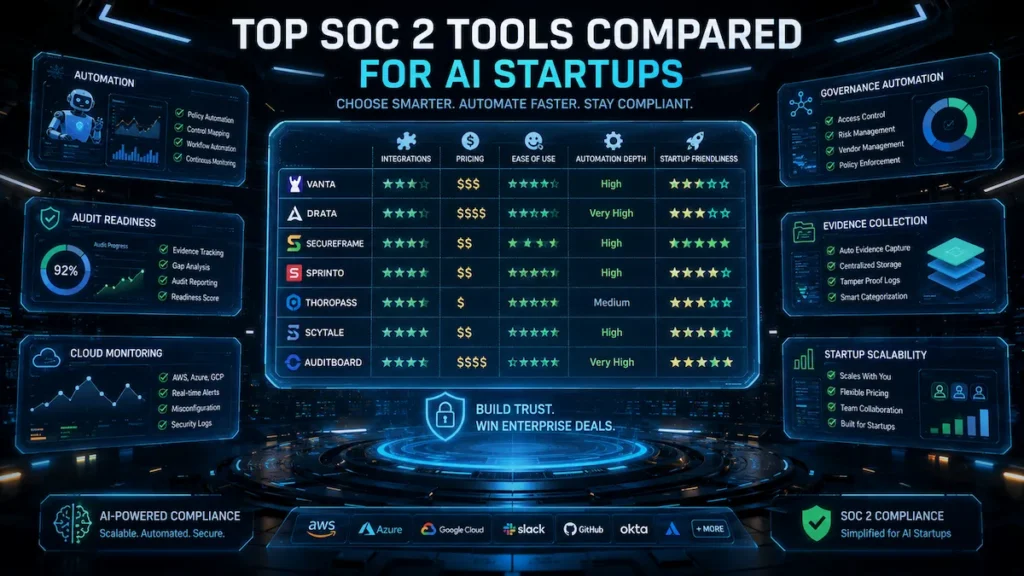
Full Comparison: SOC 2 Platforms for AI Startups
This comparison breaks down the leading SOC 2 compliance tools for AI startups across automation, pricing, audit support, and AI readiness.
Full Comparison: SOC 2 Platforms for AI Startups
| Platform | Best For | Est. Annual Cost | Automation | Audit Support | Multi-Framework | AI Readiness | Setup |
|---|---|---|---|---|---|---|---|
| Vanta | Series A+ | $7K–$25K+ | High | Partner network | Excellent | Medium-High | Moderate |
| Drata | Series A+ | $8K–$20K+ | High | Partner network | Excellent | Medium | Moderate |
| Secureframe | Seed–Series A | $12K–$18K | Moderate–High | Vetted partners bundled | Strong | Medium | Low–Moderate |
| Sprinto | Seed–Series A | $6K–$15K | Moderate | Partner network | Good | Low-Medium | Low |
| Thoropass | First-time audit | Bundled w/ audit | Moderate | In-house (included) | Growing | Low | Moderate |
| Scytale | Seed/Pre-A | $5K–$12K | Moderate | Partner support | Good | Low | Low |
| Hyperproof | 200+ employees, multi-framework | $25K–$100K+ | High (workflow-heavy) | Partner ecosystem | Excellent | Medium | High |
| Scrut Automation | Technical teams, APAC | $15K–$40K | High (agentic AI) | Auditor portal | Excellent | Medium | Moderate–High |
| TryComp AI (Comp AI) | Security-conscious, self-host capable | $2.4K–$12K | High (open-source agents) | Auditor network, varies | Good | Medium | Low–Moderate |
| Delve | First-timers (caution advised) | $10K–$22K | High (claimed) | Auditor network — disputed integrity | Limited (6 frameworks) | Unverified | Low |
| AuditBoard | Enterprise | $50K+ | Very High | Enterprise-grade | Excellent | Medium | High |
Pricing estimates based on publicly reported figures and third-party benchmarks. Contact vendors for current quotes. Delve figures reflect pre-controversy market estimates; verify current terms independently given the ongoing dispute over evidence integrity (see full review).
AI Readiness Rating explained:
| Rating | What It Means |
|---|---|
| Medium-High | The vendor risk module supports LLM documentation, AI policy templates available, and the strongest AI evidence scaffolding reviewed |
| Medium | Vendor risk workflows exist, and controls customizable but not pre-mapped to AI governance |
| Low-Medium | Basic vendor risk tracking; AI governance requires full manual development |
| Low | Minimal AI-specific support; SOC 2-focused without meaningful AI risk tooling |
Pricing estimates based on publicly reported figures. Contact vendors for current quotes.
Full Platform Reviews
These in-depth reviews analyze how each of the top SOC 2 compliance tools for AI startups performs in real operational environments.
#1 Vanta—Best Overall for AI Startups Scaling Enterprise Sales
Vanta launched in 2018 and became the category-defining compliance platform for venture-backed startups. By 2026, it covers SOC 2, ISO 27001, HIPAA, GDPR, PCI DSS, and several others—the broadest multi-framework coverage of any startup-focused platform.
What it does well:
- 200+ native integrations across AWS, GCP, Azure, GitHub, Okta, Google Workspace, HR platforms, and endpoint management
- Automated evidence collection pulls CloudTrail logs, IAM access reviews, MDM enrollment status, and more without manual intervention
- Trust center recognized by enterprise procurement teams by name—some security teams specifically ask whether you use Vanta, which is unusual for a compliance tool
- Vendor risk management module is the strongest LLM provider documentation scaffolding of any platform reviewed; supports formal risk assessments for OpenAI, Anthropic, or other AI vendor relationships
Where it falls short:
- Pricing scales quickly; seed-stage teams often pay for depth they won’t use for 18 months
- Customer support has been inconsistent at scale
- Onboarding takes more than most founders expect: budget 40–60 engineering hours upfront and 2–4 weeks to full configuration
When NOT to use Vanta: Pre-Series A without a dedicated compliance owner. You’ll under-utilize the platform and overburden your engineering team. Also avoid a standalone type 1 with no expansion plans.
“We switched to Vanta at Series A after outgrowing Sprinto. The migration was worth it—but we wish we’d started with Vanta six months earlier once we knew enterprise deals were coming.—Head of Security, Series B SaaS Startup (name withheld)
Best fit: Series A and beyond. Teams planning multi-framework compliance within 12–18 months. Before starting, ensure foundational controls (SSO, MFA, endpoint management) are already in place. Our guide on best AI security tools for startups covers that layer.
#2 Drata—Best for Continuous Compliance Monitoring
Drata stands out among SOC 2 compliance tools for AI startups for its strong real-time compliance drift monitoring capabilities.
Where Vanta’s strength is breadth, Drata’s is operational governance depth. It launched in 2020 as the continuous monitoring alternative and has earned that positioning.
What it does well:
- Controls checked automatically; compliance drift surfaces in near-real time, not during quarterly reviews
- Workflow tools for distributing control ownership across engineering, security, and operations teams—strong when compliance responsibility is shared across multiple functions
- Auditor collaboration portal reduces evidence review friction during the actual audit
- A clean UI makes the compliance program accessible to non-security team members
Where it falls short:
- Pricing similar to Vanta—out of reach for very early-stage teams
- Integration depth is uneven; some integrations fully automate evidence collection while others still require manual uploads
- AI governance support is comparable to Vanta conceptually but lacks the LLM vendor risk documentation scaffolding. Vanta’s vendor module provides
When NOT to use Drata: Seed-stage or earlier. If AI governance is the active priority, Vanta’s vendor risk module is the stronger starting point. The Drata vs. Vanta decision at Series A is genuinely close—see the head-to-head comparison below.
Best fit: Series A and beyond. Companies with distributed compliance ownership. Teams that want real-time continuous monitoring as an operational baseline, not just an audit deliverable.
#3 Sprinto—Best for Early-Stage AI Startups
Sprinto assigns specific tasks—control by control, evidence requirement by evidence requirement—and moves teams through audit readiness in a process that feels managed rather than self-serve.
What it does well:
- Guided task structure is the most meaningful differentiator for teams with no prior compliance experience
- Consistently reaches audit readiness faster than expected based on user-reported timelines
- Pricing more favorable than Vanta or Drata at the early stage
- Low implementation overhead—most teams configure it without dedicated engineering sprints
Where it falls short:
- Integration breadth not as wide as Vanta or Drata; non-standard stacks may need manual evidence collection for some controls
- AI governance documentation is entirely manual—no scaffolding for model governance, LLM vendor risk, or prompt-logging policies
- Not designed as a long-term platform for programs needing deep multi-framework automation
When NOT to use Sprinto: When closing Series A or Series B enterprise deals requiring multi-framework coverage or a trust center that procurement teams recognize by name. Sprinto is the right starting point—not a permanent home for a growing compliance program.
Best fit: Seed-stage and early Series A. Founders with no dedicated compliance staff who need efficient audit preparation. Works well for teams operating on startup-scale security budgets.
#4 Secureframe—Best for Startups Without an Auditor Relationship
Secureframe differentiates itself from other SOC 2 compliance tools for AI startups through bundled auditor access and simplified onboarding.
Secureframe sits in a practical middle ground: more accessible than Vanta or Drata at the early stage, with a built-in auditor connection that removes one of the most underestimated coordination burdens in a first-time compliance program.
What it does well:
- Most teams reach initial configuration faster than with Vanta or Drata
- Built-in relationships with vetted AICPA-accredited audit firms—independently sourcing an auditor typically adds 3–6 weeks; Secureframe removes that step
- Automated security awareness training included in some tiers, eliminating a separate vendor
- Good balance between the guided approach of Sprinto and the enterprise depth of Vanta
Where it falls short:
- Some automation features still maturing relative to Vanta and Drata
- Customer success quality has varied meaningfully by account
- AI governance support limited—vendor risk workflows exist but aren’t pre-mapped to AI-specific controls or LLM relationships
When NOT to use Secureframe: Series A and beyond, where you need deep multi-framework automation or a trust center with enterprise brand recognition. Also avoid if your compliance needs are simple enough that the bundled auditor feature isn’t useful—you may be overpaying.
Best fit: Seed to early Series A. Teams without prior compliance experience who want a guided process and no existing auditor relationship.
#5 Thoropass — Best for First-Time Audits
Thoropass combines compliance software with in-house audit services under one roof. Instead of coordinating with a third-party CPA firm, Thoropass conducts the audit through its own AICPA-accredited team.
What it does well:
- Single vendor handles both platform and audit—eliminates the friction of managing two relationships simultaneously
- Evidence review is faster when platform and auditors share the same system; audit-time surprises are significantly reduced
- Strong for teams where the biggest unknown is what the audit process actually involves
Where it falls short:
- Meaningful lock-in: switching auditors in year two means partially rebuilding your workflow
- AI governance support is the weakest of all platforms reviewed
- Bundled pricing is harder to benchmark than buying platform and audit separately
When NOT to use Thoropass: Year two onward, when you want auditor independence or competitive pricing. Also avoid if AI governance is an active concern or your program needs significant multi-framework expansion.
Best fit: First-time SOC 2 with no existing auditor relationship. Teams that want one vendor responsible for the entire compliance-to-report process.
#6 Scytale—Best for Founders Who Want Managed Support
Scytale differentiates itself through a hands-on customer success model that extends throughout the compliance journey—not just through onboarding.
What it does well:
- Dedicated guidance through audit preparation and evidence review, not just the first 30 days
- Generally accessible pricing for pre-Series A companies
- Covers SOC 2, ISO 27001, GDPR, HIPAA, and several other frameworks
Where it falls short:
- Integration depth and automation maturity still developing relative to Vanta and Drata
- AI governance support is minimal—a SOC 2 compliance tool, not an AI risk platform
- Complex multi-cloud infrastructure may require manual evidence collection for some controls
When NOT to use Scytale: When automation depth is critical to reducing engineering overhead. When you’re at Series A with active enterprise procurement conversations where trust center recognition matters.
Best fit: Seed-stage and pre-Series Founders who want ongoing guidance rather than a self-serve tool. Works well paired with a startup cybersecurity checklist before initiating the platform.
#7 Hyperproof—Best for Multi-Framework GRC at Scale (Not a Startup Tool)
A compliance operations platform, not a startup audit accelerator. Map a control once, and it updates across SOC 2, ISO 27001, HIPAA, SOX, and 20+ other frameworks at once.
Does well: A centralized control library kills duplicate work across frameworks. Strong task ownership and progress tracking. AI-assisted risk scoring flags what needs attention. ~100 integrations including enterprise systems (ServiceNow, SAP). Deep partner network for complex rollouts.
Falls short: No public pricing—custom quotes commonly $25K–$100K+/year. No native Trust Center. Vendor risk management is basic. Steep learning curve; clutter at scale. Lighter AI footprint than Vanta/Drata. Implementation runs weeks to months.
Skip if you’re pre-Series B with no dedicated compliance team or SOC 2 is your only near-term need—you’ll pay enterprise price for depth you won’t use for 18 months.
Best fit: 200+ employees running SOC 2 + ISO 27001/SOX/NIST in parallel, with a compliance function that needs one system of record across business units.
#8 Scrut Automation—Best for Technical Teams Wanting Compliance + Cloud Security in One Platform
Compliance automation bundled with cloud security posture management (CSPM) and built-in DAST—an unusual combination. Bengaluru-founded, 1,700+ customers, strong APAC presence, G2’s 2026 Best Software Award in GRC (4.9★, ~1,300 reviews).
Does well: Built-in DAST most competitors don’t offer. 60+ frameworks with cross-framework evidence reuse. The “Scrut Teammates” AI agent executes remediation and questionnaire tasks autonomously, not just flags them. Reviewers note support flags issues before the auditor does. 100+ integrations, 24/7 monitoring.
Falls short: Pricing fully opaque — no public page; estimates run $15K–$20K/year for small teams, $40K+ for larger multi-framework programs. The UI is cluttered for non-technical stakeholders (HR, legal). Setup is time-consuming for first-timers. No FedRAMP/CMMC. Recurring complaints about agent sync lag.
Skip if you’re a non-technical, founder-led team wanting full hand-holding or you need FedRAMP/CMMC.
Best fit: Technically capable teams — especially APAC-based — that want compliance and cloud security posture unified in one platform.
#9 TryComp AI (Comp AI)—Best Open-Source Option for Security-Conscious, Budget-Conscious Teams
The only credible open-source alternative on this list: ~99% of the codebase is AGPLv3 and publicly readable on GitHub. Founded in San Francisco, early 2025 (also registered as Bubba AI, Inc.); ~700–4,000 customers depending on source/date.
Does well: Auditable code — you can verify exactly what the evidence agent checks, not just trust a vendor’s word. Free self-hosting for data sovereignty. Aggressive pricing (~$199/mo managed starter tier). 580+ claimed integrations with continuous evidence pulls. AI-generated policies customized to your actual stack. 100% money-back guarantee (with conditions). Founders personally on Slack.
Falls short: Young platform (2025) — thin auditor-familiarity track record; confirm your auditor is comfortable with its evidence format first. Self-hosting needs real engineering investment (~$10K/year loaded). Managed pricing isn’t fully self-serve despite “transparent pricing” marketing. Speed claims (“audit-ready in 24 hours”) should be read skeptically—Type II still needs a multi-month observation period regardless of platform. AGPLv3 copyleft applies to network-deployed forks.
Skip if you have no engineering capacity to evaluate/maintain a self-hosted stack or your auditor/enterprise customers expect a long-established brand on the report cover.
Best fit: Security-conscious 5–50 person SaaS teams with at least one engineer willing to own the stack who value transparency and low lock-in over brand recognition.
#10 Delve—Fast AI-Native Automation, But Verify Independently Before Signing
Markets itself on speed: AI agents auto-capture evidence, audit-ready in days/weeks. Y Combinator-backed $32M Series A led by Insight Partners, with customers including Bland and (formerly) Lovable.
This one needs a different framing than the rest of this list. In March 2026, an anonymous former customer (“DeepDelver”) published a Substack post alleging Delve fabricated compliance evidence—including board meeting records and tests that never happened—and used rubber-stamp audit partners. Delve denies fabrication and called the post misleading. TechCrunch has covered this extensively since Insight Partners briefly removed its investment post about Delve. Delve and Y Combinator have “parted ways,” with Delve dropped from YC’s portfolio; customer LiteLLM publicly dropped Delve re-certified elsewhere after an unrelated security incident drew scrutiny back to its compliance vendor; a second whistleblower post in April alleged unlicensed use of another startup’s open-source code, which Delve disputes. Delve’s CEO has publicly said the company “grew too fast and fell short of our own standard.”
Does well (per product docs and pre-controversy reviews): AI agents automate screenshot/log capture and reported audit-readiness in 1–3 weeks. Approachable UX for first-timers, responsive Slack support. It covers 6 frameworks, including early ISO 42001 support. Free trust report + AI questionnaire autofill.
Falls short: No public pricing (~$10K–$22K/year estimated). Narrower integrations (100+) than Vanta/Drata. Built for first-audit speed, not long-term multi-framework governance.
Skip if anything is regulated or anything where audit-defensibility actually matters legally—given the dispute is specifically about evidence integrity. At minimum, independently verify the assigned audit firm’s credentials directly with that firm before relying on any report.
Best fit: Hard to recommend one in good conscience while this is unresolved. If proceeding anyway, only for a low-stakes first type I with no regulated exposure and only with independent auditor verification.
#11 AuditBoard—Enterprise GRC (Not a Startup Tool)
AuditBoard operates differently from most SOC 2 compliance tools for AI startups because it targets enterprise internal audit and governance teams.
AuditBoard is a full GRC platform designed for organizations with dedicated internal audit teams, complex regulatory environments, and board-level reporting requirements. Its SOC 2 capability exists within a platform that also manages risk assessments, internal audit project management, and enterprise-scale vendor risk programs.
If you’re pre-Series B without a dedicated compliance manager, AuditBoard creates more overhead than it solves.
When NOT to use AuditBoard: Any startup context. If you’re evaluating AuditBoard alongside Sprinto and Secureframe, you’re not yet at the stage this platform was built for.
Best fit: Growth-stage and enterprise AI companies with dedicated compliance and internal audit functions, operating across multiple regulated jurisdictions.
Head-to-Head Comparisons
Comparing leading SOC 2 compliance tools for AI startups side-by-side helps founders identify the best operational fit for their growth stage.
Vanta vs Drata for AI Startups
The Vanta vs Drata debate dominates discussions around premium SOC 2 compliance tools for AI startups at the Series A stage.
| Factor | Vanta | Drata |
|---|---|---|
| Automation depth | High | High |
| Real-time drift monitoring | Good | Excellent |
| Integration breadth | 200+ | 180+ |
| Trust center recognition | Very high | Moderate |
| LLM vendor risk scaffolding | Better | Basic |
| Multi-framework coverage | Excellent | Excellent |
| Distributed control ownership | Good | Excellent |
| Est. annual cost | $7K–$25K+ | $8K–$20K+ |
| AI Readiness Rating | Medium-High | Medium |
Bottom line: Choose Vanta if you’re primarily closing enterprise deals and want the compliance platform procurement teams already recognize. Choose Drata if real-time drift visibility and distributed control ownership matter more than brand recognition. For AI-specific governance scaffolding, Vanta has a meaningful edge.
Before finalizing, ask each vendor: Which specific controls auto-populate from our AWS/GCP/Azure configuration without manual uploads? What documentation support exists for third-party LLM vendor relationships?
Sprinto vs Secureframe for Early-Stage Startups
| Factor | Sprinto | Secureframe |
|---|---|---|
| Guided task structure | Excellent | Good |
| Auditor access | You source independently | Bundled partner network |
| Security awareness training | A separate vendor needed | Included in some tiers |
| Pricing | Generally lower | Mid-range |
| AI governance support | Low-Medium | Medium |
| Best for | Teams with zero compliance experience | Teams without an auditor yet |
Bottom line: If you already have an auditor relationship, Sprinto is usually the better value. If you want the platform to handle auditor coordination, Secureframe’s bundled partner network justifies the premium.
Thoropass vs Traditional Auditor (DIY)
Founders comparing DIY audits with managed SOC 2 compliance tools for AI startups often evaluate Thoropass for operational simplicity.
| Factor | Thoropass | Traditional Auditor + DIY |
|---|---|---|
| Evidence collection | Partially automated | Fully manual |
| Auditor coordination | Single vendor | Separate engagement |
| Year 2 auditor flexibility | Limited (lock-in) | Full flexibility |
| Implementation overhead | Moderate | High |
| AI governance support | Low | Depends on auditor specialization |
Bottom line: Thoropass wins on operational simplicity for a first audit. The tradeoff is year-two lock-in. If you’re doing a first audit with no compliance infrastructure, Thoropass’s integrated model is the faster path. If you’re renewing or already have an auditor relationship, stay independent.
Best SOC 2 Tool by Use Case
Different SOC 2 compliance tools for AI startups are optimized for different infrastructure, budget, and regulatory requirements.
Best for AWS-heavy teams: Vanta’s AWS coverage edges ahead in automatic evidence collection depth—CloudTrail, Config, GuardDuty, S3 access logs, and IAM. For AWS-centric infrastructure at Series A+, Vanta is the stronger fit.
Best for HIPAA + SOC 2 combined: Vanta, Drata, and Secureframe all support dual-framework programs. Vanta’s multi-framework workspace is the most mature for managing both in parallel without duplicating evidence collection.
Best for teams calling OpenAI or Anthropic APIs: No reviewed platform has native controls for LLM API risk management. Vanta comes closest with its vendor risk module. You’ll need a supplemental AI vendor risk documentation process regardless of which platform you choose.
Best for budget-conscious startups: Sprinto and Scytale, both with custom pricing accessible for pre-Series A teams. Factor in auditor fees separately—budget $12,000–$20,000 for an independent Type 2 audit on top of your platform subscription.
Best Vanta alternatives: Drata (equivalent automation depth), Secureframe (bundled auditor access), and Sprinto (guided, lower cost, early-stage focused).
AI Startup Compliance Maturity Curve
The best SOC 2 compliance tools for AI startups depend heavily on your company’s current compliance maturity and operational complexity.
| Stage | Where You Are | Right Tool |
|---|---|---|
| 1 — Security Foundations | SSO, MFA, endpoint management, basic logging in place | None yet—build the foundation first |
| 2 — Compliance Initiation | Scoping audit, implementing missing controls, selecting a platform | Sprinto, Scytale, or Secureframe |
| 3 — Continuous Compliance | Controls operating consistently; Type 2 observation period running | Vanta or Drata |
| 4 — Governance Maturity | Type 2 complete; adding HIPAA/ISO 27001/GDPR | Enterprise tiers of Vanta or Drata; AuditBoard if internal audit team exists |
| 5 — AI Governance Layer | Model governance, prompt logging, LLM vendor risk, training data controls | Custom documentation layer—no platform automates this |
For Stage 1 specifics, our startup cybersecurity checklist covers the exact controls every compliance platform expects to find already in place.
What Most Founders Get Wrong
Many founders misunderstand how SOC 2 compliance tools for AI startups fit into broader enterprise security and AI governance expectations.
The “checkbox” trap. Enterprise buyers who review Type 2 reports regularly can tell the difference between a program that operated continuously and one assembled right before the observation period started. The goal isn’t to pass an audit—it’s to run security controls consistently enough that passing is the natural outcome.
Starting too early. Getting a Type 1 before your infrastructure is stable means rebuilding after the next major architectural change. The observation period for Type 2 should start after your core systems are settled—not mid-migration.
Assuming SOC 2 closes the enterprise AI review. Security reviews now routinely include SIG questionnaires, CAIQ mappings from the Cloud Security Alliance, and custom AI vendor reviews alongside the SOC 2 report. A Type 2 accelerates those conversations—it doesn’t replace them.
Ignoring ISO 27001 for European buyers. If your AI startup sells to European enterprise buyers, ISO 27001 often carries more weight in their procurement process than SOC 2. Global enterprise sales increasingly require both. Factor this into platform selection from the start.
Hidden Costs of SOC 2 Compliance
Understanding the real costs behind SOC 2 compliance tools for AI startups helps prevent major budgeting mistakes during the first audit cycle.
| Cost Category | Typical Range | Notes |
|---|---|---|
| Compliance platform | $5K–$25K/year | Varies by stage and platform |
| Independent auditor (Type 2) | $12K–$30K | Separate from platform; bundled only in Thoropass |
| Engineering time — Year 1 | 60–100 hours | Setup, integrations, control implementation |
| Engineering time — Ongoing | 10–20 hrs/quarter | Access reviews, evidence gaps, policy updates |
| Security tooling gaps | $5K–$15K/year | EDR, vulnerability scanning, MDM if not in place |
| AI governance documentation | 20–40 hours | Manual development—no platform automates this |
| Total Year 1 (estimated) | $30,000–$70,000 | All categories combined |
“We budgeted $20K for compliance. We spent $55K. The auditor fees and the engineering hours were both 2x what we expected.” — Founder, Series A AI Startup (name withheld)
The biggest surprise for most founders isn’t the platform cost—it’s the auditor fee and the engineering hours. Both are consistently underestimated.
Frequently Asked Questions
These frequently asked questions address the most common concerns founders have about SOC 2 compliance tools for AI startups.
Which SOC 2 tool is best for AI startups?
Among the leading SOC 2 compliance tools for AI startups, Vanta is the strongest option for companies actively closing enterprise deals, while Sprinto is better suited for early-stage teams that need a guided and lower-cost compliance process.
How much does SOC 2 compliance cost for startups?
The total first-year cost of implementing SOC 2 compliance tools for AI startups typically ranges from $30,000 to $70,000 when platform subscriptions, auditor fees, engineering time, and remediation work are included.
How long does SOC 2 compliance take?
SOC 2 Type 1: 6–12 weeks from kickoff with a compliance platform in place. SOC 2 Type 2: a minimum of 6 months, including the observation period; more realistically, 8–12 months from scratch. The NIST Cybersecurity Framework outlines the foundational controls that must be operational before the observation period begins.
Is SOC 2 required for SaaS startups?
Not legally—it’s voluntary, maintained by the AICPA. But for AI startups selling to enterprise buyers, it’s functionally mandatory. Most enterprise procurement teams require a Type 2 report or will accept a Type 1 with a credible Type 2 timeline in progress.
What’s the difference between SOC 2 Type 1 and Type 2?
SOC 2 Type 1 is a point-in-time audit confirming controls exist and are designed correctly. Type 2 covers an observation period—typically 6–12 months—confirming controls operated consistently. Enterprise buyers almost universally prefer Type 2. Type 1 is accepted primarily as evidence that Type 2 is in progress.
Can AI startups automate SOC 2 compliance?
Yes, modern SOC 2 compliance tools for AI startups automate evidence collection, continuous monitoring, policy management, and audit preparation, although AI governance documentation still requires manual oversight.
Does SOC 2 cover AI-specific security risks?
Most SOC 2 compliance tools for AI startups help automate standard audit controls, but SOC 2 itself does not fully address AI-specific risks like model governance, prompt retention, training data isolation, or third-party LLM vendor management.
What are the best Vanta alternatives for startups?
Drata (equivalent automation depth, slightly different operational fit), Secureframe (bundled auditor access, faster onboarding), and Sprinto (guided structure, lower cost, early-stage focused). Choice depends on your stage and whether auditor coordination needs to be handled by the platform.
What are the best Vanta alternatives for startups?
Drata (equivalent automation depth), Secureframe (bundled auditor access, faster onboarding), Sprinto (guided structure, lower cost, early-stage focused), Scrut Automation (built-in DAST and cloud security posture management for technical teams), and TryComp AI (open-source, lowest cost, best fit if you want to audit the evidence-collection code yourself). Choice depends on stage, technical capacity, and whether auditor coordination needs to be handled by the platform.
Conclusion
The best SOC 2 compliance tools for AI startups are the ones that align with your current stage, reduce audit friction, and support the growing AI governance expectations of enterprise buyers.
SOC 2 is no longer a compliance milestone. For AI startups selling to enterprise buyers, it’s the minimum viable prerequisite for being taken seriously—and in 2026, it’s no longer sufficient on its own.
The companies closing enterprise deals aren’t the ones with the most polished security pitch decks. They’re the ones who hand over a clean Type 2 report, answer questions about prompt retention and training data isolation without hesitation, and move the security review forward before it becomes a blocker.
Final recommendations by stage:
| Stage | Best Tool | Why |
|---|---|---|
| Seed / Pre-Series A | Sprinto or Scytale | Guided, accessible, low engineering overhead |
| Series A / B | Vanta (#1) or Drata (#2) | Deepest automation, strongest enterprise trust signals |
| First audit, no auditor yet | Thoropass | Single vendor for platform and audit |
| Enterprise / growth | AuditBoard + Vanta/Drata enterprise tier | Full GRC capability |
Start before you’re asked. Build the AI governance layer in parallel—not as a future problem. Choose the platform that fits where you are today, not where you hope to be in 24 months.
The enterprise buyers who understand AI risk are already asking questions your SOC 2 report doesn’t answer. The startups that have built those answers are winning the deals.