
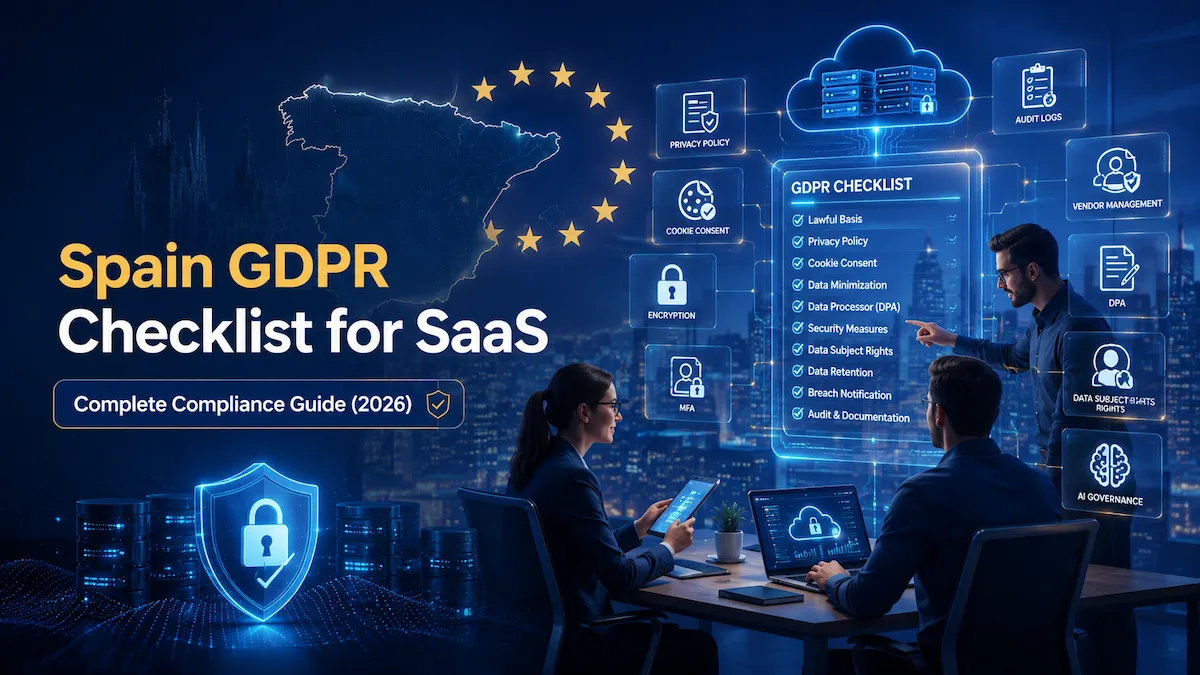
Last updated: June 2026 | Reviewed by the trusteraai.com editorial team | Sources: AEPD, EDPB, European Commission, gdpr-info.eu
This article is reviewed periodically for accuracy. For legal advice specific to your company, consult a qualified GDPR attorney or certified privacy consultant.
Last updated: June 2026 | Reviewed by the trusteraai.com editorial team | Sources: AEPD, EDPB, Euro
If your SaaS company serves customers in Spain—or anywhere in the EU—GDPR compliance isn’t optional. It’s a legal requirement with serious financial consequences. Fines can reach €20 million or 4% of your global annual turnover, whichever is higher.
For US-based SaaS founders, the Spain GDPR checklist is often the starting point before expanding into European markets. Spain has its own data protection framework enforced by the Agencia Española de Protección de Datos (AEPD) — one of the EU’s most active enforcement agencies. They’ve issued fines against companies of all sizes, including SaaS providers.
This guide gives you a practical, actionable Spain GDPR checklist for SaaS companies. You’ll know exactly what to implement, in what order, and why each item matters.
Quick Answer: Spain GDPR Checklist for SaaS
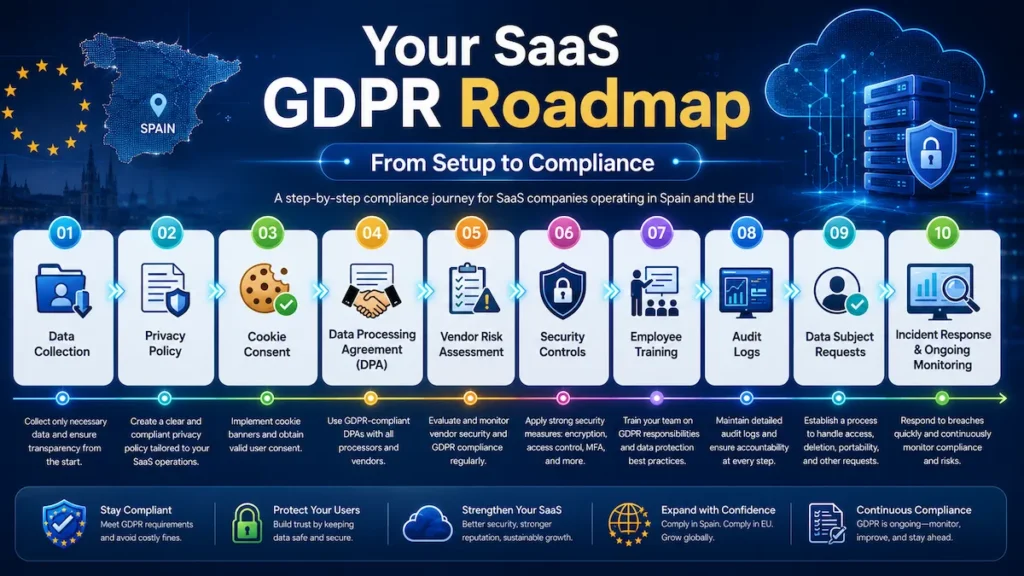
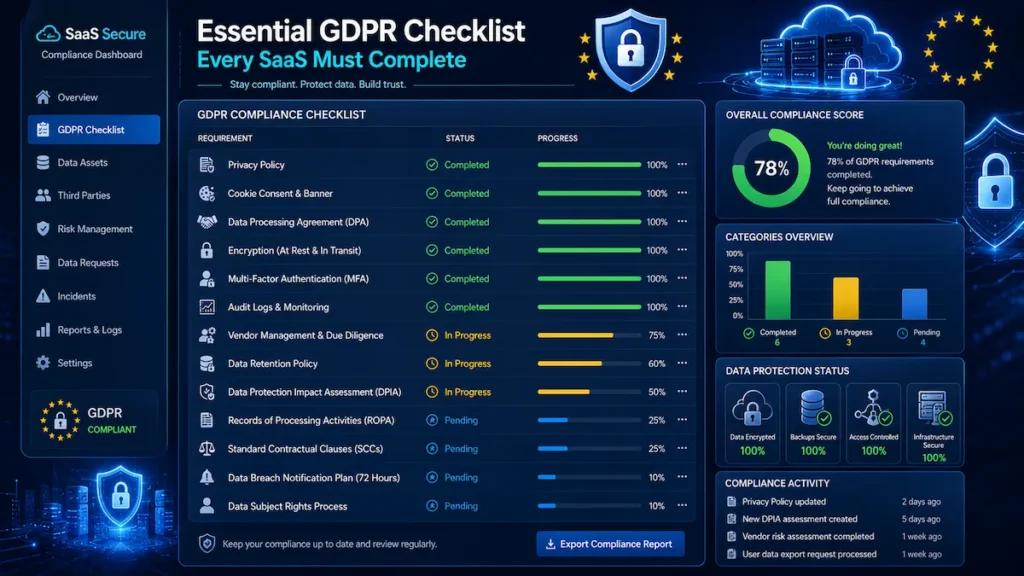
GDPR applies to any SaaS company serving users in Spain—regardless of where the company is based. The core steps are (1) determine whether you’re a data controller, processor, or both; (2) map personal data flows and build a ROPA; (3) establish lawful bases for processing; (4) update your privacy policy for GDPR compliance; (5) implement cookie consent management; (6) sign Data Processing Agreements with all vendors; (7) deploy technical security controls, including encryption and MFA; (8) create a Data Subject Rights workflow; (9) build a 72-hour breach notification plan; and (10) conduct a DPIA for any high-risk processing. US companies processing EU data regularly must also appoint an EU representative and use standard contractual clauses for cross-border transfers.
What Makes Spain GDPR- Compliant Compliance Different for SaaS
This Spain GDPR Checklist for SaaS helps founders translate broad GDPR requirements into practical controls for operating in Spain.
GDPR is an EU-wide regulation. Every EU member state follows the same core rules. But Spain adds a layer through its national law—Ley Orgánica 3/2018 (LOPDGDD)—which supplements GDPR with country-specific requirements.
Key differences US SaaS founders should know:
- The AEPD enforces GDPR independently and aggressively investigates complaints
- Spain has specific rules around employee data, minors’ data (age of digital consent is 14 in Spain), and public interest processing
- The AEPD publishes enforcement decisions publicly, creating reputational risk beyond the financial penalties
For SaaS companies, this means your standard “global privacy policy” likely isn’t enough. You need Spain-specific compliance steps built into your product, legal documents, and internal processes.
Spain-Specific GDPR Considerations for SaaS
Most GDPR guides treat the regulation as a single, uniform framework. That’s accurate at the legal level — but it misses how compliance actually plays out on the ground in Spain. The AEPD operates differently from other national supervisory authorities, and those differences affect how you build and maintain compliance as a SaaS company serving Spanish users.
Following a structured Spain GDPR checklist for SaaS reduces compliance gaps that often appear during expansion into Spanish markets.
The AEPD is one of the EU’s most active enforcement bodies. Unlike some supervisory authorities that prioritize guidance over sanctions, the AEPD has a consistent record of investigating complaints quickly and issuing fines across company sizes—including against SaaS and tech companies. Cookie consent violations, inadequate privacy notices, and failure to honor data subject rights requests are among the most frequently cited categories. The AEPD publishes every enforcement decision publicly, which means a fine creates reputational exposure beyond the financial penalty itself.
The LOPDGDD adds obligations GDPR alone doesn’t specify. Spain’s national implementing law—Ley Orgánica 3/2018 de Protección de Datos Personales y garantía de los derechos digitales—supplements GDPR with provisions that matter for SaaS companies in specific situations. These include additional requirements around processing employee data, stricter protections for minors (age of consent for data processing is 14 in Spain, compared to 16 in some other EU states), and specific rules around the right to digital disconnection. If any of your SaaS users are employees of Spanish companies using your platform, or if you serve any users under 16, these provisions are directly relevant.
Spanish enterprise buyers run thorough compliance reviews. Enterprise procurement in Spain — particularly in regulated sectors like financial services, healthcare, and public administration — typically includes a formal vendor security and privacy questionnaire. Buyers routinely ask for evidence of your DPA, your ROPA process, your breach notification procedure, and your cross-border transfer safeguards. Incomplete documentation at this stage kills deals. A completed Spain GDPR checklist is increasingly a commercial prerequisite, not just a legal one.
Customer communication considerations matter. While GDPR doesn’t require privacy notices to be in Spanish, the AEPD expects that notices are intelligible to the users they serve. In practice, for a SaaS product serving Spanish-speaking customers, maintaining your privacy policy, cookie consent interface, and data subject rights process in Spanish is both expected and prudent. Notices that are technically compliant but practically incomprehensible to Spanish users have been cited in AEPD guidance as falling short of transparency standards.
Cookie enforcement in Spain is specific and consistent. The AEPD has published detailed guidance on cookie consent requirements that goes beyond what GDPR alone specifies. Spanish enforcement has specifically targeted consent banners that make rejection harder than acceptance, implied consent through continued browsing, and cookie walls that gate content behind consent. These aren’t theoretical risks—they appear repeatedly in published AEPD enforcement records. If your SaaS has a marketing website serving Spanish users, your cookie consent implementation needs to be built specifically against AEPD guidance, not just general GDPR principles.
The Spain GDPR Compliance Lifecycle
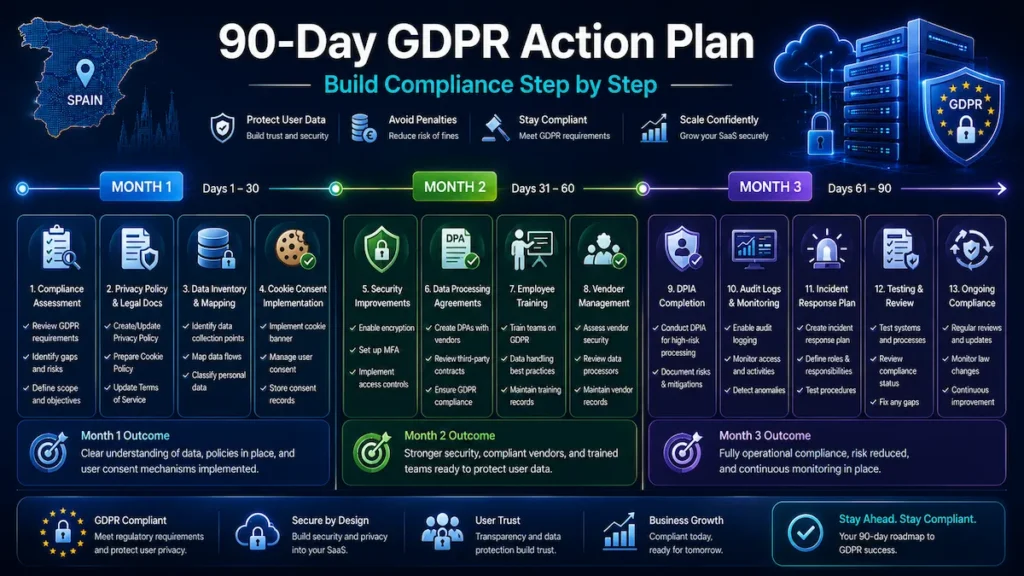
Treat this Spain GDPR Checklist for SaaS as an ongoing operational framework rather than a one-time legal project.
GDPR compliance isn’t a project with a finish line. It’s an operational cycle. Before working through each checklist step, understand the phase it belongs to—so you can build sustainable compliance processes rather than scrambling before audits.
╔═══════════════════════════════════════════════════════════════╗
║           SPAIN GDPR COMPLIANCE LIFECYCLE FOR SAAS           ║
╠═══════════════════════════════════════════════════════════════╣
║                                                               ║
║   [1. DISCOVER]  ──►  [2. DOCUMENT]  ──►  [3. IMPLEMENT]     ║
║   Map data flows      Build ROPA          Deploy controls     ║
║   Find gaps           Draft policies      Configure CMP       ║
║   Set legal roles     Sign DPAs           Enable DSR process  ║
║        │                                        │             ║
║        ▼                                        ▼             ║
║   [6. IMPROVE]  ◄──  [5. AUDIT]  ◄──  [4. MONITOR]           ║
║   Update controls     Test systems        Track access logs   ║
║   Revise policies     Review vendors      Watch for breaches  ║
║   Close gaps          DPIA review         Consent records     ║
║                                                               ║
╚═══════════════════════════════════════════════════════════════╝
Every item on this Spain GDPR checklist fits one of these six phases. The lifecycle repeats—typically on a quarterly review cadence with an annual full audit cycle. Treat compliance like a product feature: it needs iteration, not just installation.
What GDPR Compliance Actually Costs for SaaS
Using a phased Spain GDPR checklist for SaaS makes budgeting and compliance planning significantly more predictable.
This is the question most GDPR guides avoid answering. Here’s a realistic breakdown by stage—including legal review, tooling, implementation effort, and ongoing maintenance.
| Cost Category | Early SaaS (Pre-Seed to Seed) | Growth SaaS (Series A–B) | Enterprise SaaS |
|---|---|---|---|
| Legal review | One-time privacy counsel engagement to review policies and DPA templates | Ongoing privacy counsel retainer or fractional DPO | Dedicated privacy legal counsel + DPO |
| Compliance tooling | CMP deployment (free to ~$150/month); basic GDPR software ($50–$300/month) | Compliance automation platform ($300–$1,500/month); DSR workflow software | Enterprise GRC platform; integrated privacy management suite |
| Implementation effort | 40–80 engineering and legal hours for initial setup | 100–200 hours across legal, engineering, and product teams | Dedicated compliance program with ongoing headcount |
| Security controls | Encryption and MFA typically built into existing infrastructure (penetration test, $3k–$10k annually) | Formal security program; SOC 2 readiness ($15k–$50k); annual pen test | ISO 27001 certification ($30k–$100k+); continuous monitoring tooling |
| Ongoing maintenance | Quarterly policy reviews; annual vendor DPA audit (~10–20 hours/quarter) | Formal compliance calendar; ROPA updates; DSR handling (~20–40 hours/quarter) | Full-time compliance operations |
The most cost-effective early approach is combining a lightweight CMP, a compliance automation platform for ROPA and DPA management, and a one-time legal review of your core documents. Our comparison of GDPR compliance software for Spanish startups and the best GDPR compliance tools for startups covers the tools that consolidate these workflows at each price point.
One number worth keeping in mind: the average AEPD fine issued to a small or mid-size company in recent enforcement cycles has significantly exceeded what a first-year compliance program costs. Proactive implementation is the lower-cost path.
A Real Expansion Scenario: US SaaS Entering Spain
This example shows how a Spanish GDPR checklist for SaaS can move a company from planning to procurement readiness.
Company: A US-based B2B SaaS offering HR workflow automation. 12 employees. Series A. Beginning to sign Spanish enterprise customers.
Week 1–2: Discovery
The founding team completes a data mapping exercise using a compliance automation platform. They identify six categories of personal data their product processes: employee names and emails (customer end-users), usage logs, billing contacts, support ticket content, integration credentials, and behavioral analytics data.
They determine their legal role: controller for their own customer account data and processor for the HR records of their customers’ employees. Both roles require separate compliance tracks.
Week 3–4: Documentation
The team updates its privacy policy—replacing the CCPA-drafted version with a GDPR-specific document covering all required disclosures in both English and Spanish. They build their ROPA across both controller and processor functions.
They conduct a vendor audit and identify eight third-party tools touching personal data. Five already offer executed DPAs; three require outreach. All eight are added to the ROPA with their sub-processor lists noted.
Week 5–6: Implementation
A CMP is deployed on their marketing website and app login flow. The team tests the consent implementation against AEPD cookie guidance—they discover their analytics cookies were loading before consent was registered on mobile. The bug is fixed before any Spanish enterprise onboarding proceeds.
Technical controls are reviewed: encryption at rest and in transit are already in place; MFA is enforced for admin accounts but not all developer accounts—that gap has been closed. Audit logging is enabled for all data access events.
Week 7–8: Governance and Transfer Safeguards
The team appoints an EU representative through a managed service. They execute updated SCCs with their US-based cloud infrastructure provider and complete a Transfer Impact Assessment covering their three primary US-EU data flows.
A DSR intake form is deployed. An incident response template is drafted and reviewed by outside counsel. A tabletop exercise is scheduled for Q3.
Week 9–10: Procurement Readiness
The first Spanish enterprise prospect sends a security questionnaire. The team completes it in three days—pointing to their executed DPA, ROPA documentation, breach response plan, SCCs, and CMP configurations. The deal moves to legal review without a compliance hold.
This timeline is realistic for a well-resourced early-stage SaaS team using compliance automation tooling. For AI-powered SaaS products with automated decision-making components, add two to four additional weeks for DPIA completion and review of AI security compliance controls.
Spain GDPR Checklist for SaaS: The Complete 10-Step Framework
Step 1: Establish Your Legal Role — Controller vs. Processor
The first action in any Spain GDPR checklist for SaaS is identifying whether your business acts as a controller, processor, or both.
Data Controller: You decide why and how personal data is processed. If your SaaS collects user data directly, you’re likely a controller.
Data Processor: You process data on behalf of another company. If your SaaS is a backend tool used by other businesses, you may be a processor.
Many SaaS companies are both a controller for their own users and a processor for their customers’ end-user data. Getting this wrong means you may miss required legal steps entirely.
Checklist items:
- Identify all data flows in your product
- Determine your legal role for each data category
- Document your determination with written rationale
Step 2: Map Your Data and Build a ROPA
A complete Spain GDPR checklist for SaaS depends on accurate data mapping and current processing records.
Records of Processing Activities (ROPA) is a formal document listing every type of personal data your SaaS handles. Article 30 of GDPR requires most organizations to maintain a ROPA. For SaaS companies operating in Spain, the AEPD expects this documentation to be current and available upon request.
Your ROPA should include:
| Field | What to Document |
|---|---|
| Data category | User emails, payment info, usage logs |
| Processing purpose | Account creation, billing, analytics |
| Legal basis | Consent, contract, legitimate interest |
| Retention period | Per your documented retention policy |
| Recipients | Third-party tools, cloud providers |
| Transfer safeguards | SCCs, adequacy decisions |
Checklist items:
- List every category of personal data your SaaS processes
- Map each data type to a purpose and lawful basis
- Document all third-party recipients and their roles
- Assign retention periods per your documented retention policy
- Review and update your ROPA quarterly
Step 3: Define Your Lawful Basis for Processing
Every effective Spain GDPR checklist for SaaS requires documented lawful bases before personal data is processed.
Every processing activity needs a lawful basis under GDPR Article 6. The six bases are:
- Consent — User gave clear, affirmative permission
- Contract—Processing is necessary to fulfill a contract
- Legal obligation — Required by law
- Vital interests — Protecting someone’s life
- Public task — Rarely applies to SaaS
- Legitimate interests — Your business interest doesn’t override user rights
For most SaaS companies, the primary bases are consent, contract, and legitimate interests. If you rely on legitimate interest, you must complete a Legitimate Interest Assessment (LIA) and document why your interest isn’t overridden by individual user rights. The AEPD has challenged companies that use legitimate interest as a blanket justification without documented assessment.
Checklist items:
- Assign a lawful basis to every processing activity in your ROPA
- Complete and document an LIA where legitimate interest is claimed
- Never use legitimate interest as a default catch-all
Step 4: Update Your Privacy Policy for Spanish Users
A GDPR-compliant privacy policy for Spain must clearly include the following:
- Who you are and your full contact details
- All purposes for processing personal data
- The lawful basis for each processing purpose
- How users can exercise their data subject rights
- Which third parties receive personal data
- Retention periods for each data category
- International transfer safeguards where data leaves the EU
- Your Data Protection Officer’s contact details (if applicable)
A CCPA-compliant policy will not satisfy the AEPD. The transparency requirements are meaningfully different. The AEPD has also flagged policies that technically include required elements but present them in language that average users cannot reasonably understand. For Spanish-speaking users, maintaining your privacy policy in Spanish is strongly recommended.
Checklist items:
- Rewrite or update your privacy policy with all GDPR-required elements
- Use plain-language explanations throughout—avoid buried legal jargon
- Maintain your privacy policy in Spanish for Spanish-speaking users
- Make the policy accessible from your signup page, app footer, and website footer
- Version-control your privacy policy and archive older versions with dates
Step 5: Implement a Cookie Consent Management Platform
Spain follows GDPR and the ePrivacy Directive, which together require explicit consent before placing non-essential cookies on a user’s device. The AEPD has issued detailed national cookie guidance that goes beyond the base GDPR standard — and has fined companies specifically for dark patterns, pre-checked boxes, hidden reject options, and consent banners that require multiple steps to decline.
Your cookie consent implementation must:
- Default all non-essential cookies to off
- Offer an equally prominent “Reject All” option alongside “Accept All.”
- Allow granular management by cookie category
- Record consent with a timestamp and user identifier
- Allow withdrawal of consent at any time as easily as it was given
A Consent Management Platform (CMP) configured specifically against AEPD cookie guidance is the reliable implementation path. Explore the best GDPR compliance tools for startups for CMPs that include consent record storage, audit trails, and Spain-specific configuration templates.
Checklist items:
- Audit every cookie and tracker your SaaS loads at page level
- Categorize cookies (strictly necessary, analytics, marketing, preferences)
- Deploy a GDPR-compliant CMP configured against AEPD cookie guidance
- Test your consent flow on both desktop and mobile—rejection must be as simple as acceptance
- Retain consent records in accordance with your documented retention policy
Step 6: Execute Data Processing Agreements with All Vendors
Vendor agreements are a foundational requirement in every Spain GDPR checklist for SaaS.
If you share personal data with any third-party vendor, you need a signed Data Processing Agreement (DPA) under GDPR Article 28. This is non-negotiable.
Common SaaS vendors requiring DPAs:
- Cloud hosting providers (AWS, Google Cloud, Azure)
- Email marketing platforms (Mailchimp, HubSpot)
- Analytics tools (Google Analytics, Mixpanel)
- Customer support platforms (Intercom, Zendesk)
- Payment processors (Stripe)
- CRM platforms (Salesforce)
A DPA must specify the subject matter, duration, nature, and purpose of processing; the types of personal data involved; your rights and obligations as the controller; and the processor’s security and sub-processor obligations.
After executing each DPA, review the vendor’s sub-processor list. Your agreement with a vendor doesn’t automatically protect data that vendor shares with its own vendors. Contractual protections must cascade downstream. Our GDPR compliance software comparison for Spanish startups covers platforms that automate vendor DPA tracking and sub-processor monitoring in a single workflow.
Checklist items:
- List every vendor that touches personal data in your ROPA
- Confirm each vendor offers a current, GDPR-compliant DPA
- Sign and store executed DPAs for all active vendors
- Review DPAs annually and whenever vendors change their terms
- Review each vendor’s sub-processor list at least annually
Step 7: Implement Technical Security Controls
GDPR Article 32 requires “appropriate technical and organizational measures” to protect personal data. For SaaS companies, this means concrete, documented implementations — not aspirational statements.
Required technical controls for Spain GDPR compliance:
| Control | Implementation Standard |
|---|---|
| Encryption at rest | AES-256 for databases and file storage |
| Encryption in transit | TLS 1.2 or higher for all connections |
| Access control | Role-based; principle of least privilege |
| Multi-Factor Authentication (MFA) | Enforced for all admin and developer accounts |
| Audit logs | Access events logged with timestamps and user IDs |
| Vulnerability management | Regular patching and dependency scanning |
| Penetration testing | At least annually by qualified external testers |
| Backup and recovery | Encrypted, tested, stored in separate environments |
ISO 27001 certification is increasingly expected by Spanish enterprise buyers. Aligning your controls with ISO 27001 before pursuing formal certification demonstrates good-faith compliance and accelerates procurement. SOC 2 Type II is commonly required by US enterprise customers and maps well to GDPR Article 32 requirements—see best SOC 2 compliance tools for AI startups for platforms that bridge both frameworks.
For AI-powered SaaS products, security requirements extend further. Our guides to AI security compliance tools for SaaS startups and AI cloud security solutions for startups cover the additional controls needed when machine learning models process personal data.
Checklist items:
- Enable encryption at rest and in transit across all systems
- Enforce MFA for all privileged accounts
- Implement role-based access control with documented quarterly access reviews
- Enable and retain audit logs per your documented retention policy
- Schedule annual penetration testing with a qualified external provider
- Document all security controls in a written, version-controlled Security Policy
Step 8: Build a Data Subject Rights (DSR) Process
Data subject workflows are a core execution area in any Spain GDPR checklist for SaaS.
GDPR gives Spanish users six rights over their personal data. You need a working operational process — not just a policy — to honor each one within required timeframes.
| Right | What It Means | Response Timeframe |
|---|---|---|
| Right to Access | The user requests a copy of their data | Without undue delay; generally within one month |
| Right to Erasure | User requests deletion of their data | Without undue delay; generally within one month |
| Right to Rectification | User corrects inaccurate data | Without undue delay; generally within one month |
| Right to Portability | The user receives data in machine-readable format | Without undue delay; generally within one month |
| Right to Object | User objects to legitimate interest processing | Stop processing unless compelling grounds exist |
| Right to Restrict | User limits processing in certain circumstances | Confirm restriction without undue delay |
For complex or multiple simultaneous requests, you may extend the response period by a further two months — but you must notify the person of the extension within the initial one-month period.
The most operationally complex request is erasure. Before completing one, you need to know exactly where a specific user’s data lives across every integrated third-party tool. Building this map during Step 2 (ROPA) means you’re not scrambling when the first request arrives.
Checklist items:
- Build a DSR intake form or dedicated intake email address
- Map all data storage locations per user across systems and integrated vendors
- Assign a named team member responsible for DSR handling
- Set internal SLAs to respond within the required timeframe
- Log all DSR requests, responses, and outcomes with timestamps
Step 9: Create a Data Breach Notification Plan
Under GDPR Article 33, you must notify the AEPD of a personal data breach within 72 hours of becoming aware of it — if the breach is likely to result in risk to individuals’ rights and freedoms. If the breach poses a high risk, you must also notify affected users directly under Article 34.
The 72-hour window is unforgiving. Most SaaS companies without a documented plan spend the first 18–24 hours simply determining whether notification is required. A pre-built plan removes that delay.
Your breach response plan must include:
- Internal detection and escalation process with defined roles
- Breach severity assessment framework (does this trigger AEPD notification?)
- Documentation template (what happened, which data categories, how many records)
- AEPD notification procedure via the AEPD’s online portal
- User-facing notification template for high-risk breaches
- Post-incident review and corrective action process
Checklist items:
- Create a written, version-controlled Incident Response Plan
- Define breach severity levels and internal escalation contacts
- Pre-draft your AEPD notification template
- Conduct a tabletop breach response exercise at least annually
- Test your detection and alerting capabilities
Step 10: Conduct a DPIA for High-Risk Processing
Risk assessments help mature a Spain GDPR checklist for SaaS as products evolve.
A Data Protection Impact Assessment (DPIA) is required before beginning any processing likely to result in a high risk to individuals’ rights and freedoms. For SaaS companies, DPIAs are typically required when you
- Process sensitive data categories (health, biometric, financial)
- Use AI or automated decision-making that significantly affects users
- Track or profile user behavior at scale
- Process data belonging to minors
- Introduce new technologies with significant privacy implications
A DPIA must identify risks, assess their likelihood and severity, and document the controls you’ll implement to reduce them. The European Data Protection Board publishes DPIA guidelines covering when assessments are required and how to structure them.
If a DPIA reveals a high residual risk you cannot mitigate, you must consult with the AEPD before proceeding. For AI-driven SaaS products, the DPIA process increasingly intersects with EU AI Act obligations—making early documentation especially valuable.
Checklist items:
- Identify all processing activities that may require a DPIA
- Complete a DPIA before launching high-risk product features
- Involve your DPO (if applicable) throughout the DPIA process
- Document all DPIAs and review them when processing activities change materially
Do You Need a Data Protection Officer?
Many growing companies include DPO evaluation as part of their Spain GDPR checklist for SaaS.
A Data Protection Officer (DPO) is mandatory under GDPR if your SaaS processes personal data at large scale as a core business activity, processes sensitive data categories at large scale, or conducts large-scale systematic monitoring of individuals.
Most early-stage SaaS companies don’t meet the mandatory threshold. But appointing a DPO voluntarily — or contracting a DPO-as-a-service provider — simplifies compliance management and is a strong signal of operational maturity during Spanish enterprise procurement.
If you appoint a DPO, register their contact details with the AEPD and make them publicly accessible in your privacy policy.
Do US SaaS Companies Need an EU Representative?
EU representation should be reviewed early in your Spain GDPR checklist for SaaS.
Under GDPR Article 27, if you process EU residents’ data regularly and are not established in the EU, you are likely required to appoint a named EU representative based in an EU member state.
You likely need an EU representative if:
- You offer services to EU residents on a non-occasional commercial basis
- You monitor EU residents’ behavior through analytics, tracking, or profiling
- You’re not established in the EU or EEA
You may be exempt if:
- Processing is genuinely occasional and low-risk
- It doesn’t involve large-scale sensitive data processing
An EU representative receives AEPD inquiries and regulatory correspondence on your behalf. Their absence — when required — is itself a GDPR violation. Specialist services offer this as a managed annual service for a modest fee.
Checklist items:
- Assess whether your processing qualifies as regular and systematic
- If required, appoint an EU representative in an EU member state
- Document their contact details and include them in your privacy policy
Cross-Border Data Transfers: US-EU Data Flows
Transfer governance is often one of the most complex stages in a Spain GDPR checklist for SaaS.
If your SaaS is US-based and processes data from Spanish users, you’re conducting a cross-border data transfer requiring specific legal safeguards under GDPR Chapter V.
Available transfer mechanisms:
- Standard Contractual Clauses (SCCs): The most widely used mechanism. The European Commission published updated SCCs in 2021 covering controller-to-processor and controller-to-controller transfers
- EU-US Data Privacy Framework (DPF): Adopted in 2023, this provides an adequacy pathway for certified US companies. Verify current enforcement status before relying on it as your sole mechanism
- Binding Corporate Rules (BCRs): For large multinationals with intra-group transfers; requires AEPD or EDPB approval
For each transfer, complete a Transfer Impact Assessment (TIA) evaluating whether the receiving country’s legal environment undermines your SCC protections.
Checklist items:
- Identify all data flows from Spain/EU to the US or other non-adequate countries
- Implement current SCCs with each US-based vendor receiving EU personal data
- Complete a Transfer Impact Assessment for each applicable transfer
- Review transfer mechanisms when legal frameworks change
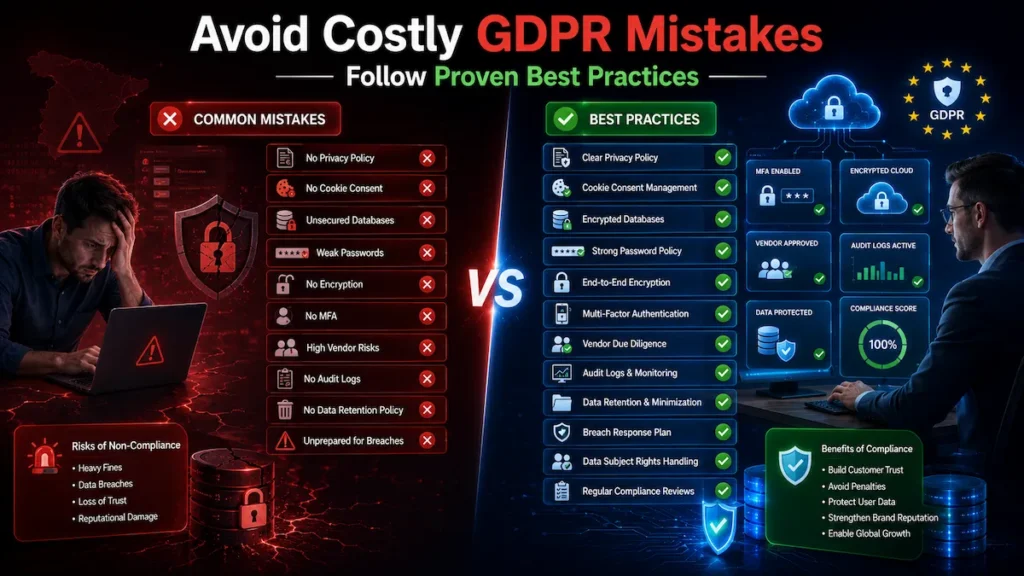
Common GDPR Mistakes SaaS Companies Make in Spain
Avoiding these mistakes makes your Spain GDPR checklist for SaaS easier to maintain over time.
Mistake 1: Treating GDPR as a one-time setup. Products change, vendors update their sub-processors, and regulations evolve. Build quarterly compliance reviews into your operational calendar.
Mistake 2: Pre-checked consent boxes. The AEPD has explicitly fined this practice. Consent must be active, informed, and unambiguous—not implied by inaction.
Mistake 3: Vague retention policies. “We keep data until it’s no longer needed” isn’t a policy. Assign specific retention periods to each data category and document them in your ROPA.
Mistake 4: No process for erasure requests. Many SaaS companies receive an erasure request and discover they have no complete picture of where a user’s data lives across all integrated tools.
Mistake 5: Ignoring sub-processors. Your DPA with a vendor doesn’t automatically protect data that vendor shares with its own vendors. Review sub-processor lists regularly.
Mistake 6: English-only privacy notices for Spanish users. Technically compliant notices in a language users cannot reasonably understand have been flagged by the AEPD as falling short of transparency requirements.
Spain GDPR Quick-Reference Compliance Table
| Requirement | Applies To | Priority |
|---|---|---|
| Privacy Policy (GDPR-specific, in Spanish) | All SaaS | Critical |
| Cookie Consent Management (CMP) | All SaaS with non-essential cookies | Critical |
| Records of Processing Activities (ROPA) | Most SaaS | Critical |
| Data Processing Agreements (DPAs) | All SaaS using third-party vendors | Critical |
| Data Subject Rights (DSR) Process | All SaaS | Critical |
| Data Breach Notification Plan | All SaaS | Critical |
| Encryption, MFA, Access Controls | All SaaS | Critical |
| Cross-Border Transfer Safeguards (SCCs) | US SaaS with EU/Spanish users | Critical |
| EU Representative Appointment | US SaaS processing EU data regularly | Conditional |
| DPIA | SaaS with high-risk processing | Required |
| Data Protection Officer (DPO) | Large-scale or sensitive data processors | Conditional |
Frequently Asked Questions
These answers support practical implementation of a Spain GDPR checklist for SaaS.
Does GDPR apply to US SaaS companies serving Spanish users?
Yes. GDPR applies extraterritorially. If you offer services to people in Spain or monitor their behavior — including through analytics or behavioral tracking — GDPR applies to your company regardless of where you’re incorporated or where your servers are located.
What is the AEPD?
The Agencia Española de Protección de Datos (AEPD) is Spain’s national data protection supervisory authority. It enforces GDPR within Spain, investigates complaints, conducts audits, and issues administrative fines. It is among the most active enforcement bodies in the EU and publishes all enforcement decisions publicly.
How large are GDPR fines in Spain?
Less serious violations can reach €10 million or 2% of global annual turnover. The most serious violations — involving core GDPR principles, consent failures, and data subject rights — can reach €20 million or 4% of global annual turnover, whichever is higher.
What is a Dadata processing agreement in GDPR terms?
A Data Processing Agreement (DPA) is a binding contract between a data controller and a data processor. It specifies how personal data can be used, the processor’s security obligations, sub-processor requirements, and breach notification duties. GDPR Article 28 requires a DPA whenever a controller uses a processor.
Does my SaaS need a cookie consent banner for Spanish users?
Yes. Non-essential cookies require prior, informed, and explicit user consent. The option to reject must be as easy to use as the option to accept. The AEPD has published specific national cookie guidance and has fined companies for making rejection harder than acceptance — including through multi-step rejection flows and implied consent designs.
What’s the difference between a data controller and a data processor?
A data controller determines the purpose and means of processing personal data. A data processor processes data on the controller’s behalf. Many SaaS companies are both a controller for their own users and a processor for their customers’ end-user data.
How long do I have to respond to a data subject rights request?
Respond without undue delay and generally within one month. For complex or multiple requests, you may extend by a further two months — but you must notify the person of the extension within the initial one-month period.
Do US SaaS companies need an EU representative?
Likely yes, if you regularly process EU residents’ data and are not established in the EU. GDPR Article 27 requires a named EU representative based in an EU member state. Regular commercial activity targeting EU customers generally triggers this requirement.
What are Standard Contractual Clauses?
Standard Contractual Clauses (SCCs) are pre-approved contract terms published by the European Commission that provide a legal basis for transferring personal data from the EU to countries without an adequacy decision — including the US. They are the most widely used cross-border transfer mechanism for US SaaS companies.
Does Spain’s LOPDGDD add requirements beyond GDPR?
Yes. Spain’s national implementing law—Ley Orgánica 3/2018—adds provisions around employee data, digital disconnection rights, and minors’ data. The age of digital consent in Spain is 14, lower than the 16 set by some other EU member states. SaaS companies whose products touch employee data or serve younger users need to account for these additional obligations.
Start Your Spain GDPR Compliance Program Today
Working through this Spain GDPR checklist for SaaS is the clearest path to compliance — and to winning enterprise deals in the Spanish market.
Here’s where to start based on your current situation:
If you haven’t started yet: Begin with your privacy policy update and CMP deployment. These are the most visible compliance requirements and the most consistently enforced by the AEPD. Run a vendor audit in parallel to identify which DPAs need to be executed.
If you have basic compliance in place: Conduct a formal data mapping exercise to build or update your ROPA, then run a gap analysis against this checklist. Pay specific attention to cross-border transfer safeguards, EU representative appointment, and breach response documentation—these are the gaps most commonly surfaced during Spanish enterprise procurement.
If you’re preparing for enterprise sales in Spain: Commission a formal GDPR readiness review with outside privacy counsel. Ensure your security documentation — including penetration test results, encryption standards, and access control policies — is in a format you can share with procurement teams. Complete any outstanding DPIAs before the sales process begins.
For compliance tooling at every stage, our comparison of GDPR compliance software for Spanish startups covers the platforms that reduce implementation time and ongoing maintenance burden. Review best GDPR compliance tools for startups for cost-effective options across documentation, consent, and DSR workflows.
For AI-powered SaaS products: start with AI security compliance tools for SaaS startups and AI cloud security solutions for startups before your next product launch. For certification readiness, the best SOC 2 compliance tools for AI startups cover the platforms that bridge SOC 2 and GDPR technical requirements in a single program.
Disclaimer: This article provides educational information about GDPR compliance for informational purposes only. It is not legal advice. GDPR interpretation is complex and fact-specific. Consult a qualified privacy attorney or certified GDPR consultant for advice tailored to your company’s specific situation and processing activities.