
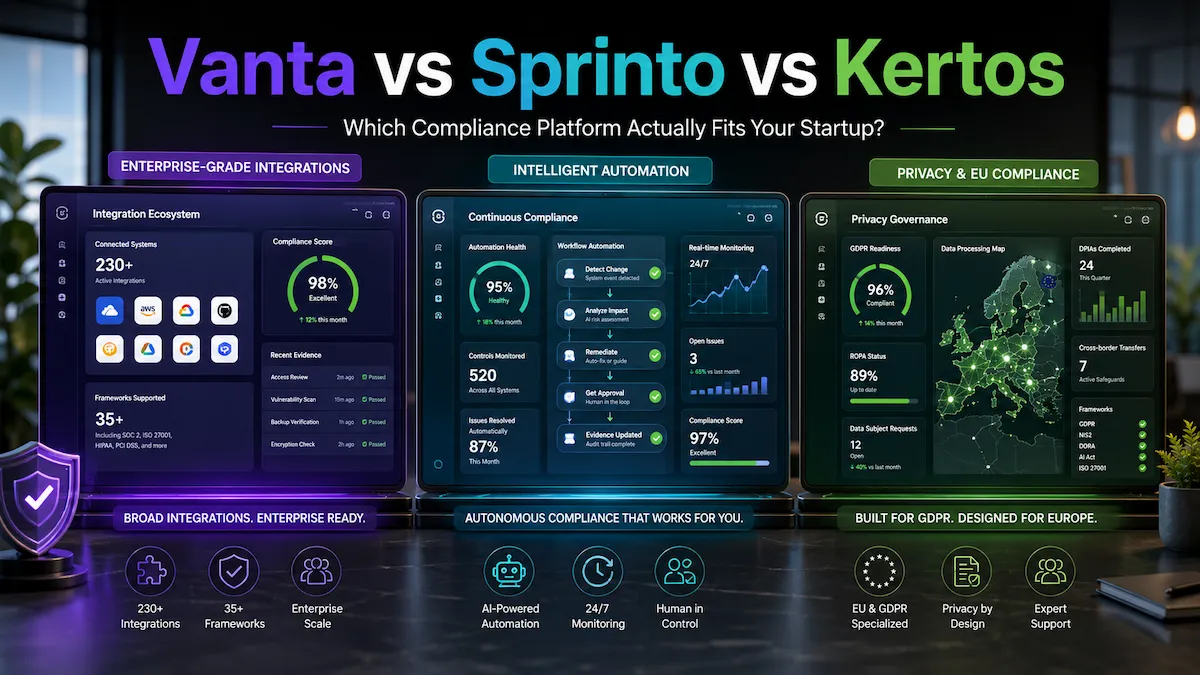
Picking a compliance platform feels like it should be simple. It isn’t. You’re staring down three vendors, three sales calls, three sets of vague pricing, and a deadline from a customer who won’t sign until you have SOC 2 or GDPR sorted.
Get this decision wrong and you’re not just out the license fee. You’re re-implementing controls six months in, retraining your team on a new dashboard, and explaining to your board why the “quick compliance fix” turned into a quarter-long slog.
Vanta vs Sprinto vs Kertos comes down to three genuinely different products built for three different situations: Vanta is the broad, integration-heavy market leader; Sprinto is the leaner, more autonomous alternative that’s closed a lot of the gap; and Kertos is the European specialist that treats GDPR as a first-class citizen instead of an add-on.
This guide breaks down what each of these compliance platforms actually does, what they cost in 2026, and which one fits your company stage.
If you care most about… choose one:
| If you care most about | Choose |
|---|---|
| Lowest implementation friction | Sprinto |
| Broadest integration ecosystem | Vanta |
| Strongest GDPR depth | Kertos |
| Multi-framework enterprise program | Vanta |
| EU market expansion (NIS2, DORA) | Kertos |
| Multi-entity / multi-product company | Sprinto |
| An enterprise buyer expects a named platform | Vanta |
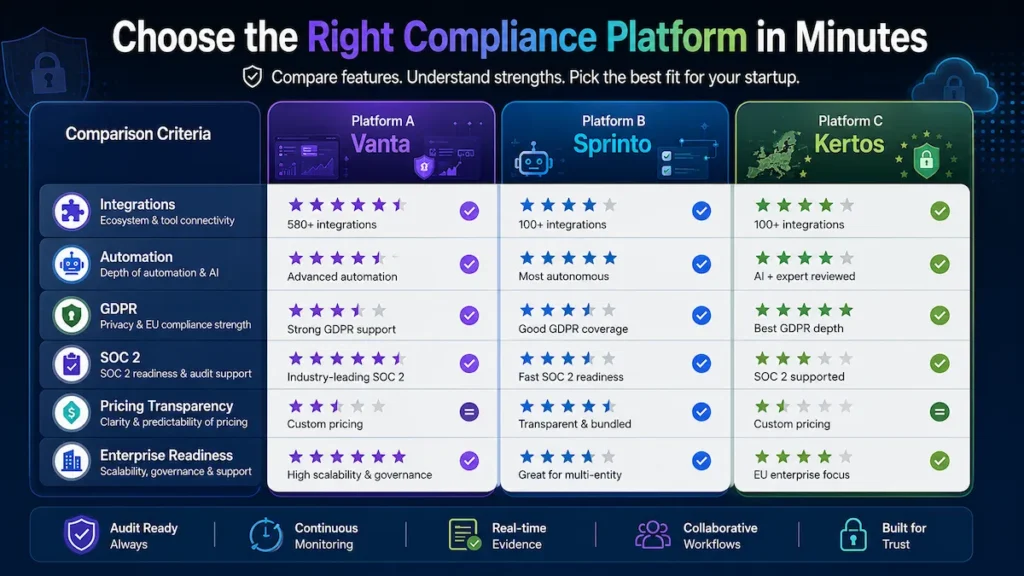
Quick Verdict at a Glance
This Vanta vs Sprinto vs Kertos comparison shows which platform is best for startups based on automation, pricing, compliance coverage, and long-term scalability.
Vanta stands out on integration breadth and market maturity. Sprinto stands out on pricing-to-automation ratio for mid-market SaaS teams. Kertos stands out clearly when GDPR and EU frameworks are the primary driver.
Choose Vanta if…
In this Vanta vs Sprinto vs Kertos comparison, Vanta stands out for organizations that need extensive integrations and enterprise-ready compliance management.
You need the widest possible integration library, you’re chasing enterprise deals that specifically ask for Vanta by name, or you want the platform with the deepest audit firm partner network. Vanta also makes sense if you’ll need multiple frameworks — SOC 2 plus ISO 27001 plus HIPAA — and want one vendor to hold all of them.
Choose Sprinto if…
Vanta vs Sprinto vs Kertos reveals Sprinto as a strong choice for SaaS companies looking for continuous compliance with less manual work.
You want continuous, largely autonomous compliance without paying a premium price, and your team is comfortable with a platform that automates more decisions rather than just flagging them for you. Sprinto’s zone-based structure also makes it a strong fit if you run multiple products or entities under one company.
Choose Kertos if…
When comparing Vanta vs Sprinto vs Kertos, Kertos is the strongest option for businesses focused on GDPR and other European compliance frameworks.
GDPR, not SOC 2, is your actual compliance driver — you’re selling into the EU, storing EU customer data, or you’re a European company yourself. If you’re evaluating your obligations under Spain’s data protection requirements specifically, our Spain GDPR compliance guide covers the regional detail this comparison doesn’t.
What Is the Difference Between These Three Platforms?
Understanding the differences in Vanta vs. Sprinto vs. Kertos helps founders choose a compliance platform that matches their security and regulatory requirements.
Platform Overview
This Vanta vs Sprinto vs Kertos overview explains how each platform approaches compliance automation and audit readiness.
Vanta was founded in 2018 in San Francisco and connects to cloud infrastructure, identity providers, HR systems, and code repositories to run automated tests against compliance frameworks, collect timestamped evidence, and surface a real-time dashboard so that when an auditor arrives, most of the evidence is already packaged. Vanta has consistently ranked among the top-rated platforms in G2’s Security Compliance category through 2026.
Sprinto, founded in 2020, is built around the idea of AI-powered autonomous trust, continuously managing risk and keeping proof of compliance current as the business changes rather than treating compliance as a periodic exercise. It detects changes across systems, understands their impact, and drives next steps while keeping humans in control of key decisions.
Kertos, based in Munich, was built specifically for the European market. It’s an all-in-one compliance platform covering GDPR, AI Act, ISO 27001, NIS2, ISO 42001, TISAX, DORA, SOC 2, and others, combining workflow automation and AI with expert support.
Core Positioning
The Vanta vs Sprinto vs Kertos comparison highlights how each vendor targets different business sizes and compliance priorities.
Vanta positions itself as the broadest trust platform for companies of any size. Sprinto positions itself as the leaner, more automated alternative for cloud-native SaaS teams. Kertos positions itself as the European compliance partner for companies that need EU-specific frameworks handled correctly the first time.
Feature Comparison
A detailed Vanta vs Sprinto vs Kertos feature comparison makes it easier to evaluate automation, integrations, reporting, and governance capabilities.
Compliance Framework Coverage
Vanta vs. Sprinto vs. Kertos supports multiple compliance frameworks, but each platform has different strengths depending on your business goals.
All three cover the core frameworks most startups need first: SOC 2, ISO 27001, and GDPR. Vanta supports 35+ frameworks, including SOC 2, ISO 27001, HIPAA, PCI DSS, GDPR, and FedRAMP. Sprinto covers SOC 2, ISO 27001, HIPAA, GDPR, PCI DSS, and 200+ global standards, with the ability to upload any additional regulation or contract for translation into controls automatically. Kertos covers fewer total frameworks but goes deeper on the EU-specific ones: GDPR, NIS2, DORA, TISAX, and the EU AI Act.
Automation: What Gets Automated
One of the biggest differences in Vanta vs Sprinto vs Kertos is how each platform automates evidence collection, monitoring, and compliance workflows.
Vanta runs automated testing against the AICPA Trust Services Criteria and 35+ other frameworks, collects timestamped evidence continuously, and maintains a real-time compliance dashboard. Its 2026 Agentic Trust Platform update added autonomous policy drafting, questionnaire automation that answers incoming security questionnaires from the existing evidence library, and vendor risk auto-scoring.
Sprinto monitors controls around the clock, and when something drifts, it acts rather than just alerting—closing gaps, refreshing evidence, and routing approval requests automatically.
Kertos uses its AI assistant, KAIA, to automate the creation of policies, risk registers, and RoPAs from the company’s own data and to monitor the tech stack for real-time risk alerts.
Automation: What Still Requires Humans
Even in Vanta vs Sprinto vs Kertos, certain compliance decisions still require human oversight despite advanced automation.
Vanta still needs a human to hire and coordinate with the independent auditor and to make judgment calls on which controls apply to custom or non-standard infrastructure.
Sprinto keeps a human in the approval loop for every remediation it routes — the platform closes gaps and refreshes evidence, but control ownership and final sign-off stay assigned to a person.
Kertos routes anything requiring legal interpretation—a cross-border data transfer, for example—to an accredited human expert rather than resolving it through automation alone.
Integrations
Comparing integrations in Vanta vs Sprinto vs Kertos helps determine which platform fits your existing technology stack.
Vanta leads on raw integration count, with vendor claims running into the hundreds. Sprinto integrates with over 100 third-party tools spanning cloud infrastructure, security, HR, CRM, and project management platforms. Kertos offers over 100 integrations, focused specifically on the systems European compliance and data protection teams use for data mapping.
Monitoring
Vanta vs. Sprinto vs. Kertos all provide continuous monitoring, but each platform prioritizes different compliance controls.
All three run continuous control monitoring rather than point-in-time checks. Vanta and Sprinto both emphasize hourly automated tests. Kertos’s monitoring is oriented around data flows and processing activities, which matters more for GDPR than for SOC 2-style infrastructure checks.
Reporting
Reporting capabilities in Vanta vs. Sprinto vs. Kertos vary depending on audit requirements and regulatory frameworks.
Vanta and Sprinto both offer real-time compliance dashboards and audit-ready reporting exports. Kertos’s reporting is built around demonstrating GDPR accountability specifically—RoPA status, DPIA completion, and data subject request turnaround time.
Team Collaboration
The Vanta vs Sprinto vs Kertos comparison also highlights important differences in collaboration, approvals, and workflow management.
Sprinto’s “zones” let you separate compliance by product line or entity. Vanta supports role-based access and approval workflows at the Plus tier and above. Kertos leans on its expert support layer as much as software collaboration features.

Pricing Comparison
Pricing is often the deciding factor in Vanta vs Sprinto vs Kertos, especially for startups balancing compliance needs with limited budgets.
Pricing Structure
Vanta vs. Sprinto vs. Kertos follow different pricing models, making it important to compare long-term costs rather than entry-level quotes alone.
Vanta pricing ranges from roughly $10,000 to $80,000 per year, with all plans custom-quoted, and Essentials starting around $10,000/year for startups pursuing their first SOC 2 or ISO 27001 certification.
Sprinto also uses custom, sales-quoted pricing. Public pricing research commonly places single-framework Sprinto programs around $6,000 to $8,000 per year for early-stage teams with clean cloud setups, with SOC 2-specific pricing generally in the $8,000 to $10,000 range. Sprinto markets itself as bundled, with no separate charges for individual modules like audit, risk, or vendor management.
Kertos does not publish pricing, and unlike the other two vendors, there isn’t enough third-party contract data publicly available yet to give a reliable range. Quotes are built around frameworks needed, company size, and whether the expert-support tier is included. If pricing certainty matters early, budget for a sales conversation rather than assuming a number.
Cost Predictability
Cost predictability is another important factor when evaluating Vanta vs Sprinto vs Kertos for long-term compliance planning.
All-in first-year compliance spend for a startup-scale SOC 2 program commonly lands at $30,000–$65,000 once audit fees are included, regardless of platform. Sprinto’s bundled approach tends to produce fewer surprise add-on costs, though multi-entity organizations running isolated “zones” typically see quotes of $15,000 to $18,000 annually. Kertos’s pricing remains the least transparent of the three simply because it isn’t commonly benchmarked yet.
Growth Economics
Vanta scales cleanly for teams adding frameworks one at a time who want a recognized name for auditors and enterprise buyers. Sprinto scales well for teams expecting to run multiple frameworks off a shared control set without per-module fees. Kertos scales specifically well if growth runs through the EU, since frameworks like NIS2 or DORA build on the same GDPR foundation.
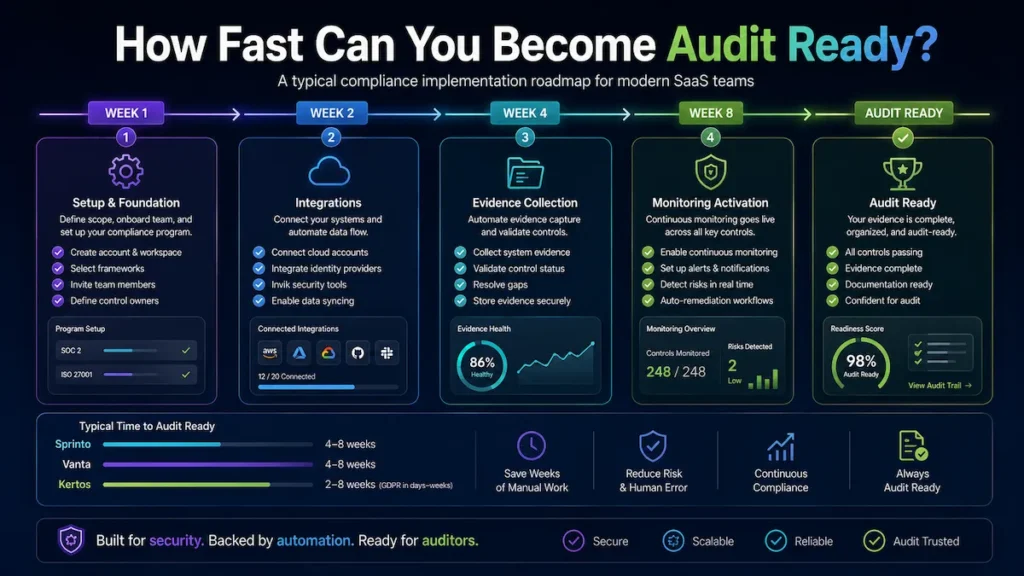
How Long Does Implementation Take?
Implementation timelines in Vanta vs Sprinto vs Kertos vary based on infrastructure complexity, framework scope, and internal readiness.
| Platform | Typical Time to Audit-Ready |
|---|---|
| Vanta | 4–8 weeks for SOC 2 Type I with an engaged team; 2–4 months for full audit-ready compliance across frameworks |
| Sprinto | Similar 4–8 week range for SOC 2 Type I, with several reviewers citing faster onboarding |
| Kertos | GDPR readiness in days to weeks per vendor claims; ISO 27001 certification reported by customers in roughly 2.5 months |
These figures assume a reasonably clean tech stack and an internal owner actively working through onboarding.
GDPR Compliance: How the Three Compare
This Vanta vs Sprinto vs Kertos comparison shows how each platform approaches GDPR automation, governance, and documentation.
Kertos’s GDPR automation is the most purpose-built of the three: RoPA generation, TOM documentation, and DPIA workflows are core product features, not translated from a SOC 2-first architecture. It also automates transfer impact assessments by identifying data flows outside the EU and allows companies to add an external data protection officer at any time. Vanta and Sprinto both pull technical evidence—access logs, encryption status, and configuration states—that supports GDPR’s technical measures but rely more heavily on self-service governance beyond that.
SOC 2: How the Three Compare
Vanta vs. Sprinto vs. Kertos offers different levels of SOC 2 automation, auditor support, and continuous monitoring.
Vanta has the deepest SOC 2 track record of the three, with the largest auditor partner network. Sprinto has closed much of that gap and is frequently cited for faster onboarding. Kertos supports SOC 2, but it isn’t the platform’s primary strength—its engineering priority has been ISO 27001 and GDPR, so SOC 2-specific test coverage is narrower.
Comparison Scorecard
This Vanta vs Sprinto vs Kertos scorecard summarizes the strongest platform across the most important buying criteria.
| Category | Winner |
|---|---|
| Integrations | Vanta |
| Automation depth | Sprinto |
| GDPR readiness | Kertos |
| Pricing transparency | Sprinto |
| Enterprise fit | Vanta |
| EU regulatory breadth | Kertos |
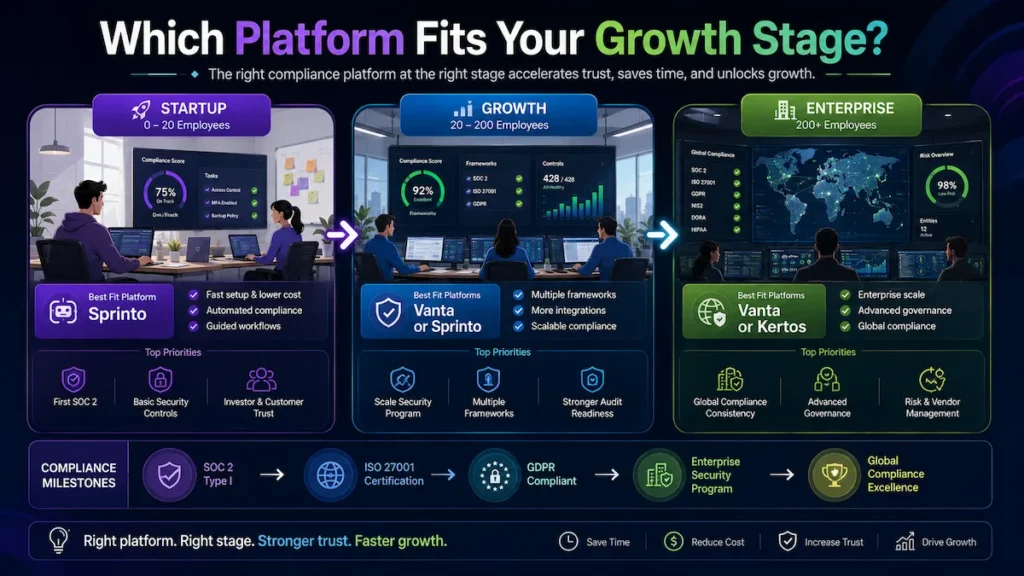
Which Platform Fits Your Company Stage?
Choosing between Vanta vs. Sprinto vs. Kertos also depends on your company’s current growth stage and future compliance roadmap.
Early Startup: If you’re a US-based startup chasing your first SOC 2 to unblock an enterprise deal, Sprinto’s lower entry pricing and faster setup usually make more sense than a premium platform. If GDPR is your actual driver, Kertos is worth a serious look even at this stage.
Growth Stage: Once you’re managing two or more frameworks and need broader integration coverage, Vanta’s Plus tier or Sprinto’s Professional tier both become reasonable. This is also the stage where Kertos becomes a strong option if you’re expanding into the EU market.
Enterprise: Vanta’s integration depth and auditor relationships give it an edge for globally distributed compliance programs. Kertos remains the stronger pick for enterprises whose obligations are primarily EU-driven.
Pros and Cons
Reviewing the strengths and weaknesses of Vanta vs Sprinto vs Kertos helps you make a more informed purchasing decision.
Vanta
- Pros: broadest integrations, largest auditor network, strong brand recognition with enterprise buyers
- Cons: highest cost, add-ons, and per-framework fees can push real spend well above the advertised price
Sprinto
- Pros: strong automation-to-price ratio, bundled pricing with fewer surprise fees, good for multi-entity companies
- Cons: pricing still requires a sales call; some integrations need engineering time to configure properly
Kertos
- Pros: purpose-built GDPR and EU framework automation, expert support included, strong fit for European compliance obligations
- Cons: pricing isn’t publicly benchmarked; narrower SOC 2 depth compared to the other two; smaller integration library
Who Should NOT Choose Each Platform
Vanta vs. Sprinto vs. Kertos isn’t about finding a universal winner—it’s about avoiding the platform that doesn’t fit your business.
Avoid Vanta if your compliance need is purely GDPR-driven with no US enterprise buyer requiring SOC 2. Also avoid it if budget is the primary constraint at the earliest stage.
Avoid Sprinto if you need the absolute deepest bench of auditor relationships for a complex, multi-framework enterprise program or if your team needs heavy customization of controls beyond a more structured, guided platform.
Avoid Kertos if SOC 2 is your only compliance requirement with no EU data protection exposure or if pricing transparency matters to you before a sales call.
Alternatives Worth Evaluating
If Vanta vs Sprinto vs Kertos doesn’t fully meet your needs, several other compliance platforms are also worth considering.
Drata is a direct competitor to Vanta with similarly broad framework coverage, priced roughly $7,500 to $100,000+ per year depending on the plan and framework count.
Secureframe — generally positioned as a lower-cost alternative, starting around $7,500 and running past $80,000 depending on scope.
Scytale — the most advisory-heavy alternative, bundling software with dedicated human compliance experts. Its Build tier starts around $7,500 per year, with year-one all-in cost for a 50-person SaaS typically running $30,000–$55,000, including platform, advisory, and audit. It supports 30+ frameworks, including ISO 42001, which has become a purchasing criterion for enterprise buyers of AI-powered software.
Common Mistakes When Choosing Compliance Software
Many businesses comparing Vanta vs Sprinto vs Kertos make avoidable mistakes that increase costs and delay compliance
The most common mistake is picking based on brand recognition alone, without checking whether the actual framework mix is better served by a different vendor. The second is treating platform price as total cost—none of these vendors perform the audit itself. The third is underestimating integration setup time.
Decision Framework
Use this Vanta vs Sprinto vs Kertos decision framework to identify the platform that best aligns with your compliance priorities.
Ask in order: What’s your primary framework — SOC 2 or GDPR? What’s your budget ceiling, including the audit? Do you need multiple entities managed separately? Does your buyer expect a named platform on your security page? Four honest answers usually narrow this to one option.
Frequently Asked Questions
These frequently asked questions answer the most common concerns people have when researching Vanta vs Sprinto vs Kertos.
Does the platform itself perform the audit?
No. All three prepare evidence and automate controls, but you still hire an independent auditor separately.
Which platform is cheapest for a first SOC 2?
Public pricing research suggests Sprinto’s entry-level pricing tends to run lower than Vanta’s. Kertos doesn’t publish comparable figures.
Is Kertos only for European companies?
No, but it’s built around EU frameworks, so it’s most relevant if GDPR, NIS2, DORA, or TISAX apply to your business.
Can I switch platforms later without losing my compliance work?
Generally yes, though migrating evidence and control mappings take time.
How fast can I actually get SOC 2 Type I done?
Realistic timelines run 4–8 weeks with an actively engaged team, depending on how clean your infrastructure already is.
Do these platforms replace the need for a compliance hire?
They reduce the workload but don’t eliminate the need for someone accountable internally.
Final Verdict
There’s no universal winner among these three compliance platforms. Vanta remains the safest default for the most recognized platform and broadest integration library. Sprinto is a strong value play for SOC 2-focused SaaS teams wanting continuous automation without a premium price tag. Kertos may be the stronger fit the moment GDPR, not SOC 2, is the framework that matters most—particularly for companies selling into or operating within the EU. For a broader look at GDPR-specific tooling beyond these three vendors, see our roundup of GDPR compliance tools for startups, and if SOC 2 is your priority for an AI product specifically, our SOC 2 compliance tools for AI startups cover that ground.