
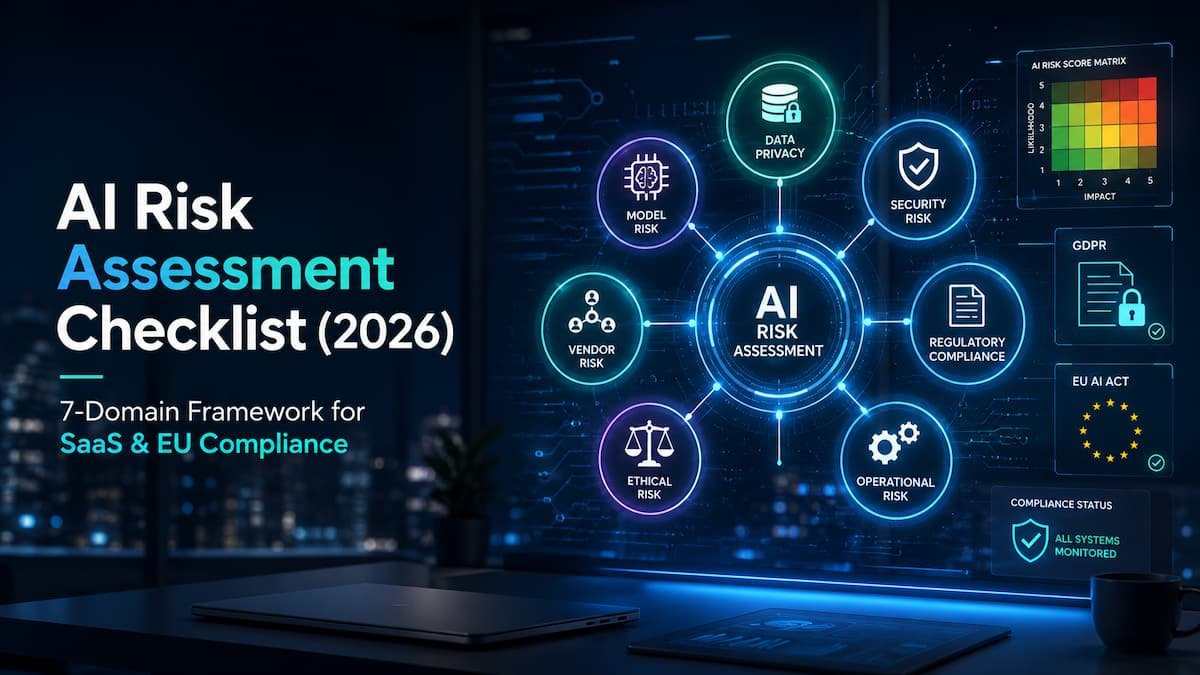
Last Updated: August 2026 · Reviewed by Irfan Ullah, Founder of TrusteraAI and creator of the TrusteraAI AI Risk Assessment Framework™. Irfan writes about AI governance, GDPR compliance, and cybersecurity strategy for SaaS founders serving Spain and the broader EU — see his Enterprise AI Security Checklist and AI Governance Checklist for related frameworks.
Quick Answer: An AI risk assessment checklist is a structured tool for identifying, scoring, and mitigating risk across an AI system before deployment and throughout its lifecycle. A complete checklist covers seven risk domains — data privacy, model, security, regulatory compliance, operational, ethical, and vendor risk — mapped to frameworks like the NIST AI Risk Management Framework, ISO/IEC 42001, the EU AI Act, and, for any system touching EU or Spain-based personal data, GDPR.
AI adoption is outpacing formal risk assessment at most organizations. A Gartner survey found that 69% of organizations already suspect or have direct evidence of employees using unsanctioned generative AI tools, and IBM’s 2025 Cost of a Data Breach Report found that breaches involving shadow AI cost organizations $670,000 more on average than standard breaches ($4.63M vs. $3.96M) — and that shadow AI was a factor in 20% of all breaches studied. A structured assessment is how you close that gap before it becomes an incident.
What Is an AI Risk Assessment Checklist?
Quick Answer: An AI risk assessment checklist is a structured set of questions and controls used to identify, evaluate, and score the risks an AI system introduces — before it’s deployed, and on a recurring basis afterward.
Unlike a general cybersecurity checklist, an AI risk assessment checklist accounts for risks unique to AI systems: model drift, training data bias, hallucinated outputs, prompt injection, and the growing regulatory weight of frameworks like the EU AI Act. It’s a living artifact, not a one-time form — revisited whenever a system changes, a new AI tool enters procurement, or a regulation shifts.
For organizations building AI-powered SaaS products for customers in Spain or the broader EU, this checklist carries extra weight: it needs to satisfy internal risk management and GDPR’s accountability principle and the EU AI Act’s risk-classification requirements, all at once.
AI Risk Assessment vs. AI Security Checklist vs. AI Risk Management
Quick Answer: An AI risk assessment covers the full risk landscape; an AI security checklist is one narrower input focused on technical controls; AI risk management is the ongoing program both feed into.
| AI Risk Assessment | AI Security Checklist | AI Risk Management | |
|---|---|---|---|
| Scope | Privacy, model, security, compliance, operational, ethical, vendor | Technical security controls only | Full governance program |
| Compliance coverage | GDPR, EU AI Act, sector rules | Limited — security frameworks only | Policy-level, spans all domains |
| Vendor risk focus | Full domain (Domain 7) | Limited to vendor security review | Ongoing vendor oversight |
| Output | Scored risk profile per system | Control checklist per system | Owned risk register + policies |
| Best used | Before deployment, periodic review | Alongside the risk assessment, for technical depth | Continuously |
For the technical security controls this assessment references in Domain 3, see our Enterprise AI Security Checklist — the two are designed to be used together, not as substitutes for each other.
Who Needs This Checklist?
Quick Answer: Any organization that builds, buys, or integrates AI systems — particularly SaaS companies serving regulated markets like the EU — needs a formal AI risk assessment process before deployment.
- SaaS founders integrating AI features into their product, especially those selling to EU or Spain-based customers
- CISOs and security leaders evaluating AI tools before procurement
- Compliance and privacy officers mapping AI risk to GDPR and the EU AI Act
- AI governance teams building or maturing a formal risk register — see our AI Governance Checklist for SaaS Founders for the broader program this feeds into
- Startups without a dedicated risk function — the framework scales down just as easily as it scales up
If your AI system touches personal data, makes or influences decisions about people, or is being evaluated by an enterprise customer during procurement, you need this — not just AI-native companies.
The TrusteraAI AI Risk Assessment Framework™
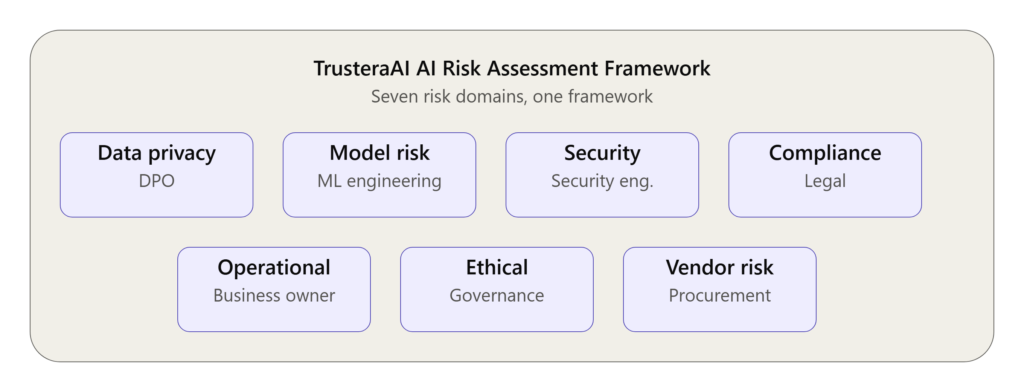
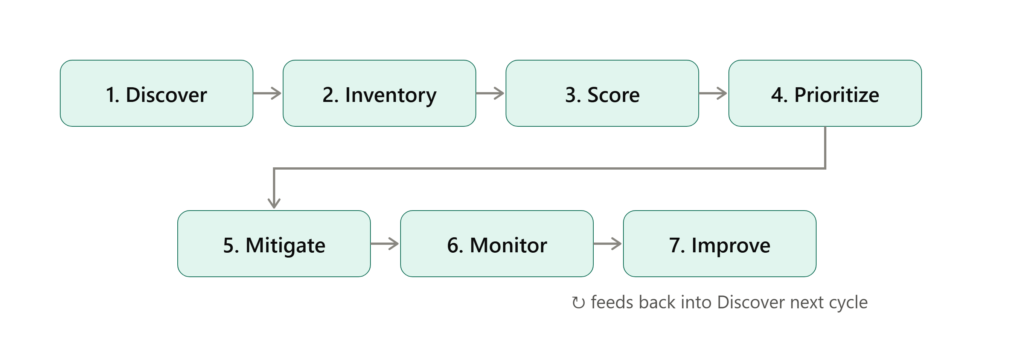
Quick Answer: The TrusteraAI AI Risk Assessment Framework™ organizes AI risk into seven domains, applied through a repeatable seven-phase lifecycle — Discover, Inventory, Score, Prioritize, Mitigate, Monitor, Improve — so no category of exposure gets missed and no assessment becomes a one-time exercise.
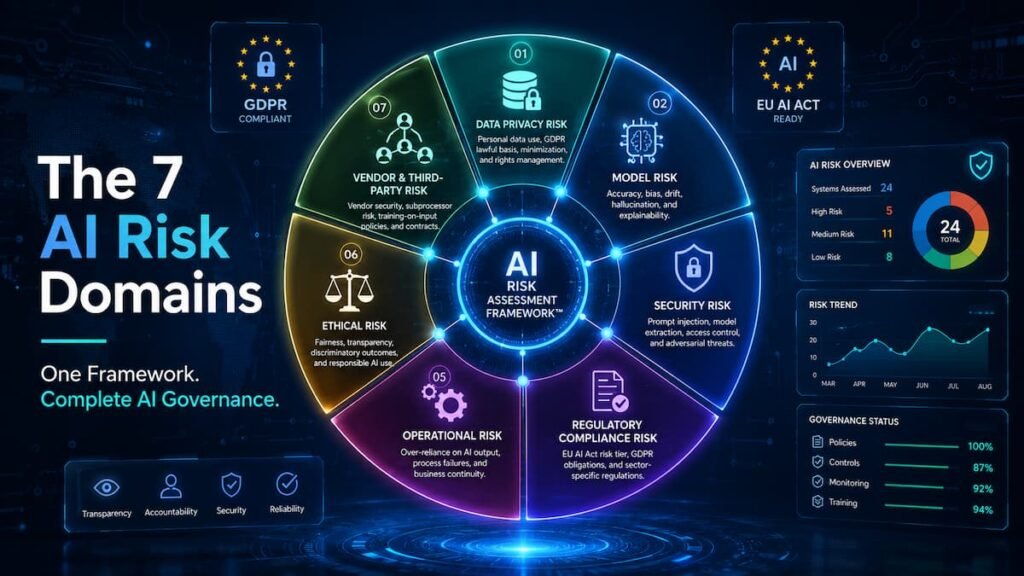
The Seven Risk Domains
| Domain | What It Covers | Primary Owner |
|---|---|---|
| 1. Data Privacy Risk | Personal data use, GDPR lawful basis, data minimization, DSARs, cross-border transfers | Privacy Officer / DPO |
| 2. Model Risk | Accuracy, bias, drift, hallucination, explainability | AI/ML Engineering |
| 3. Security Risk | Prompt injection, model extraction, adversarial inputs, access control | Security Engineering |
| 4. Regulatory Compliance Risk | EU AI Act risk tier, GDPR obligations, sector-specific rules | Legal / Compliance |
| 5. Operational Risk | Over-reliance on AI output, process failure, business continuity | Business Unit Owner |
| 6. Ethical Risk | Discriminatory outcomes, fairness across user groups | AI Governance Committee |
| 7. Vendor & Third-Party Risk | Supply chain exposure, subprocessor risk, training-on-input policies | Procurement / Legal |
The Seven-Phase Assessment Lifecycle
Running the seven domains once isn’t enough — this is how they get applied on a recurring cycle:
- Discover — Identify every AI system in use, including shadow AI not formally approved
- Inventory — Document each system’s purpose, data touched, and vendor relationship
- Score — Assess every system across all seven domains using the Likelihood × Impact matrix below
- Prioritize — Rank findings by risk score; flag anything crossing the DPIA or EU AI Act high-risk threshold
- Mitigate — Assign named owners and deadlines for every High or Critical finding
- Monitor — Track model drift, new incidents, and control effectiveness on an ongoing basis
- Improve — Feed findings back into policy, vendor selection, and the next assessment cycle
This structure is deliberately compatible with the domains used in our Enterprise AI Security Checklist and Enterprise AI Governance Framework — so if you’ve already implemented either, this assessment slots directly into your existing governance structure rather than duplicating it.
Risk Classification & Quantitative Scoring
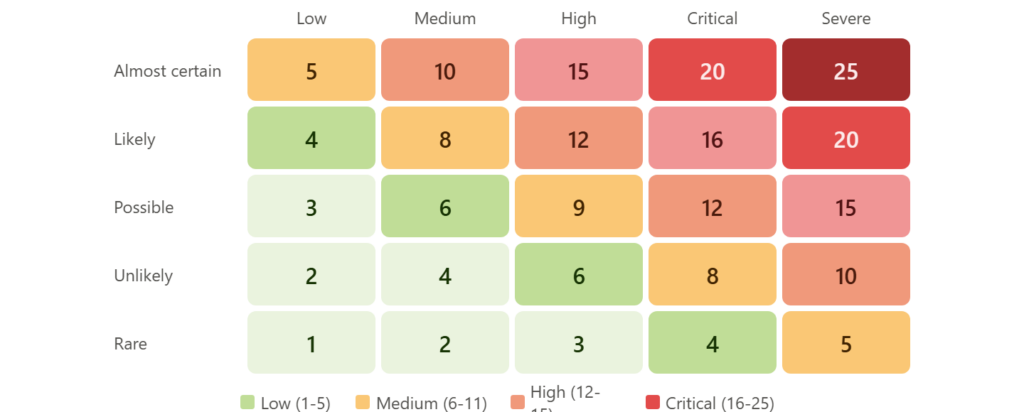
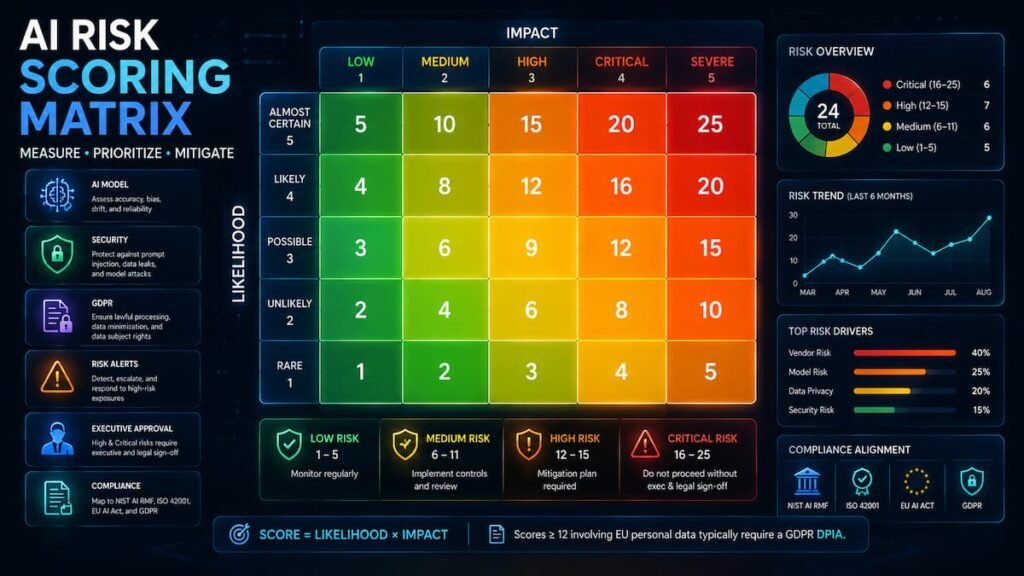
Quick Answer: Score each identified risk using a Likelihood × Impact matrix (1–5 scale each), producing a risk score from 1–25. Scores above 12 that also involve EU personal data typically require a GDPR Data Protection Impact Assessment (DPIA) in addition to this checklist.
Impact Levels
| Level | Score | Description | Example |
|---|---|---|---|
| Low | 1 | Minimal impact on operations | Minor formatting error in AI-generated draft |
| Medium | 2 | Manageable, limited disruption | Delayed customer response due to AI queue error |
| High | 3 | Significant, requires prompt attention | Incorrect AI-generated pricing shown to customers |
| Critical | 4 | Major business disruption | Service outage caused by model failure |
| Severe | 5 | Catastrophic consequences | Personal data breach via prompt leakage |
Likelihood Levels
| Level | Score | Description |
|---|---|---|
| Rare | 1 | Very unlikely to occur |
| Unlikely | 2 | Low probability |
| Possible | 3 | Moderate probability |
| Likely | 4 | High probability |
| Almost Certain | 5 | Very high probability, already observed |
Risk Score Matrix
| Likelihood ↓ / Impact → | Low (1) | Medium (2) | High (3) | Critical (4) | Severe (5) |
|---|---|---|---|---|---|
| Almost Certain (5) | 5 | 10 | 15 | 20 | 25 |
| Likely (4) | 4 | 8 | 12 | 16 | 20 |
| Possible (3) | 3 | 6 | 9 | 12 | 15 |
| Unlikely (2) | 2 | 4 | 6 | 8 | 10 |
| Rare (1) | 1 | 2 | 3 | 4 | 5 |
Interpreting Your Score — and the Spain/EU Trigger
| Score Range | Status | Action | GDPR / EU AI Act Trigger |
|---|---|---|---|
| 1–5 | Low Risk | Document and proceed with standard monitoring | None |
| 6–11 | Medium Risk | Implement controls, review regularly | Review whether GDPR Article 35 DPIA criteria are met |
| 12–15 | High Risk | Mitigation plan required before proceeding | DPIA typically required if EU personal data is involved |
| 16–25 | Critical Risk | Do not proceed without executive and legal sign-off | Likely EU AI Act high-risk classification; DPIA mandatory if personal data involved |
The EU AI Act sets fines of up to €35 million or 7% of global annual turnover for prohibited AI practices — the highest of three penalty tiers under Article 99. Mid-tier violations (most high-risk system failures) carry fines up to €15 million or 3% of turnover.
The Complete AI Risk Assessment Checklist (7 Domains)
1. Data Privacy Risk
- All personal data used in training, fine-tuning, or prompts is documented in a data inventory
Evidence to retain: timestamped data inventory export - A lawful basis under GDPR is identified for each AI processing activity involving personal data
Evidence to retain: documented lawful-basis assessment per processing activity - Data minimization is applied — AI systems receive only the data fields necessary for the task
Evidence to retain: data flow diagram showing fields sent to the AI system - A defined process exists for handling Data Subject Access Requests (DSARs) involving AI-processed data
Evidence to retain: DSAR procedure document + sample response log - Cross-border data transfer mechanisms (SCCs, adequacy decisions) are documented
Evidence to retain: signed SCCs or documented adequacy decision reference - A DPIA has been completed for high-risk AI processing activities
Evidence to retain: completed DPIA report with sign-off
2. Model Risk
- Model outputs are evaluated for accuracy against a defined benchmark before release
Evidence to retain: benchmark testing report with pass/fail criteria - Bias testing has been conducted across relevant user demographics
Evidence to retain: bias testing results by demographic segment - Model drift monitoring is in place for systems already in production
Evidence to retain: drift monitoring dashboard or alert configuration - Explainability documentation exists for any AI system materially affecting user outcomes
Evidence to retain: model explainability report or documentation - Model versioning and rollback capability are in place
Evidence to retain: version control log and rollback procedure
3. Security Risk
- Prompt injection defenses are implemented for user-facing AI applications (OWASP Top 10 for LLM Applications)
Evidence to retain: input validation test results - Model access follows least-privilege principles
Evidence to retain: access control policy + permissions audit - Adversarial robustness testing has been performed before deployment
Evidence to retain: red-team/adversarial testing report - Rate limiting and query monitoring reduce model extraction/inversion risk
Evidence to retain: monitoring dashboard configuration or logs - Output filtering catches unsafe or non-compliant content before it reaches users
Evidence to retain: output filtering rules + sample flagged outputs
4. Regulatory Compliance Risk
- The AI system’s EU AI Act risk tier (unacceptable, high, limited, minimal) has been determined
Evidence to retain: documented risk-tier classification with rationale - GDPR obligations — lawful basis, transparency, data subject rights — are mapped for this system
Evidence to retain: GDPR obligations mapping document - Sector-specific regulatory requirements (HIPAA, financial services rules, etc.) have been checked
Evidence to retain: sector-specific compliance review notes - Legal/compliance sign-off is documented before high-risk systems reach production
Evidence to retain: signed legal/compliance approval record - Technical documentation required under EU AI Act Article 11 is maintained and current
Evidence to retain: Article 11 technical documentation file
5. Operational Risk
- A human-in-the-loop review step exists for high-stakes AI decisions
Evidence to retain: documented human-review workflow - A fallback/manual process exists if the AI system fails or is unavailable
Evidence to retain: business continuity/fallback procedure document - Staff are trained on the system’s known limitations and failure modes
Evidence to retain: training records or completion log - Business continuity impact has been assessed if the AI vendor discontinues service
Evidence to retain: vendor dependency risk assessment
6. Ethical Risk
- Output fairness has been evaluated across different user groups
Evidence to retain: fairness evaluation report by user segment - A process exists for users to contest or appeal AI-influenced decisions
Evidence to retain: documented appeals/contestation procedure - Disclosure to users that they are interacting with AI is clear and accessible
Evidence to retain: screenshot or copy of user-facing AI disclosure - Ethical review is required before deploying AI in sensitive use cases (hiring, credit, healthcare)
Evidence to retain: ethical review sign-off for sensitive use cases
7. Vendor & Third-Party Risk
- A formal AI vendor security assessment is completed before contract signature
Evidence to retain: completed vendor security assessment report - The vendor’s subprocessor list and data-handling terms have been reviewed
Evidence to retain: reviewed subprocessor list + data processing agreement - The vendor’s training-on-input policy is documented
Evidence to retain: vendor’s written training-on-input policy or contract clause - A fallback option exists if the AI vendor experiences an outage or is discontinued
Evidence to retain: documented vendor contingency plan - Incident notification terms are contractually defined
Evidence to retain: contract clause specifying incident notification timelines
Want this as a fillable spreadsheet? Explore our AI Governance Resource Library to track every system against this checklist in one place.
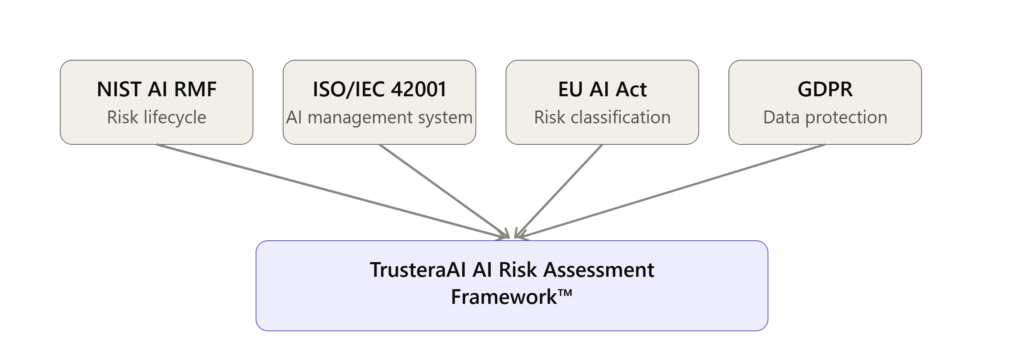
Framework Mapping: NIST, ISO 42001, EU AI Act & GDPR
| Framework | Primary Focus | Relevance to This Checklist |
|---|---|---|
| NIST AI Risk Management Framework | Risk-based lifecycle guidance (Govern, Map, Measure, Manage) | Provides the govern/map/measure/manage structure this checklist operationalizes |
| ISO/IEC 42001 | AI management system standard | Formal certification path; this checklist supports the required AI impact assessment |
| EU AI Act | AI risk classification and legal obligations | Domain 4 directly determines your system’s risk tier and resulting obligations |
| GDPR | Data protection and lawful processing | Domain 1 operationalizes GDPR’s accountability and data minimization principles for AI |
Domain-Level Framework Mapping
For teams that need to trace each domain back to a specific clause or article for audit purposes:
| Domain | NIST AI RMF Function | ISO/IEC 42001 Clause | EU AI Act Reference |
|---|---|---|---|
| 1. Data Privacy Risk | Map | Clause 8.3 (Data for AI systems) | Art. 10 (Data governance) |
| 2. Model Risk | Measure | Clause 8.4 (AI system design/development) | Art. 15 (Accuracy, robustness) |
| 3. Security Risk | Manage | Clause 8.9 (Information security for AI) | Art. 15 (Cybersecurity) |
| 4. Regulatory Compliance Risk | Govern | Clause 5 (Leadership) + Clause 9 (Performance evaluation) | Art. 6, Art. 16 (Risk classification, provider obligations) |
| 5. Operational Risk | Manage | Clause 8.6 (AI system operation) | Art. 14 (Human oversight) |
| 6. Ethical Risk | Measure | Clause 8.4 (Impact assessment) | Recital 27, Art. 5 (Prohibited practices) |
| 7. Vendor & Third-Party Risk | Govern | Clause 8.2 (Third-party/supplier relationships) | Art. 16, Art. 25 (Provider/deployer obligations) |
For the security-specific controls that complement this assessment, see our Enterprise AI Security Checklist; for the broader governance program this checklist feeds into, see our AI Governance Checklist for SaaS Founders and Enterprise AI Governance Framework.
Enterprise Scenario: Applying the Checklist
Scenario: A US-based SaaS company adds an AI-powered onboarding assistant to its product, used by customers across the US, Spain, and the broader EU.
Initial assessment (Week 1):
| Risk Identified | Domain | Initial Score | Why |
|---|---|---|---|
| Assistant processes customer names and emails in prompts | Data Privacy | 15 (High) | Likely (4) × High (3) — personal data sent to a third-party LLM API with no lawful basis documented |
| Occasional hallucinated onboarding steps | Model | 9 (Medium) | Possible (3) × High (3) — no benchmark testing had been run |
| No formal vendor review of underlying LLM provider | Vendor | 16 (Critical) | Almost Certain (4) × Critical (4) — vendor contract signed before any AI-specific review |
| No EU AI Act risk tier determined | Compliance | 16 (Critical) | Almost Certain (4) × Critical (4) — no legal review had taken place at all |
Controls implemented (Weeks 2–8):
- Data Privacy: DPIA completed, lawful basis (legitimate interest, documented) established, data minimization applied to strip unnecessary fields from prompts
- Model: Benchmark testing added; human review required for any onboarding step involving billing or account changes
- Vendor: Formal AI vendor security assessment completed; subprocessor list and training-on-input policy obtained and reviewed
- Compliance: Legal review classified the system as limited-risk under the EU AI Act; transparency disclosure added to the onboarding flow
Re-assessment (Week 9):
| Risk | Domain | Revised Score | Status |
|---|---|---|---|
| Data exposure in prompts | Data Privacy | 4 (Low) | Documented, standard monitoring |
| Hallucinated onboarding steps | Model | 3 (Low) | Documented, standard monitoring |
| Vendor risk | Vendor | 6 (Medium) | Controls in place, quarterly review scheduled |
| EU AI Act compliance | Compliance | 4 (Low) | Classification documented, disclosure live |
Business outcome: The nine-week remediation cycle moved two Critical-risk findings and one High-risk finding down to Low or Medium — closing the gap before the feature’s EU launch rather than after an incident forced it. The documented DPIA and vendor assessment also became reusable evidence for the company’s next enterprise security questionnaire, cutting review time on a subsequent deal.
This is the same underlying methodology used in the healthcare scenario in our Enterprise AI Security Checklist, applied here to a Spain/EU customer base. For the regulatory-inspection side of this same scenario, see our AEPD Inspection Guide.
AI Risk Assessment vs. DPIA — Do You Need Both?
Quick Answer: Yes, typically. An AI risk assessment is broader and covers model, security, and operational risk; a DPIA is a GDPR-specific legal requirement focused narrowly on data protection risk. High-scoring systems under this checklist that touch EU personal data usually need both.
This is a common point of confusion, and one most generic AI risk assessment content — written from a US or non-EU perspective — never addresses. A DPIA is a legal obligation under GDPR Article 35 for processing likely to result in high risk to individuals. This checklist’s Domain 1 scoring is designed to flag exactly when that threshold is likely met. For Spain-specific regulatory context, see our Spain GDPR Checklist for SaaS.
Implementation Roadmap
| Phase | Timeframe | Key Activities |
|---|---|---|
| 1. Discover & Inventory | Weeks 1–2 | List every AI system in use or planned, including shadow AI |
| 2. Score | Weeks 2–4 | Score every system across all 7 domains |
| 3. Prioritize | Week 4 | Rank findings by risk score; flag DPIA triggers |
| 4. Mitigate | Weeks 4–10 | Assign owners, implement controls for High/Critical items |
| 5. Monitor & Improve | Quarterly | Re-score, update the risk register, reassess new systems |
Not sure where your organization currently stands? Our AI Governance Readiness Assessment gives you a scored starting point in under 5 minutes.
Common Mistakes to Avoid
- Treating this as a one-time exercise instead of a recurring process tied to a review cadence
- Assessing security risk thoroughly while skipping privacy, ethical, or vendor risk entirely
- Scoring risk without a documented threshold for what triggers a DPIA or legal review
- Assuming a vendor’s general security certification (SOC 2, ISO 27001) covers AI-specific risk — it doesn’t
- No named owner per domain, leaving findings undocumented and unactioned
Best Practices
- Assemble a cross-functional team (security, legal, privacy, a business owner) for any Medium-risk-or-above assessment
- Document evidence for every scored item — an auditor or enterprise customer will ask to see it
- Tie every High or Critical score to a named remediation owner and deadline
- Re-run the assessment on any material change: new AI vendor, new data type, regulatory update
- Keep completed assessments on file as audit evidence, not just as a checklist that gets discarded after use
Key Takeaways
✅ A complete AI risk assessment covers seven domains, not just security — privacy, model, compliance, operational, ethical, and vendor risk all need a formal score.
✅ Quantitative scoring (Likelihood × Impact) turns a checklist into a prioritization tool, not just a form.
✅ For Spain- and EU-facing SaaS companies, a High or Critical score involving personal data is a strong signal a formal DPIA is also required under GDPR.
✅ Every checklist item now includes the evidence an auditor or enterprise customer will expect to see — turning this from a checklist into an audit-ready framework.
✅ This checklist complements, not replaces, your broader AI Governance Checklist and AI Security Checklist.
Frequently Asked Questions
What is an AI risk assessment checklist?
A structured tool covering data privacy, model, security, compliance, operational, ethical, and vendor risk domains, used to identify and score AI-related risk before deployment and on a recurring basis afterward.
How is this different from an AI security checklist?
An AI security checklist focuses narrowly on technical security controls. An AI risk assessment checklist is broader, covering privacy, ethics, compliance, and vendor risk alongside security — see the comparison table above.
Do I need an AI risk assessment if I only use third-party AI tools, not build my own models?
Yes. Vendor and third-party risk (Domain 7) is one of the seven domains specifically because most organizations use AI through vendors rather than building models in-house.
How often should an AI risk assessment be repeated?
At minimum quarterly for systems already in production, and immediately before deploying any new AI system or making a material change to an existing one.
What score triggers a mandatory GDPR DPIA?
There’s no universal numeric threshold in GDPR itself, but any system scoring 12 or higher on this checklist’s matrix that processes EU personal data should be evaluated against the Article 35 DPIA criteria — high volume of sensitive data, systematic monitoring, or automated decision-making with legal effect are the clearest triggers.
Who should own the AI risk assessment process?
Typically the same AI governance owner or committee responsible for the broader governance program, with input from legal, privacy, and the relevant business unit.
Can startups use a lightweight version of this checklist?
Yes. A startup’s version can focus on the highest-risk domains first — data privacy and vendor risk are usually the most urgent — and expand to all seven domains as the AI footprint grows.
What evidence should we retain for each checklist item?
Each of the 27 checklist items above specifies the exact evidence to retain — from data inventory exports to signed vendor assessments — so a completed checklist doubles as an audit trail, not just a point-in-time snapshot.