
Most AI security assessment guides are written for a Fortune 500 CISO with a twelve-person GRC team and a red-team budget. If you’re a founder running a lean SaaS team that happens to sell into Spain, France, or Germany, none of that maps to your Monday morning.
You don’t need a six-phase enterprise framework borrowed from a security vendor’s product page. You need a way to know, in plain terms, where your AI features could create legal exposure, a breach, or friction in an EU customer’s procurement process — and what to fix first.
This guide gives you that process: a practical AI security risk assessment built for resource-constrained SaaS teams with cross-border exposure, using a framework we call the Cross-Border AI Risk Stack™.
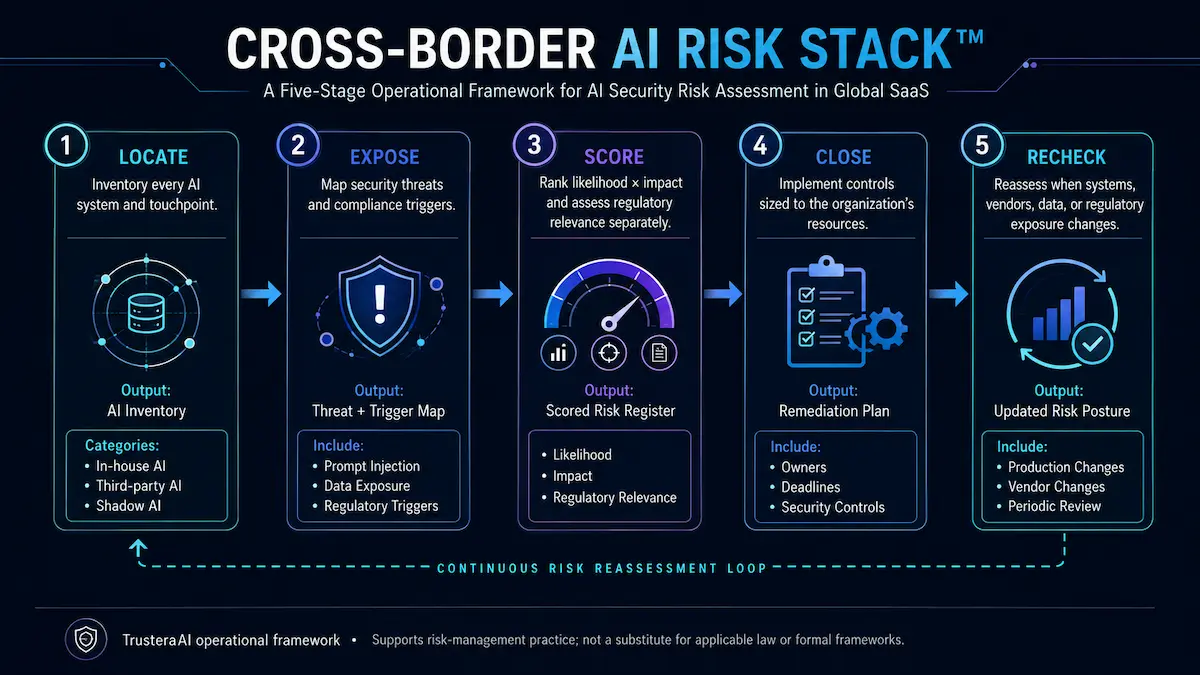
Quick answer: The Stack is five steps — Locate every AI system you use, Expose the security threats and compliance triggers each one creates, Score them by likelihood, impact, and regulatory relevance, Close the gaps in order of effort-to-impact, and Recheck on a trigger-based cadence rather than a fixed annual date alone.
What Is an AI Security Risk Assessment?
An AI security risk assessment is a structured process for identifying, scoring, and mitigating the security risks created by the AI features your product uses — whether you built the model yourself, embedded a third-party API, or adopted a vendor’s AI-powered tool.
It specifically covers risks unique to machine learning systems: data exposure through prompts, model manipulation, vendor AI data retention, unauthorized access to model endpoints, and excessive AI agency — distinct from a general IT security audit. It is not, on its own, a legally mandated document; specific obligations (documented risk management, DPIAs, security measures) may apply depending on your system and data, which is exactly why this guide keeps security findings, compliance triggers, and governance consequences separate rather than treating them as one category.
The output is three concrete artifacts, not a binder nobody reads:
- An inventory of every AI system and vendor touching your product
- A scored risk register ranking what’s actually dangerous versus theoretical
- A remediation plan with named owners and deadlines
Security Assessment vs. AI Risk Assessment vs. DPIA vs. Vendor Risk Assessment
- AI security risk assessment (this guide): the technical question — where can this AI system be attacked, misused, or leak data?
- AI risk assessment: broader — folds security findings together with operational, ethical, and reputational risk to decide what the business addresses first.
- AI DPIA (Data Protection Impact Assessment): a GDPR obligation under Article 35 that applies when processing — AI-driven or otherwise — is likely to result in a high risk to the rights and freedoms of natural persons. It is not triggered automatically by AI use or by having EU customers; whether it applies depends on the specific processing, and your security assessment supplies much of the evidence a DPIA needs.
- AI vendor risk assessment: scoped to third-party AI tools specifically — the vetting process for every embedded AI feature or API you didn’t build.
Run the security assessment first. Its findings inform whether a DPIA is warranted, feed your broader risk register, and structure your vendor reviews — one process, not four disconnected projects.
Why EU Exposure Changes the Assessment
Two things apply here, and it’s worth being precise about both rather than compressing them into “you have EU users, so the rules apply.”
GDPR may apply when you process personal data in connection with EU individuals — something that can be common when your SaaS serves Spanish or broader EU customers. Whether a particular processing activity requires a DPIA depends on the Article 35 high-risk test, not on AI involvement alone.
The EU AI Act’s territorial scope, under Article 2, is broader than “US company, EU users, therefore covered.” It also reaches providers and deployers established outside the EU where the output produced by an AI system is used within the Union, alongside other categories tied to placing a system on the EU market. Being a US-headquartered company does not automatically place you outside the Act’s reach — but it also doesn’t automatically place you inside every obligation. This is a fact-specific determination worth a proper legal read for any AI feature with real EU-facing impact, not something this guide can resolve in a paragraph.
What this means practically: your assessment process needs to surface which systems plausibly trigger which obligation, so you know where to get that legal read — rather than assuming either “nothing applies” or “everything applies.”
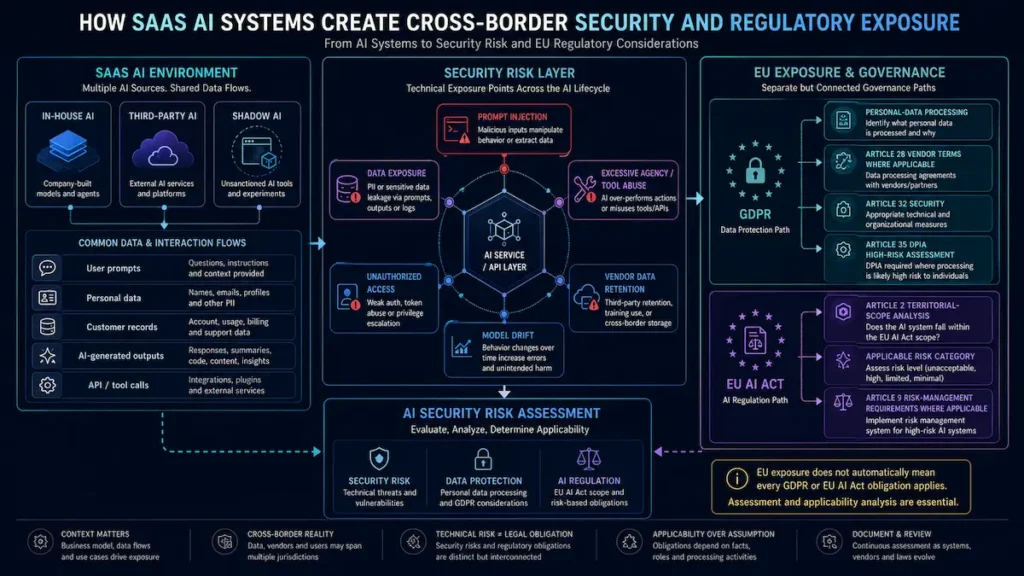
The Cross-Border AI Risk Stack™
Five layers, each producing one artifact, scoped to what a founder or a single ops/security hire can execute. The Stack is TrusteraAI’s operationalization of established risk-management concepts for lean teams — it’s designed to help you produce the documentation and practices that support NIST AI RMF alignment and relevant EU AI Act risk-management obligations, not a substitute for either. Article 9’s specific risk-management-system requirement applies to high-risk AI systems covered by the EU AI Act; this Stack can also be used voluntarily for lower-risk systems as an internal security practice.
1. Locate — Inventory every AI system and touchpoint
2. Expose — Map the security threats and compliance triggers each one creates
3. Score — Rank by likelihood, impact, and regulatory relevance
4. Close — Implement controls sized to your team
5. Recheck — Review on a trigger-based cadence
[Image 1 — Cross-Border AI Risk Stack™ diagram — placed here]
Layer 1 — Locate: Build the AI Inventory
List every AI system in three categories: built in-house (anything your team trained or fine-tuned), embedded third-party AI (any API or model you call — an LLM provider, an embedded recommendation engine, an AI support widget), and shadow AI (tools adopted without a formal decision — an AI plugin a contractor installed, a browser assistant someone started using).
Shadow AI is where lean teams get caught, because there’s no procurement process rigid enough to catch it automatically. Ask directly: “What AI tool did you start using in the last six months that nobody signed off on?”
For each item, record what it does, what data it touches, who owns it, and whether it processes EU personal data — that field is what Layer 2’s compliance check runs on. If you’ve already built an AI inventory, this is a refresh, not a rebuild.
Layer 2 — Expose: Map Threats and Compliance Triggers
For each system, check the security threat and the compliance trigger side by side — a technically low-risk system can still require a higher-priority compliance review when it processes EU personal data or triggers another potentially applicable obligation.
Security threats to check:
- Data exposure through prompts — employees pasting customer data into a public AI tool
- Prompt injection — malicious or user-controlled input that overrides system instructions, especially in any AI feature that calls tools or takes action based on its output
- Excessive agency / tool abuse — can the model invoke tools, access records, send messages, or modify data beyond what the requesting user is actually authorized to do? This matters most for any agentic feature, and it’s distinct from prompt injection even though the two often chain together
- Vendor data retention — does the vendor train on your data, and is that contractually controllable?
- Unauthorized access — who can view, modify, or query the model, and is that logged?
- Model drift — degraded accuracy over time producing unreliable outputs
Compliance triggers to check:
- Does this system process personal data of an identified or identifiable EU resident?
- Does it make or materially influence a decision affecting a person?
- Could it plausibly fall under an EU AI Act risk category relevant to your product?
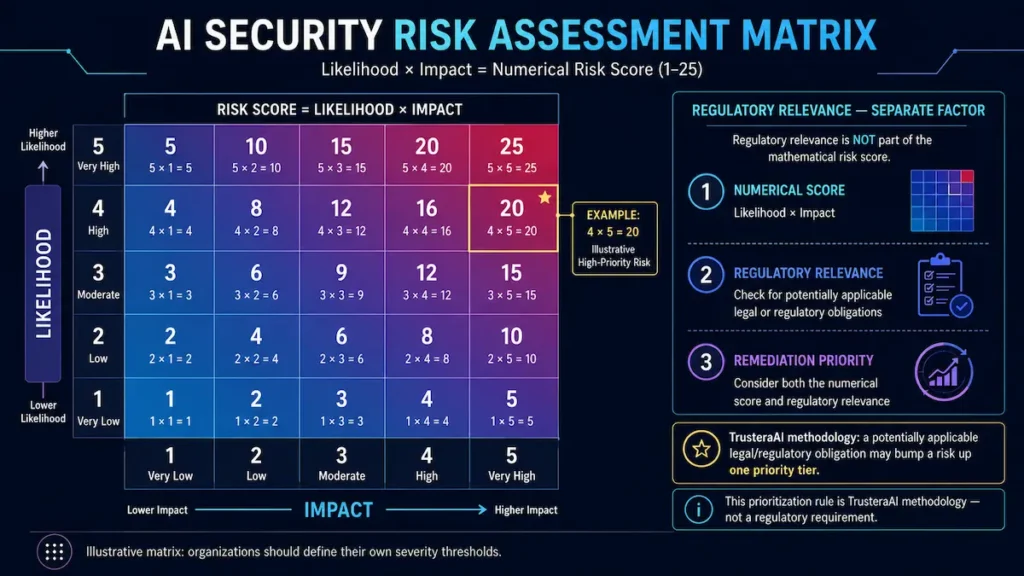
Layer 3 — Score: Build the Risk Register
Here’s a worked example — an AI-powered support chatbot serving both US and EU customers.
| Risk | Likelihood (1–5) | Impact (1–5) | Compliance Trigger | Score |
|---|---|---|---|---|
| Chatbot logs full transcripts, including EU customer PII, at a vendor with no data-processing terms in place | 4 | 5 | GDPR Art. 28 review; possible DPIA trigger | 20 |
| Vendor terms permit using conversation data to train their general model | 3 | 4 | Potential GDPR purpose/processing-compatibility issue | 12 |
| User-controlled prompts can influence system instructions or tool calls — potential prompt injection path | 3 | 3 | None directly; could cascade into exposure | 9 |
| No rate limiting on the chatbot API | 2 | 2 | None directly | 4 |
| No documented escalation path for incorrect billing information given by the bot | 2 | 3 | Consumer protection exposure | 6 |
Score = Likelihood × Impact. Note the API rate-limiting row is scored separately from the prompt-injection row above it — the two are related but distinct controls, and conflating them understates the injection risk.
[Image 2 — Likelihood × Impact matrix, with “Risk Score = Likelihood × Impact” and “Regulatory relevance = separate prioritization factor” shown distinctly — placed here]
TrusteraAI prioritization rule: if a risk involves a potentially applicable legal or regulatory obligation, we bump its priority up one tier even when the numerical score alone wouldn’t rank it that high. This is our methodology, not a NIST, GDPR, or EU AI Act requirement — flag it as such internally so the distinction between your scoring and a regulatory mandate stays clear.
Layer 4 — Close: Implement Controls Sized to Your Team
Sequence by effort-to-impact, not by framework completeness.
First (low effort, high impact):
- Put the appropriate data-processing terms in place with every AI vendor handling personal data, including a DPA where GDPR Article 28 applies; confirm training-data use, retention, subprocessors, geographic storage, and deletion terms in writing
- API keys and provider secrets stored in a secrets manager, never exposed client-side, rotated on a schedule, with separate credentials per environment
- Basic role-based access on AI tools and model endpoints
- A named owner for every item in your Layer 1 inventory
Next (moderate effort):
- Input validation and tool-call authorization on any AI feature exposed to untrusted input or capable of taking action
- Logging on AI queries and outputs
- A one-page rollback procedure for each production AI feature
Defer until you have dedicated security resourcing:
- Formal adversarial/red-team testing
- Continuous automated monitoring platforms
- Full incident response simulations — though a lightweight written version belongs here regardless of team size
Layer 5 — Recheck: A Sustainable Cadence
Risk management here works best as a hierarchy, not a single date on the calendar: continuous change triggers first, periodic checks second, a full annual reassessment as the floor, not the whole plan.
Trigger immediately on: any new AI feature reaching production, any AI vendor contract signed or renewed, expansion into a new EU market, or a material change to what data an existing AI system touches.
Quarterly: a shadow-AI and vendor-change check against the Layer 1 inventory.
Annually at minimum: a full re-score of the risk register, even with no obvious changes — vendor terms and regulatory guidance both shift quietly.
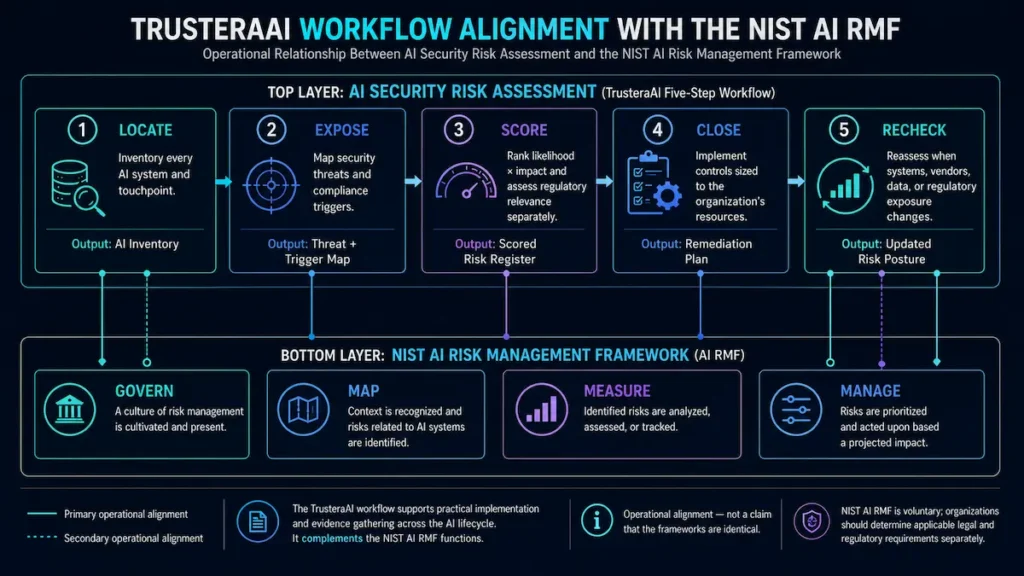
How the Stack Aligns with NIST AI RMF
The NIST AI Risk Management Framework organizes work around four functions — Govern, Map, Measure, Manage — which NIST describes as continuous and non-sequential, not an ordered checklist. The Stack is a lean operationalization of that structure, not a substitute for it:
| Cross-Border AI Risk Stack™ | Related NIST AI RMF function |
|---|---|
| Locate | Map / Govern |
| Expose | Map |
| Score | Measure |
| Close | Manage |
| Recheck | Govern / Measure / Manage (continuous) |
NIST AI RMF is voluntary; nothing here implies your organization is legally required to follow it. Aligning with it is a credible, widely recognized way to demonstrate a documented risk-management practice and can provide useful evidence during security or AI governance reviews.
Common Mistakes
Treating it as a one-time document. An unrevisited assessment is a snapshot of a moment that’s already passed.
Skipping the shadow AI question. Every team has AI tools nobody formally approved — often the highest-risk items on the list.
Scoring security risk without checking the compliance trigger. A technically low-risk system can still create a legal question the moment it touches EU personal data.
Confusing “we discussed it” with “we fixed it.” A risk register entry needs an owner and a deadline, not just a conversation.
Copying an enterprise checklist wholesale. If your plan assumes resourcing you don’t have, it stalls at Layer 1 — sequence for the team you actually have.
How Often Should You Reassess?
Treat the trigger list in Layer 5 as primary and the annual cycle as the floor beneath it: run a full Stack pass at least once a year, and immediately off-cycle whenever a trigger event occurs. A quarterly shadow-AI check keeps the inventory honest in between.
Frequently Asked Questions
Does the EU AI Act apply to my SaaS product if my company is based in the US?
Possibly — and it’s a fact-specific question, not a simple yes/no by headquarters location. Article 2’s territorial scope extends to providers and deployers outside the EU in certain circumstances, including where an AI system’s output is used within the Union. Being US-based doesn’t automatically place you outside the Act, but it also doesn’t mean every obligation applies. Any AI feature with meaningful EU-facing impact is worth a specific legal review against Article 2 rather than an assumption either way.
Is an AI security risk assessment legally required?
Not as a standalone universal requirement simply because a company uses AI. Specific obligations — documented risk management under the EU AI Act for certain systems, a DPIA under GDPR Article 35 where high-risk processing applies, general security measures under Article 32 — can require the underlying work this assessment produces, depending on your system and data. Treat the Stack as the practical process that generates the evidence those obligations ask for, not as a legal form in itself.
What’s the difference between this and a SOC 2 audit?
SOC 2 examines your organization’s controls against a fixed set of trust criteria at a point in time, via an external auditor, producing a customer-facing report. This assessment is narrower and technical — it evaluates the AI systems and data flows in your product for exploitable risk, run internally.
Do I need a DPIA if I only use a third-party AI chatbot?
Possibly — the trigger is the nature and risk of the processing, not who built the underlying model. If a vendor’s chatbot processes EU personal data in a way likely to result in high risk to individuals’ rights, a DPIA obligation can apply even though you didn’t train the model. Layer 2’s compliance-trigger check is what surfaces this for a legal read.
How long does a first-time assessment take for a small team?
As a rough estimate, not a benchmark: for a team with fewer than 10 AI systems in inventory, Layers 1–3 often take one to two focused weeks, with Layer 4 remediation continuing over the following weeks depending on what the register turns up.
This framework pairs directly with our AI Risk Assessment Checklist, AI Vendor Risk Assessment, AI Incident Response Plan, AI Governance Checklist for SaaS, and AI Inventory Template. For the Spain/EU regulatory specifics referenced above, see our Spain GDPR Checklist for SaaS and AEPD Inspection Guide.
Sources: NIST AI Risk Management Framework · EU AI Act, Regulation (EU) 2024/1689, Article 2 (scope) and Article 9 (risk management system) — EUR-Lex · GDPR Articles 28, 32, and 35 — EUR-Lex · MITRE ATLAS · ISO/IEC 42001