

I’ve worked with over a dozen SaaS startups at various growth stages—seed-funded teams running lean infrastructure; Series companies suddenly facing traffic surges they weren’t prepared for; and pre-IPO engineering teams scrambling to patch compliance gaps before enterprise deals closed. Across cloud-native SaaS, e-commerce, developer tooling, and AI startups, I’ve seen security requirements evolve dramatically as companies move from MVP to enterprise scale. In every environment, the debate over Cloudflare vs. competitors for startup security surfaced fast—and Cloudflare was almost always the first name on the whiteboard.
That’s not surprising. Cloudflare is genuinely excellent for many startups, at least initially. But as teams scaled, the gaps started showing. Pricing that worked at 10,000 daily users stopped making sense at 10 million. Support tiers that felt fine during development became friction during incidents. Configurations that worked on marketing sites showed real limits on API-heavy SaaS platforms running containerized workloads in Kubernetes or Docker.
This guide breaks down Cloudflare vs. competitors for startup security comparison across seven alternatives—AWS Shield, Sucuri, Fastly, Akamai, Imperva, StackPath, and Bunny.net—so you can choose the platform that fits your actual threat model, budget, and growth trajectory. Understanding how to secure a startup with AI tools from day one makes this choice easier, but the edge security platform decision is where it starts.
Quick Answer: What Is the Best Cloudflare Competitor for Startup Security?
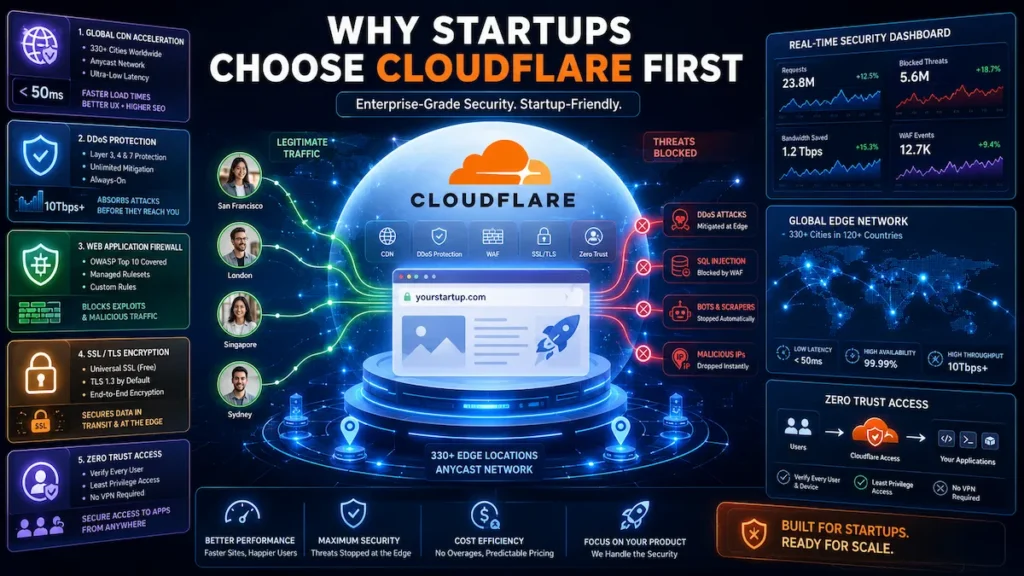
For most startups, Cloudflare remains the strongest all-around option for balancing performance, protection, and price. When evaluating Cloudflare vs. competitors for startup security, however, the right platform depends on your infrastructure stack and growth stage. AWS Shield wins for AWS-native environments. Imperva leads on API security and WAF depth. Fastly offers superior developer control at the edge. Sucuri excels for WordPress-focused businesses. StackPath is the best budget edge security option. Bunny.net suits cost-optimized early-stage CDN needs. Compliance obligations — SOC 2, PCI DSS, GDPR — should shape your decision as much as feature sets do.
| Platform | Best For | Starting Price |
|---|---|---|
| Cloudflare | Most startups | Free |
| AWS Shield | AWS-native teams | Free |
| Imperva | API security | Enterprise |
| Sucuri | WordPress | $199/year |
| Fastly | Developer control | Usage-based |
| Akamai | Enterprise scale | Enterprise |
| StackPath | Budget security | $10/month |
| Bunny.net | Low-cost CDN | $1/month |
Winner by Category
Before diving into the full Cloudflare vs. competitors for startup security analysis, here’s the fast-reference decision table:
| Category | Winner |
|---|---|
| Best Overall | Cloudflare |
| Best AWS Integration | AWS Shield |
| Best API Security | Imperva |
| Best WordPress Security | Sucuri |
| Best Developer Control | Fastly |
| Best Enterprise-Scale Security | Akamai |
| Best Budget Edge Security | StackPath |
| Best Cost-Optimized CDN | Bunny.net |
How We Evaluated Cloudflare Competitors for Startup Security
Every platform was assessed against criteria that reflect real startup operational realities—not enterprise procurement checklists. We weighted ten factors in this Cloudflare vs. competitors for startup security evaluation:
DDoS mitigation across layers 3, 4, and 7—does it activate automatically without manual intervention?
WAF Quality—does it cover OWASP Top 10 vulnerabilities by default, and does it use behavioral analysis or static signature matching?
API Security—Can it enforce rate limiting, detect anomalous usage patterns, and prevent credential abuse at the API layer specifically?
AI-Powered Threat Detection — Does it use machine learning or behavioral analytics to identify novel threats and zero-day attacks that static rules miss?
Edge Performance — how large and distributed is the network? What real-world latency improvement does it deliver for global user bases?
Pricing Predictability—Does cost scale reasonably with traffic growth or spike unpredictably during attack events?
Deployment Complexity — how long does a mid-level DevOps engineer need to achieve meaningful protection across containerized, serverless, or bare-metal environments?
Support Quality—Is human expert support accessible during active incidents, or is it primarily documentation-based?
Compliance Support — does the platform provide meaningful audit logging for SOC 2, PCI DSS, and GDPR requirements?
Zero Trust Network Access (ZTNA)—does the platform verify every user and device before granting resource access, regardless of network location?
Why Startups Default to Cloudflare for Security Infrastructure
Cloudflare has done something genuinely difficult: making enterprise-grade edge security accessible to small teams from day one. That’s why it dominates the Cloudflare vs. competitors for startup security conversation for most early-stage companies.
CDN Performance and Website Speed Optimization
Cloudflare operates one of the largest anycast networks in the world, with points of presence in over 330 cities. The free tier includes HTTP/3 support, Brotli compression, and intelligent caching. Its edge network also shields origin servers from direct exposure, making infrastructure mapping harder for attackers targeting your actual cloud hosts.
DDoS Protection for Startup Traffic Spikes
Cloudflare’s unmetered DDoS protection absorbs volumetric attacks at the network edge before traffic reaches your application—covering Layers 3, 4, and 7 without manual activation during incidents. DDoS events for SaaS startups don’t only come from malicious actors — misconfigured integrations, bot floods, and API abuse at scale all generate the same operational pain. If you’re building out your startup cybersecurity checklist for 2026, always-on edge-level DDoS mitigation should be one of the first capabilities you lock in.
WAF and Zero Trust Security Advantages
Cloudflare’s WAF covers OWASP Top 10 vulnerabilities, platform-specific exploits, and emerging threat signatures. Its Zero Trust Network Access product line—Cloudflare Access and Cloudflare Tunnel—enforces identity-verified resource access without maintaining a traditional VPN, a real operational advantage for distributed teams.
The honest caveat: WAF tuning requires genuine expertise. Startups with custom application logic regularly generate false positives until rules are properly refined. Budget for that operational cost from day one.
Where Cloudflare Becomes Limiting for Startups
The Cloudflare vs. competitors for startup security debate gets interesting here. Cloudflare isn’t always the obvious winner — specific friction patterns appear consistently as startups scale past the early stage.
Pricing Challenges During Startup Scaling
Cloudflare’s free and Pro tiers are compelling. The Business tier at $200/month is manageable for many early-stage startups. But the jump to enterprise pricing—where meaningful SLAs, dedicated support, and advanced security live—is significant. For e-commerce startups specifically, WAF tuning, bot management, and rate limiting are often gated behind higher tiers. A startup budgeting on the Pro plan that discovers it needs business-tier bot management after a credential stuffing attack faces a difficult conversation.
Complex Enterprise Configurations
Cloudflare’s platform has grown substantially through acquisitions. Teams configuring workers, integrating Zero Trust Network Access, managing multiple domains, and implementing custom WAF rules simultaneously often find it harder to navigate than demos suggest. DevOps engineers also managing CI/CD pipelines, Kubernetes clusters, and Docker infrastructure rarely have the bandwidth to become Cloudflare configuration specialists. Simpler platforms can deliver better actual security posture when adoption friction is lower. Learning how to secure a startup with AI tools helps fill that expertise gap without a dedicated security hire.
Customization and Support Limitations
Below the Enterprise tier, Cloudflare’s support is primarily documentation and community-based. For startups navigating a first serious security incident—a WAF misconfiguration, origin exposure, or unusual traffic pattern—real-time expert support matters enormously. Competitors with a more service-oriented model, like Sucuri, hold a genuine advantage here.
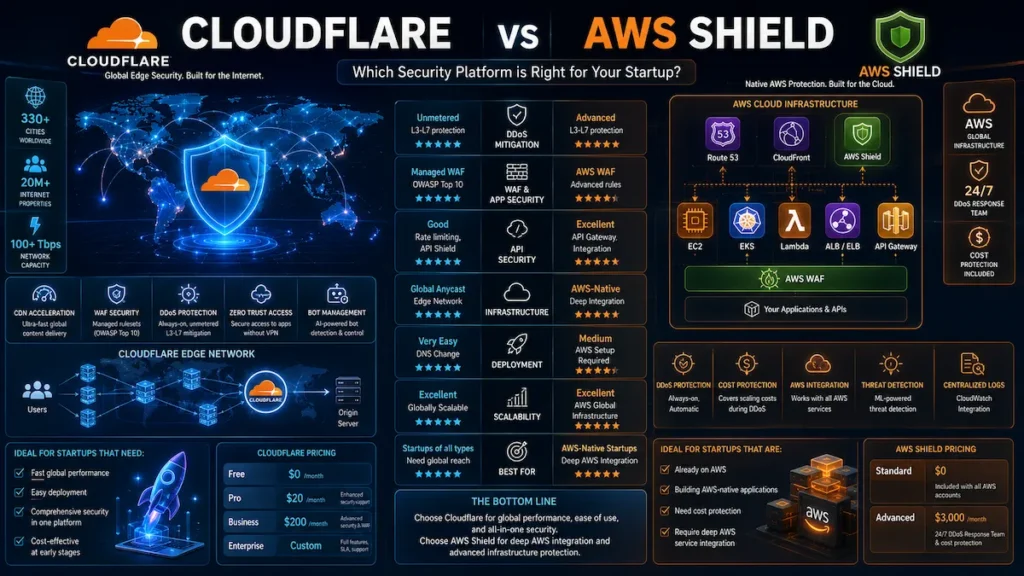
AWS Shield vs Cloudflare for Startup Security
AWS Shield is the first alternative most AWS-native startups evaluate in Cloudflare vs. competitors for startup security conversations. If your stack runs on EC2, ECS, Lambda, or EKS, the integration story is compelling from the start.
Best Fit for AWS-Native Startups
AWS Shield Standard is included at no additional cost with all AWS accounts, providing automatic Layer 3 and Layer 4 DDoS protection. For startups whose entire infrastructure lives in AWS, this baseline protection is effectively free.
AWS Shield Advanced adds enhanced detection, 24/7 access to the AWS DDoS Response Team, and cost protection, reimbursing CloudWatch-tracked scaling charges triggered by attack events—critical for auto-scaling or serverless architectures where large attacks generate unexpected infrastructure bills. AWS API Gateway integration provides meaningful API-layer protection without deploying a separate security product.
Threat Detection and Infrastructure Protection
Shield Advanced integrates directly with CloudFront, Route 53, ELB, and EC2, enabling application-layer protection that understands your specific traffic patterns. Combined with AWS WAF and GuardDuty for threat intelligence, this creates a layered posture tightly coupled with your CloudWatch observability stack. AWS WAF’s Bot Control managed rule group adds ML-based bot detection — a meaningful AI-powered capability for startups dealing with credential stuffing or API scraping without custom detection logic.
Pricing and Scalability Tradeoffs
AWS Shield Advanced costs $3,000 per month minimum — not realistic for seed-stage startups. For Series A and beyond, the economics improve when you factor in DDoS cost protection and operational savings from deep AWS integration. For early-stage startups, AWS Shield Standard plus AWS WAF is the practical starting point. The comparison to Cloudflare comes down to one question: is your infrastructure primarily AWS-native? If yes, Shield’s integration advantages often outweigh Cloudflare’s broader edge network reach.
Sucuri vs Cloudflare for Startup Security
Sucuri occupies a meaningfully different niche in the Cloudflare vs. competitors for the startup security landscape—less focused on raw network performance and more focused on website security as a managed service.
Malware Protection and Managed Incident Response
Sucuri’s core differentiator is active malware scanning, detection, and cleanup. While Cloudflare focuses on traffic filtering and edge performance, Sucuri scans for malware, backdoors, and injected code—and provides remediation as part of its service plans. The Sucuri Security Operations Center provides 24/7 monitoring and hands-on incident response. Cloudflare at comparable price points doesn’t offer this service model.
WordPress Startup Security Benefits
A large portion of early-stage startups in e-commerce, media, and content run on WordPress. Sucuri has deep WordPress-specific expertise: plugin vulnerability scanning, wp-login brute force protection, and WAF rules covering known plugin and theme exploits. For this segment, Sucuri’s specialized focus delivers better practical security than Cloudflare’s generalist approach. As startups scale beyond WordPress into containerized microservices and API-first architectures, Cloudflare’s broader capabilities become more relevant.
Ease of Deployment for Smaller Teams
Sucuri’s DNS-based setup typically takes under an hour. The dashboard surfaces actionable security information without requiring deep expertise. For small startup teams where a non-specialist manages security alongside product responsibilities, Sucuri’s operational simplicity translates into a better actual security posture—because it actually gets implemented and maintained.
Fastly vs Cloudflare for Startup Security
Fastly is underestimated in the Cloudflare vs. competitors for startup security comparison by non-technical founders but presents a compelling case for development-driven teams building sophisticated edge infrastructure.
Edge Performance and Developer Control
Fastly’s edge cloud platform is built around Varnish Cache with VCL — giving developers granular caching control that Cloudflare’s more abstracted approach doesn’t match. Its Compute@Edge platform runs custom logic at the edge using WebAssembly, enabling more precise WAF customization and custom bot detection logic without waiting for vendor feature releases.
For code-level application security alongside Fastly’s edge layer, pairing it with a focused Snyk alternative for startups covers both edge and application dependency attack surfaces effectively.
Real-Time Security Monitoring
Fastly’s real-time log streaming surfaces attack patterns and security events with minimal delay. For DevOps teams integrating security telemetry into Datadog, Splunk, or Elastic, Fastly’s streaming log architecture avoids vendor lock-in on observability while delivering the raw data needed for AI-powered network security monitoring workflows.
The startup tradeoff: a steeper learning curve than Cloudflare and usage-based costs that are harder to predict without careful upfront traffic modeling.
Akamai vs Cloudflare for Startup Security
Akamai is the incumbent enterprise CDN and security platform—the company that built the market Cloudflare disrupted. That history shapes both its genuine strengths and real limitations in the Cloudflare vs. competitors for startup security comparison.
Enterprise-Level AI Threat Intelligence
Akamai processes a meaningful fraction of global internet traffic, feeding machine learning models and AI-driven anomaly detection systems with threat data that smaller networks can’t replicate. Its behavioral analytics continuously profile normal traffic and surface deviations that signature-based WAF systems miss entirely—including low-and-slow attacks designed to evade volume-based detection. Kona Site Defender reinforces OWASP Top 10 coverage with behavioral context rather than purely static rule matching.
Large-Scale DDoS Mitigation and Global Reach
Akamai Prolexic delivers scrubbing capacity measured in terabits per second—overkill for most startups, but genuinely relevant for crypto exchanges, major e-commerce platforms, and critical infrastructure-adjacent applications. Akamai’s network spans over 4,000 points of presence globally — a footprint no competitor in this guide matches.
Akamai is expensive and complex, with enterprise contracts that don’t match early-stage startup rhythms. It belongs in this comparison for completeness and for funded startups at significant scale, not as a first-choice platform for seed or Series A companies.
Imperva vs Cloudflare for Startup Security
Imperva positions itself as an enterprise application security specialist, and its WAF and API protection depth make it worth serious evaluation in the Cloudflare vs. competitors for startup security analysis—particularly for SaaS startups with regulated data requirements.
Advanced WAF Security with AI-Driven Analysis
Imperva’s WAF consistently leads independent evaluations. It goes beyond OWASP Top 10 coverage to include behavioral analysis, reputation scoring, and AI-driven dynamic profiling of normal application behavior. Machine learning distinguishes legitimate traffic anomalies from genuine attack patterns, significantly reducing false positives compared to static-rule WAFs. Virtual patching applies WAF rules to shield known vulnerabilities before engineering teams can deploy application-level fixes—meaningful for teams under release deadline pressure.
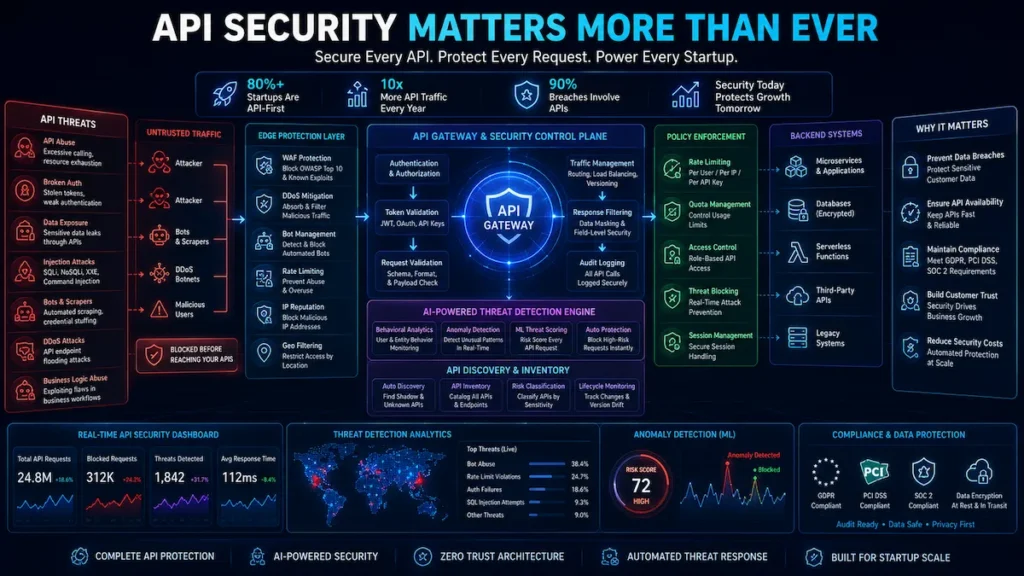
API Threat Protection and Discovery
Imperva’s API Security product automatically discovers API endpoints — including shadow APIs teams don’t know exist — identifies sensitive data exposure, and uses behavioral analytics to detect credential abuse and business logic exploitation. For SaaS startups where the API is the product, this depth is difficult to find elsewhere at comparable price points.
Startups with GDPR obligations should pair Imperva’s data-awareness capabilities with dedicated GDPR compliance tools for startups to address API security posture and data privacy requirements together rather than in silos.
Compliance and Enterprise Application Security
Imperva’s audit logging and compliance reporting simplify SOC 2 Type II evidence collection significantly. Startups preparing for enterprise sales cycles should evaluate this early alongside dedicated SOC 2 compliance tools for AI startups — your security platform shapes the audit evidence you can produce. Runtime protection, client-side security, and advanced bot management complete a platform built for application security depth across complex, multi-tier architectures.
StackPath vs Cloudflare for Startup Security
StackPath occupies a useful niche in the Cloudflare vs. competitors for startup security comparison that most articles overlook: it’s the best-positioned platform for cost-conscious startups needing real edge security before they can justify Cloudflare’s paid tiers.
Best for Budget-Conscious Startups
StackPath starts at $10 per month, putting WAF protection, CDN delivery, DDoS mitigation, and basic bot detection within reach of pre-revenue startups in runway-constrained stages. OWASP Top 10 protection, custom WAF rules, SSL/TLS management, and rate limiting cover the core threat vectors most early-stage startups face. DNS-based onboarding requires no significant architectural changes and works well across Docker-hosted applications on infrastructure outside AWS.
Limitations Compared to Cloudflare
StackPath’s AI-powered threat detection is limited compared to Cloudflare, Imperva, or Akamai. API security is basic—rate limiting is available, but behavioral analytics and API discovery aren’t. Zero Trust Network Access support is minimal. The edge network isn’t as performant or geographically distributed as Cloudflare’s 330+ city anycast infrastructure. StackPath works as a budget bridge, not as a long-term platform for startups handling regulated data or expecting significant scale.
Bunny.net vs Cloudflare for Startup Security
Bunny.net sits at the opposite end of the capability spectrum from Akamai—and its place in the Cloudflare vs. competitors for startup security comparison is specifically for the earliest-stage teams with genuinely limited threat exposure.
Budget CDN for Early-Stage Startups
Bunny.net’s bandwidth-based pricing starts at roughly $0.01 per GB, with a $1/month minimum. For pre-traction startups building products without real threat volume yet, Bunny.net provides CDN performance without a meaningful security budget commitment. Its 100+ point global network delivers solid content delivery with a dashboard that non-technical team members can actually navigate.
When Bunny.net Makes Sense—and When It Doesn’t
Bunny.net’s security capabilities are limited by design: basic DDoS protection and SSL/TLS management, with no meaningful WAF, no AI-powered threat detection, no API security controls, and no Zero Trust Network Access. For startups handling user authentication, payment data, or sensitive API operations, the capability gap relative to Cloudflare’s free tier is significant.
For teams using Bunny.net, pair it with a dedicated detection layer — AI security tools on a startup budget can add the response capabilities Bunny.net doesn’t provide. Bunny.net is right for static assets, documentation sites, and low-risk public content delivery. It’s not the right primary security platform for SaaS startups handling regulated information.
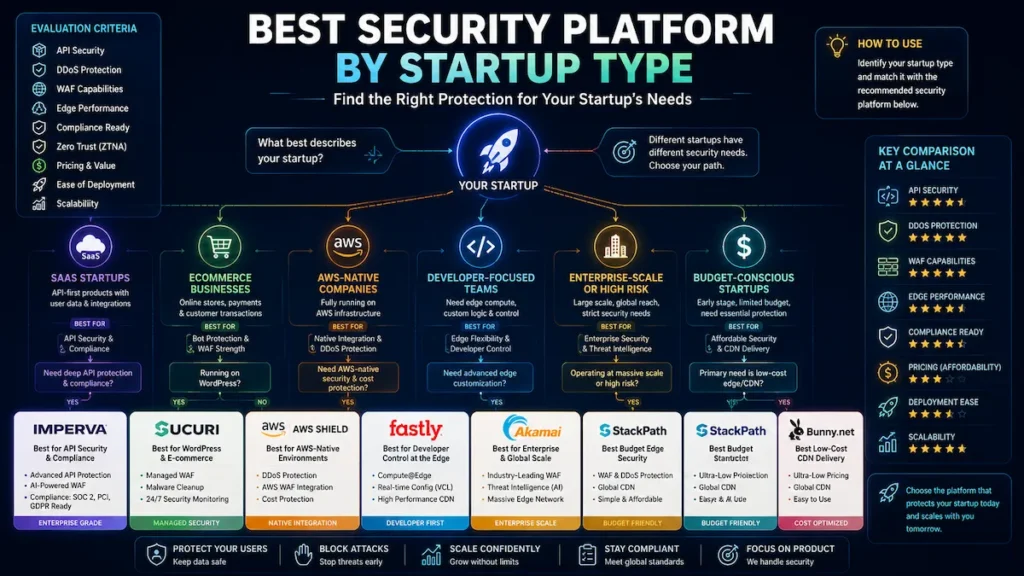
Best Cloudflare Competitor by Startup Type
SaaS Startups: AWS Shield + AWS WAF for AWS-native platforms; Imperva for API-heavy SaaS with compliance obligations. Review SOC 2 compliance tools for AI startups early — your security platform directly shapes your audit evidence.
E-commerce Startups: Cloudflare for performance-optimized e-commerce at an early scale. Sucuri for WordPress-based operations. Imperva for larger platforms with PCI DSS requirements and complex fraud risk.
Budget-Constrained Early-Stage: Cloudflare free or Pro tier for most teams. StackPath for tighter budgets needing WAF and DDoS coverage. AWS Shield Standard for AWS users at no added cost. Bunny.net for pure CDN delivery needs.
Enterprise Growth Track: Cloudflare Enterprise or Akamai for global infrastructure at scale. Imperva for regulated industries requiring API discovery and compliance reporting. Fastly is for developer-first teams with the engineering bandwidth to leverage its full edge capabilities.
Cloudflare vs. Competitors: Full Comparison Table
| Platform | Best For | Price | WAF | DDoS | API Security | ZTNA | Bot Protection | AI Detection | Compliance (SOC 2 / PCI DSS / GDPR) | Rating |
|---|---|---|---|---|---|---|---|---|---|---|
| Cloudflare | General startup security | Free / $20/mo | Strong | Excellent | Good | Strong | Good | Moderate | Moderate | ⭐⭐⭐⭐⭐ |
| AWS Shield | AWS-native startups | Free / $3,000/mo | Good (+WAF) | Excellent | Good (+API GW) | Good (IAM) | ML-based | Good | Strong | ⭐⭐⭐⭐ |
| Sucuri | WordPress & managed security | $199/yr | Good | Good | Limited | Limited | Basic | Basic | Moderate | ⭐⭐⭐⭐ |
| Fastly | Dev-driven edge platforms | Usage-based | Good | Good | Moderate | Limited | Moderate | Limited | Moderate | ⭐⭐⭐ |
| Akamai | High-risk, enterprise-scale | Enterprise | Excellent | Industry-leading | Good | Strong | Advanced | Excellent (ML/AI) | Strong | ⭐⭐⭐ |
| Imperva | API-heavy SaaS & regulated | Enterprise | Industry-leading | Strong | Excellent | Moderate | Advanced | Excellent (AI/ML) | Strong | ⭐⭐⭐⭐ |
| StackPath | Budget edge security | $10/mo | Moderate | Good | Limited | Limited | Basic | Limited | Limited | ⭐⭐⭐ |
| Bunny.net | Cost-optimized CDN only | $1/mo+ | Basic | Basic | Limited | No | Basic | No | Limited | ⭐⭐⭐ |
Expert Final Verdict on Cloudflare vs Competitors for Startup Security
Cloudflare earns its default status in the Cloudflare vs. competitors for startup security debate. For most startups in their first two years — with modest security budgets and standard web or API infrastructure — it’s the right starting point. CDN performance, DDoS protection, WAF capability, and Zero Trust Network Access in a single platform at accessible price points are genuinely difficult to beat.
That said, defaulting to Cloudflare without running the evaluation is a mistake. AWS Shield wins when your infrastructure is AWS-native and CloudWatch-integrated. Sucuri wins when you need managed security with human incident response. Fastly wins when your team needs granular developer-controlled edge infrastructure. Akamai wins when you need AI-driven threat intelligence at terabit-scale DDoS capacity. Imperva wins when you’re building an API-first SaaS product with SOC 2, PCI DSS, or GDPR obligations. StackPath or Bunny.net bridges the gap in the earliest runway-constrained stages.
The most common mistake in any Cloudflare vs. competitor startup security evaluation is choosing a platform based on familiarity rather than fit. The best platform isn’t the most technically capable—it’s the one that gets fully implemented and maintained over a 24-month horizon. Pairing whichever platform you choose with dedicated machine learning intrusion detection adds an independent detection layer outside your CDN or WAF vendor—giving you defense in depth rather than single-vendor dependence.
Conclusion
The Cloudflare vs. competitors for startup security conversation doesn’t have a universal answer—it has the right answer for your specific situation. Cloudflare is the strongest general-purpose choice for most early-stage companies: fast, well-documented, affordable at lower tiers, and covering core threat vectors day-to-day. AWS Shield wins on deep AWS infrastructure integration. Sucuri wins on managed service depth and WordPress expertise. Fastly wins on developer-controlled edge flexibility. Akamai wins on AI-driven threat intelligence and DDoS scale. Imperva wins on WAF depth, API discovery, and compliance reporting for regulated environments. StackPath and Bunny.net serve the most budget-constrained early stages where basic coverage beats no coverage.
Map the platform to your actual threat model—not a prestige model. Start with your infrastructure environment, compliance path (SOC 2, PCI DSS, GDPR), team operational capacity, and realistic 24-month cost ceiling. Those four constraints will guide Cloudflare vs. competitors for startup security decisions more reliably than any feature matrix alone.
Ultimately, the Cloudflare vs. competitors for startup security decision should be based on infrastructure architecture, compliance requirements, operational resources, and long-term growth plans rather than feature lists alone.
Frequently Asked Questions
Is Cloudflare still the best option for startups?
In the Cloudflare vs. competitors for startup security comparison, Cloudflare is the best all-around option for most early-stage startups needing CDN performance, DDoS protection, and WAF capability without deep security expertise or a large budget. It’s not universally the best choice. AWS-native startups should evaluate AWS Shield. API-heavy SaaS platforms with compliance requirements should evaluate Imperva. WordPress-based businesses should consider Sucuri. High-risk-vertical companies should assess Akamai. The right call depends on your infrastructure stack and compliance path, not brand familiarity alone.
Which startup security platform scales best?
In the Cloudflare vs. competitors for startup security scalability comparison, Cloudflare, AWS Shield, and Akamai all scale effectively to enterprise-level traffic volumes. For most startups, the more important question is whether the platform’s pricing scales predictably alongside traffic growth. Cloudflare is more startup-friendly at early and mid-scale. AWS Shield Advanced and Akamai become more cost-competitive at very large volumes where their infrastructure integration depth justifies the premium.
What is the best DDoS protection platform for SaaS startups?
Across the Cloudflare vs competitors for startup security For DDoS comparison, Cloudflare offers the best capability-to-price ratio for most SaaS startups. AWS Shield is right for AWS-native SaaS behind CloudFront or ELB. For SaaS at significant scale facing targeted attacks, Akamai Prolexic provides the highest-capacity mitigation available. The critical requirement: ensure Layer 7 application-layer protection is included—sophisticated SaaS API attacks operate at the application layer, not just volumetric Layer 3 and Layer 4 levels.
Which startup security platform is easiest to deploy?
In the Cloudflare vs. competitors for startup security deployment comparison, Sucuri and Cloudflare rank as the easiest—both offer DNS-based setup complete in under an hour. Cloudflare’s onboarding is particularly streamlined for non-specialists. AWS Shield integrates naturally for teams familiar with AWS Console, CloudWatch, and GuardDuty workflows. StackPath and Bunny.net are straightforward for basic CDN needs. Fastly and Akamai have the steepest learning curves and require dedicated infrastructure engineering resources.
Which Cloudflare competitor offers the best WAF protection?
In the Cloudflare vs. competitors for startup security WAF comparison, Imperva consistently leads independent evaluations—its AI-powered machine learning engine and behavioral analytics deliver superior accuracy compared to static-rule platforms, particularly for complex application-layer attacks and API-specific threats. Akamai’s Kona Site Defender is also highly capable, with AI-driven threat intelligence reinforcing OWASP Top 10 coverage with behavioral context. For startups on standard budgets, Cloudflare’s managed WAF rulesets provide strong OWASP Top 10 protection — significantly better than having no WAF deployed, which remains the real benchmark for most early-stage teams.
Is Cloudflare better than AWS Shield for startups?
For most startups, the Cloudflare vs. competitors for startup security comparison often favors Cloudflare because it combines CDN performance, DDoS protection, WAF security, and Zero Trust access in a single platform with affordable entry-level pricing. AWS Shield is a stronger choice for startups running entirely on AWS infrastructure, especially when deep integration with CloudFront, Route 53, and AWS WAF is a priority.
Does Cloudflare provide API security?
Yes, Cloudflare provides API security features, including rate limiting, API Shield, bot management, authentication controls, and DDoS protection for API endpoints. In the Cloudflare vs. competitors for startup security evaluation, Cloudflare offers solid API protection for most startups, although platforms like Imperva provide deeper API discovery and advanced behavioral analysis capabilities.
Can startups use Cloudflare for free?
Yes, startups can use Cloudflare’s free plan, which includes CDN services, SSL encryption, basic DDoS protection, and performance optimization features. One reason Cloudflare frequently leads the Cloudflare vs. competitors for startup security discussion is that its free tier delivers meaningful security and performance benefits without requiring an upfront investment.
Which Cloudflare alternative is best for WordPress?
Sucuri is widely considered one of the best Cloudflare alternatives for WordPress websites because it offers malware scanning, website cleanup, plugin vulnerability monitoring, and WordPress-specific WAF protection. In the Cloudflare vs. competitors for startup security comparison, Sucuri is often the preferred choice for content-driven businesses and e-commerce stores built on WordPress.