
By a cybersecurity strategist who has worked with early-stage SaaS teams navigating their first serious security decisions — from pre-seed infrastructure to post-Series A compliance requirements.
| Tool | Best For | Trial / Demo | Pricing |
|---|---|---|---|
| CrowdStrike Falcon | Growing startups | Free trial | Custom / varies by package |
| SentinelOne | Autonomous endpoint protection | Demo / evaluation | From $69.99/endpoint/year |
| Darktrace | Complex environments | Demo | Custom quote |
| Microsoft Defender for Business | Microsoft 365 environments | Trial available with eligible plans | Subscription-based |
| Vectra AI | Hybrid and multi-cloud environments | Demo | Custom quote |
Imagine you’re three months from your Series A. Your product is gaining traction, and your team is growing—and then a breach hits. Customer data exposed. Investors spooked. Engineers pulled off roadmap work for weeks. Legal fees mounting before you’ve even closed the round.
This isn’t a hypothetical. IBM’s 2024 Cost of a Data Breach Report found that the global average cost of a data breach reached $4.88 million, underscoring the potentially significant financial impact of a serious security incident.
The threat is accelerating. Cybercriminals no longer focus exclusively on Fortune 500 targets. They actively hunt startups precisely because early-stage companies store valuable intellectual property, handle customer data, and — critically — often run with minimal security infrastructure. You’re a high-value, low-resistance target.
AI-powered threat detection platforms are changing that equation. Platforms once reserved for enterprise budgets are now accessible, scalable, and designed specifically for lean teams without dedicated security staff.
Why Startups Are Prime Targets for Cyber Attacks
Startups are prime targets for cyber attacks because they often have valuable customer data, intellectual property, and cloud infrastructure but limited cybersecurity budgets and small IT teams. Attackers see startups as easier targets than large enterprises while still offering high-value data and financial opportunities.
Understanding why startups are targeted is the first step toward choosing the right AI-powered threat detection platform for your environment.
Common Cybersecurity Risks Facing Startups
These are exactly the types of risks that modern AI threat detection platforms are designed to identify, monitor, and prioritize before they escalate.
In working with early-stage SaaS teams, the most common mistake I see is founders assuming size provides protection. It doesn’t. Attackers don’t target companies based on revenue — they target based on opportunity and data value.
Startups face a threat profile distinct from large enterprises. Phishing attacks, ransomware, credential theft, and insider threats top the list. Verizon’s 2026 Data Breach Investigations Report shows that vulnerability exploitation has become the leading initial access vector, while ransomware continues to affect organizations of all sizes.
The structural risk compounds because of how startups naturally operate. Most early-stage companies run a patchwork of SaaS tools, cloud services, and remote access systems—each one a potential entry point. A single misconfigured S3 bucket, a reused employee password, or an unreviewed third-party integration can expose your entire operation overnight. Startups can reduce this exposure by applying zero-trust principles across identities, devices, applications, and cloud resources.
Before evaluating any specific tool, reviewing a startup cybersecurity software comparison gives you a structured framework for understanding your options relative to your actual risk profile.
Why Traditional Security Tools Fail Against Modern Threats
This growing gap between legacy tools and modern attack sophistication is precisely why the best AI-powered threat detection tools for startups have become a non-negotiable security layer.
Legacy security tools—antivirus software, basic firewalls, and signature-based detection systems—were designed for a fundamentally different threat environment. They work by matching activity against databases of known threats. When attackers use novel techniques or previously unknown exploits, signature-based tools may have limited ability to detect the activity on their own.
Modern attackers use polymorphic malware, AI-generated phishing emails, and advanced persistent threats that move slowly and deliberately through systems specifically to avoid triggering static rule-based detection. These attacks are engineered to look normal until they aren’t.
That gap — between what traditional tools can detect and what modern attacks look like — is exactly why automated cyber defense tools have moved from optional to operationally essential for any startup handling sensitive data.
What Are the Best AI-Powered Threat Detection Tools for Startups?
AI-powered threat detection platforms commonly considered by startups include CrowdStrike Falcon, SentinelOne, Microsoft Defender for Business, Vectra AI, and Darktrace. The right choice depends on your startup’s budget, infrastructure, team size, and security requirements.
Before evaluating specific platforms, it’s important to understand how modern AI threat detection systems work and what separates them from conventional security software.
How AI Cybersecurity Systems Work
Knowing how these systems operate helps startups evaluate whether a given AI-powered threat detection tool aligns with their infrastructure and team capabilities.
AI-powered threat detection tools use machine learning algorithms and behavioral analytics to continuously monitor your network, endpoints, and cloud environments. Rather than checking activity against a static threat list, these systems learn what “normal” looks like in your specific environment—and flag meaningful deviations from that learned baseline.
Modern AI security platforms operate across three core layers simultaneously:
Network layer — monitors traffic patterns, lateral movement, and unusual data flows
Endpoint layer — monitors device behavior, process execution, and file-system activity
Cloud/workload layer — monitors cloud configurations, API activity, and identity behavior
Together, these layers can give startups broader visibility across endpoints, networks, and cloud workloads, helping security teams identify activity that might be missed when each layer is monitored separately.
Machine Learning vs Traditional Threat Detection
This architectural difference can make AI-powered threat detection tools better suited to identifying evolving attack patterns than systems that rely primarily on known signatures and predefined rules.
The fundamental difference between machine learning threat detection and traditional methods is adaptability. Traditional signature-based detection relies heavily on known threat indicators and predefined rules, while machine-learning systems can analyze behavioral patterns and anomalies that may not match previously cataloged threats.
For startups operating in cloud-heavy, remote-first environments, this adaptability is not a luxury. Your attack surface changes constantly as you onboard new tools, hire employees across geographies, and scale cloud infrastructure. AI-driven security platforms can adapt to changing environments through behavioral analytics and automated detection models, reducing reliance on manually maintained rules for some detection scenarios.
For a deeper look at how these approaches compare in real deployment scenarios, the AI cybersecurity tools for small business 2026 guide covers the practical differences across team sizes and infrastructure types.
How AI-Powered Threat Detection Tools Detect Cyber Threats in Real Time
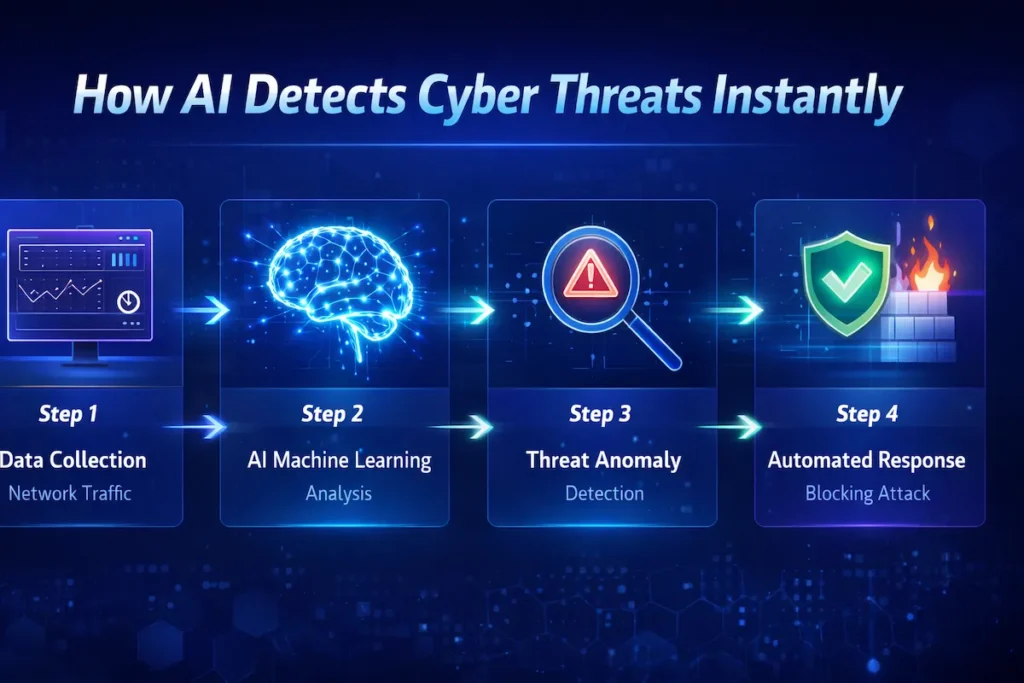
AI-powered threat detection tools detect cyber threats in real time by using artificial intelligence and machine learning to analyze network traffic, user behavior, endpoint activity, and cloud workloads. They identify suspicious patterns, prioritize high-risk alerts, and automate responses to stop attacks before they cause significant damage.
Behavior-Based Threat Monitoring
Behavior-based monitoring is one of the core capabilities that makes modern AI threat detection platforms more effective against evolving threats than purely rule-based alternatives. The system establishes a behavioral baseline for every user, device, and application across your environment. When someone logs in from an unusual geography, accesses files outside their normal pattern, or transfers large data volumes at 2 a.m., the system flags it immediately—not hours or days later.
This is particularly critical for startups with distributed teams. Remote employees, contractors, and third-party integrations introduce behavioral complexity that rule-based tools have no reliable framework to track. A contractor who suddenly accesses your entire customer database over a weekend looks normal to a firewall. To a behavior-based AI system, it’s an immediate red flag.
Anomaly Detection and Predictive Security Analytics
This predictive capability separates advanced threat detection platforms from systems that only react after an attack is already underway.
Anomaly detection cybersecurity goes further than reactive flagging. Predictive cyber threat detection identifies early warning signals—unusual DNS requests, quiet reconnaissance scans, and subtle privilege escalation attempts—and surfaces them before an attack fully materializes.
Darktrace, for example, uses unsupervised machine learning to detect anomalies without requiring pre-labeled training data. This approach can help identify previously unseen or anomalous behavior that may not match established threat signatures.
Combined with active cyber threat intelligence feeds, these systems give startups a proactive security posture — catching attack precursors before they become breach events.
Best AI-Powered Threat Detection Tools for Startups to Consider in 2026
AI-powered threat detection tools for startups can combine capabilities such as real-time threat detection, automated response, behavioral analytics, and cloud security. Options such as CrowdStrike Falcon, SentinelOne, Microsoft Defender for Business, Vectra AI, and Darktrace offer different approaches, capabilities, deployment models, and pricing structures for different business needs.
Choosing the right platform depends on your team size, cloud environment, budget, and technical capacity. Here is a detailed breakdown of the leading platforms, followed by a comparison table for rapid evaluation.
Darktrace AI Security Platform
Darktrace is particularly suited to complex or rapidly scaling environments where startups need autonomous threat detection with limited security staff.
Darktrace is among the most recognized names in autonomous AI network security. Darktrace uses machine learning and behavioral analysis to establish an understanding of activity across an organization’s digital environment and identify anomalous behavior in real time.
Key features: Autonomous response engine (Antigena), email security, and cloud and endpoint coverage across hybrid environments.
Startup use case: Well suited to startups that want automated threat detection and response capabilities with less reliance on manual security monitoring.
Advantages: Designed to identify anomalous behavior and previously unseen attack patterns without relying exclusively on known signatures; automated response capabilities can help contain certain suspicious activity with less manual intervention.
Limitations: Premium pricing; initial calibration period can generate elevated alert noise while the system learns your baseline.
Pricing: Custom quotes based on the size and requirements of the environment. Pricing can vary depending on the products, modules, coverage, and licensing arrangement selected.
| Decision Factor | Recommendation |
|---|---|
| Best For | Mid-sized and enterprise startups with hybrid, cloud, or multi-cloud environments that need AI-driven network, cloud, identity, and email threat detection. |
| Not Ideal For | Early-stage startups or small businesses with limited budgets and basic security requirements. |
| Deployment | Cloud, On-Premises, Hybrid, Multi-Cloud |
| Free Trial | Demo Available (Contact Sales) |
| Pricing | Custom Quote |
| TrusteraAI Verdict | Best for fast-growing startups that need self-learning detection to identify anomalous behavior, advanced threats, insider risks, and previously unseen attack patterns across complex environments. |
TrusteraAI Recommendation: Choose Darktrace if your startup has a growing cloud infrastructure, multiple users, and needs autonomous AI-powered threat detection with minimal manual monitoring. For very small startups with tight budgets, more affordable endpoint-focused solutions may be a better fit.
CrowdStrike Falcon AI Protection
CrowdStrike Falcon is a strong option for SaaS and cloud-native startups that need endpoint and identity security from a cloud-based platform.
CrowdStrike Falcon is a cloud-native endpoint protection platform built on AI and behavioral analytics. Its cloud-native architecture combines endpoint detection and response with threat intelligence and identity protection capabilities, making it a strong option for startups seeking broad endpoint security coverage.
Key features: AI-driven endpoint detection and response (EDR), threat intelligence feeds, identity threat protection.
Startup use case: Excellent for SaaS startups needing robust endpoint and identity security with strong compliance alignment.
Advantages: Industry-leading threat intelligence; fast deployment; strong audit trail for compliance requirements.
Limitations: Can be cost-prohibitive for pre-revenue or very early-stage startups operating on minimal security budgets.
Pricing: CrowdStrike offers multiple Falcon packages, with pricing varying by product tier, endpoint coverage, and additional modules. Check current vendor pricing for the package that matches your environment.
For SaaS-specific security considerations and deployment patterns, the AI security tools for SaaS startups in 2026 guide covers platform selection across different infrastructure models in detail.
Best For: Startups with 50–500 employees that need enterprise-grade endpoint protection and have the budget for a premium security platform.
Not Ideal For: Bootstrapped startups or small teams looking for a low-cost security solution.
| Decision Factor | Recommendation |
|---|---|
| Best For | Fast-growing startups with 50–500 employees |
| Not Ideal For | Very small startups with limited budgets |
| Deployment | Cloud |
| Free Trial | Demo Available |
| Pricing | Custom Quote |
| TrusteraAI Verdict | Best overall for startups needing enterprise-grade endpoint protection. |
SentinelOne Autonomous Cybersecurity
SentinelOne is a strong choice for startups seeking autonomous endpoint protection without a dedicated internal security team.
SentinelOne provides endpoint detection, response, and remediation capabilities, including automated actions that can reduce the need for constant manual intervention. Its Singularity platform unifies endpoints, cloud workloads, and identity management in a single console.
Key features: autonomous threat response, one-click rollback capability, cloud security posture management, and strong API access.
Startup use case: Ideal for startups that need “deploy and protect” security with minimal ongoing management overhead.
Advantages: Automated remediation capabilities can reduce manual intervention; broad cloud workload coverage; developer-friendly API.
Limitations: The reporting interface has a learning curve for non-technical founders reviewing security posture.
Pricing: SentinelOne offers multiple Singularity packages, with pricing varying by package, endpoint coverage, contract terms, and selected capabilities. Verify current vendor pricing for the package that matches your environment.
Best For: SaaS startups that need AI-powered endpoint detection with minimal security staff.
Not Ideal For: Organizations looking for a free security solution.
Microsoft Defender AI Security
For Microsoft-centric teams, Defender offers an accessible AI-driven security option that can provide strong endpoint protection without introducing another security platform.
Microsoft Defender for Business is an accessible endpoint security option built into the Microsoft 365 ecosystem, with security capabilities that use threat intelligence, machine learning, and automated detection. For startups already operating within Microsoft’s environment, it delivers solid integrated security without adding vendor complexity or a separate management console.
Key features: AI-driven endpoint protection, vulnerability management, threat analytics, integrated identity security.
Startup use case: Best for Microsoft-centric startups wanting native AI security without purchasing a separate platform.
Advantages: Strong Microsoft 365 integration; straightforward deployment for organizations already using eligible Microsoft plans; Defender for Business can be included with certain Microsoft 365 subscriptions.
Limitations: Substantially less effective outside the Microsoft ecosystem; fewer advanced features than purpose-built security platforms.
Pricing: Microsoft 365 Business Premium pricing varies by billing arrangement and region; Defender for Business is included with eligible Business Premium subscriptions.
Best For: Startups already using Microsoft 365 that want affordable security without deploying a separate endpoint protection platform.
Not Ideal For: Companies running primarily on Linux or mixed cloud environments.
| Decision Factor | Recommendation |
|---|---|
| Best For | Startups already using Microsoft 365 |
| Not Ideal For | Linux-first environments |
| Deployment | Cloud |
| Free Trial | Yes |
| Pricing | Subscription-based |
| TrusteraAI Verdict | Best value for Microsoft-centric startups. |
Vectra AI Threat Detection
Vectra AI is particularly relevant for startups running hybrid or multi-cloud infrastructure where network-level threat detection is a priority.
Vectra AI specializes in network detection and response (NDR), using AI-driven behavioral analysis across cloud, hybrid, and on-premises environments to help identify attacker behaviors such as lateral movement, privilege abuse, and other suspicious activity.
Key features: Attack signal intelligence, hybrid cloud environment coverage, and automated threat prioritization to reduce analyst workload.
Startup use case: Strong fit for startups with complex hybrid or multi-cloud environments where network visibility is the primary gap.
Advantages: AI-driven detection and prioritization of attacker behaviors such as lateral movement and privilege abuse, designed to help security teams focus on higher-risk activity.
Limitations: Network-focused rather than endpoint-first; maximizing the platform requires some analyst experience.
Pricing: Custom enterprise pricing; contact sales directly for startup-specific packages.
Best For
Mid-sized and enterprise startups with hybrid or multi-cloud environments that need AI-driven network, identity, and cloud threat detection without relying only on endpoint security.
Not Ideal For
Bootstrapped startups or very small teams that have a limited cybersecurity budget or only need basic endpoint protection. Vectra AI is designed for organizations with more complex environments and security operations.
TrusteraAI Verdict
Best for fast-growing startups that already have cloud infrastructure and need advanced behavioral threat detection, attack prioritization, and reduced alert fatigue. It may be more than early-stage startups need if they have only a handful of devices and limited security requirements.
| Decision Factor | Recommendation |
|---|---|
| Best For | Cloud-native and hybrid startups with growing security needs |
| Not Ideal For | Early-stage startups with basic security requirements |
| Deployment | Cloud, Hybrid, Multi-cloud |
| Free Trial | Demo Available |
| Pricing | Custom Quote |
| TrusteraAI Verdict | Excellent for advanced AI-driven network and identity threat detection. |
AI-Powered Threat Detection Tools: Startup Comparison Table
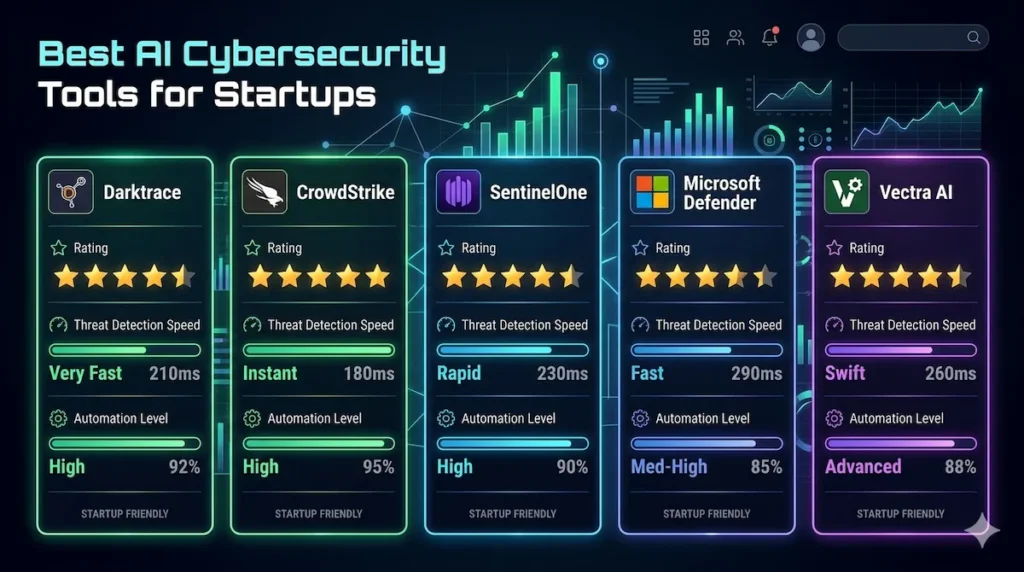
| Tool | Best For | Starting Price | Deployment Complexity | Automated Response | Ideal Team Size |
|---|---|---|---|---|---|
| Darktrace | Novel/zero-day threats | Custom (SMB tiers available) | Medium | Yes | 10–200+ |
| CrowdStrike Falcon | Endpoint + identity security | Custom / varies by package | Low | Yes, depending on package/modules | 5–500+ |
| SentinelOne | Autonomous protection | $69.99/endpoint/year* | Low–Medium | Yes | 5–200+ |
| Microsoft Defender | Microsoft-native environments | Included with eligible Microsoft 365 plans | Very Low | Yes, depending on configuration/licensing | 1–100 |
| Vectra AI | Hybrid/multi-cloud networks | Custom | Medium–High | Automated response/integration capabilities | 25–500+ |
*Vendor pricing can change and may vary by package, contract, region, or licensing terms. Verify current pricing before purchasing.
For a complete feature-by-feature breakdown, including trial availability and support quality, the best AI security tools for startups 2026 guide covers each platform in granular detail.
Benefits of AI-Powered Threat Detection Tools for Startups
AI-powered threat detection tools help startups identify and respond to cyber threats faster using artificial intelligence and machine learning. They improve security by reducing response times, detecting advanced attacks, minimizing false positives, automating routine tasks, and protecting critical business data with limited security resources.
Automated Threat Monitoring
Automated monitoring is one of the most valuable capabilities these platforms provide from the first day of deployment.
Security automation for startups delivers one immediate, non-negotiable operational benefit: your environment is monitored continuously without overnight staff or expensive managed security service providers. Automated cyber defense tools handle alert generation, initial triage, and, in many platforms, basic containment—all without human intervention as a prerequisite.
In working with early-stage teams, I’ve consistently seen founders underestimate how much security coverage they lose outside business hours. Security teams may face greater response challenges outside normal business hours, making continuous monitoring particularly valuable for startups with limited security coverage. Automation helps reduce that coverage gap by providing continuous monitoring outside normal business hours.
Faster Cyber Attack Detection
Faster detection is one of the clearest advantages AI-powered security platforms provide over manual monitoring and legacy security systems.
Time-to-detection is one of the most consequential metrics in cybersecurity outcomes. Traditional security approaches can leave organizations with significant detection and response gaps, particularly when alerts depend heavily on manual investigation. AI-powered systems can reduce the time required to identify suspicious activity by continuously monitoring telemetry and prioritizing anomalous behavior, potentially reducing the exposure window during an incident.
Reduced Security Team Workload
By handling alert triage and, in some cases, initial response automatically, these platforms allow small teams to maintain broader security coverage without adding equivalent security headcount.
Most startups don’t have dedicated security teams — and realistically, most don’t need to build one from scratch if they implement AI threat detection properly. These platforms handle continuous monitoring, alert triage, and initial response automatically, allowing your developers and IT generalists to stay focused on building product rather than chasing security alerts.
Limitations of AI-Powered Threat Detection Tools for Startups
AI-powered threat detection tools improve cybersecurity but are not a complete security solution. They can generate false positives, require quality data for accurate detection, involve implementation costs, and still need human expertise to investigate complex incidents and make critical security decisions.
False Positives and Alert Fatigue
Alert fatigue is one of the most underestimated challenges when deploying AI-powered security platforms, so startups should establish alert-prioritization and escalation processes from the beginning.
No AI security system is perfect. Machine learning models sometimes flag legitimate behavior as suspicious—particularly during the initial calibration period while the system learns your environment’s normal patterns. High false-positive rates lead to alert fatigue, where teams begin dismissing notifications without proper review. That behavioral pattern is dangerous and actively exploited by attackers who understand it.
Prioritize platforms with strong alert prioritization, contextual scoring, and noise reduction features. Ask vendors specifically about their false-positive rates during onboarding periods before committing.
Implementation Complexity
Implementation complexity can prevent startups from realizing the full value of the security platforms they purchase.
Some enterprise-grade AI cybersecurity platforms require substantial configuration, integration work, and ongoing maintenance to perform at their rated capabilities. For startups without dedicated IT staff, implementation complexity can become a genuine barrier—even when the underlying product is strong.
Look explicitly for platforms with structured onboarding documentation, pre-built cloud integrations, and dashboards designed for teams without specialist security backgrounds.
Cost Considerations for Small Businesses
Understanding total cost of ownership is essential for startups operating with constrained security budgets.
While AI security tools are more accessible than at any previous point, premium platforms still carry meaningful costs that scale with team size. Per-seat or per-endpoint pricing models can become significant line items quickly as your headcount grows.
The affordable cybersecurity tools for startups resource provides a detailed breakdown of cost-effective options that maintain core protection capabilities without enterprise-level investment.
How Startups Should Choose AI-Powered Threat Detection Tools
Startups should choose AI-powered threat detection tools based on their budget, infrastructure, business size, security requirements, scalability, ease of deployment, and integration capabilities. The best solution should provide real-time threat detection, automated response, reliable support, and room to grow as the business expands.
Budget and Scalability
Budget alignment and long-term scalability are two of the most practical filters for narrowing down which AI security platforms make sense at each growth stage.
Start with your realistic 12-month security budget and identify platforms offering modular, usage-based pricing. Pay for what you need now and expand coverage as your infrastructure and team grow. Avoid locking into long-term enterprise contracts before you’ve validated actual usage requirements against your specific environment and workflow.
Integration With Cloud Infrastructure
Cloud compatibility is a non-negotiable requirement when evaluating AI security platforms for startups running AWS, Google Cloud, or Azure infrastructure.
If your startup runs on AWS, Google Cloud, or Azure, verify native integrations with those environments before shortlisting any platform. Poor cloud compatibility creates visibility gaps — and visibility gaps are precisely the blind spots sophisticated attackers probe for first. For a deeper look at cloud-focused protection, see our AI Cloud Security Solutions for Startups guide.
Ease of Deployment
Ease of deployment determines whether the selected platform actually gets implemented correctly—or sits misconfigured and underused.
Prioritize platforms with fast, well-documented deployment processes and responsive implementation support. The most technically impressive AI cybersecurity platform for startups is the one your actual team can configure, maintain, and respond to effectively. A sophisticated tool running misconfigured delivers worse outcomes than a simpler tool implemented correctly.
The AI security tools for small businesses guide walks through the full selection framework across these criteria with practical evaluation questions for each.
How Startups Can Implement AI-Powered Threat Detection Tools
Startups can implement AI-powered threat detection tools by assessing their security needs, selecting a solution that fits their budget and infrastructure, integrating it with existing systems, configuring security policies, training employees, and continuously monitoring alerts to improve protection against evolving cyber threats.
Step 1: Assess Startup Cybersecurity Risks
A thorough risk assessment ensures your selected threat detection platform is configured around the startup’s highest-priority vulnerabilities from the first day of operation.
Before purchasing any platform, map your actual attack surface with specificity. Identify where sensitive data lives, which systems are internet-facing, what third-party integrations you’re running, where access controls are weakest, and which team members have administrative privileges they may not actively need.
The NIST Cybersecurity Framework provides a free, widely respected structure for this assessment process—particularly well-suited to startups building their first formal security program without prior institutional security knowledge.
For a broader startup security baseline, see our Cybersecurity Checklist for Startups.
Step 2: Select the Right AI Security Platform
Matching risk findings to platform capabilities is what separates a strategic security investment from simply choosing a popular security product without evaluating environment fit.
Match your risk assessment findings directly to platform capabilities. A cloud-native SaaS startup has fundamentally different needs than a fintech startup processing payment data under PCI-DSS requirements. Prioritize platforms that address your highest-risk areas first, and always run a structured trial against real traffic in your environment before committing to a contract.
Recommended startup security stack by infrastructure type:
Example layered security architecture
These are example layers rather than a requirement to purchase every product listed.
- SentinelOne Singularity — autonomous endpoint and cloud workload protection
- Microsoft Defender for Business — identity and Microsoft 365 environment coverage
- AWS Security Hub — centralized signal aggregation across cloud workloads
- Darktrace or Vectra AI — network-level anomaly detection as the team scales past 25 people
Hybrid Infrastructure Startup (multi-cloud or on-premises):
- CrowdStrike Falcon — endpoint detection with strong identity protection
- Vectra AI — network detection and response across hybrid environments
- AWS Security Hub or Microsoft Sentinel — cloud-native SIEM for log aggregation and compliance
This layered approach can provide coverage across four important startup security areas: endpoints, cloud workloads, identity, and network security—without requiring a dedicated security operations center to manage them.
Step 3: Deploy and Monitor Threats Continuously
Continuous monitoring and regular recalibration help these platforms maintain appropriate detection accuracy and coverage as the environment evolves.
Realistic onboarding timeline for most AI security platforms:
| Timeline | Action |
|---|---|
| Day 1–2 | Install agents, connect cloud integrations, configure baseline settings and admin access |
| Day 3–5 | Review initial alert volume, tune false-positive thresholds, establish escalation workflow |
| Day 6–7 | Confirm full coverage across all endpoints, cloud workloads, and user accounts |
| Week 2–4 | Monitor behavioral baselines as system learns environment; adjust alert sensitivity |
| Month 2+ | Schedule first formal security review; evaluate coverage gaps against updated risk profile |
Security implementation should not be treated as a one-time event. Establish a regular review cadence appropriate to your risk profile and update configurations as your infrastructure evolves. AI systems perform best when calibrated continuously against your current environment, not the environment you had at deployment.
Real-World Use Case Scenarios
SaaS Startup Handling Payment Data
A 20-person SaaS startup processing payments needs strong endpoint protection, identity security, and monitoring aligned with PCI-DSS requirements. The recommended approach: CrowdStrike Falcon for endpoint and identity coverage; Microsoft Defender for Business across the Microsoft 365 environment; and Vectra AI, adding network-level monitoring if infrastructure spans multiple cloud regions.
This combination can provide broader coverage across endpoints, identity, cloud workloads, and network activity.
For startups handling regulated customer data, our AI Security Compliance Tools for SaaS Startups guide covers the compliance-focused security layer in more detail.
AI Startup With API-Heavy Architecture
An AI startup with significant API exposure faces a distinct risk profile—data exfiltration through API abuse, model theft, and supply chain attacks targeting development dependencies. SentinelOne’s autonomous response combined with Darktrace’s network anomaly detection creates a strong layered defense. AWS Security Hub centralizes signal aggregation across the cloud environment and simplifies compliance reporting.
Both scenarios benefit materially from automated cyber defense tools rather than manual monitoring processes. The speed and scale of modern attacks simply outpace human-only response capabilities—especially for teams where security is a secondary responsibility rather than a primary role.
Future of AI Cybersecurity for Startups
The future of AI threat detection is moving from reactive response toward predictive analytics and increasingly autonomous security operations.
Predictive Threat Intelligence
Predictive threat intelligence represents the next frontier of AI cybersecurity, helping organizations identify and harden potential attack paths before they are exploited.
The next evolution of AI threat detection moves beyond real-time response into genuine prediction. Advanced security platforms increasingly combine historical attack data, threat intelligence, and behavioral modeling to help organizations identify potential risks and suspicious activity earlier.
For startups, this represents a fundamental shift: from reactive security — responding after an alert fires — to proactive defense, where potential attack paths are hardened before they’re ever exploited. Some advanced security platforms offer capabilities that support predictive or proactive threat analysis, although the specific features available depend on the product, package, and configuration.
Autonomous Security Operations
Autonomous security operations could allow AI-powered security platforms to expand their detection, investigation, and response capabilities without requiring security headcount to grow at the same rate.
Autonomous security capabilities are increasingly being incorporated into security platforms, allowing AI-assisted systems to support detection, triage, investigation, and response while keeping human oversight in the security process.
SentinelOne and CrowdStrike continue to expand their AI-driven detection, investigation, and response capabilities.
As these capabilities mature, they may allow smaller security teams to expand their detection and response coverage without increasing headcount at the same rate. Startups that build AI-native security foundations today will be positioned to scale those capabilities automatically rather than rebuilding their security posture from scratch at each growth stage.

Frequently Asked Questions
Do startups really need AI-powered threat detection tools, or is basic security enough?
Basic security controls may not provide sufficient protection for startups handling customer data or valuable intellectual property, particularly as their infrastructure and attack surface grow. Modern AI-powered threat detection platforms provide continuous behavioral monitoring that can be difficult for small teams to maintain manually—and they can identify behavioral patterns that signature-based tools may not detect reliably.
Which AI security tool is the most affordable for early-stage startups?
Microsoft Defender for Business can be an accessible entry point for startups already using Microsoft 365 because Defender for Business is included with Microsoft 365 Business Premium. Microsoft also offers Defender for Business as a standalone option for eligible small and medium-sized businesses. Verify current Microsoft pricing and licensing terms for your region.
How do AI-powered threat detection tools differ from traditional antivirus software?
Traditional signature-based antivirus relies heavily on known threat indicators, while modern endpoint and AI-driven security platforms can combine behavioral analytics, machine learning, reputation signals, and other detection techniques. This distinction can be particularly important when defending against previously unseen attacks, insider threats, and advanced attack techniques designed to evade signature-based detection.
How long does it take to deploy an AI cybersecurity platform?
Most modern AI security platforms are designed for rapid deployment. Cloud-native endpoint platforms such as CrowdStrike Falcon and SentinelOne can often begin generating security telemetry shortly after deployment, although full configuration, integration, and behavioral tuning can take longer. Behavioral baselining and tuning can take additional time as the platform learns the environment and the security team adjusts detection policies and alert thresholds. Build in a one-week buffer before relying on the system as your primary threat detection layer.
Can AI threat detection tools replace a dedicated security team entirely?
Not entirely — but they dramatically reduce the headcount and specialist expertise required to maintain a strong security posture. Automated threat detection systems handle continuous monitoring, alert triage, and initial response automatically. Where human judgment remains essential: strategic security decisions, policy-setting, compliance planning, vendor evaluation, and incident response communication. Think of AI security platforms as multiplying the effectiveness of whatever security capacity you already have — not eliminating the need for human oversight at the strategic level.
What is the biggest mistake startups make when choosing AI security tools?
The most common mistake I see in working with early-stage SaaS teams is purchasing based on brand recognition rather than environment fit. The most sophisticated, best AI cybersecurity platform for startups is only effective if it integrates cleanly with your existing infrastructure, if your team can realistically manage it, and if the alert volume is calibrated appropriately to your size. Where a trial or evaluation program is available, run a structured evaluation against representative activity in your actual environment before committing to a contract.
What should startups look for when evaluating AI cybersecurity platforms?
The four most important evaluation criteria are cloud infrastructure compatibility (native integration with your existing stack), deployment complexity (realistic manageability for your team), alert quality (does it reduce noise or generate it?), and scalability (will pricing and features still work when you’re 10x larger?). Structuring a formal trial evaluation checklist before engaging vendors will dramatically improve the quality of your selection decision.
Are AI-powered threat detection tools for startups worth it?
Yes. AI-powered threat detection tools for startups are worth the investment because they help detect cyber threats in real time, reduce manual security workloads, and improve incident response. For startups with limited IT resources, AI-driven security can provide stronger protection against ransomware, phishing, insider threats, and other evolving cyber risks.
Is Microsoft Defender enough for startups?
Microsoft Defender for Business can be enough for startups that primarily use Microsoft 365 and need integrated endpoint protection. However, startups with complex cloud environments or advanced security requirements may need broader platforms that combine threat detection, behavioral analytics, and automated response capabilities.
Conclusion
The cyber threat landscape in 2026 gives startups no grace period for being small or for planning to “add security later.” Attackers actively target the security gaps that come with moving fast and scaling quickly — and a serious breach during the early stages can create financial, operational, legal, and reputational consequences that are difficult for a young company to absorb.
The best AI-powered threat detection tools for startups to adopt today are not a premium add-on reserved for post-Series B infrastructure budgets. They can form an important layer of responsible security operations, helping protect data and infrastructure while supporting customer trust and business continuity.
The platforms in this guide — Darktrace, CrowdStrike, SentinelOne, Microsoft Defender, and Vectra AI — represent different approaches to threat detection across budgets, team sizes, infrastructure environments, and technical requirements. Start with an honest assessment of your actual risk surface, match those findings to platform capabilities, and invest in a solution built to grow alongside your company rather than one you’ll outgrow in eighteen months.
The business case is straightforward: the potential financial and operational impact of a serious breach can substantially exceed the cost of maintaining appropriate security controls. Security is not a cost center. At the startup stage, it is existential risk management.
Build it into your foundation now. The window to do it right — rather than rebuild it under pressure after an incident — is always shorter than founders expect.
Continue strengthening your security posture: explore the best AI security tools for startups in 2026 and the complete startup cybersecurity software comparison to make the most informed security investment for your stage.