
TrusteraAI Security Intelligence Team
Updated May 2025 · 15 min read · Reviewed by a senior DevSecOps architect
Executive Summary
5 Strategic Findings for Security and Engineering Leaders
<5%
Actionable Finding Rate
In mature DevSecOps environments, fewer than 5% of scanner findings require immediate remediation once exploitability, exposure, and privilege context are correlated.
Stage 1–2
Where Most Teams Start
Most enterprises enter this market at reactive or continuous scanning maturity. Platforms marketed as “autonomous” require Stage 3–4 readiness to operate safely.
40–60%
Audit Effort Reduction
Automated evidence generation cuts SOC 2 and ISO 27001 collection effort significantly — but does not replace auditor judgment or governance oversight.
68%
TCO Surprise Rate
Of post-deployment reviews cite integration engineering—not license cost—as the primary underestimated budget item in year one.
Core Finding: Most organizations don’t fail vulnerability management because they lack scanning tools. They fail because they lack the prioritization discipline and governance maturity to act on what those tools surface. The scanner is rarely the bottleneck — the remediation workflow is.
Most enterprise vulnerability programs were designed for infrastructure that changed monthly. Modern SaaS infrastructure changes every few minutes. That gap — between the cadence of security review and the velocity of software delivery — is precisely where breaches live.
A single misconfigured cloud resource. A container image built three sprints ago with an unpatched dependency. An undocumented API exposed during a microservices migration. Patterns documented across the NIST National Vulnerability Database consistently show cloud misconfigurations and unpatched application vulnerabilities among the leading breach entry points — not because organizations lack scanning tools, but because their scanning cadence cannot match their deployment velocity.
This is the structural problem that automated vulnerability scanning startups have been purpose-built to address—combining continuous scanning, AI-driven prioritization, DevSecOps-native workflows, and compliance automation into platforms designed for cloud-native scale. Before evaluating enterprise scanning platforms, organizations should establish baseline controls—our startup cybersecurity checklist for 2026 covers the groundwork these platforms are designed to reinforce.
Contrarian Insight
The scanning gap is overstated. The remediation governance gap is not there. Most enterprise vulnerability programs fail not because they lack detection coverage — they fail because findings enter queues where prioritization logic is absent, developer ownership is unclear, and remediation SLAs are undefined. Adding more scanning to a broken triage workflow accelerates the accumulation of unresolved findings. The scanner is rarely the bottleneck. The governance model around it almost always is.
What Are Automated Vulnerability Scanning Startups?
Automated vulnerability scanning startups are cybersecurity companies that continuously identify, classify, and prioritize security weaknesses across cloud infrastructure, application code, containers, APIs, and third-party dependencies. They differ from legacy vendors not primarily in what they scan, but in how deeply they integrate with the systems that generate vulnerabilities: software delivery pipelines, infrastructure-as-code repositories, container orchestration systems, and developer toolchains.
How They Work in DevSecOps Pipelines
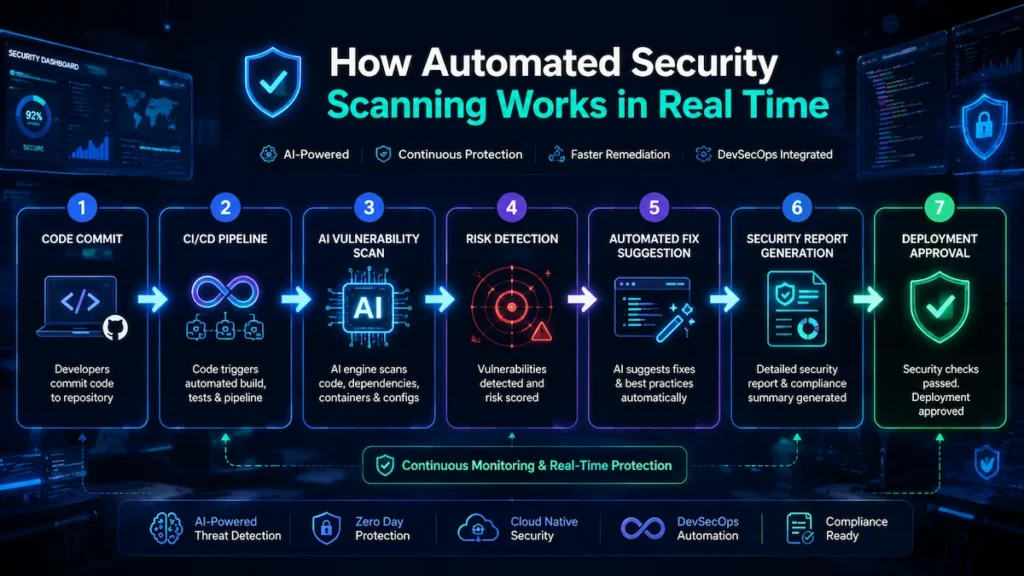
Automated vulnerability scanning startups integrate directly into DevSecOps pipelines to identify vulnerabilities before insecure code reaches production.
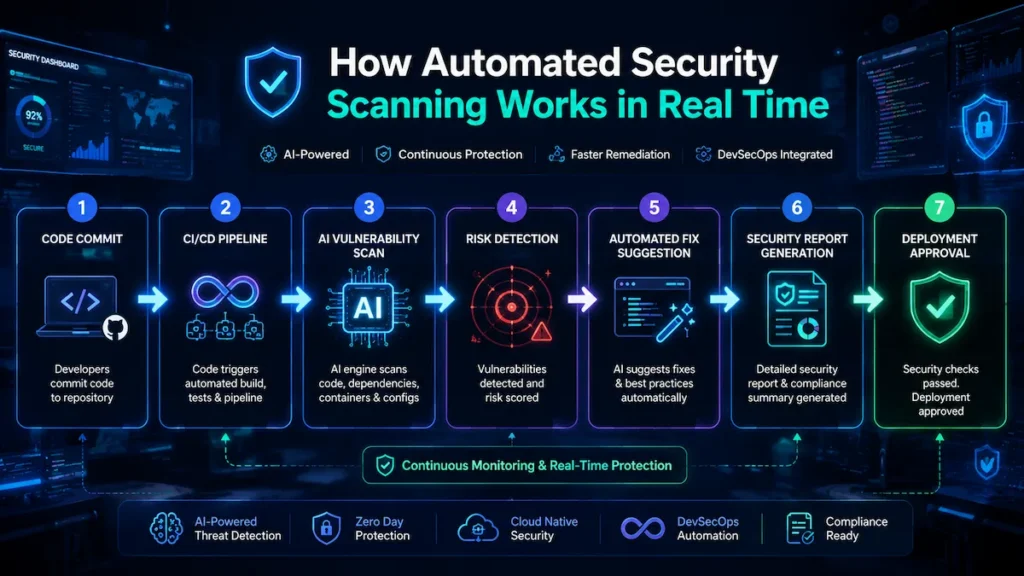
The operational model embeds security checks as native pipeline steps. A developer commits code; the scanner runs software composition analysis (SCA) against dependency CVEs, a SAST pass against the code itself, and a container image scan if a Dockerfile is present—all before the pull request merges. At the infrastructure layer, the platform continuously monitors cloud configuration against CIS Benchmarks, flagging drift in real time. The result: a shift from point-in-time vulnerability discovery to continuous security monitoring — what DevSecOps describes as “shifting security left.” For teams building this capability, our guide to securing a startup with AI tools covers the foundational architecture before scanning platforms are layered in.
Figure 1—Automated Scanning in a DevSecOps Pipeline Code Commits SCA · SAST secrets detection build & image container scan IaC analysis staging / TestDAST · API scan Configure the audit policy GateRisk threshold. Block / PassProductionRuntime monitoring · ASM continuous threat intel ↑ Findings feed SIEM, ticketing, and governance dashboards at every stage SCA = Software Composition Analysis · SAST = Static App Security Testing · DAST = Dynamic App Security Testing · ASM = Attack Surface Management
Why Enterprises Adopt These Startups
Enterprises adopt automated vulnerability scanning startups to reduce breach exposure, accelerate compliance readiness, and secure rapidly changing cloud infrastructure.
Three converging pressures drive adoption: cloud-native scale that exceeds manual audit capacity; regulatory requirements (SOC 2, ISO 27001, PCI DSS, GDPR) mandating continuous risk evidence; and the narrowing exploitation window. CISA’s Known Exploited Vulnerabilities catalog shows high-severity CVEs weaponized within days of public disclosure—a window no quarterly scan cycle closes. See our roundup of the best AI security tools for startups in 2026 for the broader ecosystem context.
Why Traditional Vulnerability Management Is Breaking Down
Legacy vulnerability management was designed for static, on-premises environments. A scan ran, a report generated, a ticket created, and a patch applied—on monthly or quarterly cycles. In cloud-native environments where infrastructure is rebuilt dozens of times per day, this model collapses structurally. By the time a ticket reaches a developer, the resource it describes may no longer exist.
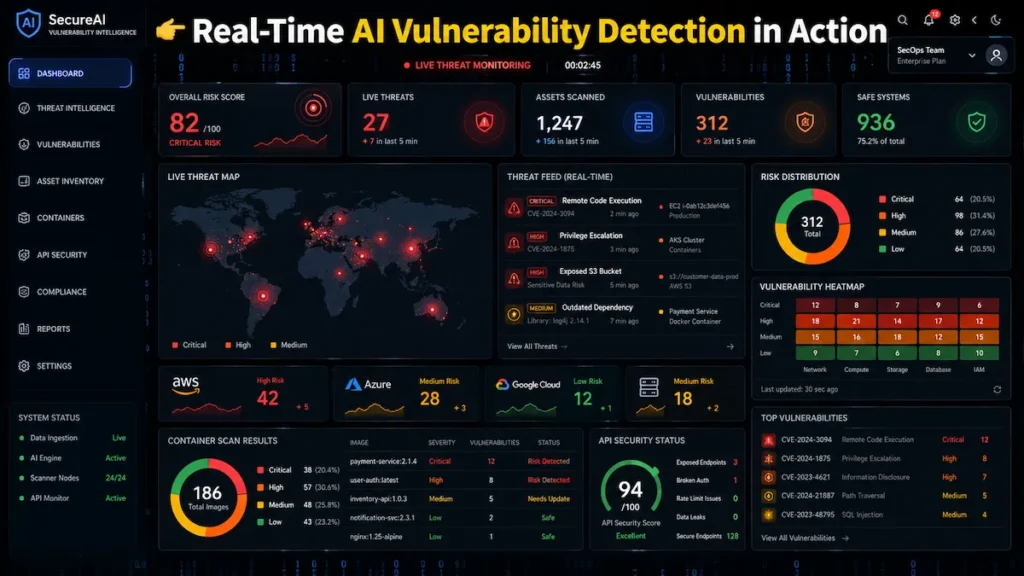
Unconfigured legacy scanners compound the problem with alert overload. A single scan of a mid-size cloud environment generates thousands of findings—most non-exploitable in context or already protected by compensating controls. In mature DevSecOps environments, security teams discover that fewer than 5% of findings require immediate remediation once exploitability, internet exposure, and privilege escalation context are correlated. Legacy tools surface all findings at equal urgency. When everything is critical, nothing is.
Container scanning, Kubernetes security, serverless analysis, and IaC scanning (Terraform, CloudFormation, and Pulumi) were retrofitted onto legacy platforms built for on-premise network scanning. The architectural mismatch creates coverage gaps and integration friction that cloud-native startups were built without from day one.
Industry Reference
The OWASP Software Assurance Maturity Model (SAMM) classifies automated scanning as a core practice in mature security programs. NIST SP 800-53 Rev. 5 continuous monitoring controls SI-7 and RA-5 directly correspond to capabilities these platforms provide.
Core Technology Stack
The core technology stack behind automated vulnerability scanning startups combines AI prioritization, cloud-native scanning, and continuous monitoring automation.
AI Vulnerability Detection & Risk Prioritization
Automated vulnerability scanning startups use AI-driven risk prioritization to help security teams focus on exploitable vulnerabilities instead of overwhelming alert volumes.
Leading platforms train ML models on CVE corpora, exploit databases, and MITRE ATT&CK framework technique mappings. These models identify patterns without assigned CVEs, predict exploit paths, and learn from team triage decisions over time. Critically, CVSS scores alone are insufficient: a CVSS 9.8 finding in an isolated dev environment is less urgent than a CVSS 7.0 finding in an externally exposed service processing customer PII. Risk-based models factor in asset criticality, network exposure, active exploitation intelligence, and compensating controls.
Continuous Monitoring & CI/CD Integration
Continuous monitoring capabilities allow automated vulnerability scanning startups to detect security risks in real time across CI/CD environments.
True continuous monitoring is event-driven—not scheduled polling. A new container image is pushed to a registry, a Terraform plan is applied, and an IAM role is created: each triggers a focused scan. This achieves dramatically lower MTTD without proportionally increasing infrastructure cost. Native integrations with GitHub Actions, GitLab CI/CD, Jenkins, and CircleCI then embed scan results as pipeline gates—policy-as-code defines which findings block deployments, which warn, and which log silently. For small and scaling teams, our guide on AI network security monitoring for small teams covers operationalizing continuous monitoring without enterprise headcount.
Container, Kubernetes, and API Coverage
Leading automated vulnerability scanning startups provide deep visibility into Kubernetes clusters, container workloads, APIs, and infrastructure-as-code environments.
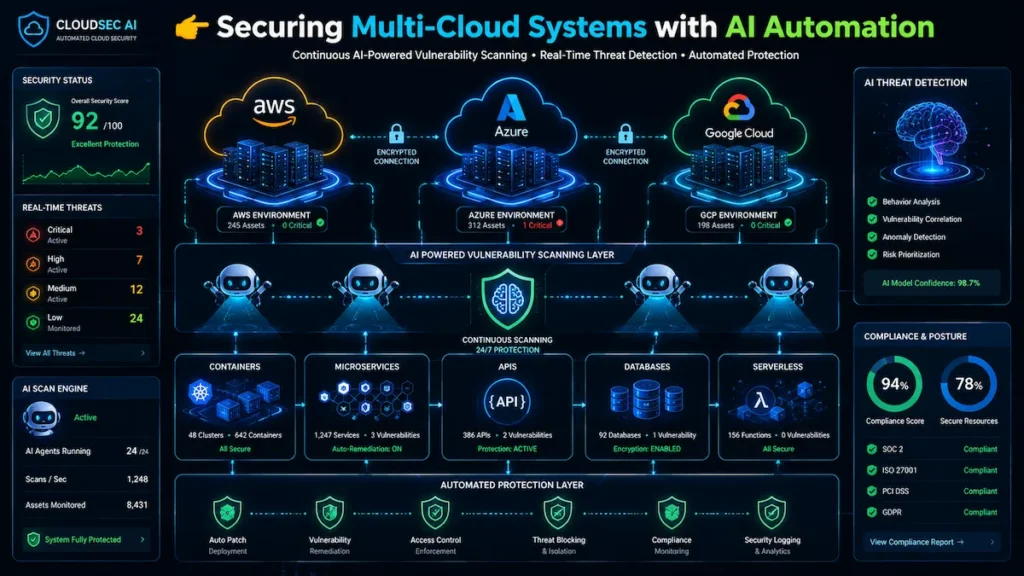
Container images inherit vulnerabilities from base images, package managers, and compiled dependencies. Leading platforms scan both images at rest in registries and running containers. Kubernetes scanning extends to RBAC misconfigurations, pod security policies, and secrets management — consistently among the most exploited cloud-native vectors in breach investigations. For API-heavy architectures, platforms with dedicated API attack surface monitoring discover undocumented endpoints, authentication gaps, and schema deviations. Organizations should also evaluate machine learning intrusion detection for startups as a complementary runtime detection layer.
The Vulnerability Automation Maturity Model (VAMM)
The most consistent operational mistake organizations make is deploying enterprise-grade platforms against a security program not mature enough to use them effectively. The VAMM—developed from observed enterprise DevSecOps implementations—maps the five stages of vulnerability automation maturity, their operational characteristics, and their limiting failure modes.
Vulnerability Automation Maturity Model (VAMM) TrusteraAI Framework
| Stage | Model | Operational Characteristic | Primary Limitation | Readiness Signal |
|---|---|---|---|---|
| Stage 1 Reactive | Scheduled scans | Quarterly/monthly reports; manual triage | Months between detection and remediation | First scan deployed |
| Stage 2 Continuous | Real-time scanning | Event-driven triggers; scan on every commit | Alert overload without prioritization | MTTD under 24 hours |
| Stage 3 Contextual | AI prioritization | Risk-scored findings; developer-facing results | Workflow fragmentation across toolchains | <5% findings need immediate action |
| Stage 4 Integrated | Full DevSecOps | CI/CD gates; compliance evidence automation | Vendor lock-in; integration maintenance | SOC 2 evidence auto-generated |
| Stage 5 Autonomous | Self-healing | AI agents handle routine triage & remediation | Governance risk from over-automation | Human review only on exceptions |
Figure 2—DevSecOps Risk Prioritization Pyramid (VAMM Stages): Autonomous Remediation, Integrated DevSecOps + Compliance Automation Contextual AI Prioritization & Risk Scoring: Continuous Real-Time Scanning (Event-Driven) Asset Inventory · Baseline Scheduled Scanning Stage 5 Stage 4 Stage 3 Stage 2 Stage 1
“Deploying a Stage 5 platform into a Stage 1 organization doesn’t accelerate maturity — it creates an expensive, under-governed scanner that generates findings nobody acts on.” — Observed across enterprise DevSecOps post-deployment reviews
Market Landscape & Platform Comparison
The market segments into four meaningful categories. AI-native startups (e.g., Orca and Wiz) built ML-first detection that correlates findings across code, infrastructure, and runtime layers—not retrofitted. DevSecOps platforms (e.g., Snyk, Semgrep) focus on developer workflow integration and CI/CD-native scanning. Container and Kubernetes specialists (e.g., Sysdig, Aqua) own cluster-native runtime protection. CSPM + vulnerability hybrids (e.g., Lacework, Prisma Cloud) provide unified cloud configuration and software vulnerability visibility that neither capability alone achieves. For budget-constrained teams, our guide to AI security tools on a startup budget covers how to sequence platform investments before committing to enterprise annual contracts.
| Category | Automation | Key Integrations | Compliance | AI Capability |
|---|---|---|---|---|
| AI-Native Startups | High | Cloud APIs, IaC, SIEM | SOC 2, ISO 27001, CIS | Native ML |
| DevSecOps Platforms | High | GitHub, GitLab, Jira, Slack | SOC 2 evidence gen. | AI-assisted |
| Container Specialists | High | Docker, K8s, ECR/GCR | CIS Kubernetes, NIST | AI-assisted |
| CSPM + Vuln Hybrid | High | AWS/Azure/GCP, Terraform | PCI, HIPAA, SOC 2, GDPR | Native ML |
| Legacy (Modernized) | Medium | Broad — agents + agentless | Comprehensive | Retrofitted AI |
Capability profiles reflect general category architectures. Conduct a proof-of-concept in your actual environment before any procurement decision.
How AI Is Transforming Automated Vulnerability Scanning
The highest-impact AI application in this space is not detection — it is prioritization. ML models trained on exploit timelines, threat actor behavior, and live threat intelligence can predict which newly disclosed CVEs will be weaponized within days, shifting programs from reactive to predictive. Risk engines that simultaneously consider exploit probability, asset criticality, network exposure, and lateral movement potential produce actionable prioritization that CVSS scores alone cannot replicate at enterprise scale.
“The real competitive advantage of AI-native platforms is not detection breadth—it is the ability to tell a security team which 40 findings out of 4,000 matter today.”
Beyond prioritization, leading platforms are extending into automated remediation: PR-level dependency fixes, IaC corrections for cloud misconfigurations, and RBAC policy suggestions. These require explicit governance—automated changes to production infrastructure carry their own risk profile and must operate within well-defined policy boundaries. Teams that skip governance frameworks here routinely encounter automation-induced incidents that erode trust in the entire scanning program.
AI security agents — software components that query systems, create tickets, and escalate findings based on policy without per-step human instruction — are moving into early production deployment at mature organizations. The value proposition: routine triage and escalation handled autonomously, freeing security engineers for threat modeling, architecture review, and governance decisions that require contextual judgment automation cannot substitute.
Enterprise Benefits
<24h
Detection Speed
Continuous event-driven scanning reduces MTTD from weeks to hours in well-configured implementations.
92–98%
Noise Reduction
AI prioritization shrinks thousands of raw findings to tens of genuinely exploitable, actionable items.
40–60%
Compliance Effort Cut
Automated evidence generation reduces SOC 2 and ISO 27001 audit preparation effort significantly.
Stage 3
ROI Threshold
Organizations reaching contextual AI prioritization maturity within 12 months consistently report positive ROI.
SOC 2, GDPR, and Regulatory Compliance
Automated vulnerability scanning startups help enterprises maintain continuous compliance evidence for SOC 2, GDPR, ISO 27001, and PCI DSS requirements.
SOC 2 Type II audits require demonstrating that security controls operated continuously—not just that they exist. Automated scanning generates the ongoing evidence mapped to Common Criteria controls CC6, CC7, and CC8 that auditors require. Evaluate the best SOC 2 compliance tools for AI startups alongside your scanning platform selection — compliance automation and vulnerability management have become interdependent capabilities. For organizations under GDPR jurisdiction, continuous scanning directly supports Article 32 obligations for appropriate technical measures. See our guide to the best GDPR compliance tools for startups for integrated evidence management across regulatory frameworks.
Risks, Limitations, and Failure Scenarios
Before deploying automated vulnerability scanning startups, organizations should evaluate governance readiness, integration complexity, and remediation ownership models.
Read Before Deploying
Security teams that adopt these platforms without understanding their limitations create a false sense of security more dangerous than acknowledged gaps. Every failure mode below is drawn from real implementation patterns.
AI false negatives: ML models are trained on known patterns. Novel attack techniques, zero-day exploits, and bespoke attack chains targeting custom application logic can evade automated detection entirely. AI scanning excels at scale and speed for known vulnerability classes — it is not a substitute for human threat modeling of complex systems.
Over-automation dependency: Organizations that allow scanning to replace rather than augment security expertise risk skill atrophy. When scanners are down, when a new attack surface emerges unconfigured, or when a sophisticated adversary deliberately avoids triggering detections, teams without deep foundational knowledge are unable to respond. The tooling amplifies human capability — it does not replace it.
Integration complexity: Enterprise environments are not clean slates. Legacy applications, air-gapped systems, and non-standard stacks frequently fall outside cloud-native scanning coverage. Integration complexity is cited in 68% of post-deployment reviews as the primary underestimated cost — exceeding license fees in year one.
🚩
Red Flag: “100% Coverage” Claims
No platform covers every attack surface. Ask for explicit scope exclusions before evaluating. Vendors who cannot provide them are defining “coverage” narrowly.
🚩
Red Flag: Proprietary Finding Formats
Platforms that cannot export in SARIF or CycloneDX create lock-in that compounds annually. Data portability must be a procurement requirement, not a post-contract negotiation.
🚩
Red Flag: No POC in Your Environment
Vendor demo environments are optimized for performance. Require a 30-day proof-of-concept against your actual infrastructure. False positive rates in production consistently exceed demo rates.
🚩
Red Flag: Auto-Compliance Reports
Automated scanning data is evidence, not compliance. Treating auto-generated SOC 2 or ISO 27001 reports as audit-ready without governance review is a documented failure mode.
Vendor lock-in: Proprietary data formats, non-portable policy configurations, and deep workflow integrations create switching costs that compound year over year. Evaluate data portability terms and contractual data ownership rights before signing.
Enterprise Procurement Framework
Procurement decisions fail most often not during technical evaluation, but during contract negotiation and deployment scoping. These are the questions security teams consistently wish they had asked before signing.
7 Critical Questions Before Purchasing
- What is your documented false positive rate in production environments comparable to ours? Ask for customer references in your industry vertical—false positive rates differ substantially between financial services, healthcare, and e-commerce environments.
- What does your coverage scope explicitly exclude? Mainframe systems, air-gapped environments, legacy custom stacks. Know the gaps before they become incident reports.
- What is your mean time to update detection logic after a new CVE is published? Vendors who cannot answer specifically are operating on batch-update cycles that widen your exploitation window.
- What are the contract terms governing data portability and export? Require SARIF/CycloneDX export capabilities and define data ownership contractually before signing.
- How is our data isolated in your multi-tenant architecture? For regulated industries, tenant isolation architecture directly affects compliance posture. Request documented diagrams, not marketing assertions.
- What does a full deployment look like with our technology stack? Ask for case studies from organizations with comparable legacy complexity to yours — not clean-slate reference implementations.
- What security certifications does your own platform hold? A vulnerability scanning vendor without SOC 2 Type II attestation for their own platform creates a trust contradiction that should end the conversation.
Pricing Models and What Teams Regret
Common pricing models: per-asset (per managed host, container, or cloud resource); per-developer-seat (common in CI/CD-first platforms); platform-tier (flat-rate feature bundles). Budget additionally for professional services—vendors typically charge $5,000–$25,000 for enterprise deployment support. Skipping this cost routinely results in higher total spend through extended tuning cycles.
⚠️
Regret: Underestimating Integration Work
Budget 2–4 weeks of dedicated engineering per major integration point — not hours. Most post-deployment reviews cite this as the biggest underestimated cost.
⚠️
Regret: Enabling Gates Too Early
Enabling hard CI/CD blocking before developer workflows are tuned generates adoption resistance that sets programs back by months. Run in observation mode first.
✅
Works: Phased VAMM Deployment
Visibility first, soft gates second, hard gates third. Organizations following this sequence consistently report faster adoption and less engineering friction.
✅
Works: Security Champions Model
Designating a security champion per engineering team — someone who understands both the tool and the codebase — consistently outperforms top-down mandates.
Expert Evaluation Decision Framework
Security accuracy: Verify false positive and false negative claims through a POC against your actual environment — not a vendor demo. Configure with real complexity: legacy dependencies, polyglot codebases, and custom components.
DevOps integration depth: Evaluate as a workflow assessment, not a checkbox. An integration requiring ten minutes of configuration per repository is functionally weaker than one developers can enable in two minutes. Developer experience quality determines real adoption rates — and a platform developers work around produces a false security posture.
Compliance coverage: Map reporting capabilities to your specific audit requirements before purchase. Request sample audit evidence packages. Verify that the platform supports the exact control framework versions your auditors use—compliance frameworks update, and vendor mapping frequently lags by 12–18 months.
Multi-cloud depth: Evaluate AWS, Azure, and GCP coverage independently. Ask specifically how quickly the platform adds coverage for newly released cloud services—the gap between provider releases and vendor detection coverage routinely runs six to twelve months.
Total cost of ownership: Factor in implementation engineering, integration maintenance, ongoing tuning, and training alongside license costs. Platforms with lower sticker prices but higher operational overhead frequently carry higher three-year TCO—a pattern that repeats consistently in enterprise security tool post-mortems.
Real-World Use Cases
Real-world deployments show how automated vulnerability scanning startups improve cloud visibility, accelerate DevSecOps adoption, and streamline compliance workflows.
SaaS Startup Security Scaling
Automated vulnerability scanning startups allow SaaS companies to strengthen security posture without building large internal security teams early on.
For startups scaling from seed to Series B without a dedicated security team, automated scanning with low-friction developer integration enables continuous vulnerability visibility and SOC 2 evidence generation — without a full-time security engineer as the first security hire. Selection criterion: a platform whose developer experience matches the existing toolchain so adoption happens organically, not through mandate.
Enterprise DevSecOps Transformation
Large enterprises modernizing from waterfall security models use automated scanning as the anchor for DevSecOps transformation programs. Phased VAMM deployment — visibility, then soft gates, then hard gates — manages developer resistance while improving security posture. Top-down mandated tooling without developer input consistently generates the adoption backlash that sets programs back months before they deliver value.
Cloud Migration Protection and Compliance Automation
Automated vulnerability scanning startups help organizations secure cloud migration projects while maintaining compliance visibility across hybrid environments.
Cloud migrations create a specific vulnerability window: On-premise controls do not automatically transfer, and the migration period generates configuration drift that static programs miss. Scanning tools configured during migration planning — not after go-live — catch misconfigurations at the point of greatest risk. For multi-framework compliance programs (SOC 2, ISO 27001, PCI DSS, and GDPR Article 32 simultaneously), integrated scanning-to-compliance evidence pipelines eliminate the redundant manual collection that consumes disproportionate team time across parallel audit cycles.
Future of Automated Vulnerability Scanning Startups
The trajectory points toward progressively autonomous security operations. Scanning is becoming a component of broader autonomous workflows where detection, prioritization, ticketing, and, in limited cases, remediation occur without human intervention for routine findings—reserving human judgment for complex decisions requiring contextual understanding of business operations and regulatory implications that AI models cannot reliably substitute.
Zero trust security automation and vulnerability scanning are converging: continuous identity and access verification generates signals that feed vulnerability prioritization (a vulnerable system hosting privileged credentials is a higher priority than its CVSS score suggests), while vulnerability data informs which systems can be trusted to handle sensitive workloads.
The frontier capability is genuine prevention — identifying code patterns, architecture decisions, and dependency choices likely to introduce vulnerabilities before the code is written. IDE plugins and PR review agents that guide design decisions toward secure patterns at the point of creation represent the ultimate expression of shifting security left. The governance frameworks for determining which remediation decisions are low-risk enough for autonomous handling remain the critical unsolved problem across the entire space.
Adoption Recommendation Framework
Adopt automation-first when: you deploy continuously to cloud-native infrastructure; your engineering team significantly outnumbers your security team; you’re pursuing SOC 2 or ISO 27001 on a defined timeline; your current program relies on periodic scan reports reviewed weeks after generation.
Manual testing is still required for application logic vulnerabilities requiring business context, complex attack chain assessment, social engineering and physical security testing, and initial baseline assessments of previously unaudited systems. The NIST SP 800-115 security testing guide remains the authoritative reference for how automated and manual testing should complement each other in a mature program.
The evidence-based model is hybrid: automated scanning for continuous coverage, AI prioritization to focus human attention on exploitable risk, and human expertise for threat modeling, penetration testing, and governance decisions automation cannot substitute. The five adoption stages:
- Foundational: Deploy for visibility only. No gates. Establish baseline metrics and asset inventory.
- Integrated: Connect findings to developer ticketing. Begin SLA tracking for critical findings.
- Enforced: Implement soft CI/CD gates (block with documented override) for critical findings.
- Optimized: Enable AI prioritization, compliance automation, and executive risk reporting.
- Autonomous: Introduce AI agents for routine triage within governed policy boundaries.
Conclusion
The rise of automated vulnerability scanning startups reflects a structural shift in what enterprise security operations can feasibly achieve. In cloud-native environments, shipping code multiple times per day, continuous automated scanning is not an enhancement to traditional vulnerability management—it is the only viable operational foundation for it.
These platforms deliver measurable value: faster detection, dramatic noise reduction through AI prioritization, integrated DevSecOps workflows that surface vulnerabilities at the point of introduction, and compliance evidence generation that reduces SOC 2 and ISO 27001 audit burden by 40–60%. For the complete security architecture context, our guide to the best AI security tools for startups in 2026 maps where scanning platforms fit alongside the full investment portfolio.
They also carry real limitations: AI detection gaps on novel patterns, integration complexity in heterogeneous environments, vendor lock-in that compounds over time, and the governance failure mode of over-automation outpacing organizational maturity. The enterprises that capture full platform value treat these tools as force multipliers for skilled security teams — not replacements for the people who understand what the platforms cannot see.
Automated vulnerability scanning startups are becoming a critical layer in modern enterprise cybersecurity strategies built around cloud-native infrastructure and continuous delivery models.
Most organizations don’t fail vulnerability management because they lack scanners. They fail because findings enter queues where prioritization logic is absent, developer ownership is unclear, and remediation SLAs are undefined. Fix the governance model first. Then choose the scanner that integrates best with the workflow you have built to act on what it surfaces.
Frequently Asked Question
What are automated vulnerability scanning startups?
Automated vulnerability scanning startups are cybersecurity companies that continuously detect, classify, and prioritize vulnerabilities across cloud infrastructure, applications, APIs, containers, and CI/CD pipelines using AI-driven automation and DevSecOps integrations.
Why are automated vulnerability scanning startups replacing traditional vulnerability management tools?
Automated vulnerability scanning startups are replacing legacy vulnerability management tools because traditional quarterly or scheduled scanning cannot keep pace with modern cloud-native infrastructure that changes continuously through CI/CD pipelines and microservices deployments.
How do automated vulnerability scanning startups reduce alert fatigue?
Automated vulnerability scanning startups reduce alert fatigue by using contextual AI prioritization to filter thousands of raw findings into a smaller set of genuinely exploitable vulnerabilities based on exposure, exploitability, asset criticality, and threat intelligence.
Can automated vulnerability scanning startups fully replace manual penetration testing?
Automated vulnerability scanning startups improve continuous monitoring and vulnerability detection, but they cannot replace manual penetration testing for complex attack chains, business-logic flaws, social engineering risks, or advanced threat modeling.
What should enterprises evaluate before purchasing automated vulnerability scanning startups?
Before purchasing automated vulnerability scanning startups, enterprises should evaluate false positive rates, multi-cloud coverage, DevSecOps integration depth, compliance reporting capabilities, data portability, and total implementation complexity.
How do automated vulnerability scanning startups support SOC 2 and ISO 27001 compliance?
Automated vulnerability scanning startups support SOC 2 and ISO 27001 compliance by generating continuous evidence such as scan histories, remediation timelines, configuration monitoring, and policy enforcement records required during audits.
What is the biggest failure point when implementing automated vulnerability scanning startups?
The biggest failure point when implementing automated vulnerability scanning for startups is weak remediation governance—where findings lack prioritization logic, developer ownership, escalation workflows, and clearly enforced remediation SLAs.
What is the future of automated vulnerability scanning startups?
The future of automated vulnerability scanning startups includes predictive AI risk analysis, autonomous remediation workflows, security AI agents, runtime attack prevention, and deeper integration with zero trust and cloud-native security architectures.