
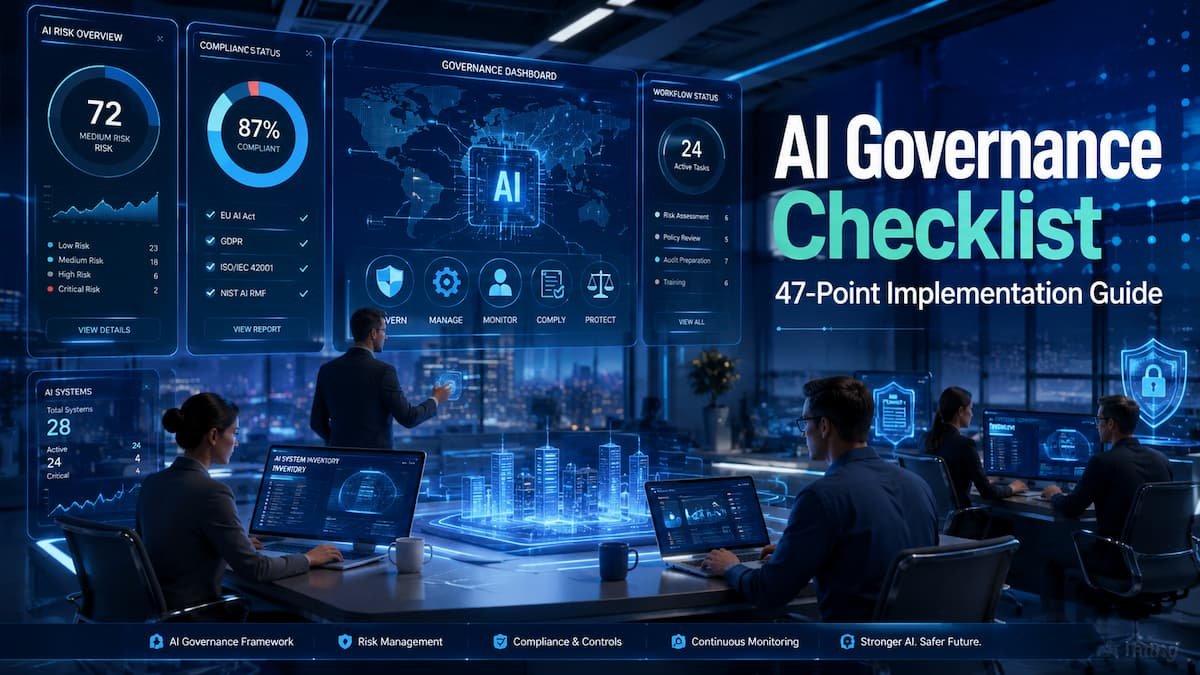
Reading Time: 18 minutes · Last Updated: July 2026 — reflects the EU AI Act implementation timeline available at publication.
Reviewed by: TrusteraAI Research Team — specializing in AI Governance, EU AI Act, ISO/IEC 42001, NIST AI RMF, and Enterprise AI Security.
✅ “At a Glance” Box
AI Governance Checklist at a Glance
47 Controls
7 Governance Layers
3 Templates
4 Original Diagrams
90-Day Implementation Roadmap
Aligned with:
EU AI Act
NIST AI RMF
ISO/IEC 42001
Quick Answer: What an AI Governance Checklist Must Cover
At minimum, a defensible AI governance checklist must address seven layers: AI system inventory, risk classification, data governance, human oversight, transparency, vendor management, and incident response.
An AI governance checklist should include:
- AI system inventory
- Risk classification
- Data governance
- Human oversight
- Transparency
- Vendor management
- Incident response
Miss any one and your AI governance program won’t hold up under a customer security questionnaire, an AEPD inquiry, an EU AI Act audit, or investor due diligence.
Executive Summary
Most “AI governance checklists” online are repackaged risk-management theory — long on principles, short on what to actually do on a Tuesday afternoon with a five-person engineering team.
This article is built on the TrusteraAI 7-Layer AI Governance Framework, structured around three converging sources of authority: the EU AI Act, the NIST AI Risk Management Framework, and ISO/IEC 42001.
You’ll leave with a complete AI governance program: a 47-control checklist, three ready-to-use templates, a maturity model, a RACI matrix, a cross-framework mapping table, governance KPIs, four visual diagrams, and a 90-day implementation roadmap.
This guide pairs with our enterprise AI governance framework guide and our enterprise AI security checklist.
✅ “What You’ll Learn”
By the end of this guide, you’ll know how to:
- Build an AI system inventory
- Classify AI systems under the EU AI Act
- Create human oversight processes
- Document AI systems for regulators and customers
- Track governance KPIs
- Implement a governance program in 90 days
Who This Guide Is For
This guide is written for SaaS founders, CTOs, product leaders, compliance managers, security leaders, and startup executives selling into the EU.
If your company uses AI internally or embeds AI into customer-facing products, this checklist is designed to help you build an operational AI governance program without creating unnecessary bureaucracy.
The $2M Question Most SaaS Founders Can’t Answer
A mid-sized SaaS company added an AI-powered support triage feature in early 2025. It classified incoming tickets, flagged churn risk, and auto-escalated “high-value” accounts to human reps.
Nobody classified it as a governance concern. It wasn’t hiring, it wasn’t lending — it was “just support routing.”
Eighteen months later, during Series B due diligence, the investor’s technical team asked a simple question: who owns this system, what data does it see, and what happens when it’s wrong?
The founding team didn’t have a clean answer. The system had quietly started influencing which customers got proactive discounts, built on a model nobody had re-reviewed since launch.
The round closed three weeks late, only after the company produced under pressure exactly the kind of documentation this article walks through calmly, in advance. This is the pattern behind most AI governance failures: not a dramatic breach, but a quiet accumulation of AI-driven decisions nobody was tracking.
AI Governance vs. AI Security vs. AI Risk Management vs. AI Compliance
Quick Answer
An AI governance checklist defines who owns AI systems, how risks are managed, and how compliance is maintained throughout the AI lifecycle. While AI security protects systems from threats, AI risk management evaluates potential impacts, and AI compliance ensures regulatory obligations are met. AI governance brings all of these functions together under one structured program.
These four terms get used interchangeably in vendor marketing, which creates real confusion about what a governance checklist is actually for.
| Concept | Core Question It Answers | Primary Owner (Typically) | Example Artifact |
|---|---|---|---|
| AI Governance | Who is accountable for this AI system, and how are decisions about it made? | Founder / designated AI owner | System inventory, oversight policy, this checklist |
| AI Security | Can this AI system be attacked, manipulated, or made to leak data? | Security/engineering lead | Threat model, prompt injection testing — see our enterprise AI security checklist |
| AI Risk Management | What could go wrong, and how severe would it be? | Risk owner / governance lead | Risk register, impact assessments |
| AI Compliance | Does this system satisfy specific legal or contractual obligations? | Legal / compliance owner | DPIA, AI Act conformity documentation |
An AI governance program is the umbrella. Security, risk management, and compliance are each a function within governance.
AI Governance Framework vs. AI Governance Checklist
Quick Answer
An AI governance checklist is the practical implementation tool, while an AI governance framework provides the overall structure, policies, and governance model. Organizations use the framework to define governance principles and the checklist to verify that every required control has been implemented.
A framework is the structure — the layers, principles, and roles that define your AI governance model. A checklist is the operational artifact derived from that framework — the specific items you check off during implementation.
Think of the framework as the blueprint and the checklist as the punch list. Most organizations skip straight to a checklist without a governance framework behind it, which is why controls end up disconnected — a classification step that doesn’t inform the oversight process, an incident log nobody ties back to risk tiering.
For a deeper look at how a full AI governance program comes together beyond this checklist — organizational design, executive reporting, board-level oversight — see our enterprise AI governance framework guide.
AI Governance Standards You Should Know
Quick Answer
A comprehensive AI governance checklist should align with recognized standards such as the EU AI Act, NIST AI Risk Management Framework (AI RMF), ISO/IEC 42001, OECD AI Principles, and GDPR. Together, these frameworks provide the foundation for responsible AI governance and regulatory compliance.
- EU AI Act — binding law, phased implementation, enforced in part by the European AI Office.
- NIST AI RMF — voluntary US framework built around four functions: Govern, Map, Measure, Manage.
- ISO/IEC 42001 — the first certifiable international standard for AI management systems.
- OECD AI Principles — non-binding international principles many national frameworks, including the EU AI Act, draw from conceptually.
- GDPR, enforced in Spain by the AEPD and coordinated across the EU by the EDPB — not AI-specific, but governs the personal data layer underneath most AI governance controls.
For most SaaS companies selling into the EU: EU AI Act and GDPR first, NIST AI RMF second (US enterprise buyers), ISO 42001 last (procurement differentiator, not a baseline requirement).
AI Governance Structure for SaaS Companies
Quick Answer
Every AI governance checklist should assign clear ownership for AI systems. Even small SaaS companies can establish effective governance by designating an AI owner, a technical reviewer, and a human oversight reviewer responsible for high-impact AI decisions.
For most SaaS companies under 50 people, a workable AI governance structure is three roles, not a department:
- A designated AI owner — accountable for the inventory, classification, and the overall governance program.
- A technical reviewer — responsible for data governance and vendor oversight.
- A human-in-the-loop reviewer for each system that makes consequential decisions — often a support, sales, or ops lead.
You don’t need a Chief AI Officer at seed stage. You need these three roles clearly assigned, even if one person holds two of them.
Why This Matters Now for US SaaS Founders Selling Into the EU
Quick Answer
An AI governance checklist helps SaaS companies prepare for evolving regulations, enterprise customer requirements, and investor due diligence. Implementing governance early reduces compliance risks and simplifies future audits under frameworks such as the EU AI Act and ISO/IEC 42001.
EU AI Act. GPAI obligations have applied since August 2, 2025. The compliance timeline for high-risk AI systems was pushed back from August 2026 to December 2027 following a political agreement reached in May 2026, giving most SaaS companies more runway than earlier guidance suggested. Euaiact
Transparency obligations for AI-generated content, including labeling, are still on track for December 2, 2026. The delay is real relief — but classification work is the slowest part of building an AI governance process, and it doesn’t get faster by waiting. Euaiact
NIST AI RMF. Not law, but the de facto reference framework US enterprise buyers and cyber insurers now expect vendors to reference in their AI governance documentation.
ISO/IEC 42001. Not mandatory, but increasingly requested in enterprise procurement — the AI-era equivalent of what SOC 2 became for cloud SaaS a decade ago.
For a company selling into Spain, the AEPD treats AI systems processing personal data as squarely within GDPR’s accountability principle. If you’ve worked through our Spain GDPR checklist for SaaS or use GDPR compliance software built for Spain-based startups, most of the data governance controls below are already partially in place.
The TrusteraAI 7-Layer AI Governance Framework
Quick Answer
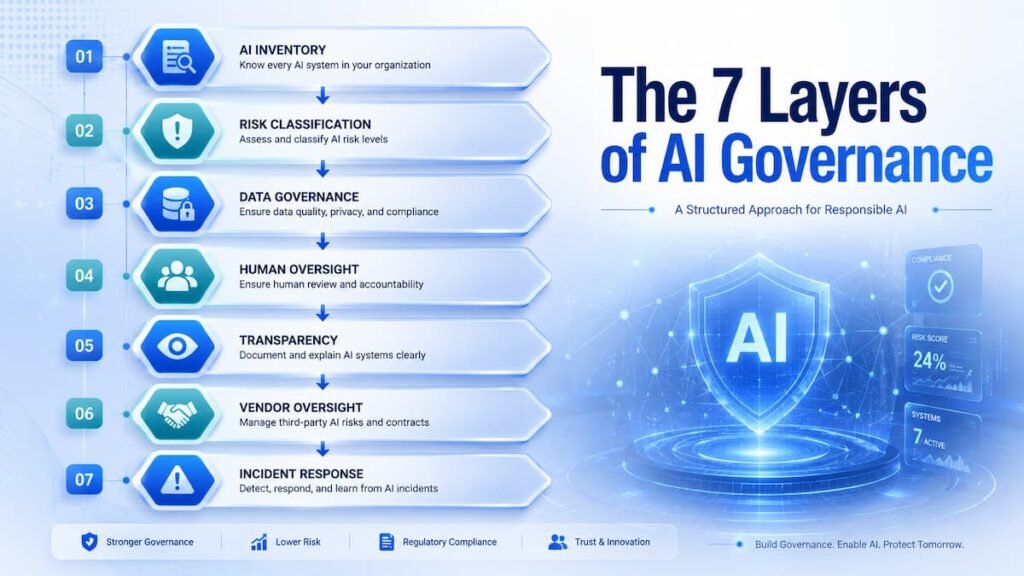
The TrusteraAI AI governance checklist organizes governance into seven connected layers: AI inventory, risk classification, data governance, human oversight, transparency, vendor oversight, and incident response. Together, these layers create a complete operational AI governance program.
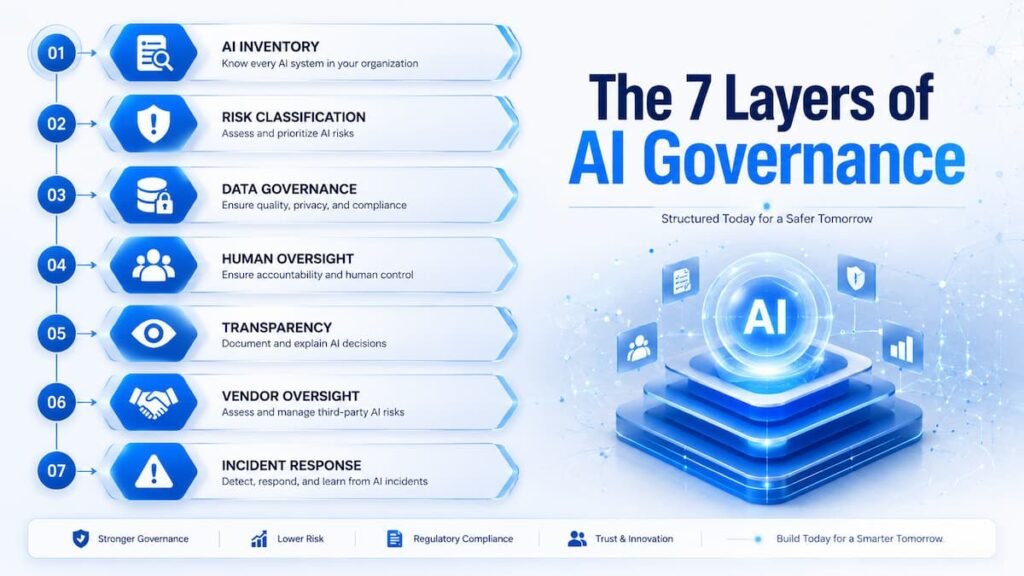
Rather than a flat list of 47 items, the governance model organizes controls into seven layers — each a distinct discipline, each satisfying obligations from more than one regulatory framework at once.
Figure 1. TrusteraAI 7-Layer AI Governance Framework — [Diagram: embed the 7-Layer Framework widget here]
Alt text: “TrusteraAI 7-Layer AI Governance Framework diagram showing inventory, classification, data governance, human oversight, transparency, vendor oversight, and incident response as a dependency stack.” Source: TrusteraAI.
Layer 1 — Inventory: know every AI system you have.
Layer 2 — Classification: know how risky each one is.
Layer 3 — Data: know what feeds each system and why that’s lawful.
Layer 4 — Oversight: know who can override the system when it’s wrong.
Layer 5 — Transparency: know you can explain the system to anyone who asks.
Layer 6 — Vendors: know your exposure through every AI tool you didn’t build.
Layer 7 — Incident Response: know what happens the day something breaks.
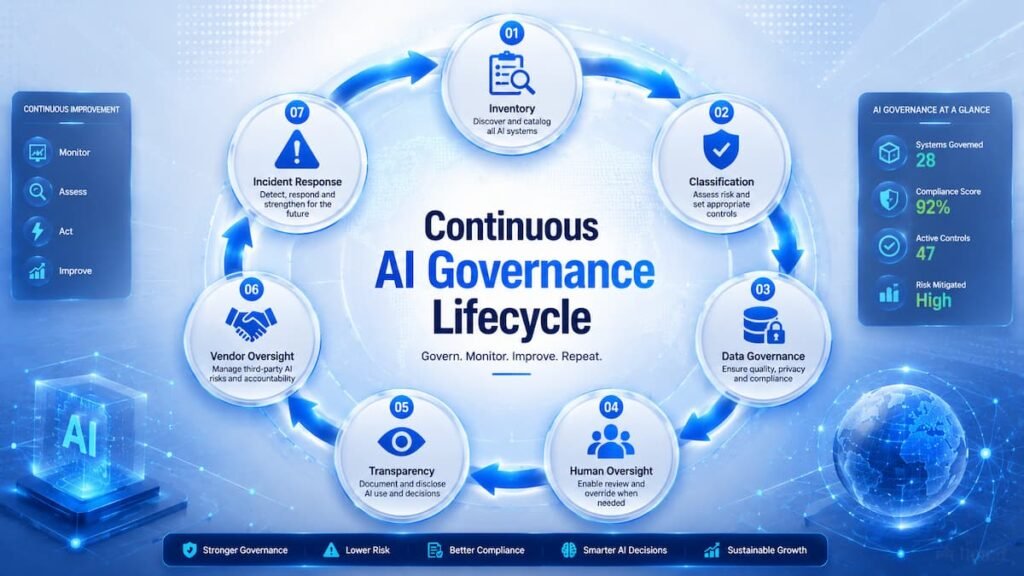
Each layer builds on the one before it. The full AI governance lifecycle repeats on a quarterly review:
Figure 2. AI Governance Lifecycle — [Diagram: embed the Lifecycle widget here]
Alt text: “AI Governance Lifecycle diagram showing seven stages in sequence, cycling back to inventory each quarter.” Source: TrusteraAI.
Cross-Framework Mapping: How the 7 Layers Map to EU AI Act, NIST AI RMF, and ISO 42001
Quick Answer
A well-designed AI governance checklist maps individual governance controls across multiple frameworks simultaneously. This reduces duplicate work while helping organizations satisfy the EU AI Act, NIST AI RMF, and ISO/IEC 42001 using one governance program.
| TrusteraAI Layer | EU AI Act | NIST AI RMF Function | ISO/IEC 42001 |
|---|---|---|---|
| 1. Inventory | Provider/deployer identification (Art. 3, 25) | Map | AI system scope (Clause 4) |
| 2. Classification | Risk-tier determination (Art. 6, Annex III) | Map | Risk assessment (Clause 6) |
| 3. Data Governance | Data & data governance (Art. 10) | Map, Measure | Data quality controls (Annex A) |
| 4. Human Oversight | Human oversight (Art. 14) | Manage | Operational controls (Clause 8) |
| 5. Transparency | Technical documentation (Art. 13, 50) | Govern, Map | Documented information (Clause 7) |
| 6. Vendor Oversight | Provider/deployer obligations (Art. 25) | Govern | Supplier relationships (Annex A) |
| 7. Incident Response | Post-market monitoring (Art. 72–73) | Manage | Continual improvement (Clause 10) |
If an auditor, customer, or investor asks which framework a control satisfies, the answer for most rows is: all three, at once.
The TrusteraAI AI Governance Maturity Model
Quick Answer
An AI governance checklist supports organizations as they progress from ad hoc governance to a fully managed and optimized AI governance program. Most SaaS startups begin at Level 1 or Level 2 and should aim to achieve Level 3 maturity.
Figure 3. AI Governance Maturity Model — [Diagram: embed the Maturity Model widget here]
Alt text: “AI Governance Maturity Model diagram showing five progressive levels from ad hoc to optimized.” Source: TrusteraAI.
| Level | Name | What It Looks Like | Typical Stage |
|---|---|---|---|
| 1 | Ad Hoc | No inventory, no reviews | Pre-seed to seed |
| 2 | Documented | Inventory exists, oversight inconsistent | Seed to Series A |
| 3 | Managed | Every system owned, classified, overseen | Series A to B |
| 4 | Measured | KPIs tracked on a fixed cadence | Series B+ |
| 5 | Optimized | Governance embedded in the dev lifecycle | Late-stage / regulated customers |
Most founders reading this sit at Level 1 or 2 of AI governance maturity. Aim for Level 3.
The AI Governance Checklist™ — 47 Controls Across 7 Layers
Layer 1: AI System Inventory (6 controls)
- Maintain a single register listing every AI/ML system in use.
- Record purpose, data inputs, data outputs, and business function for each.
- Identify systems that make or influence decisions about individuals.
- Assign a named individual owner to each system.
- Review the inventory quarterly at minimum.
- Flag any system added without a documented governance review at launch.
Use the AI Inventory Template to document every system before classification:
| System | Owner | Purpose | Data Touched | Risk Level (pending) | Last Reviewed |
|---|---|---|---|---|---|
| Support Triage Model | J. Alvarez (Support Lead) | Classifies & routes support tickets | Customer name, ticket text, account tier | TBD in Layer 2 | 2026-06-01 |
| ChatGPT (support macros) | M. Chen (Support Ops) | Drafts reply suggestions for agents | Ticket text (no PII by policy) | TBD | 2026-05-15 |
| Microsoft Copilot | Internal IT | General productivity, internal docs | Internal documents only | TBD | 2026-05-15 |
Implementation scenario: A company using Microsoft Copilot internally, ChatGPT for support macros, and a home-built recommendation model lists all three separately — the inventory captures adoption, not just development.
Layer 2: Risk Classification (7 controls)
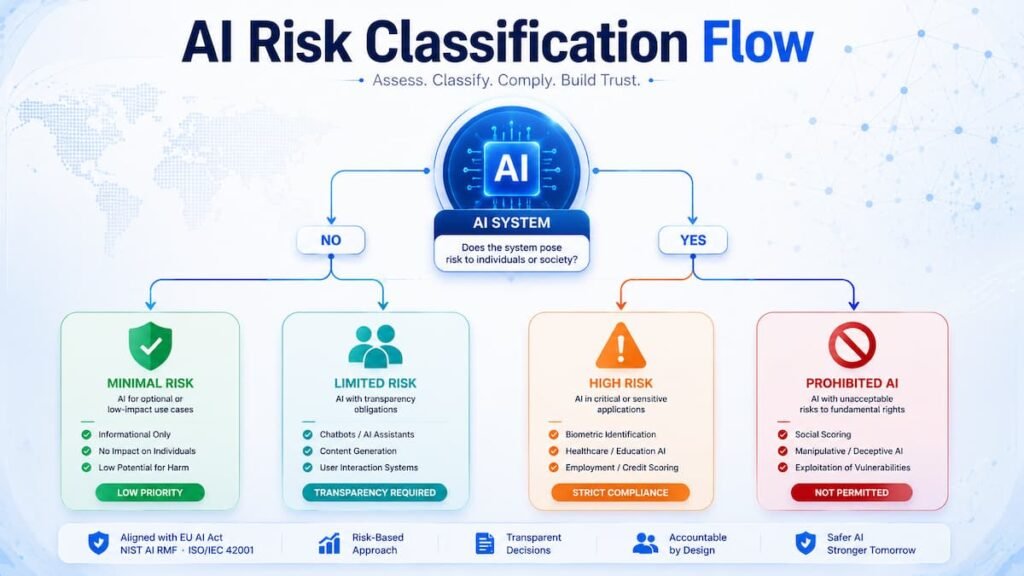
- Classify each system against the EU AI Act’s four-tier model.
- Document the reasoning for each classification.
- Re-classify when a system’s function changes materially.
- Identify systems subject to Article 50 transparency obligations.
- Cross-check against sector-specific rules for regulated verticals.
- Determine which market surveillance authority applies — for Spain: the AEPD. See our AEPD inspection guide for what an actual inquiry looks like.
- Track deadlines via the official EU AI Act page — high-risk at December 2027, transparency at December 2026.
Use the Risk Register:
| System | Risk Tier | Reasoning | Article 50 Applies? | Re-review Trigger |
|---|---|---|---|---|
| Support Triage Model | Limited-risk (trending toward consequential) | Influences discount eligibility, not purely informational routing | No (not customer-facing generative content) | If it starts directly approving/denying discounts |
| ChatGPT (support macros) | Limited-risk | Drafts suggestions; human sends final reply | Yes — AI-assisted content disclosure | If auto-send is enabled |
Figure 4. AI Risk Classification Decision Flow — [Diagram: embed the Decision Flow widget here]
Alt text: “AI Risk Classification Decision Flow diagram showing the branching logic from AI system to minimal, limited, or high-risk classification.” Source: TrusteraAI.
Implementation scenario: The support-triage system from the opening example would classify as limited-risk on its own. The moment it started influencing discount eligibility, it moved toward a consequential-decision system — which should have triggered re-classification, not a quiet feature update.
Layer 3: Data Governance for AI (7 controls)
- Map personal data feeding each AI system; confirm a lawful basis.
- Confirm training data excludes personal data without documented basis and DPIA where required. (For a full walkthrough of this step, see our AI DPIA for Spanish Startups guide — link pending publication.)
- Verify data minimization — systems get only the fields they need.
- Document retention periods for AI logs, prompts, and outputs.
- Confirm cross-border transfer mechanisms for non-EU AI vendors.
- Review whether AI output constitutes special category data.
- Ensure data subject rights processes cover AI-processed and AI-generated data.
Layer 4: Human Oversight (6 controls)
- Define, in writing, which AI decisions require human review before taking effect.
- Ensure reviewers have genuine override authority.
- Train reviewers on the specific failure modes of their system.
- Set escalation paths for edge cases.
- Log override rates and reasons.
- Document the oversight process per system.
Implementation scenario: If the account-discount decisions in the opening example had a human-review step confirming each AI-flagged discount, the due-diligence conversation would have been a five-minute confirmation instead of a three-week delay.
Layer 5: Transparency & Documentation (7 controls)
- Maintain technical documentation explainable to a non-technical reviewer.
- Disclose AI use to end users where required.
- Keep version history for each system’s model or configuration.
- Document known limitations, reviewed twice yearly.
- Prepare a plain-language governance summary for questionnaires and DPAs.
- Reconcile marketing claims with actual documented capability.
- Store documentation accessibly for regulator, investor, or customer requests.
AI Governance Policy Template
Quick Answer
Every AI governance checklist should be supported by a written governance policy that defines ownership, risk classification, human oversight, incident response, and review schedules. The policy transforms governance from individual tasks into an organization-wide process.
A workable AI governance policy doesn’t need to be long. At minimum, state in writing:
- Scope — which systems the policy covers (link to your inventory).
- Ownership — who is accountable overall (link to your RACI matrix).
- Classification method — how you determine risk tier, and how often you re-check it.
- Oversight requirement — which decisions require human review before taking effect.
- Incident definition and escalation path — what counts as an incident and who’s notified.
- Review cadence — how often the policy itself gets revisited.
A one-to-two-page document covering those six points satisfies most enterprise customer requests and forms the backbone of an ISO 42001 policy artifact later.
Layer 6: Third-Party & Vendor AI Oversight (7 controls)
- Inventory every third-party AI vendor and API your product depends on.
- Review vendor governance documentation before integration.
- Confirm contractual responsibility allocation (provider vs. deployer).
- Verify DPAs cover AI-specific processing.
- Reassess vendor risk on material model changes.
- Maintain a fallback plan for critical AI vendor dependencies. Compare compliance automation platforms in our Vanta vs. Sprinto vs. Kertos comparison.
- Include AI-specific questions in vendor security reviews — pairs directly with the technical controls in our enterprise AI security checklist and our guide to AI-powered threat detection tools for startups.
Layer 7: Incident Response (7 controls)
- Define what counts as an AI incident.
- Assign incident response ownership for AI incidents specifically.
- Build a notification decision tree (GDPR breach vs. AI Act reporting vs. internal-only).
- Set response time targets consistent with existing security SLAs.
- Conduct post-incident reviews that update documentation and classification.
- Maintain an incident log distinct from general support tickets.
- Run an annual tabletop exercise simulating an AI incident — consider running it alongside the exercises described in our AI-powered threat detection tools for startups guide, since AI incidents and AI security incidents often share the same responders.
Use the Incident Log Template:
| Date | System | Description | Severity | Root Cause | Action Taken | Classification Updated? |
|---|---|---|---|---|---|---|
| 2026-04-12 | ChatGPT (support macros) | Suggested reply cited a refund policy that doesn’t exist | Medium | Model hallucination, no grounding in current policy doc | Reviewer caught it before send; added policy doc as reference context | No — existing oversight worked as designed |
| 2026-06-03 | Support Triage Model | Auto-flagged a customer as “low value” incorrectly, delaying response | Low | Stale account-tier data feeding the model | Corrected data pipeline; added weekly freshness check | Yes — added to Layer 3 controls |
Can You Download an AI Governance Checklist PDF?
A formatted, downloadable version of this checklist — spreadsheet or PDF — is in production. Contact us to request the AI Governance templates and we’ll send them directly as they’re finalized, rather than link to a page that doesn’t exist yet.
The Risk-Tiering Decision Matrix
| Your Situation | Priority Layers | Rationale |
|---|---|---|
| AI touches hiring, credit, pricing, or content moderation | Classification, Oversight, Transparency | Highest likelihood of Annex III high-risk |
| Customer-facing AI, non-consequential | Transparency, Data Governance | Article 50 applies regardless of risk tier |
| Entirely internal AI | Inventory, Vendor Oversight | Lower external obligation, still needs an owner |
| Heavy third-party API reliance | Vendor Oversight, Incident Response | Risk is largely inherited from vendors |
Who Owns What: The AI Governance RACI Matrix
| Activity | Founder/CEO | Designated AI Owner | Engineering Lead | Legal/Counsel |
|---|---|---|---|---|
| AI system inventory | Consulted | Responsible | Accountable | Informed |
| Risk classification | Accountable | Responsible | Consulted | Consulted |
| Data governance controls | Informed | Consulted | Responsible | Accountable |
| Human oversight design | Consulted | Responsible | Consulted | Informed |
| Documentation & disclosures | Informed | Responsible | Consulted | Accountable |
| Vendor AI review | Consulted | Responsible | Consulted | Accountable |
| Incident response | Accountable | Responsible | Consulted | Consulted |
Governance KPIs: Measuring Success After Implementation
| KPI | What It Tells You | Target |
|---|---|---|
| Inventory coverage | % of production AI systems registered | 100% |
| High-risk systems reviewed | % of flagged systems with current documentation | 100% |
| Vendor review completion | % of AI vendors reviewed before integration | 100% |
| Human override rate | Frequency reviewers actually override outputs | Tracked, not zero |
| Governance review cycle time | Days from inventory change to updated classification | Under 30 days |
| AI incident frequency | Count and pattern of logged incidents | Trending down |
| Time-to-produce governance summary | Time to answer an investor/customer request | Under 48 hours |
Budget planning for these KPIs — tooling, review time, incident tabletop exercises — follows the same logic as security budgeting; our startup cybersecurity budget guide (link pending publication) walks through a comparable allocation model.
✅ Estimated Implementation Effort
Estimated implementation effort
Startup:
3–6 weeks
Scale-up:
6–10 weeks
Enterprise:
2–4 months
Actual timelines depend on the number of AI systems, governance maturity, and available resources.
Implementation Roadmap (30/60/90 Days)
Quick Answer
An AI governance checklist is most effective when implemented in phases. Following a structured 30-, 60-, and 90-day roadmap allows organizations to establish governance without disrupting day-to-day operations.
Days 1–30: Complete the inventory (Layer 1) and initial classification (Layer 2) using the templates above. Assign owners via the RACI matrix.
Days 31–60: Close the highest-risk gaps per the Risk-Tiering Matrix. Implement oversight (Layer 4) and documentation (Layer 5) for flagged systems. Review vendor contracts (Layer 6).
Days 61–90: Stand up incident response (Layer 7) with the incident log template, set the quarterly review cadence, and start tracking the Governance KPIs table. Governance and security overlap heavily at this stage — cross-check your baseline against our minimum viable security for a startup guide.
Common Mistakes That Undermine AI Governance Programs
Quick Answer
Many organizations complete an AI governance checklist once and never revisit it. Effective AI governance is an ongoing process that requires regular reviews, updated documentation, clear ownership, and continuous monitoring.
Treating governance as a document, not a process. Put the review on the calendar before you publish the policy.
Classifying by product category instead of function. Classify by what the system does, not your industry label.
No named owner per system. Use the RACI matrix — assign a name, not a team.
Ignoring vendor-inherited risk. Being a deployer doesn’t remove obligations, it changes them.
Confusing “not yet enforced” with “not yet necessary.” Classification and documentation take months to do properly.
The AI Governance Capability Scorecard
Quick Answer
An AI governance checklist should include measurable indicators that evaluate governance maturity over time. Regularly reviewing inventory coverage, documentation, incident response, and oversight effectiveness helps maintain a strong AI governance program.
Score one point per “yes”:
- Every AI system is listed in a single inventory.
- Every system has a documented risk classification.
- Every system has a named individual owner.
- Human oversight is defined in writing for consequential decisions.
- Technical documentation exists for each system’s limitations.
- Every vendor has been reviewed before integration.
- A defined AI incident process exists.
- The inventory has been reviewed in the last quarter.
- You could produce a governance summary within 48 hours.
- Someone could explain, without preparation, what happens when your highest-risk system fails.
7–10: Managed (Level 3). 4–6: Documented (Level 2). 0–3: Ad Hoc (Level 1).
Frequently Asked Questions
Do I need an AI governance checklist if I’m not high-risk under the EU AI Act?
Yes — Article 50 transparency obligations apply regardless, and customers and investors increasingly ask independent of legal requirement.
How is a checklist different from a DPIA?
A DPIA assesses privacy risk for one processing activity. A governance checklist covers accountability and oversight for the system itself.
Does the December 2027 deadline mean I can wait?
No — classification and documentation take months, and the deadline extension doesn’t shorten that work.
Can I use the same program for GDPR and AI Act compliance?
Largely yes — GDPR data governance transfers directly; the AI Act adds classification, oversight, and system documentation.
Do I need ISO 42001 certification, or is the checklist enough?
The checklist at Level 3 maturity is sufficient for most early-stage companies. Certification matters once enterprise customers require it as a procurement gate.
Can small startups implement AI governance without ISO 42001 certification?
Yes. Certification is a procurement differentiator, not a baseline requirement — most early-stage companies get full regulatory and commercial value from a documented, Level 3 (Managed) governance program without pursuing formal certification.
Who should own AI governance in a startup?
A single named individual — often the founder or a senior product/engineering lead wearing a second hat — rather than a team or department. See the AI Governance Structure section above and the RACI matrix for how to split responsibility as the company grows.
How often should an AI inventory be reviewed?
Quarterly at minimum. Review more frequently if you’re shipping new AI features often, since an inventory that lags behind production is the most common way governance programs quietly fail.
What documentation does the EU AI Act require?
It varies by risk tier, but at minimum: a description of the system’s purpose and logic, known limitations, human oversight measures for high-risk systems, and — for limited-risk systems like chatbots — a disclosure to end users under Article 50. High-risk systems require more extensive technical documentation under Article 13.
Can I download an AI governance checklist PDF?
A formatted downloadable version is in production — contact us to request it directly rather than wait for a public download page.
✅ Related Resources
- Enterprise AI Governance Framework
- AI Security Checklist
- Resources Page
- Spain GDPR Checklist
- AEPD Inspection Guide
- Vanta vs Sprinto vs Kertos
- AI-Powered Threat Detection Tools
- Minimum Viable Security for a Startup
Next Steps
Quick Answer
Completing an AI governance checklist is the first step toward building a mature AI governance program. Organizations should begin by creating an AI inventory, classifying systems, assigning ownership, and implementing continuous governance reviews.
- Contact us to request the AI Governance templates — Inventory, Risk Register, and Incident Log.
- Complete your AI inventory using Layer 1 of this checklist.
- Run the Capability Scorecard above to establish your baseline maturity level.
- Begin the 30-day implementation roadmap.
✅ Final CTA
Ready to operationalize AI governance?
Contact the TrusteraAI team to discuss your implementation roadmap or request early access to the AI Governance Toolkit (Inventory, Risk Register, Incident Log) while it’s being finalized.
Key Takeaways
- The TrusteraAI 7-Layer Framework organizes 47 controls into a complete AI governance program, satisfying EU AI Act, NIST AI RMF, and ISO 42001 obligations simultaneously.
- Three ready-to-use templates — Inventory, Risk Register, Incident Log — turn the checklist into something you can fill out today.
- The high-risk EU AI Act deadline moved to December 2027; transparency obligations remain due December 2026.
- Most SaaS companies start at Maturity Level 1–2; aim for Level 3.
- Every system needs a named owner — the RACI matrix ensures that’s never blank.
- Track the Governance KPIs quarterly; a policy document alone doesn’t constitute a working AI governance process.