
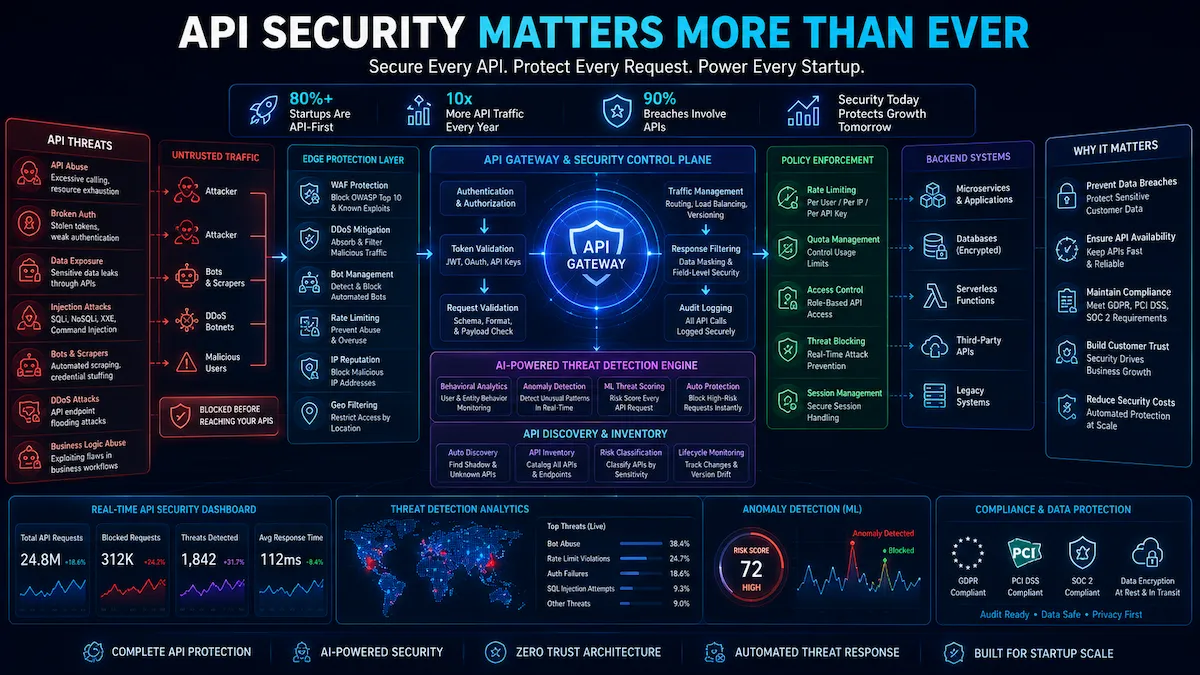
Open source AI security tools for startups have become essential for protecting LLM-powered products, AI agents, RAG systems, and cloud-native applications without requiring enterprise security budgets.
If your startup is shipping an AI-powered product and you haven’t thought seriously about security, you’re already behind. Open source AI security tools for startups have matured rapidly — in 2026, a two-person engineering team can build a production-grade AI security stack covering prompt injection defense, model red teaming, runtime guardrails, and supply chain integrity, entirely with free tools.
This guide ranks the 12 best open source AI security tools for startups, shows you how to stack them using the START Framework, and explains exactly where each tool fits. No CISO required.
Featured Snippet: What Are the Best Open Source AI Security Tools for Startups?
The best open source AI security tools for startups in 2026 are Garak (LLM red teaming), Promptfoo (CI/CD-integrated testing), LLM Guard (runtime input/output scanning), and NeMo Guardrails (conversation policy enforcement). Together, these four cover the OWASP Top 10 for LLM applications’ attack surface at zero licensing cost—making them the default starting stack for budget-conscious teams.
Key Takeaways
- Prompt injection is the #1 vulnerability in the OWASP Top 10 for LLMs 2025 — exploitable in virtually every LLM-powered product by default.
- A full open source AI security stack costs $0 in licensing; infrastructure typically runs $50–$300/month for an early-stage product.
- 100% of surveyed organizations have AI-generated code in their codebases, yet 81% lack visibility into AI usage across their SDLC (Cycode, 2026).
- Garak and Promptfoo are the two most widely adopted free LLM testing tools in 2026; both integrate cleanly with modern CI/CD pipelines.
- Runtime guardrails and pre-deployment testing are complementary layers — you need both, not just one.
- The EU AI Act and SOC 2 compliance reviews now surface AI-specific security questions; open source tools generate the audit logs you’ll need.
- Agentic AI (model + tool use + autonomous actions) requires a significantly expanded posture—the OWASP Agentic Top 10 (ASI) 2026 is the right starting framework.
Why Open Source AI Security Tools for Startups Matter Now
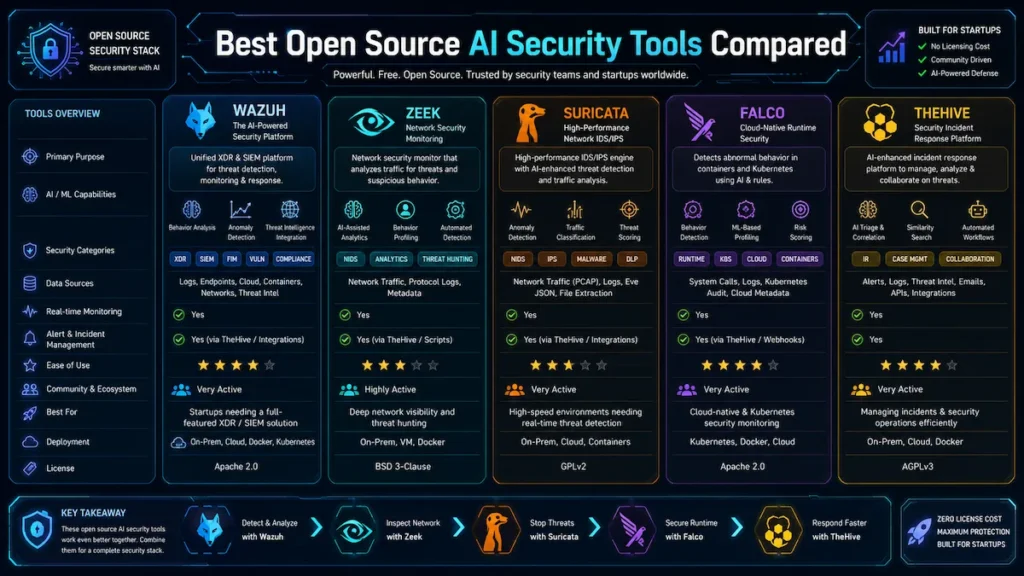
Open source AI security tools for startups help small engineering teams defend against modern AI-specific threats while maintaining the speed and flexibility required for rapid product growth.
Three years ago, AI security was a research topic. In 2026, it’s a product liability issue. According to Cycode’s 2026 State of Product Security report, 100% of surveyed organizations have AI-generated code in their codebases, while 81% lack visibility into AI usage across the SDLC. That’s the default state of most startup codebases — not just enterprise ones.
The numbers get sharper. Research published at USENIX Security 2025 demonstrated that just five crafted documents can manipulate AI responses 90% of the time in production RAG systems through poisoned retrieval. IBM’s 2024 Cost of a Data Breach Report put the average breach cost at $4.88 million—a figure that has climbed every year AI adoption has grown. Wiz’s State of AI in the Cloud 2026 found that one in five organizations using AI-powered development platforms had applications impacted by widespread security flaws introduced at scale through AI-generated defaults.
This is why open source AI security tools for startups are becoming a launch prerequisite, not a nice-to-have.
The attack surface for LLM-powered products differs fundamentally from traditional web apps. Your threat model now includes:
- Prompt injection — hidden instructions in user input that override your system prompt, causing the model to exfiltrate data or act against your product’s intent. Read more in our guide to AI security tools on a startup budget.
- RAG poisoning — corrupted documents or vectors in your retrieval system that manipulate model responses at scale.
- Model supply chain attacks—open-weight models from public registries containing backdoors baked into the weights.
- Sensitive information disclosure — the model inadvertently revealing PII, API keys, or system prompt contents.
- Excessive agency—agentic workflows were hijacked to take unauthorized actions because tool-use permissions weren’t scoped correctly.
Traditional AppSec tools weren’t built for any of this. A SAST scanner won’t find prompt injection. A WAF won’t protect your RAG pipeline. Purpose-built open-source tools fill that gap. Before diving into the tools, also review our cybersecurity checklist for startups to ensure baseline security hygiene is in place.
The START Framework for Evaluating Open Source AI Security Tools for Startups
The START framework helps organizations evaluate and deploy open source AI security tools for startups using a structured and repeatable security model.
Most startups deploy tools randomly and call it a security program. The START Framework gives you a structured model for building a complete AI security posture:
| Letter | Phase | What It Covers |
|---|---|---|
| S | Scan | Pre-deployment vulnerability scanning — find weaknesses before they ship |
| T | Test | Continuous CI/CD security testing — catch regressions on every update |
| A | Audit | Supply chain and code integrity — verify what you’re deploying |
| R | Runtime | Live guardrails and monitoring defend what’s already in production |
| T | Track | Logging, alerting, and incident response — know when something goes wrong |
Every tool in this guide maps to one of these five phases. A secure startup has coverage across all five — not just one or two.
The 12 Best Open Source AI Security Tools for Startups in 2026
The following open source AI security tools for startups provide coverage across testing, monitoring, governance, runtime protection, and incident response.
1. Garak — LLM Red Teaming (Scan)
Developed by NVIDIA, Garak is a free open source LLM vulnerability scanner that runs automated adversarial probes against your model or API. It covers prompt injection, jailbreaks, hallucination risks, data leakage, and attack patterns mapped to the OWASP Top 10 for LLMs.
Use case: Run before every major prompt update, model version change, or fine-tune deployment.
Strength: Comprehensive attack coverage; actively maintained; OWASP-aligned.
Weakness: Doesn’t provide runtime protection; output requires some security interpretation.
Mistake to avoid: Running Garak once at launch. It’s a testing tool—run it on every significant change.
2. Promptfoo — CI/CD-Integrated LLM Testing (Test)
Promptfoo is among the most practical open source AI security tools for startups seeking automated CI/CD security testing.
Promptfoo is an open source LLM testing and security evaluation framework with first-class CI/CD support. It integrates with GitHub Actions, GitLab, and most deployment pipelines in under two hours. OpenAI acquired Promptfoo in March 2026, but the open-source project remains active and free. More than 25% of Fortune 500 companies use it.
Use case: Define security test cases for your product context and run them automatically on every pull request. For teams already investing in AI-powered security monitoring, Promptfoo is the natural CI/CD complement.
Strength: Developer-friendly; excellent CI/CD integration; supports custom test cases alongside built-in attack libraries.
Weakness: Requires investment in writing product-specific test cases to maximize value.
Mistake to avoid: Using only default test cases. Promptfoo’s power multiplies when tests reflect your specific attack surface.
3. LLM Guard — Runtime Input/Output Scanning (Runtime)
LLM Guard is one of the leading open source AI security tools for startups requiring production-ready runtime protection.
LLM Guard is the most widely deployed open source runtime guardrail for LLM applications. You wrap your API call with LLM Guard and configure which scanners to activate, and it returns a risk score and sanitized text before the model sees the input or the user sees the output.
Use case: Any production LLM-powered feature handling user input — especially customer-facing chatbots, support tools, or document processors.
Strength: Modular design; fast enough for production; strong PII and injection detection.
Weakness: Adds 20–80ms latency depending on configuration; community maintenance has slowed post-acquisition by Palo Alto Networks.
Mistake to avoid: Enabling every scanner by default. Activate only scanners relevant to your threat model — unnecessary scanners add latency with no security benefit.
4. NeMo Guardrails — Conversation Policy Enforcement (Runtime)
NeMo Guardrails (NVIDIA) lets you define explicit conversation flow rules and safety policies for LLM-powered applications. Rather than scanning for known attack patterns, it enforces what your AI system should and shouldn’t do at the application logic level—rules like “never discuss competitor products” or “refuse medical advice” hold regardless of what the model would naturally produce.
Use case: Products where conversation scope control is critical — enterprise copilots, customer service bots, regulated-industry applications.
Strength: Highly customizable; production-tested at NVIDIA scale; works with any LLM backend.
Weakness: Requires learning the Colang configuration language; adds architectural complexity.
Mistake to avoid: Using NeMo Guardrails as your only security layer. It enforces policies you define — it won’t catch attack patterns you haven’t anticipated.
5. DeepTeam — Agentic AI Red Teaming (Scan)
DeepTeam is an open-source red teaming framework covering both the OWASP Top 10 for LLMs 2025 and the new OWASP Agentic Top 10 (ASI) 2026. If your product uses AI agents, DeepTeam is currently the most complete free framework for testing that attack surface.
Use case: Any startup building agentic AI features — AI that browses the web, executes code, sends emails, or takes actions on behalf of users.
Strength: OWASP alignment; strong agentic coverage; Python-native; actively maintained.
Weakness: Newer and less battle-tested than Garak or Promptfoo; smaller community.
Mistake to avoid: Skipping this tool if you’re deploying agents. Standard LLM security tests don’t cover agentic attack vectors.
6. Microsoft Presidio — PII Detection and Anonymization (Runtime)
Presidio strengthens open source AI security tools for startups by providing advanced privacy and PII protection capabilities.
Presidio is an open source data protection SDK from Microsoft. It detects over 50 types of PII in text and can anonymize, pseudonymize, or redact it before it enters your LLM pipeline or after the model outputs it. GDPR, CCPA, HIPAA, and SOC 2 compliance requirements intersect directly with LLM applications that process user data. Pair Presidio with our guide to GDPR compliance tools for startups for a complete data protection picture.
Use case: Any LLM feature processing user-submitted text, documents, or customer data. Integrate on both input and output sides.
Strength: Comprehensive PII coverage; Microsoft-maintained; multilingual; generates compliance-friendly audit logs.
Weakness: Requires configuration for domain-specific PII types; adds overhead for high-volume pipelines.
Mistake to avoid: Using Presidio only as an output filter. PII that enters your model’s context window can be memorized or leaked—filter inputs too.
7. Guardrails AI — Structured Output Validation (Runtime)
Guardrails AI is an open source Python framework that validates and structures LLM outputs. You define output schemas, apply validators, and automatically retry or correct model outputs that fail security-relevant specifications like “must not contain PII.”
Use case: Any pipeline where LLM outputs are parsed, stored, or acted on programmatically. Critical in agentic systems where model outputs become instructions for downstream tools.
Strength: Combines output quality and security validation in one framework; clean Python API; active community.
Weakness: Adds retry latency when outputs fail validation; some validators require custom implementation.
Mistake to avoid: Treating output validation as a functional concern only. A malformed output that’s also a prompt injection payload is a security issue—validate for both.
8. Semgrep (AI Security Ruleset) — Static Code Analysis (Audit)
Semgrep’s AI security rulesets (free on the Semgrep registry) scan your codebase for insecure LLM integration patterns — hardcoded system prompts, unsanitized user input passed to model APIs, and insecure LangChain or LlamaIndex usage. Most AI security vulnerabilities don’t start at the model—they start in the code that calls it. See our guide on how to secure a startup with AI tools.
Use case: Run in CI/CD on every commit — especially valuable when using LangChain, LlamaIndex, or custom LLM orchestration code.
Strength: Integrates with every major CI/CD platform; fast; catches issues before deployment.
Weakness: Can’t find runtime-only vulnerabilities; AI ruleset coverage is still maturing.
Mistake to avoid: Relying on Semgrep alone for AI security. It’s a complement to Garak and Promptfoo, not a replacement.
9. Trivy (with AI/ML Plugin) — Supply Chain Scanning (Audit)
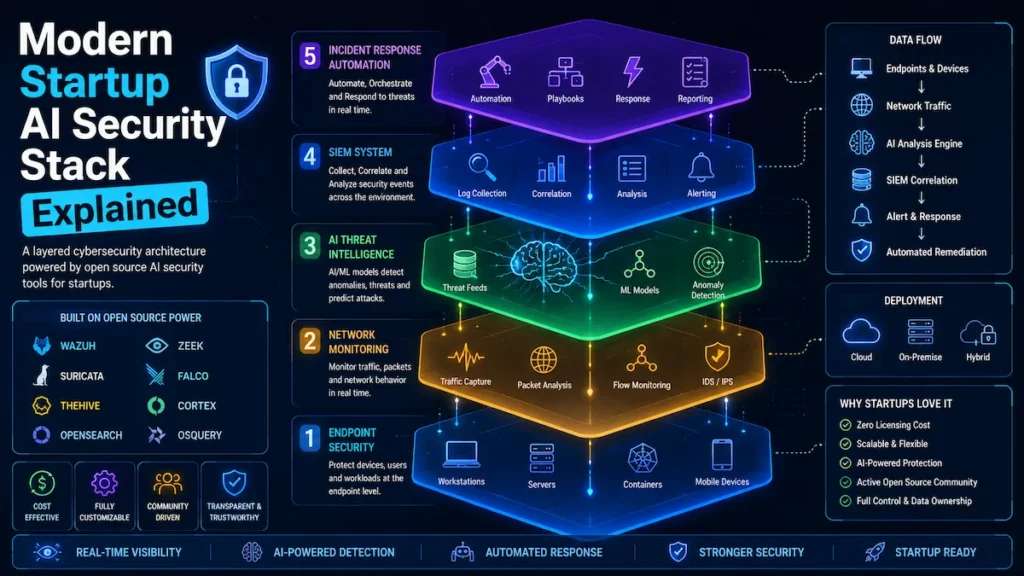
Trivy supports open source AI security tools for startups by improving AI supply chain and container security.
Trivy is an open source vulnerability scanner for containers, filesystems, and Git repositories. With AI/ML plugins, it scans Hugging Face model files, model containers, and ML dependencies for known CVEs, malicious packages, and supply chain integrity issues. The MITRE ATLAS framework documents model supply chain attacks as a top-tier AI threat category—Trivy covers the container and dependency layer of that surface.
Use case: Scan every model artifact and container before deploying to production. Integrate into your model registry workflow.
Strength: Industry-standard tool; excellent CVE database coverage; fast scans.
Weakness: ML-specific model scanning is newer; it doesn’t detect weight-level backdoors, only known malicious packages.
Mistake to avoid: Assuming model files from reputable registries are safe without scanning. Supply chain attacks on public model hubs are documented and increasing.
10. KubeArmor — Runtime Kubernetes Enforcement (Runtime)
KubeArmor is an open-source cloud-native runtime security engine using eBPF and Linux Security Modules (LSM) to enforce security policies for containerized AI workloads at the kernel level. It prevents model processes from making unauthorized network calls, file system accesses, or executing unexpected code.
Use case: Production Kubernetes deployments running model inference, training pipelines, or agentic AI systems.
Strength: eBPF-based; lightweight; supports AWS EKS, GKE, AKS; strong runtime enforcement.
Weakness: Requires Kubernetes expertise; not relevant for serverless or managed inference API deployments.
Mistake to avoid: Skipping runtime enforcement because you trust your model code. Runtime security catches unexpected behavior from dependencies and libraries you don’t control.
11. Caldera (MITRE ATLAS Extension) — Adversarial Simulation (Scan)
MITRE Caldera’s AI security extensions support structured simulated attacks against ML systems, mapped to the MITRE ATLAS framework. These exercises surface vulnerabilities and demonstrate security maturity to enterprise customers and investors.
Use case: Structured red team exercises; pre-fundraising security reviews; enterprise sales security questionnaire preparation.
Strength: MITRE-backed; ATLAS framework alignment; useful for enterprise due diligence responses.
Weakness: Steeper learning curve; more useful for teams with some security background.
Mistake to avoid: Using Caldera as your first AI security tool. Build testing and guardrail foundations first.
12. Nuclei (AI Templates) — Attack Surface Discovery (Scan)
Nuclei rounds out open source AI security tools for startups by identifying exposed AI services and attack surfaces.
Nuclei is an open-source vulnerability scanning engine driven by community-contributed templates. Its growing AI-specific template library scans for LLM API misconfigurations, exposed model endpoints, insecure AI integrations, and common LLM application vulnerabilities. ProjectDiscovery raised $28M and remains actively developing the platform.
Use case: External attack surface scanning; finding misconfigured AI API endpoints; testing deployed application surfaces quarterly.
Strength: Large and growing template library; fast; strong community.
Weakness: AI-specific template coverage still growing; strongest as a complement to model-focused tools.
Mistake to avoid: Treating Nuclei as an LLM security tool only. It’s strongest at the infrastructure and API layer.
Comparison Table: Open Source AI Security Tools for Startups
This comparison highlights how different open source AI security tools for startups address specific stages of the AI security lifecycle.
| Tool | START Phase | Attack Layer | Deploy Stage | CI/CD | Complexity | Best For |
|---|---|---|---|---|---|---|
| Garak | Scan | Prompt injection, jailbreak | Pre-deploy | Yes | Low–Med | Model testing before launch |
| Promptfoo | Test | OWASP LLM Top 10 | Pre-deploy | Yes | Low | CI/CD-native regression testing |
| LLM Guard | Runtime | Input/output scanning | Runtime | Yes | Low | Production chatbots and copilots |
| NeMo Guardrails | Runtime | Application logic / policy | Runtime | Partial | Medium | Scoped AI, regulated industries |
| DeepTeam | Scan | Agentic / OWASP ASI 2026 | Pre-deploy | Yes | Medium | Startups deploying AI agents |
| Presidio | Runtime | Data privacy / PII | Runtime | Yes | Low | GDPR / HIPAA / SOC 2 compliance |
| Guardrails AI | Runtime | Output integrity | Runtime | Yes | Low–Med | Programmatic output pipelines |
| Semgrep (AI) | Audit | Insecure LLM code patterns | Pre-deploy | Yes | Low | Developer shift-left security |
| Trivy (AI) | Audit | Model / container supply chain | Pre-deploy | Yes | Low | Open-weights model deployments |
| KubeArmor | Runtime | Workload / process level | Runtime | Yes | Med–High | Kubernetes AI inference |
| Caldera | Scan | Adversarial AI scenarios | Pre-deploy | No | High | Enterprise readiness exercises |
| Nuclei (AI) | Scan | API / infrastructure layer | Pre-deploy | Yes | Low | External attack surface discovery |
Open Source AI Security Tools for Startups vs. Commercial AI Security Platforms
The most common question startup founders ask isn’t which open-source tool to use—it’s whether open source is the right call at all. Here’s an honest comparison.
Cost: Open source tools cost $0 in licensing. Commercial platforms such as Lakera (now Check Point), Protect AI Guardian (now Palo Alto Networks), and Mindgard typically run $2,000–$15,000/month for startup tiers. For pre-revenue or early-revenue teams, open source is the only realistic option.
Flexibility: Open source tools are highly configurable and integrable with any stack. Commercial platforms often impose architecture requirements or vendor lock-in that becomes painful at scale.
Support: Commercial platforms provide dedicated support, onboarding, and SLA guarantees. Open source tools rely on community support, GitHub issues, and documentation. For a one-engineer team, this tradeoff is real—but solvable with good documentation habits.
Compliance evidence: Both options produce audit logs, but commercial platforms often provide pre-built compliance report templates for SOC 2, ISO 42001, and EU AI Act requirements. Open source tools require more manual work to translate logs into auditor-friendly formats. Our guide on SOC 2 compliance tools for AI startups covers that gap specifically.
Enterprise readiness: Enterprise customers doing vendor due diligence care about a demonstrated security posture—not a licensing model. An open source stack with proper documentation, testing cadence, and incident response planning passes enterprise security reviews as effectively as commercial tooling. See our AI security on a startup budget guide for how to present this to enterprise buyers.
Verdict: At seed and Series A, open source is the right call. At Series B and beyond, a hybrid approach—open source for testing, commercial for compliance reporting, and managed support—often makes more sense.
Implementation Roadmap for Open Source AI Security Tools for Startups
Beginner — Weeks 1–2: Minimum Viable Stack
Goal: Stop the most commonly exploited vulnerabilities before your next deployment.
- Scan: Install Garak. Run it against your model endpoint and log findings.
- Test: Add Promptfoo to CI/CD with 5–10 test cases covering prompt injection and system prompt extraction.
- Runtime: Deploy LLM Guard with
PromptInjectionscanners. Log all flagged inputs. - Track: Enable structured logging for all model inputs and outputs in your existing observability stack.
Cost: $0 licensing. ~2–3 days of engineering time. See our free AI cybersecurity tools for startups for complementary options.
Intermediate — Month 1–2: Full OWASP Coverage
Goal: Cover all 10 OWASP LLM vulnerability categories with automated tooling.
- Scan: Add DeepTeam if you’re deploying any agentic features.
- Audit: Add Semgrep AI rules to your static analysis pipeline. Add Trivy if you’re pulling open-weight models.
- Runtime: Add Presidio for PII filtering if your product handles personal data—see our GDPR compliance tools guide for the regulatory context.
- Track: Build a security runbook—who responds to flagged events, escalation paths, and what constitutes an incident vs. a product bug.
Advanced — Month 3+: Compliance-Ready Posture
Goal: Pass enterprise due diligence, SOC 2 reviews, and investor security questionnaires.
- Scan: Run a structured Caldera / MITRE ATLAS exercise. Document findings and remediation.
- Runtime: Deploy KubeArmor if running AI inference on Kubernetes.
- Scan: Add Nuclei AI templates for quarterly external attack surface sweeps.
- Track: Create a formal AI risk register—threat model, control mapping, testing cadence, and incident history.
One engineer spending 4–8 hours per week manages this comfortably at the early stage. See our guide on machine learning intrusion detection for startups for the full picture.
Why Open Source AI Security Tool Implementations Fail
“We’ll do it after launch.” Agentic architectures and RAG pipelines are significantly harder to secure post-launch. Prevention at architecture time costs roughly 5–10x less than post-incident remediation.
No owner assigned. LLM Guard without anyone reviewing flagged events is security theater. Every tool needs a human review loop—even for one engineer two hours a week.
Testing dev, not production. Production environments have different system prompts, retrieval contexts, and input patterns. Test against production-representative conditions, or the results are meaningless.
Over-relying on provider safety filters. Model-level filters from OpenAI or Anthropic don’t know your threat model, can be bypassed by indirect injection, and don’t protect your RAG pipeline or agentic permissions.
Default guardrail configurations. A default LLM Guard installation generates false positives and misses context-specific attacks. Spend time tuning—it’s not a deploy-and-forget tool.
No incident response plan. Without a documented escalation path, even well-deployed tools don’t translate to effective security. Our startup cybersecurity checklist includes an incident response template you can adapt.
Future Trends in Open Source AI Security Tools for Startups
The open source AI security ecosystem is moving fast. Here are the developments worth tracking over the next 12–18 months:
AI-native SOC automation. Security operations are beginning to incorporate LLMs for alert triage and threat correlation. Expect open source tooling that applies LLMs to monitoring the security of other LLMs.
Autonomous red teaming. The next generation of Garak and DeepTeam will generate novel adversarial prompts dynamically, expanding coverage without manual test authorship.
AI Software Bills of Materials (AI SBOMs). Regulators and enterprise buyers are beginning to require transparency about which models and datasets underpin a product. AI SBOM tooling is in early development and will become a standard CI/CD step within two years.
Model provenance verification. Cryptographic signing and verification of model weights is moving from research to tooling, directly addressing supply chain attacks at the weight level that Trivy currently cannot detect.
AI governance automation. Tools that auto-generate compliance documentation from security testing logs — mapped to NIST AI RMF, EU AI Act, or SOC 2 criteria — will reduce the manual overhead that makes compliance painful for small teams.
Agent security platforms. As multi-agent systems become common in production, dedicated open-source platforms for securing agent-to-agent communication, permission scoping, and action audit trails will emerge beyond DeepTeam’s current scope.
What Most Articles About Open Source AI Security Tools Get Wrong
Even the best open source AI security tools for startups can fail when organizations lack ownership, monitoring processes, or security governance.
“Deploy guardrails and you’re secure.” Guardrails are a runtime defense layer, not a substitute for pre-deployment testing. A startup with LLM Guard in production but no Garak testing is like a company that installed a firewall but never checked whether the application behind it is exploitable.
“Open source tools aren’t production-ready.” In 2026, Garak, Promptfoo, LLM Guard, and Presidio are all used in production by Fortune 500 companies. The concern isn’t readiness — it’s configuration.
“AI security is about blocking bad prompts.” Prompt injection is one vector. Supply chain attacks, RAG poisoning, sensitive information disclosure, and excessive agency are all actively exploited. Blocking prompts alone misses the majority of the attack surface.
“You need a CISO to do this.” You don’t. A mid-level engineer can set up a functioning AI security stack in a week. What you need is an owner — not a dedicated team.
“Compliance isn’t relevant until enterprise customers.” The EU AI Act is live with ongoing milestones through 2026. Series A and B due diligence processes now include AI security questions. Building audit-trail-friendly tooling from day one costs almost nothing extra.
“Agentic AI security is a future problem.” If your product lets the model browse the web, send messages, query a database, or execute code, you’re already building agentic AI. The OWASP Agentic Top 10 (ASI) 2026 documents vulnerabilities currently exploited in production.
FAQ: Open Source AI Security Tools for Startups
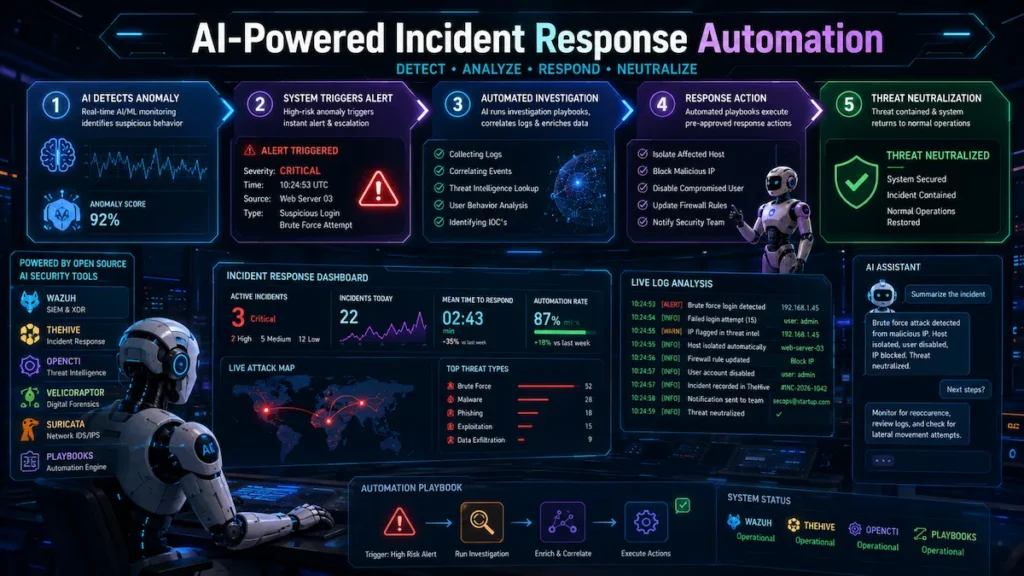
These frequently asked questions address common concerns about implementing open source AI security tools for startups.
Q: What’s the minimum AI security setup for a one-engineer startup?
Promptfoo in CI/CD plus LLM Guard in production. One afternoon to set up, it covers the most commonly exploited attack surface at $0 in licensing.
Q: How much does an open-source AI security stack cost?
Licensing: $0. Infrastructure adds $50–$300/month depending on traffic. Engineering time to set up and maintain is the primary cost.
Q: Is Garak better than Promptfoo for LLM security testing?
They’re complementary. Garak covers the widest adversarial attack range for deep vulnerability scanning. Promptfoo has superior CI/CD integration for continuous regression testing. Most teams use both: Promptfoo on every deploy, Garak for periodic deep scans.
Q: Do I need these tools if I’m just calling the OpenAI API?
Yes. Model provider safety filters don’t protect your application layer, RAG pipeline, data handling, or agentic tool permissions. Unsanitized user input passed directly to GPT-4 is vulnerable to prompt injection regardless of OpenAI’s filtering.
Q: Can startups use open source AI security tools without a security engineer?
Yes, with caveats. Promptfoo, LLM Guard, and Semgrep are developer-friendly. Caldera and Garak benefit from security familiarity. Start with Promptfoo and LLM Guard, then layer in complexity.
Q: Are open-source AI security tools good enough for enterprise due diligence?
Yes — if they’re deployed, maintained, and producing audit logs. Enterprise reviewers care about demonstrated security posture, not licensing model. See how to structure that documentation in our SOC 2 compliance guide for AI startups.
Q: Which open source AI security tool works best with LangChain?
Use all three in combination: Semgrep flags insecure LangChain code patterns, Promptfoo and Garak test the LLM interactions LangChain orchestrates, and LLM Guard sits at the output layer.
Q: How do I secure a RAG pipeline specifically?
Validate inputs before retrieval queries, scan retrieved documents for injected instructions, enforce access controls on your vector store, and monitor for anomalous retrieval patterns. Garak has specific RAG vulnerability probes; LLM Guard can be positioned to scan both user inputs and retrieved context.
Q: What is the difference between OWASP LLM Top 10 and OWASP ASI?
The OWASP LLM Top 10 (2025) covers vulnerabilities in applications where the model generates text—prompt injection, data poisoning, and sensitive disclosure. OWASP ASI (2026) extends this to autonomous agents that take actions—covering agent goal hijacking, tool misuse, and multi-agent privilege escalation.
Q: What framework should I align with?
Start with the OWASP Top 10 for LLMs 2025—it’s the most actionable and directly maps to the tools here. Add OWASP Agentic Top 10 (ASI) 2026 if you’re deploying agents. Use NIST AI RMF for broader AI risk governance.
Q: What happened to Lakera Guard and Protect AI?
Lakera Guard was acquired by Check Point (September 2025); Protect AI Guardian by Palo Alto Networks (July 2025). Open-source variants remained available post-acquisition, but maintain awareness of your tool dependencies.
Q: How long does full implementation take?
Minimum stack (Promptfoo + LLM Guard): 1–2 days. Full intermediate stack: 1–2 weeks, including tuning. Advanced compliance posture: an ongoing program, not a one-time project.
Conclusion
The best open source AI security tools for startups combine testing, monitoring, runtime protection, and governance into a practical, affordable security stack — and in 2026, all of it is free to license.
First 30 days: Promptfoo in CI/CD and LLM Guard in production. Approaching Series A or your first enterprise customer: add Garak, Semgrep, Presidio, and Trivy and then document your posture. Deploying agents: add DeepTeam and treat the OWASP Agentic Top 10 as your checklist.
The attack surface is documented. The vulnerabilities are known. The defenses cost nothing to license. What separates secure AI startups from vulnerable ones isn’t tooling knowledge — it’s ownership. Assign an owner, build the habit, and the tooling will handle the rest.
Last updated: June 2026. Tool acquisition status and framework versions subject to change. Verify current project status before deployment decisions.