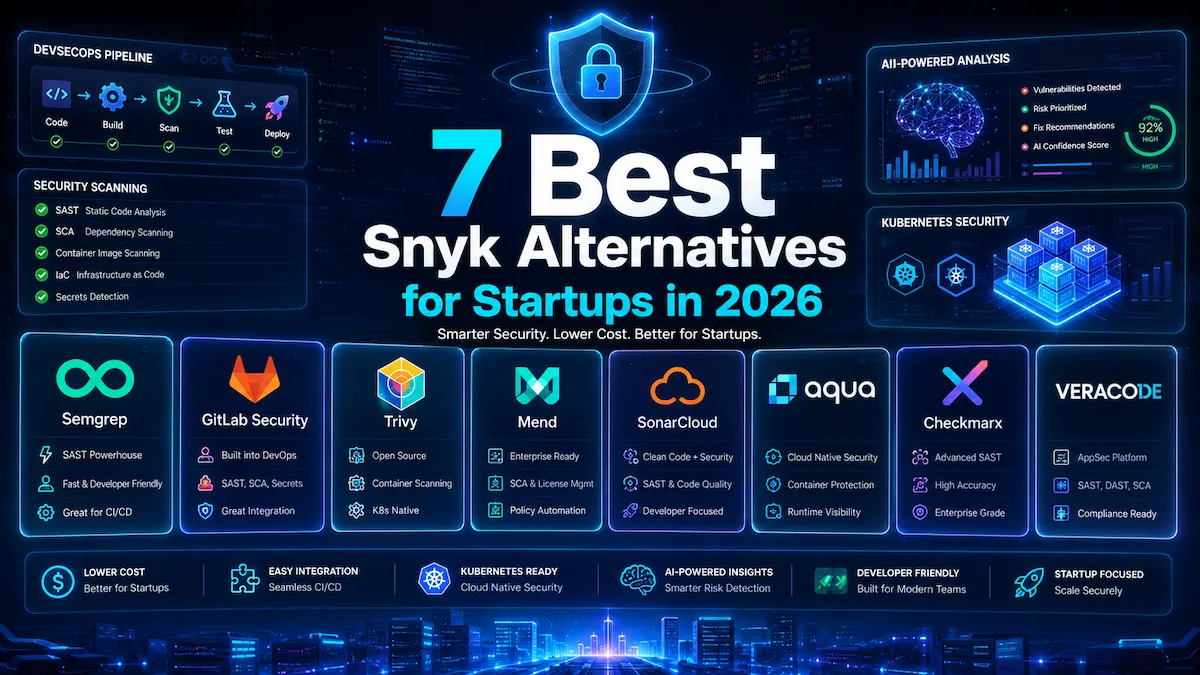
This guide evaluates the best Snyk alternatives for startups using real-world startup security, pricing, CI/CD integration, and scalability criteria.
The moment a startup lands its first enterprise customer, security tooling stops being optional. That customer’s procurement team sends a questionnaire. Your investors start asking about your vulnerability management program. And suddenly the Snyk invoice—manageable at five engineers—looks entirely different at fifteen.
Most startup security programs hit the same wall: the tool that got you through the seed stage is now creating cost pressure, operational overhead, and CI/CD friction that a growing team can’t absorb. Snyk built an excellent product, but it was architected for security teams and budgets that most startups reach at Series B—not Series A.
The market has caught up. There are now credible, production-ready Snyk alternatives for startups covering SCA, SAST, container scanning, IaC security, and AI-powered remediation—some free, some meaningfully cheaper, and several that outperform Snyk in specific categories. Before choosing any tool, map your actual risk surface first. Most teams are surprised by what their real exposure looks like—the tooling decision flows from a structured startup cybersecurity checklist, not the other way around.
This guide is decision-ready analysis for CTOs, DevSecOps leads, and technical founders. No affiliate rankings. No vendor hype. Honest tradeoffs evaluated through the lens of startup stage, team size, and operational reality.
Why You Can Trust This Guide Every tool in this comparison was assessed across six dimensions: CI/CD deployment complexity, scan quality and false positive rates, pricing scalability at startup team sizes, developer workflow integration, Kubernetes and container security coverage, and startup-stage suitability from seed through Series B. Pricing data reflects 2025–2026 publicly available information and verified industry sources. Tools were excluded where pricing, complexity, or architectural requirements make them impractical for the startup context this guide targets.
Jump To
- Quick Recommendations
- What Snyk Actually Does
- Why Startups Leave Snyk
- Best Snyk Alternatives (Tool Reviews)
- Snyk vs Semgrep
- Snyk vs Mend
- Snyk vs GitLab Security
- Cheapest Alternatives
- AI-Powered AppSec Platforms
- Full Comparison Table
- Startup Security Stack by Stage
- Migration Checklist
- FAQ
- Final Verdict
Quick Recommendations: Best Snyk Alternatives at a Glance
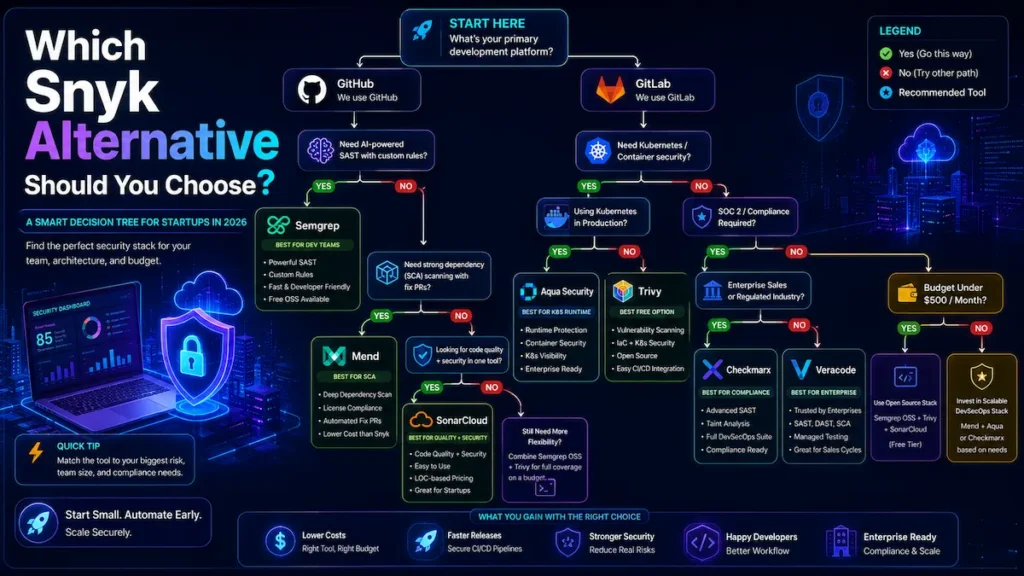
These quick recommendations highlight the most practical Snyk alternatives for startups based on budget, DevSecOps maturity, and infrastructure needs.
| Your Situation | Best Tool | Free Option? | Starting Price |
|---|---|---|---|
| Best free stack | Semgrep OSS + Trivy | ✅ Yes | $0 |
| GitHub-native workflow | Semgrep + Mend | ✅ Semgrep OSS | ~$40/dev/mo |
| GitLab-native teams | GitLab Ultimate | ⚡ Basic SAST | ~$99/user/mo |
| Kubernetes + container security | Trivy → Aqua (Series B+) | ✅ Trivy OSS | Free → $20K+/yr |
| Compliance (SOC 2, HIPAA) | Checkmarx One | ❌ No | $15K+/yr |
| Enterprise sales credibility | Veracode | ❌ No | $10K+/yr |
| AI-powered SAST | Semgrep Pro | ✅ OSS version | ~$40/dev/mo |
| Code quality + security combined | SonarCloud | ✅ Public repos | $10/mo (LOC) |
The detailed rationale for each recommendation—including Snyk vs Semgrep, Snyk vs Mend, and open-source Snyk replacement options—follows in the tool breakdowns below.
What Snyk Actually Does—and Why Startups Outgrow It
Understanding why teams migrate from Snyk helps startups choose the right Snyk alternatives for startups without sacrificing security coverage.
Before evaluating Snyk competitors, understand what you’re replacing — because many startups are migrating only part of what they think they’re migrating.
Snyk operates across five distinct security categories:
Software Composition Analysis (SCA): Scans open-source dependencies for known vulnerabilities, checks license compliance, and generates automated fix pull requests. This is Snyk’s strongest capability and the reason most startups adopt it first.
Static Application Security Testing (SAST): Analyzes application source code for injection flaws, authentication weaknesses, and insecure configurations without executing the code. Snyk Code is the SAST module.
Container scanning: Inspects Docker images for OS-level and application-level vulnerabilities before deployment. Integrates with Docker Hub, ECR, and GCR.
Infrastructure as Code (IaC) security: Scans Terraform, CloudFormation, Helm charts, and Kubernetes manifests for misconfigurations before they reach production.
Fix PRs and developer tooling: Generates automated remediation pull requests, provides VS Code and JetBrains IDE plugins, and surfaces findings inline in GitHub and GitLab code reviews.
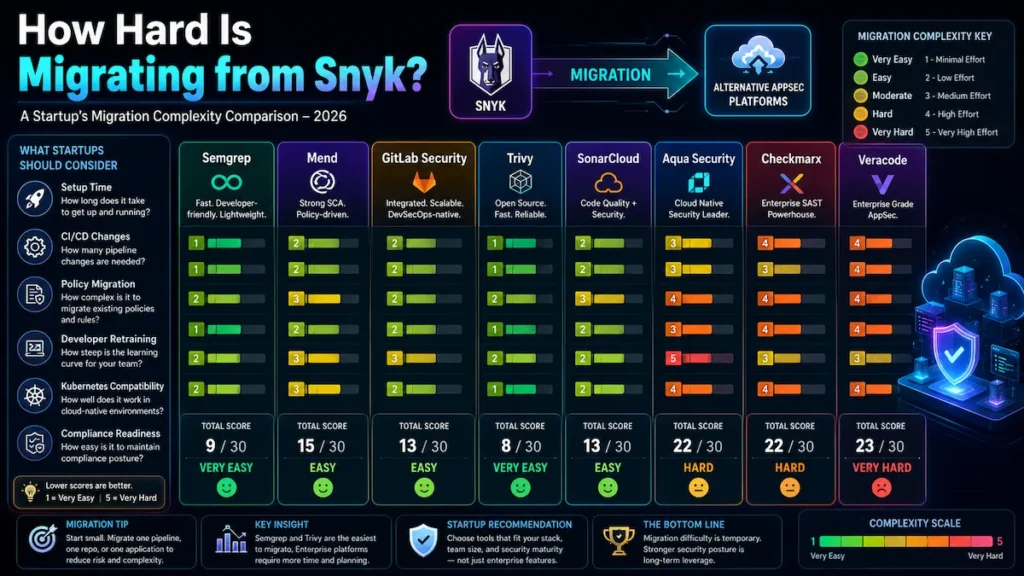
Understanding this scope matters because most Snyk alternatives for startups specialize rather than generalize. Semgrep is a superior SAST tool. Mend is a comparable SCA tool at lower cost. Trivy is a better free container scanner. No single alternative replicates all five categories at Snyk’s quality level—the migration decision is always about which categories matter most for your current risk profile.
Why Startups Are Searching for Snyk Alternatives in 2026
More engineering teams are evaluating Snyk alternatives for startups because of rising costs, operational overhead, and CI/CD complexity.
The Cost Problem Is Structural
Snyk’s free tier creates adoption; it was never designed to sustain production use across multiple teams and repositories. At $98–$330+ per developer per month depending on plan tier and add-ons, a 10-engineer team faces $12,000–$40,000 annually for dependency scanning and SAST alone.
The structural problem: Snyk’s pricing penalizes startup behavior. High commit velocity, broad scanning across microservices, and iterative infrastructure changes all drive usage upward. The more aggressively your team ships, the higher the bill.
According to the GitLab 2024 Global DevSecOps Report, 56% of developers cite security tool complexity and cost as the primary barriers to consistent security practice adoption. Snyk’s model concentrates on friction points for teams under 20 engineers.
Onboarding Friction at Small Team Scale
Snyk was built for enterprise security programs with dedicated AppSec headcount. Policy configuration, organization hierarchy setup, and integration management routinely take 2–4 weeks to fully operationalize. For startup engineering teams stretched across platform reliability and feature delivery, that timeline derails sprint commitments.
The post-migration patterns are consistent across teams: false positive rates that require additional weeks of tuning before alerts are actionable, remediation guidance that assumes senior AppSec context, and a licensing structure that doesn’t flex when headcount shifts between quarters. Teams managing automated vulnerability scanning across evolving multi-cloud infrastructure find Snyk’s IaC and container modules particularly sensitive to configuration drift, generating noise rather than signal when pipelines are still stabilizing.
Product Sprawl vs. Startup Capacity
The deeper issue is cognitive load. Snyk now covers five scanning categories, each with its own dashboard, policy engine, and alert stream. For a large security team, that breadth is consolidation value. For a startup engineer who also handles platform ops and feature delivery, five separate modules create overhead rather than reducing it.
The best Snyk alternatives for startups—whether open-source Snyk replacements, commercial Snyk competitors, or dedicated DevSecOps platforms for startups—solve for operational simplicity without sacrificing coverage on the categories that actually matter.
Best Snyk Alternatives for Startups in 2026
1. GitLab Security — Best for GitLab-Native Startups
GitLab Security stands out among Snyk alternatives for startups because it integrates directly into existing GitLab CI/CD workflows.
GitLab Ultimate consolidates SAST, DAST, dependency scanning, container scanning, secret detection, and IaC scanning into one platform. For teams already on GitLab, this is the most frictionless Snyk alternative for startups — no secondary vendor, no separate API keys, no additional integration overhead.
🏆 Best For: GitLab-native startups prioritizing platform consolidation. ⚠️ Avoid If: You’re committed to GitHub—platform migration cost is not justified by the security gains.
Pricing: ~$99/user/month. GitLab’s startup program offers meaningful discounts—request them before signing at list price.
What works operationally: The merge request security widget is the standout feature. Developers see vulnerability findings inline before code merges, eliminating the dashboard-to-code-review handoff that stalls MTTR improvement programs. Scanning templates activate with a single include directive in .gitlab-ci.yml — zero configuration overhead for teams with existing GitLab CI.
Quantified performance: SAST scans on mid-sized Node.js and Python repositories complete in 3–7 minutes—suitable for non-blocking CI checks. Most startups can have GitLab Security fully operational in under one hour if GitLab CI is already configured.
Limitations: SCA and container scanning depth lag behind purpose-built tools. False positives run higher on legacy codebases before policy tuning. Not worth switching platforms for.
| Free plan | Basic SAST + secret detection |
| Paid from | ~$99/user/month |
| Setup time | Under 1 hour (existing GitLab CI) |
| Best startup stage | Seed – Series B |
✅ Pros: Single vendor, zero integration overhead, compliance dashboards included, no data egress if self-hosting ❌ Cons: Weaker SCA than Snyk or Mend, higher false positives on legacy code, not worth a platform migration
2. Semgrep — Best Open-Source Snyk Replacement for Developer-Led Teams
Semgrep is one of the most developer-friendly Snyk alternatives for startups thanks to its customizable open-source SAST engine.
Semgrep is the most significant open-source Snyk alternative for application code security and one of the strongest GitHub security scanning tools available. Unlike commercial scanners that treat developers as consumers of findings, Semgrep treats them as rule authors—a scanner your team can tune, extend, and trust because they control what it checks.
🏆 Best For: Developer-led startups wanting high-quality, customizable SAST with zero vendor lock-in. ⚠️ Avoid If: You need plug-and-play enterprise SAST with no rule investment—Semgrep’s power requires upfront curation.
In practice, Semgrep adoption succeeds fastest in startups where platform engineers already own CI tooling and custom automation. Teams expecting a push-button experience take longer to operationalize it—the same customizability that makes Semgrep powerful requires an initial investment.
Pricing: Semgrep OSS is free, permanently, with no functional SAST limitations. Commercial Semgrep Code starts at ~$40/developer/month with managed rules, team dashboards, and SCA in the Pro tier.
What works operationally: The community rule registry covers the OWASP Top 10, framework-specific vulnerabilities, and custom business logic. Signal-to-noise ratio is genuinely higher than most commercial alternatives because rules are precise by design. Native integrations with GitHub Actions, GitLab CI, CircleCI, Jenkins, and Buildkite deploy in under 15 minutes. Most startups can deploy Semgrep + Trivy across all repos in under one sprint.
Quantified performance: Semgrep scans complete in under 90 seconds on mid-sized repositories (50,000–150,000 LOC)—fast enough for blocking CI gates without meaningful developer friction.
Limitations: No native SCA in the free tier. Container scanning and runtime security require separate tooling. Kubernetes-specific rules are limited compared to purpose-built K8s scanners.
| Free plan | Full OSS (unlimited SAST) |
| Paid from | ~$40/developer/month |
| Setup time | Under 15 minutes |
| Best startup stage | Seed – Growth |
✅ Pros: Best free SAST available, fastest scan times in category, fully customizable, zero lock-in ❌ Cons: Requires rule investment, no native container scanning, SCA requires Pro tier
3. SonarCloud — Best AppSec Tool for Startups Combining Code Quality and Security
SonarCloud combines quality analysis and security scanning, making it one of the most affordable Snyk alternatives for startups.
SonarCloud blends static code quality analysis with security vulnerability detection in a single platform. For startups where quality and security ownership fall on the same engineer—the majority before Series A—this combination eliminates a context switch that quietly costs hours every sprint.
🏆 Best For: Startups wanting code quality + security in one tool, particularly teams with large monorepos. ⚠️ Avoid If: Your primary risk is dependency, container, or Kubernetes security.
Pricing: Free for public repositories. Private repo pricing is LOC-based, starting at $10/month for up to 100,000 lines. Cost scales with product growth, not hiring pace—meaningfully more predictable than per-seat pricing during rapid headcount expansion.
What works operationally: The quality gate enforces security and quality standards as a merge prerequisite. SonarCloud analyses on typical startup codebases (100,000–500,000 LOC) are complete in 4–10 minutes. GitHub PR and GitLab MR integration delivers inline blocking feedback that developers find natural rather than disruptive.
Limitations: SCA is significantly weaker than Snyk or Mend. Container and IaC scanning are not meaningful capabilities. Runtime security is outside scope entirely.
| Free plan | Public repos (unlimited) |
| Paid from | $10/month (LOC-based) |
| Setup time | 30–60 minutes |
| Best startup stage | Seed—Series A |
✅ Pros: Most startup-friendly paid pricing in category, code quality + security combined, long reliability track record ❌ Cons: Weak SCA, no container or IaC scanning, limited compliance reporting
4. Aqua Security — Best Snyk Competitor for Kubernetes-Native Startups
Aqua Security and Trivy are powerful Snyk alternatives for startups needing advanced Kubernetes and container security.
Aqua Security is purpose-built for cloud-native workloads. The critical distinction: Snyk scans for vulnerabilities in container images. Aqua scans images and enforces runtime behavior—detecting container escapes, anomalous process execution, and unauthorized network connections in production. That is a categorically different security posture.
🏆 Best For: Kubernetes-first Series A+ startups handling sensitive data with dedicated DevSecOps ownership. ⚠️ Avoid If: You don’t have dedicated DevSecOps ownership — commercial Aqua requires expertise to deploy meaningfully.
Pricing: Commercial Aqua starts at ~$20,000–$30,000/year. Aqua’s open-source project Trivy is free and covers container scanning, Kubernetes manifest auditing, and IaC security checks that handle 80%+ of startup scanning needs at zero cost.
What works operationally: Trivy integrates into GitHub Actions and GitLab CI in under 30 minutes with no persistent infrastructure. Commercial Aqua adds runtime enforcement, compliance dashboards mapping to CIS Benchmarks, NIST, and PCI-DSS, plus a centralized policy engine for Kubernetes fleets.
Quantified performance: Trivy scans a standard Docker image in 15–45 seconds. Full Kubernetes cluster audits are trivy k8s complete in 2–5 minutes—fast enough for pre-deploy blocking checks.
| Free plan | Trivy (full-featured OSS) |
| Paid from | ~$20K+/year (commercial) |
| Setup time | 30 min (Trivy) / Weeks (commercial) |
| Best startup stage | Trivy: All / Aqua commercial: Series B⁺ |
✅ Pros: Unmatched Kubernetes depth, Trivy is production-grade free tooling, and runtime protection is unique in the category. ❌ Cons: Commercial platform budget-prohibitive early-stage, complex full deployment, requires AppSec expertise
5. Checkmarx — Best for Compliance-Driven Startups in Regulated Industries
Checkmarx One consolidates SAST, SCA, IaC security, API security, and container scanning with compliance reporting that maps findings to FedRAMP, HIPAA, SOC 2, and PCI-DSS frameworks automatically. For startups accelerating toward SOC 2 Type II compliance, Checkmarx’s audit documentation infrastructure is materially better than most alternatives.
🏆 Best For: Compliance-first startups in fintech, healthtech, or government-adjacent markets. ⚠️ Avoid If: You’re pre-Series A and compliance isn’t existential—cost and complexity are not justified at an early stage.
Pricing: Enterprise contract-based; expect $15,000–$50,000+ annually.
What works operationally: Checkmarx’s taint analysis engine tracks data flow from source to sink across complex codebases — best-in-class for detecting injection vulnerabilities that pattern-matching tools miss. The pipeline scan returns results in under 60 seconds for lightweight SAST, suitable as a non-blocking CI check. Full taint analysis scans take 30–90 minutes on large codebases.
| Free plan | No |
| Paid from | ~$15K–$50K+/year |
| Setup time | Weeks |
| Best startup stage | Series A–B (compliance-driven) |
✅ Pros: Best compliance reporting in category, strongest taint analysis, unified platform across all scan types ❌ Cons: Budget-prohibitive early-stage, requires AppSec expertise, heavy operational overhead
6. Veracode—Best for Enterprise Sales Credibility
Veracode has the longest continuous track record in application security testing of any platform in this comparison. For growth-stage startups in enterprise B2B sales cycles, Veracode’s brand recognition in procurement questionnaires carries tangible commercial value—enterprise security teams trust the Veracode certification in ways they don’t yet extend to newer startup DevSecOps tools.
🏆 Best For: Growth-stage startups where failing security questionnaires is actively blocking enterprise deal closures. ⚠️ Avoid If: You’re early-stage—the brand premium doesn’t deliver ROI until you’re in active named-account enterprise sales.
Pricing: Contracts start at $10,000–$30,000/year.
What works operationally: Veracode’s pipeline scan returns results in under 60 seconds in CI — genuinely fast for an enterprise scanner. The developer sandbox lets engineers test proposed fixes before committing. SAST, DAST, SCA, and managed pen testing under one vendor simplifies the security narrative in procurement conversations.
| Free plan | No |
| Paid from | ~$10K–$30K+/year |
| Setup time | Days–Weeks |
| Best startup stage | Series A–B (enterprise sales) |
✅ Pros: Strongest brand in enterprise procurement, full-spectrum AppSec, fast pipeline scan ❌ Cons: Not cloud-native focused, expensive early-stage, full scans slow for large codebases
7. Mend—Best Direct SCA Replacement for Snyk
Mend (formerly WhiteSource) is the most direct Snyk competitor in SCA—comparable dependency scanning depth, automated remediation PRs, license compliance analysis, and a workflow model close enough to Snyk’s that most engineers adapt within a sprint. Commercial pricing runs approximately 20–30% below Snyk for equivalent SCA coverage.
🏆 Best For: Startups migrating off Snyk primarily for SCA who want feature parity at lower cost with minimal disruption. ⚠️ Avoid If: You need strong SAST or runtime container security—Mend’s strength is SCA, not full-stack AppSec.
Pricing: Free for public repositories. Commercial seat-based pricing runs ~20–30% below Snyk for comparable SCA coverage.
What works operationally: Mend’s automated fix PRs match Snyk’s quality for dependency updates. License compliance scanning is particularly strong for startups approaching Series A or first enterprise audits where OSS license exposure is a legal risk. Most teams implementing AI-assisted AppSec workflows benefit from standardizing their security monitoring in parallel—the AI network security monitoring guide covers the complementary detection layer.
One reality that migration teams consistently underestimate: the cleanup required for historical dependency policies. Snyk’s policy engine accumulates organizational context—suppressed vulnerabilities, accepted risks, and team-level configurations—that doesn’t transfer automatically. Budget 2–4 weeks for policy reconciliation on a mature Snyk implementation.
Quantified performance: Mend SCA scans on repos with 200–500 direct dependencies complete in 90–180 seconds in CI. Fix PR generation adds approximately 30–60 seconds per identified fix.
| Free plan | Public repos |
| Paid from | Custom (~20–30% below Snyk) |
| Setup time | Days |
| Best startup stage | Seed – Series B |
✅ Pros: Closest feature parity to Snyk for SCA, lower price, automated fix PRs, strong license scanning ❌ Cons: Weaker SAST and container security, policy migration underestimated, lower enterprise brand recognition
Why We Didn’t Include These Tools
Several credible platforms were evaluated and excluded because they aren’t startup-practical at current pricing, complexity, or architectural orientation:
Wiz: Outstanding CSPM platform, but priced for cloud security teams at Series C+. Seed and Series A startup rarely has the operational context to maximize its value before incurring significant cost.
Orca Security: Strong agentless cloud security for compliance-heavy environments. Pricing and deployment models are enterprise-oriented—not practical for startups still standardizing their cloud architecture.
Prisma Cloud (Palo Alto Networks): Comprehensive CNAPP platform, deeply enterprise in contract structure and required operational maturity. Over 90% of startups won’t need this before Series C.
Falco: Excellent open-source Kubernetes runtime detection engine, but it doesn’t overlap with Snyk’s SCA and SAST capabilities. Worth layering on top of the tools in this guide—not a replacement for them.
JFrog Xray: Strong SCA and binary scanning integrated with Artifactory. Highly relevant inside the JFrog ecosystem; less practical as a standalone Snyk replacement for teams without JFrog artifact management.
Snyk vs Semgrep
For SAST specifically, Semgrep is often the stronger startup choice. It scans in under 90 seconds versus several minutes for Snyk Code, is fully customizable, and is dramatically cheaper—free at the OSS tier. The gap narrows when you need SCA and automated fix PRs at Snyk’s polish level. For most early-stage teams, the practical answer is Semgrep for SAST + Trivy or Mend for SCA—rather than paying Snyk’s premium for integrated coverage you may not yet need. If your primary pain point is application code security rather than dependency scanning, Semgrep wins clearly on cost, speed, and customizability.
Snyk vs Mend
For SCA specifically, Mend is the closest like-for-like Snyk replacement — similar scanning depth, similar fix PR quality, similar developer workflow — at approximately 20–30% lower cost. Where Mend concedes is SAST quality (Semgrep is materially stronger), container and Kubernetes security (Trivy and Aqua are better), and enterprise brand recognition (Snyk’s name carries more weight in procurement). If your migration is driven by SCA cost rather than SAST quality, Mend is the lowest-friction move.
Snyk vs GitLab Security
GitLab Security wins on consolidation and total cost of ownership for teams already on GitLab—one bill replaces 3–4 tool contracts, and zero additional integration overhead is a real operational advantage at small team sizes. Where GitLab concedes is scanning depth: its SCA is weaker than Snyk’s, container scanning lags Aqua/Trivy, and false positives run higher on legacy codebases out of the box. For teams considering the switch, the decision should hinge on whether you’re on GitLab already, not on raw scanning quality.
Cheapest Snyk Alternatives for Startups
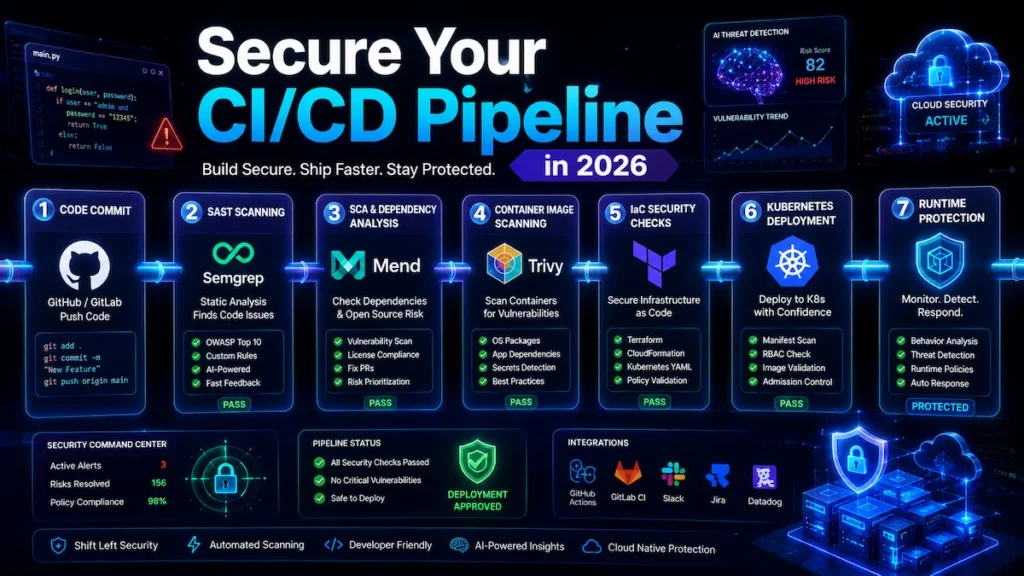
Budget-conscious engineering teams increasingly rely on free and open-source Snyk alternatives for startups like Semgrep and Trivy. For budget-constrained teams, the honest free tier breakdown:
Semgrep OSS — best free SAST available. Production-grade, unlimited scans, CI/CD-native, zero functional limitations for application code scanning.
Trivy is the best free container and IaC scanner. No SaaS dashboard required; native GitHub Actions and GitLab CI support; zero configuration for standard image scanning.
SonarCloud — free for public repositories, $10/month for private repos on LOC pricing. Most startup-friendly paid tier in the AppSec category.
Hidden costs to watch for: Enterprise free tiers cap scan volume, repository count, or developer seats. Teams routinely hit those limits within 60–90 days of active pipeline use. Budget $500–$1,500/month in commercial tooling once your team exceeds 5–7 engineers running 50+ daily scans across multiple services.
Teams building toward SOC 2 compliance should also factor in that free-tier tools rarely include the compliance reporting and audit trail features that enterprise customers and auditors will ask for. Plan the commercial upgrade before the first audit, not during it. Separately, teams integrating machine learning-based intrusion detection alongside AppSec scanning find that operational costs consolidate more predictably when both layers are budgeted as a unified stack from the start.
Best AI-Powered AppSec Platforms for Startups in 2026
The newest generation of Snyk alternatives for startups now includes AI-powered remediation and intelligent vulnerability prioritization.
The 2025–2026 security tooling generation has moved well past static rule matching. AI now operates at three distinct levels: prioritization (ranking findings by real exploitability and business context), remediation (generating accurate, codebase-specific fix suggestions), and detection (identifying novel vulnerability patterns that rules miss entirely).
According to the Mandiant M-Trends 2024 Report, organizations using AI-assisted vulnerability triage reduced mean time to remediate by an average of 38% compared to manual-only workflows—a material improvement for startup teams without dedicated AppSec staffing.
Snyk remains the benchmark for AI-powered SCA remediation. Its fix PRs are trained on millions of real-world dependency updates and produce the highest first-pass merge success rate in the category.
Semgrep Pro generates autofix suggestions tuned to your specific codebase patterns—not generic CVE templates. The quality gap between Semgrep and Snyk on AI-assisted SAST fixes has narrowed substantially through 2025.
Checkmarx uses AI-driven taint analysis to reduce false positives and prioritize findings by actual exploitability—a material improvement over raw CVSS severity scoring.
GitLab Duo integrates AI security assistance directly into merge request reviews, explaining vulnerabilities in plain language and suggesting code-level fixes without leaving the developer’s primary interface.
For startups also exploring the AI security tools landscape on a startup budget, the AI-assisted security market has matured enough that budget is no longer a credible reason to operate without AI-augmented triage.
Full Comparison: Snyk vs Competitors for Startups
Key: ✅ Strong | ⚡ Good | ⚠️ Limited | ❌ None | 🆓 Free tier
| Tool | Free Plan | Paid Pricing | CI/CD | AI Fix | Kubernetes | Container | SCA | IaC | Setup | Best Stage |
|---|---|---|---|---|---|---|---|---|---|---|
| Snyk | 🆓 Limited | ~$98/dev/mo | ✅ Excellent | ✅ Strong | ⚡ Good | ⚡ Good | ✅ Excellent | ⚡ Good | Easy | Seed–Series B |
| GitLab Security | 🆓 Basic | ~$99/user/mo | ✅ Native | ⚡ Moderate | ⚡ Good | ⚡ Good | ⚡ Good | ⚡ Good | Very Easy | Seed–Series B |
| Semgrep | 🆓 Full OSS | ~$40/dev/mo | ✅ Excellent | ⚡ Good (Pro) | ⚠️ Limited | ❌ None | ⚠️ Pro only | ⚠️ Limited | Easy | Seed–Growth |
| SonarCloud | 🆓 Public repos | $10/mo (LOC) | ✅ Very Good | ⚠️ Limited | ❌ None | ❌ None | ⚠️ Limited | ⚠️ Limited | Easy | Seed–Series A |
| Aqua / Trivy | 🆓 Trivy OSS | $20K+/yr | ⚡ Good | ⚠️ Limited | ✅ Excellent | ✅ Excellent | ⚠️ Limited | ⚡ Good | Easy/Hard | All / Series B+ |
| Checkmarx | ❌ None | $15K–50K+/yr | ✅ Very Good | ✅ Strong | ⚡ Good | ⚡ Good | ⚡ Good | ⚡ Good | Complex | Series A–B |
| Veracode | ❌ None | $10K–30K+/yr | ⚡ Good | ⚡ Moderate | ⚠️ Limited | ⚠️ Limited | ⚡ Good | ⚠️ Limited | Moderate | Series A–B |
| Mend | 🆓 Public repos | ~20% below Snyk | ✅ Very Good | ⚡ Moderate | ⚠️ Limited | ⚠️ Limited | ✅ Excellent | ⚠️ Limited | Easy | Seed–Series B |
Recommended Startup Security Stack by Stage
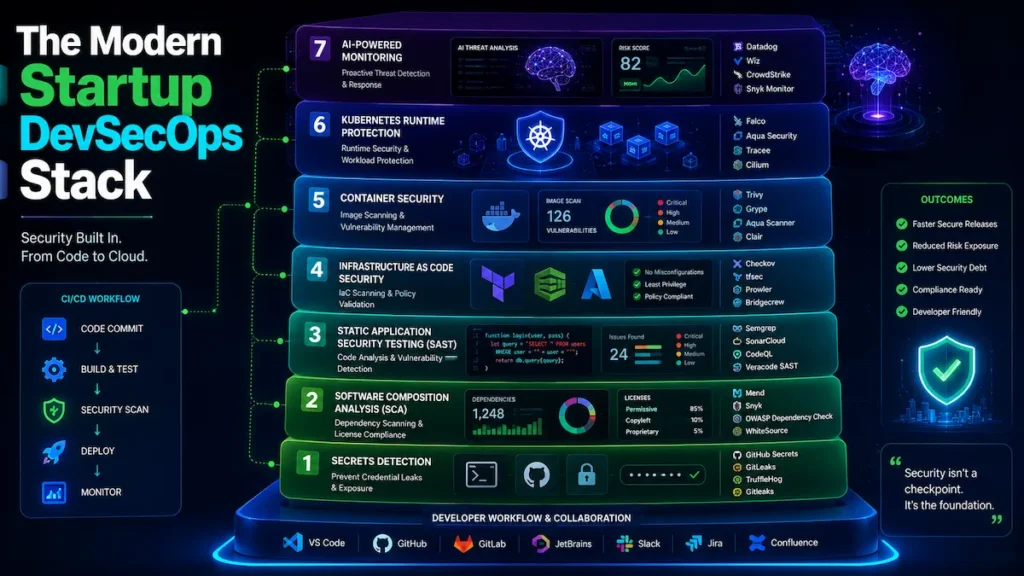
Choosing individual tools is only half the decision. The right combination depends on your stage, headcount, and compliance pressure. Overbuying creates tool sprawl and unactioned findings. Under-buying creates exploitable gaps.
🌱 Seed Stage — Instrument Fast, Spend Nothing
Goal: Security visibility in CI/CD before your first enterprise customer conversation.
| Layer | Tool | Cost |
|---|---|---|
| Secrets detection | GitHub secret scanning or GitLeaks | Free |
| SAST | Semgrep OSS | Free |
| Container + IaC scanning | Trivy | Free |
| Code quality + basic security | SonarCloud (public repos) | Free |
Total monthly cost: $0. Setup time: 1–2 days across all repos. This covers the four categories responsible for the majority of startup security incidents—secrets exposure, vulnerable dependencies, container misconfigurations, and application code flaws.
🚀 Series A — Upgrade Where Compliance and Scale Demand It
Goal: Replace free tier limits, add managed rules and fix PRs, prepare SOC 2 evidence.
| Layer | Tool | Approx. Cost |
|---|---|---|
| SAST + AI fix suggestions | Semgrep Pro | ~$40/dev/mo |
| SCA + automated fix PRs | Mend (commercial) | ~20–30% below Snyk |
| Container + Kubernetes | Trivy (CI) + Aqua upgrade path | Free now |
| CI/CD security gates | GitHub Actions or GitLab CI native | Included |
Total monthly cost: $500–$2,000/month for a 10-person team. The right upgrade window: before your first SOC 2 audit, before your first enterprise customer questionnaire.
🏢 Series B+ — Full-Stack DevSecOps for Enterprise-Facing Startups
Goal: Compliance-ready posture, Kubernetes runtime visibility, security credentials that clear enterprise procurement.
| Layer | Tool | Approx. Annual Cost |
|---|---|---|
| SAST + SCA + IaC + API security | Checkmarx One | $15K–50K+ |
| Enterprise AppSec credibility | Veracode | $10K–30K+ |
| Kubernetes + runtime security | Aqua Security | $20K+ |
| SIEM integration | Splunk, Datadog, or cloud-native | Separate budget |
Total annual cost: $50,000–$120,000+. Justified, once a single failed enterprise security questionnaire costs more than the annual tool investment—a threshold most Series B companies cross quickly.
Snyk Migration Checklist for Startups
Migrating from Snyk is a methodical handoff—not just a CI/CD reconfiguration. Use this checklist to avoid post-migration security regressions.
Phase 1 — Pre-Migration Preparation
- Export all current Snyk policies, ignore rules, and accepted risk decisions
- Inventory every repository currently scanned by Snyk
- Document which Snyk modules are actively used: SCA, SAST, container, IaC, fix PRs
- Pull a baseline vulnerability report for post-migration comparison
- Note compliance evidence or audit trails stored in Snyk dashboards
Phase 2 — Installation and Pipeline Reconfiguration
- Install replacement tool(s) in a single test repo before broad rollout
- Validate CI scan times and false positive rates against Snyk baseline
- Recreate severity thresholds and blocking policies in the new tool
- Configure automated fix PR settings to match previous Snyk behavior
- Update IDE plugins and developer integrations across the team
- Notify engineering teams before switching production pipelines
Phase 3 — Policy Reconciliation and Validation
- Recreate suppressed vulnerability decisions from Snyk export
- Re-establish license compliance rules and blocklist policies
- Rebuild compliance evidence workflows (SOC 2, ISO 27001)
- Run parallel scans across 5–10 repos to compare finding parity
- Benchmark new tool scan times against documented Snyk CI latency
- Tune false positives aggressively in the first 2–3 weeks post-migration
Phase 4 — Completion and Documentation
- Decommission Snyk integrations after 30-day parallel run validation
- Update internal security runbooks and onboarding documentation
- Archive Snyk historical data before contract termination
- Document the new tool stack in your security policy for compliance records
Estimated migration time: 2–4 weeks for under 20 repos. 6–8 weeks for larger codebases or multi-environment Kubernetes setups. Terminate the Snyk contract 60 days out to allow adequate overlap buffer.
The full implementation sequencing—including how to layer in AI-assisted tooling post-migration—is covered in the startup AI security implementation guide.
Frequently Asked Questions
What is the cheapest Snyk alternative for startups?
The cheapest Snyk alternatives for startups are Semgrep OSS and Trivy because both offer production-grade security scanning completely free.
What is the best DevSecOps tool for startups in 2026?
The best Snyk alternatives for startups in 2026 combine fast CI/CD integration, AI-assisted remediation, and low operational overhead.
What is the best Kubernetes security tool for startups?
Trivy is the correct starting point—free, CI/CD-native, covering image scanning, Kubernetes manifest auditing, and IaC checks. Commercial Aqua Security adds runtime protection for mature deployments at scale.
What is the best CI/CD security scanner for startups?
Semgrep offers the fastest CI integration with the lowest false positive rate in the SAST category. GitLab Security is native to GitLab CI pipelines with zero configuration overhead. Checkmarx’s pipeline scan returns results in under 60 seconds for lightweight SAST without blocking deploy velocity.
Are open-source security tools reliable for production use?
Yes. Semgrep OSS, Trivy, and SonarCloud are production-grade and widely deployed at scale. The limitation isn’t reliability—it’s the absence of managed rule updates, SLA-backed support, compliance audit reporting, and centralized team management that commercial tools provide.
What is the best AI-powered AppSec platform for startups?
Semgrep Pro for SAST AI fix suggestions. GitLab Duo for AI security assistance is integrated into the developer workflow. Snyk for AI-powered SCA remediation. Choosing between them depends on which scanning category is your primary pain point.
What is the best overall startup security platform in 2026?
The best Snyk alternatives for startups depend on your infrastructure, compliance requirements, and preferred CI/CD ecosystem.
Final Verdict: Best Snyk Alternatives for Startups in 2026
The security tooling market has matured to the point where Snyk is no longer the automatic choice for startups needing production-grade scanning.
Best overall for early-stage startups: Semgrep OSS + Trivy. Zero cost, CI/CD-native, no vendor lock-in. Covers everything a seed-stage startup needs before compliance requirements arrive.
Best platform consolidation: GitLab Ultimate for GitLab-native teams. Per-seat cost is justified by eliminating 3–4 point tool contracts and their integration overhead.
Best direct Snyk SCA replacement: Mend. Closest feature parity to Snyk for dependency scanning at ~20–30% lower cost with a familiar developer workflow.
Best for compliance-driven startups: Checkmarx One. Compliance reporting depth and taint analysis quality justify the cost for regulated-industry startups approaching SOC 2 or HIPAA requirements.
Best for enterprise sales credibility: Veracode. When large B2B deals require a recognized security brand on procurement questionnaire responses, Veracode’s name recognition has measurable revenue-side value.
Best budget option: SonarCloud — predictable LOC pricing, developer-friendly integration, meaningful free tier for public repositories.
Best AI-powered option: Semgrep Pro—accurate AI fix suggestions, a low false positive rate, and a developer-first experience that doesn’t require resident AppSec expertise to operate.
The most important operational insight: The biggest startup AppSec mistake in 2026 is over-buying enterprise tooling before engineering processes have matured enough to operationalize it. A startup that deploys Checkmarx or commercial Aqua before it has consistent CI/CD security gates in place has spent $30,000+ for findings that go unactioned. The right sequencing is instrument first, operationalize gates second, and upgrade tooling as compliance and scale requirements make the investment defensible.
If you’re a startup with under 20 engineers, don’t overcomplicate your AppSec stack. Start with Semgrep OSS and Trivy, instrument your CI/CD pipeline this sprint, and focus on reducing real exposure before adding enterprise-grade complexity. The best security tooling isn’t the platform with the largest feature matrix — it’s the stack your engineering team consistently uses under shipping pressure.
Start with the free combination. Get security blocking in your pipeline this sprint. Build the commercial tooling case from operational evidence, not from vendor demos. That discipline—more than any individual tool choice—is what separates startup security programs that genuinely improve security posture from ones that generate compliance theater.