

Introduction
The best GDPR compliance tools for startups have fundamentally changed how lean SaaS teams build privacy infrastructure — and in 2026, choosing the wrong one is an expensive mistake that compounds fast.
Most founders delay compliance until a customer demands it or a regulator asks questions. In 2024 alone, European regulators issued over €2.9 billion in fines. Ireland’s DPC handed Meta a €1.2 billion fine over transatlantic data transfers. Italy temporarily banned ChatGPT over data processing concerns. These aren’t abstract threats — they’re precedents that enterprise procurement teams now cite in vendor reviews.
For startups processing EU user data, GDPR isn’t a legal formality. It’s a direct risk to fundraising, enterprise sales, and long-term valuation.
📌 Founder Reality Check: Most startups begin their compliance program 6–12 months too late—typically the week an enterprise prospect sends a security questionnaire. By then, the gaps that take weeks to remediate are already deal blockers.
Why Manual Compliance Fails
Most founders underestimate how quickly data complexity grows, which is exactly why GDPR compliance tools for startups have become essential for scaling privacy operations without adding massive legal overhead.
Compliance is a scaling problem as much as a legal one. A 20-person AI startup using OpenAI APIs, HubSpot, Stripe, and Mixpanel may unknowingly create cross-border data processing obligations across four separate subprocessors—each requiring a valid DPA, documented lawful basis, and transfer mechanism. Most startups at this stage have zero of those agreements in place.
Spreadsheet-driven compliance fails through version drift: policies go stale, engineers add data fields without updating ROPAs, and vendor contracts expire unnoticed. GDPR Article 5 requires documented evidence of compliance decisions, not just good intentions. “We didn’t know” stops being a viable defense at a certain scale. Building a robust AI security compliance foundation early matters far more than most founders expect — especially once enterprise sales conversations begin.
📌 Founder Takeaway: Your cloud provider’s compliance certifications don’t transfer to your product. AWS secures the infrastructure. You own the data layer on top of it.
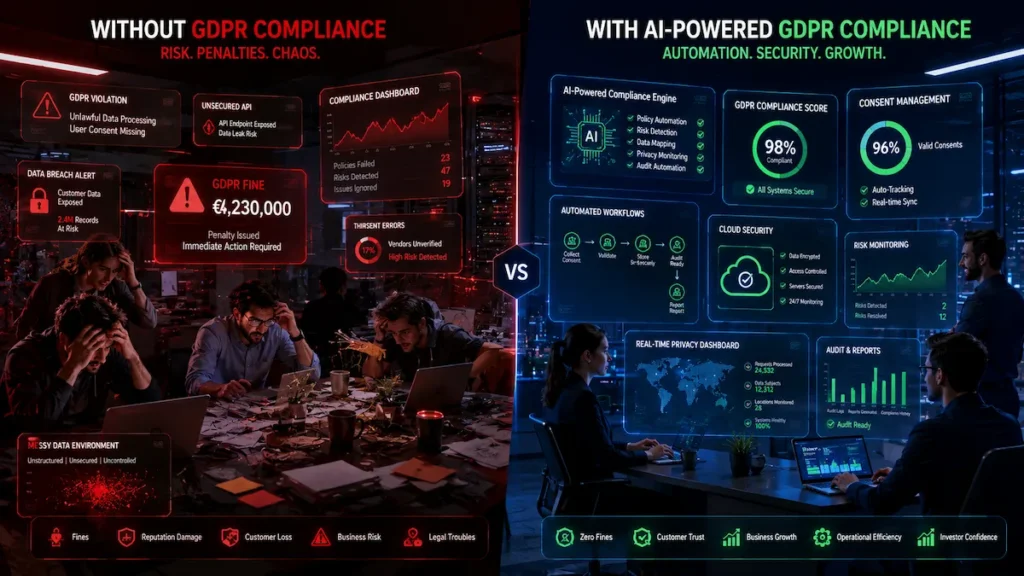
The Startup Compliance Maturity Model
The Startup Compliance Maturity Model helps founders choose the right GDPR compliance tools for startups based on company stage, customer requirements, and operational complexity.
Most startups try to jump from Stage 1 directly to Stage 3 without building Stage 2, which creates the gaps regulators and enterprise buyers most commonly flag.
| Stage | Company Profile | Minimum Requirements | Recommended Tools |
|---|---|---|---|
| Stage 1 — Foundation | Pre-revenue, 1–10 employees | Privacy policy, basic consent, lawful basis documentation | Termly, CookieYes |
| Stage 2 — Operational | Revenue, first enterprise customers | DPAs with all vendors, ROPA, breach response, basic access controls | Secureframe, early Vanta |
| Stage 3 — Automated | Series A/B, multiple enterprise customers | Continuous monitoring, automated evidence collection, vendor risk management | Vanta, Drata—see our guide to AI network security monitoring for small teams |
| Stage 4 — Enterprise | Series B+, regulated verticals | Multi-jurisdiction consent, AI governance, full audit automation | OneTrust, Drata (enterprise) |
📌 Founder Takeaway: Before buying a $10,000/year platform, verify you have Stage 2 fundamentals in place. Automating broken processes doesn’t fix them.
Best Tool by Startup Stage
Choosing the right GDPR compliance tools for startups depends heavily on whether your company is pre-revenue, entering enterprise sales, or scaling globally.
| Stage | Profile | Best Tool | Why |
|---|---|---|---|
| Pre-revenue | 1–5 employees, no enterprise customers | CookieYes / Termly | Free or near-free; covers consent and basic policy |
| First enterprise deal | 5–20 employees, first security questionnaire | Secureframe | Fastest setup; founder-operable without compliance staff |
| Seed–Series A | 10–75 employees, 2+ enterprise customers | Vanta | Best integration breadth; SOC 2 + GDPR in one platform |
| AI startup scaling fast | Complex data pipelines or LLM features | Drata | Strongest AI automation; best multi-framework coverage |
| Series B+ / Global ops | 100+ employees, enterprise privacy requirements | OneTrust | Best-in-class consent orchestration requires dedicated staff |
Quick Comparison Table
This comparison highlights the most effective GDPR compliance tools for startups based on automation depth, pricing, integration coverage, and long-term scalability.
| Tool | Best For | Starting Price (Annual) | Automation | GDPR Coverage | Startup Fit |
|---|---|---|---|---|---|
| Vanta | Seed–Series C SaaS | ~$7,500–$10,000 | ⭐⭐⭐⭐⭐ | Strong | ⭐⭐⭐⭐⭐ |
| Drata | AI & multi-framework startups | ~$6,000–$8,000 | ⭐⭐⭐⭐⭐ | Strong | ⭐⭐⭐⭐⭐ |
| Secureframe | Early-stage, first program | ~$5,000–$7,000 | ⭐⭐⭐⭐ | Solid | ⭐⭐⭐⭐ |
| OneTrust | Series B+, enterprise | $25,000+ | ⭐⭐⭐⭐⭐ | Best-in-class | ⭐⭐⭐ |
Full Tool Reviews
These in-depth reviews evaluate the leading GDPR compliance tools for startups from an operator’s perspective, including implementation realities and hidden costs.
Vanta
Vanta remains one of the most widely adopted GDPR compliance tools for startups because of its strong automation, fast setup, and enterprise-friendly integrations.
Best for: Seed through Series C SaaS, any startup facing enterprise due diligence for the first time.
Vanta effectively created the modern compliance-as-a-service category. It automates evidence collection, continuously monitors security controls, and accelerates SOC 2, ISO 27001, GDPR, HIPAA, and other framework certifications. With 300+ integrations—AWS, GCP, Azure, GitHub, Okta, Slack, HubSpot, and Salesforce—its integration breadth is a genuine competitive advantage.
Setup complexity: Low to moderate. Most startups connect their core environment and see meaningful monitoring within days. The dashboard is built for founders and CTOs, not full-time compliance staff.
| Category | Score |
|---|---|
| Ease of Setup | 9/10 |
| GDPR Coverage | 8/10 |
| AI Automation | 8/10 |
| Integration Breadth | 10/10 |
| Startup Fit | 10/10 |
Strengths: Fast time-to-value, AI-powered risk prioritization, continuous monitoring, mature audit partner ecosystem.
Weaknesses: GDPR functionality is solid but not as deep as OneTrust for complex multi-jurisdiction consent. Pricing scales with headcount.
❌ When NOT to Buy: Pre-revenue with fewer than five employees — cost-to-value doesn’t work yet. Complex multi-jurisdiction consent orchestration requires supplementing with a dedicated CMP.
💰 Hidden Cost: Budget 1–2 days/month of internal engineering time in the first 60–90 days for control remediation. It drops once the program matures, but most vendors don’t mention it upfront.
Pricing: ~$7,500–$10,000/year for small teams. Startup Fit: ⭐⭐⭐⭐⭐
Drata
Drata has emerged as one of the most advanced AI-powered GDPR compliance tools for startups, particularly for SaaS companies managing multiple compliance frameworks simultaneously.
Best for: AI-first companies, startups pursuing GDPR and SOC 2 simultaneously, teams wanting the highest degree of automation.
Drata has invested most aggressively in AI-powered compliance automation. Its automated control testing continuously assesses control effectiveness — a meaningful advancement over traditional point-in-time reviews. Onboarding is more guided than Vanta’s, which benefits teams newer to formal compliance.
Setup complexity: Low to moderate. 200+ integrations cover the vast majority of startup tech stacks.
| Category | Score |
|---|---|
| Ease of Setup | 8/10 |
| GDPR Coverage | 9/10 |
| AI Automation | 10/10 |
| Integration Breadth | 8/10 |
| Startup Fit | 9/10 |
Strengths: Best AI automation in the category, excellent multi-framework support, comprehensive GDPR documentation for EU + US compliance simultaneously.
Weaknesses: Fewer integrations than Vanta. Customer support has been inconsistent during rapid growth periods.
❌ When NOT to Buy: Standard tech stack with SOC 2 as the only immediate priority — Secureframe or Vanta may serve you equally well at lower cost. Drata’s AI depth pays off most for complex, evolving infrastructure.
💰 Hidden Cost: Starting from scratch requires 2–3 weeks of part-time effort before the program runs efficiently. Multi-framework bundles add cost but represent better value than managing frameworks across separate vendors.
Pricing: ~$6,000–$8,000/year. Startup Fit: ⭐⭐⭐⭐⭐
Secureframe
Secureframe is one of the simplest GDPR compliance tools for startups for early-stage teams that need fast compliance readiness without dedicated security staff.
Best for: Early-stage startups, first-time compliance programs, and the fastest path to SOC 2.
Secureframe is the most accessible entry point in the category. A founder can meaningfully operate it without dedicated compliance staff — setup is fast, the interface prioritizes clarity, and time-to-certification is the fastest of the major platforms.
Setup complexity: Low. 150+ integrations cover core infrastructure solidly.
| Category | Score |
|---|---|
| Ease of Setup | 10/10 |
| GDPR Coverage | 7/10 |
| AI Automation | 6/10 |
| Integration Breadth | 7/10 |
| Startup Fit | 9/10 |
Strengths: Fastest time-to-certification, clean UI, transparent pricing, solid GDPR module, responsive support.
Weaknesses: Less AI automation depth than Drata. Some companies migrate to a more capable platform at Series B. Control testing is rules-based, not AI-driven.
❌ When NOT to Buy: If you anticipate ISO 27001, HIPAA, and GDPR simultaneously within 18 months or have unusual infrastructure, factor platform migration costs into your total cost of ownership evaluation.
Pricing: ~$5,000–$7,000/year. Best paired with AI security tools on a startup budget to cover the security layer Secureframe doesn’t fully automate. Startup Fit: ⭐⭐⭐⭐
OneTrust
OneTrust is among the most comprehensive enterprise-grade GDPR compliance tools for startups operating in highly regulated industries or multiple jurisdictions.
Best for: Series B+, enterprise SaaS with global operations, AI companies with complex data pipelines, regulated industries.
OneTrust is the enterprise-grade leader in privacy and consent management—covering GDPR, CCPA, LGPD, and dozens of global regulations, with best-in-class consent orchestration, data mapping, and vendor risk management.
Setup complexity: High. Enterprise deployments typically involve implementation partners and multi-week rollouts. Even mid-market customers should expect significant setup investment and ongoing platform administration.
| Category | Score |
|---|---|
| Ease of Setup | 4/10 |
| GDPR Coverage | 10/10 |
| AI Automation | 9/10 |
| Integration Breadth | 9/10 |
| Startup Fit | 5/10 |
Strengths: Best-in-class consent management, most sophisticated data mapping available, strong multi-regulation coverage, deep vendor risk management.
Weaknesses: $25,000+ starting price. Steep learning curve. Requires dedicated compliance resources. Significant overkill for companies not yet ready for enterprise-grade infrastructure.
❌ When NOT to Buy: Pre-Series B without a dedicated compliance function. Most startups that buy OneTrust early underutilize it significantly while paying enterprise prices.
💰 Hidden Cost: Implementation partner fees and ongoing administration add 30–50% to list price in year one. Realistic all-in cost for a mid-market deployment often exceeds $40,000.
Pricing: $25,000+/year. Startup Fit: ⭐⭐⭐
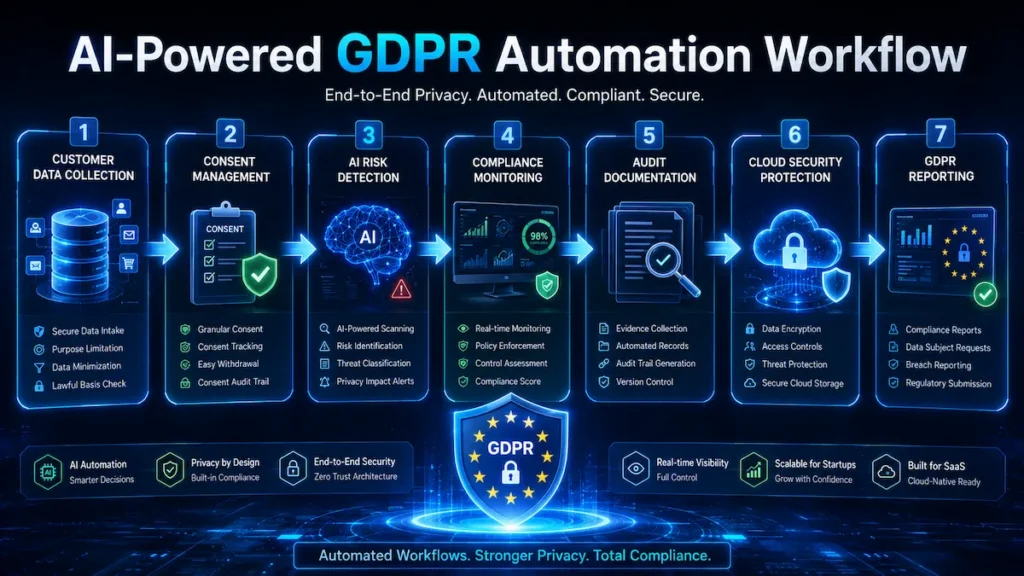
GDPR Implementation Timeline
A realistic implementation timeline helps founders deploy GDPR compliance tools for startups without creating documentation gaps or operational bottlenecks.
The most consistent gap in startup compliance programs isn’t missing tools—it’s missing sequences. Teams buy platforms before establishing the manual foundations those platforms are meant to automate.
Weeks 1–2 — Inventory and Foundation Before touching any platform, run a vendor inventory. List every third-party tool processing personal data. Most startups find 15–30 subprocesses they hadn’t formally documented. Map what personal data flows to each vendor and under what lawful basis. Gaps in lawful basis documentation are the single most common GDPR enforcement target.
Weeks 3–4 — Consent and Policies Audit every data collection touchpoint—sign-up flows, cookie banners, marketing opt-ins, and session recording tools. The EDPB’s guidelines on consent are unambiguous: pre-ticked boxes, bundled consent, and obscured withdrawal options are consistent enforcement targets. Update your privacy policy to reflect your actual vendor list and processing activities. Execute DPAs with your five highest-risk subprocessors first: cloud provider, analytics, CRM, support platform, and payment processor. A startup cybersecurity checklist can help you verify the underlying security controls are in place before you begin automating evidence collection.
Month 2 — Platform Setup Connect your compliance platform to cloud infrastructure, an identity provider, and key SaaS tools. Configure automated evidence collection. Transfer your data flow inventory into the ROPA module. Work through remaining vendor DPAs—vendor management modules in Vanta and OneTrust automate tracking.
Month 3 — Process Testing Run a simulated data subject request through your DSR workflow to find bottlenecks before a real one arrives. Document and tabletop test your article 33 breach notification process. Pull a compliance report and assign sprint capacity to the highest-severity gaps.
Ongoing (Monthly) Review new vendor onboarding for DPA requirements before tools are adopted. Update ROPA when new data fields or processing activities are added. Review platform monitoring alerts — don’t let the platform run unattended.
📌 Founder Takeaway: Most startups skip Weeks 1–2 and go straight to platform setup. That creates automated documentation of processes that don’t reflect your actual data environment. Inventory first, automate second.
Biggest Hidden GDPR Costs
Before investing in GDPR compliance tools for startups, founders should understand the hidden costs tied to engineering remediation, consent redesign, and vendor management.
Platform pricing is the most visible compliance cost. It’s rarely the largest one.
Engineering remediation time. Compliance platforms surface gaps—they don’t fix them. Expect 2–4 weeks of part-time engineering in the first 90 days and 4–8 hours/month ongoing. This cost doesn’t appear on any vendor’s pricing page.
DPA negotiation delays. Standard DPAs from major vendors are click-to-accept. Non-standard DPAs from enterprise vendors can take 4–8 weeks with legal review on both sides, potentially blocking an enterprise deal during that window.
Consent redesign work. Discovering your consent implementation is noncompliant—pre-ticked boxes, missing withdrawal mechanisms—requires product and engineering work, not just a policy update. A full preference center rebuild can be a 2–4 week project.
Specialist legal counsel. Compliance platforms handle operations. They don’t provide regulatory advice. Cross-border transfer mechanisms, DPIAs for high-risk AI features, and supervisory authority inquiries typically cost €5,000–€20,000+ per engagement.
Platform migration costs. Startups that outgrow Secureframe at Series B face non-trivial migration costs — evidence archives, control mappings, and audit history don’t transfer cleanly. Factor this into your total cost of ownership comparison.
Internal ownership time. Every platform requires a human owner—generating alerts, making policy decisions, and reviewing findings. At an early stage: 4–10 hours/month on the CTO’s plate. At growth stage: often a dedicated hire.
📌 Realistic Total: For a 20-person SaaS startup in year one, expect all-in costs of $25,000–$45,000 when platform, engineering time, DPA review, and consent remediation are included.
Common GDPR Mistakes Founders Make
Many startups purchase GDPR compliance tools for startups but still fail audits because of weak consent management, stale documentation, and missing DPAs.
Weak consent management. The most common GDPR violation isn’t a dramatic data breach — it’s inadequate consent. Cookie banners that pre-select all categories, consent flows that bury withdrawal options, and marketing lists built on implicit consent—these are consistent enforcement targets. Tools like FullStory and Hotjar require explicit GDPR handling that many startups skip entirely when onboarding them.
Incomplete vendor risk assessments. Every third-party tool processing personal data on your behalf is a data processor under GDPR — and you’re responsible for their compliance. Most startups have DPAs with two or three major vendors and ignore the rest. A project management tool storing client names and a support platform processing ticket conversations both require DPAs.
Stale ROPAs. Records of processing activities are a core Article 30 requirement. Most startups either don’t maintain them or have versions months out of date because product changes outpace documentation updates. Without automated workflows tied to your infrastructure, the ROPA drifts from reality almost immediately.
Poor API security. API endpoints passing personal data without authentication controls, logging configurations that capture user tokens — these create GDPR risk at the intersection of security and compliance. GDPR Article 32 requires “appropriate technical measures.” The NIST Cybersecurity Framework provides practical guidance on what satisfies that standard. Proactive machine learning-based intrusion detection helps catch API-level anomalies before they become reportable incidents under Article 33’s 72-hour breach notification requirement.
What enterprise procurement teams? Actually Reject
Enterprise buyers increasingly evaluate whether GDPR compliance tools for startups are backed by real operational processes and current compliance documentation.
Understanding what enterprise buyers evaluate is useful. Understanding what causes immediate rejection is more useful.
Missing DPAs for common subprocessors. The gap isn’t usually the cloud provider—it’s Intercom, Mixpanel, Zendesk, Hotjar, and Amplitude. Enterprise teams know these tools have standard DPAs available. Missing them signals an immature program, not a complex edge case.
Stale privacy policies. A policy last updated in 2022 that doesn’t reflect your current vendor list is cross-referenced against your stated tech stack. Inconsistencies are flagged as misrepresentations, not oversights.
No documented incident response plan. Article 33 requires breach notification within 72 hours. A written process, even a simple one-pager, is sufficient. Its complete absence is a deal-breaker in regulated industries.
No MFA enforcement. Multi-factor authentication on your cloud console, identity provider, and code repository is the baseline control that virtually every enterprise security questionnaire checks. Vendors who can’t demonstrate it are rejected at the initial vendor review. Our guide on how to secure a startup with AI tools covers these baseline security controls in practical detail.
No data subject rights process. “We’d handle it manually” is not a sufficient answer for a 30-day DSR deadline. Enterprise buyers want a documented process with a named owner.
AI features without Article 22 documentation. The fastest-growing rejection category. Enterprise buyers in financial services, HR tech, and healthcare ask whether your AI features make decisions with significant effects on individuals — and want evidence of human intervention rights documented. Absence of any documentation signals regulatory exposure that enterprise legal teams won’t accept.
📌 Key Insight: Enterprise procurement teams don’t reject vendors for imperfect compliance programs. They reject vendors who can’t demonstrate they’ve thought through the basics. Current, organized documentation addresses most of these triggers even if the underlying program isn’t perfect.
What Happens During a GDPR Audit?
Modern GDPR compliance tools for startups make audits significantly easier by organizing evidence, tracking controls, and maintaining current compliance records.
GDPR doesn’t have a standardized third-party audit process. “Audits” occur in three ways:
Regulatory investigation. A supervisory authority (the ICO, Ireland’s DPC) initiates a formal inquiry, triggered by a complaint, a reported breach, or a proactive regulatory sweep. Ireland’s DPC oversees most major US tech companies’ EU operations and has issued some of the largest fines in GDPR history.
Enterprise due diligence. A prospective customer’s vendor security team reviews your ROPAs, DPAs, consent management, security controls, and incident response documentation. Security questionnaires now routinely exceed 200 control checks.
Investor due diligence. Growth-stage investors with European LPs conduct data protection reviews—sometimes engaging specialist privacy counsel to assess regulatory exposure. GDPR compliance has become a fundraising variable, not just a legal checkbox.
In all three scenarios, what matters is organized, current documentation — not the most sophisticated compliance program on paper.
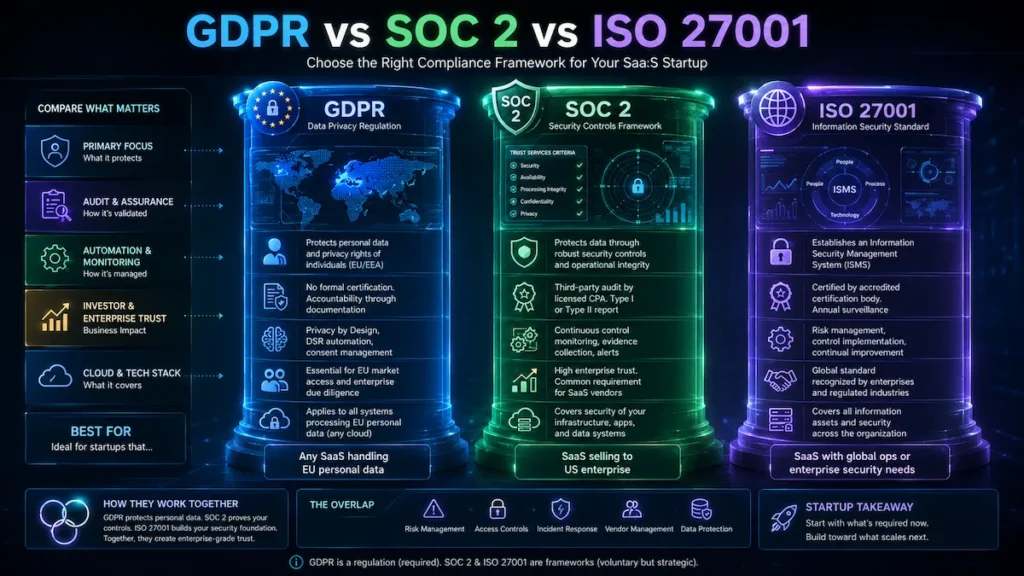
GDPR vs SOC 2 vs ISO 27001
Understanding how GDPR compares with SOC 2 and ISO 27001 helps founders choose the right GDPR compliance tools for startups based on customer and regulatory requirements.
| Framework | Primary Focus | Formal Audit? | Enterprise Value | Typical Timeline |
|---|---|---|---|---|
| GDPR | Data privacy | No (self-assessment) | Essential for EU markets | Ongoing |
| SOC 2 Type II | Security controls | Yes (licensed auditor) | Essential for US enterprise | 6–12 months |
| ISO 27001 | Information security management | Yes (accredited auditor) | High in EU + regulated verticals | 9–18 months |
Prioritization guidance: SOC 2 Type II first if you’re selling to US enterprises—see our detailed breakdown of the best SOC 2 compliance tools for AI startups for a parallel deep dive. GDPR applies to your first EU user regardless of where you’re incorporated—it’s not optional. ISO 27001 is best deferred until explicitly required by customers.
SOC 2 and GDPR share significant control overlap, which is one of the strongest practical arguments for unified platforms like Vanta and Drata over managing frameworks separately.
Cost reality: SOC 2 Type II audits run $15,000–$40,000 for the audit alone. ISO 27001 initial certification often runs $20,000–$50,000. GDPR requires no certification audit but has real costs in platform fees, engineering hours, and consent infrastructure.
Critical distinction: SOC 2 and ISO 27001 are security frameworks. GDPR is a privacy regulation. You can have robust SOC 2 controls and still be GDPR non-compliant if you’re missing consent documentation, data subject rights processes, or DPAs. The reverse is also true.
Best GDPR Compliance Tools for AI Startups
AI companies face unique regulatory risks, which makes specialized GDPR compliance tools for startups increasingly important for managing training data, AI governance, and automated decision-making obligations.
AI startups face disproportionate GDPR exposure in three areas:
Training data provenance. GDPR requires a documented lawful basis for every personal data processing activity. If user data trained or fine-tuned a model without a clear lawful basis established at collection, the entire dataset may represent ongoing exposure.
Automated decision-making. Article 22 governs decisions made solely by automated systems with significant effects on individuals—employment, credit, health, and content moderation at scale. Most AI products that touch these domains trigger Article 22 obligations, including the right to human review.
Model output risks. LLM features that can surface or reconstruct personal information from training data create disclosure risks most standard frameworks don’t adequately address.
Enterprise procurement has shifted accordingly. Three years ago, a privacy policy and cookie banner passed basic vendor reviews. Today, sophisticated buyers ask for model cards, automated decision-making disclosures, bias testing documentation, and evidence that AI features have been reviewed against Article 22 criteria. The ICO’s AI and data protection guidance is the most practical regulatory resource for working through these questions. For a broader view of the security tooling AI startups need alongside compliance, see our guide to the best AI security tools for startups in 2026.
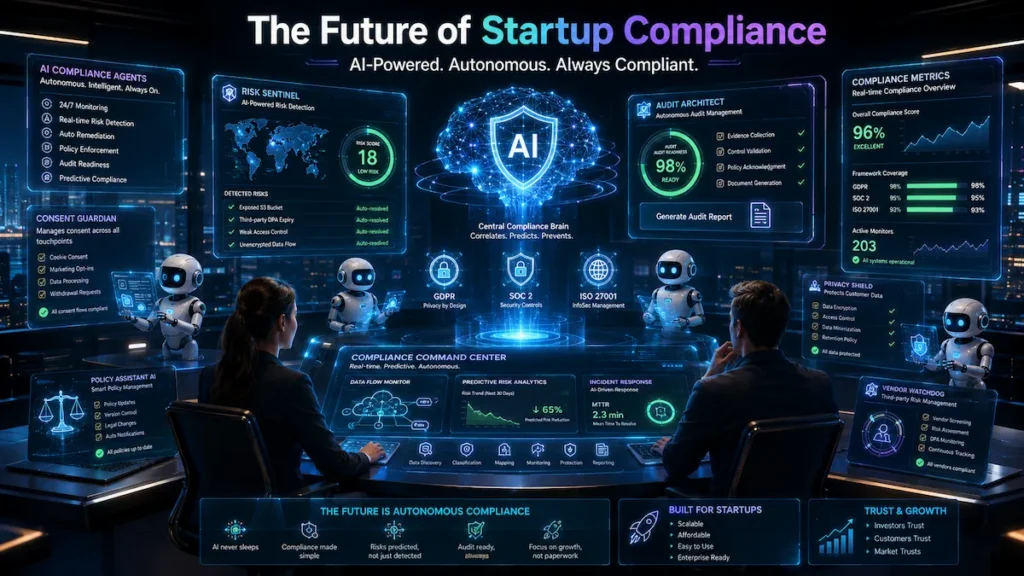
Final Verdict
The best GDPR compliance tools for startups ultimately depend on company stage, enterprise sales exposure, and the complexity of your data infrastructure.
Vanta is the best all-around choice for most startups—strong automation, 300+ integrations, solid GDPR and SOC 2 coverage, and a product that scales from early stage through growth. Default recommendation for most SaaS companies starting a formal compliance program.
Drata is the strongest alternative, with the best AI automation in the category and excellent multi-framework support. Worth a head-to-head evaluation against Vanta if you have complex infrastructure or are pursuing GDPR and SOC 2 simultaneously.
Secureframe is the right entry point for very early-stage startups prioritizing speed and simplicity. Real limitations at scale — factor migration costs into your total cost of ownership if you expect to outgrow it within 18 months.
OneTrust is right once you have a dedicated compliance function, complex multi-jurisdiction requirements, and an enterprise customer base that demands best-in-class privacy infrastructure. Genuinely excellent software at enterprise prices — and genuinely the wrong call for most startups before Series B.
📌 Final Founder Takeaway: The common thread across every effective compliance program isn’t the platform — it’s ownership. Someone internally must make policy decisions and ensure monitoring leads to remediation. The tools in this guide make that feasible for lean teams. The decision to prioritize it is yours.
FAQs
What are the best GDPR compliance tools for startups in 2026?
The best GDPR compliance tools for startups in 2026 include Vanta, Drata, Secureframe, and OneTrust, depending on company size and compliance maturity.
How much does GDPR compliance software cost for startups?
$5,000–$15,000 annually for Secureframe, Drata, or Vanta. OneTrust starts at $25,000+. All-in costs, including engineering time and implementation, typically run 30–50% higher than list prices—expect $25,000–$45,000 in year one for a 20-person startup.
Do US-based SaaS startups need to comply with GDPR?
US companies processing EU customer data still require GDPR compliance tools for startups to manage lawful processing, consent, and audit readiness.
Yes. Processing personal data from EU residents — including free trial sign-ups or usage analytics — triggers GDPR regardless of where your company is incorporated. Fines reach €20 million or 4% of global annual turnover, whichever is higher.
What is the difference between SOC 2 and GDPR?
SOC 2 certifies your internal security controls. GDPR governs how personal data from EU residents is collected, processed, stored, and deleted. They overlap significantly but address different requirements — SOC 2 doesn’t substitute for GDPR compliance.
Can GDPR compliance tools handle data subject access requests automatically?
Modern GDPR compliance tools for startups automate DSR workflows, helping companies respond to access and deletion requests within GDPR timelines.
What GDPR risks do AI startups specifically face?
Training data provenance, automated decision-making obligations under Article 22, and model outputs that may reconstruct personal data. The EU AI Act adds additional governance requirements for high-risk AI applications.
How long does it take to implement a GDPR compliance program?
Most teams can deploy GDPR compliance tools for startups within several weeks, although full audit readiness often takes several months.
Is Vanta or Drata better for GDPR?
Both platforms are leading GDPR compliance tools for startups, with Vanta excelling in integrations and Drata leading in AI-driven automation.
Both are strong. Vanta has broader integration coverage. Drata has stronger AI automation and is better for complex multi-framework programs. Both offer trials—evaluate them against your specific tech stack.
Can startups handle GDPR without a lawyer?
Mostly yes, for day-to-day compliance. Legal counsel is important for cross-border transfer mechanisms, DPIAs for high-risk AI features, non-standard DPA negotiations, and responding to regulatory inquiries.
Key Takeaways
- Best tools in 2026: Vanta (all-around), Drata (AI automation), Secureframe (entry-level), OneTrust (enterprise)
- GDPR applies to US startups processing EU data regardless of company location or server geography
- Don’t skip Stage 2 of the Startup Compliance Maturity Model—automating broken processes doesn’t fix them
- Most startups start 6–12 months too late—typically when a security questionnaire arrives
- The all-in year-one cost for a 20-person startup is typically $25,000–$45,000, not just the platform license
- AI startups face elevated scrutiny under Article 22 and the EU AI Act—model cards and ADM documentation are now enterprise procurement requirements
- “When NOT to buy” matters: OneTrust before Series B and Secureframe beyond Series B are both expensive mistakes
- SOC 2 and GDPR overlap significantly—pursuing both on a unified platform is more efficient than managing them separately
- Someone must own compliance internally—automation amplifies human judgment; it doesn’t replace it