Reviewed by: Irfan Ullah, compliance content specialist Research sources: AEPD annual publications · GDPR text and recitals · Vendor documentation · Privacy practitioner commentary · CMS GDPR Enforcement Tracker Updated: June 2026
Quick Answer
The best GDPR compliance software for Spain-based startups depends on headcount and funding stage. Sprinto and Kertos suit early Series A teams (10–60 employees) needing fast RoPA documentation at lean cost. Vanta fits Series A companies (20–150 employees) running SOC 2 and GDPR simultaneously. Scrut Automation handles Series B complexity (50–300 employees) with multi-framework depth. Every tool should address Spain’s LOPDGDD obligations and the AEPD’s strong emphasis on DPIA documentation for AI systems — two requirements generic compliance tools commonly miss.
Choosing the right GDPR Compliance Software for Spain Startups can reduce compliance overhead, improve documentation readiness, and support sustainable growth under GDPR and Spain’s LOPDGDD requirements.
Who this guide is for:
SaaS startups operating in Spain or serving Spanish customers
Series A–B companies with 10–300 employees
Teams actively evaluating GDPR compliance automation
Founders preparing for investor due diligence or enterprise sales
GDPR Software for Spanish SaaS Companies: Comparison Table
This comparison of GDPR compliance software for Spain Startups evaluates six platforms based on regulatory fit, automation, implementation speed, and startup suitability.
Tool
Best for
Spain-specific strength
Where it falls short
Headcount fit
Implementation
Price
Sprinto
Fast GDPR baseline
RoPA templates, multi-framework
Light vendor management
10–100
2–4 weeks
Entry-mid
Kertos
EU-native GDPR + ISO 27001
External DPO add-on, GDPR-first build
No SOC 2 track
5–200
2–6 weeks
Mid
Vanta
SOC 2 + GDPR dual-track
DSAR automation, vendor DPA tracking
LOPDGDD not explicitly mapped
20–150
4–8 weeks
Mid
Scrut Automation
Series B multi-framework
Sub-processor visibility, audit reporting
Overkill below 50 employees
50–300
6–10 weeks
Mid-high
User-centric
Consent management only
AEPD-aligned cookie compliance
Not a full GRC platform
Any
1–2 days
Low
OneTrust
Enterprise governance
Full LOPDGDD module, AI governance
Excludes early stages on price
200+
3–6 months
High
Our Recommendations
Fastest implementation (based on published onboarding timelines) → Sprinto
Best for EU-first startups → Kertos
Best SOC 2 + GDPR → Vanta
Best scaling choice → Scrut Automation
Best consent layer → Usercentrics
Best enterprise governance → OneTrust
[CTA: Not sure which layer your startup is weakest on? Download the Spain GDPR Readiness Stack™ Self-Assessment—free for trusteraai.com subscribers.
<a name="methodology"></a>
How We Evaluated These Tools
To identify the best GDPR compliance software for Spain Startups, we assessed each platform against nine weighted compliance and operational criteria.
Every tool in this guide was assessed against nine criteria weighted toward the Spain-specific compliance reality — not the generic EU GDPR baseline that most software roundups use.
Evaluation criteria:
Spain-specific regulatory coverage (LOPDGDD alignment, AEPD readiness, AI DPIA support)
RoPA workflow quality and ease of maintenance
DSAR automation depth and response tracking
Vendor DPA management and sub-processor visibility
Implementation speed for lean startup teams
Multi-framework support (GDPR + SOC 2 + ISO 27001)
Startup affordability across funding stages
Ease of ongoing maintenance without dedicated compliance staff
Scalability from Series A through Series B and beyond
Scoring weights:
Regulatory fit — 30%
Operational usability — 25%
Automation depth — 20%
Cost efficiency — 15%
Scalability — 10%
Tools were evaluated based on publicly available documentation, published customer case studies, and independent capability analysis. Overall scores reflect weighted methodology and do not represent an objective benchmark or legal certification. Individual results will vary based on company-specific compliance requirements and configuration.
Editorial disclosure: This comparison combines regulatory review of GDPR, LOPDGDD, and AEPD publications with vendor documentation, implementation analysis, and startup operational fit assessment. It is informational content and not legal advice. Platform capabilities may change over time. Inclusion does not imply endorsement or sponsored placement. Consult a qualified privacy lawyer for advice specific to your situation.
<a name="scorecard"></a>
Tool Scorecard
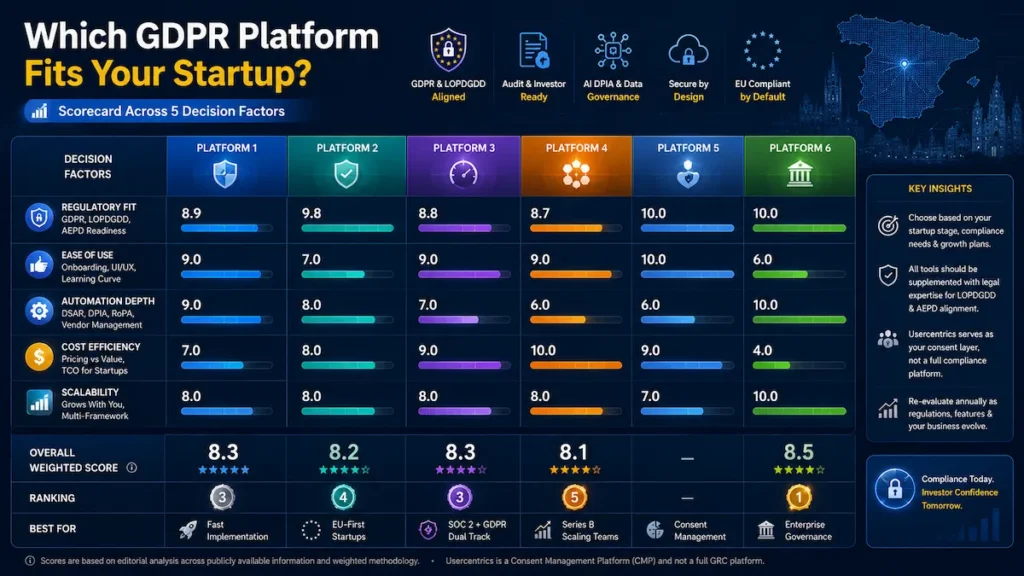
This scorecard highlights how each GDPR compliance software for Spain Startups performs across cost, automation, scalability, and regulatory readiness.
Scores out of 10. Based on editorial assessment across weighted criteria. The overall score reflects a weighted methodology and does not represent an objective benchmark or legal certification. Usercentrics scored as a standalone CMP, not a full GRC platform, and was excluded from overall ranking.
Tool
Regulatory Fit
Ease of Use
Automation
Cost Efficiency
Scalability
Overall
Sprinto
8
9
8
9
7
8.3
Kertos
9
8
7
8
8
8.2
Vanta
8
8
9
7
9
8.3
Scrut Automation
8
7
9
6
10
8.1
User-centric*
10
10
6
9
7
—
OneTrust
10
6
10
4
10
8.5
*Usercentrics evaluated as a standalone CMP only. Not directly comparable to full GRC platforms in this table.
Reading the scorecard: Kertos and Vanta tie on overall score at 8.3 but serve different use cases — Kertos for EU-first startups without SOC 2 requirements, Vanta for dual-framework Series A companies. OneTrust scores highest overall at 8.5, but its cost efficiency score of 4 reflects the significant investment required, making it impractical for most growth-stage startups. Sprinto’s ease of use score of 9 reflects its particular strength for lean teams without dedicated compliance staff.
<a name="tools"></a>
Best GDPR Compliance Platforms for EU Startups Operating in Spain
Sprinto
Sprinto was built for the lean startup compliance problem: get audit-ready fast, without a dedicated compliance team. Its RoPA templates are the most operationally accessible in the market at the entry-mid-price tier, making foundational documentation achievable for a technical co-founder managing compliance alongside other responsibilities. Sprinto supports GDPR alongside SOC 2 and ISO 27001, which matters for Series A companies receiving enterprise sales requests that include certification requirements from European buyers.
Where it falls short for Spain: Sprinto’s GDPR implementation addresses the generic EU baseline. LOPDGDD-specific obligations and the AEPD’s emphasis on DPIA documentation for AI systems — as outlined in the AEPD’s 2024 Guía de adecuación al RGPD de tratamientos con IA — are not explicitly surfaced in the platform. Legal support is advisable to map Spain-specific gaps.
Who should NOT choose Sprinto:
Teams requiring explicit LOPDGDD mapping out of the box
Companies with more than 150 employees and complex vendor governance needs
Organisations requiring deep sub-processor management at scale
Startups where SOC 2 is not a current or near-term requirement and EU-native architecture is preferred
Best suited to: Early Series A companies (10–60 employees) prioritizing speed to GDPR baseline and cost efficiency.
Figure 1. Sprinto RoPA dashboard and framework progress tracker. [Screenshot: sprinto-gdpr-ropa-dashboard.webp] What to look for: ✓ RoPA workflow setup · ✓ DSAR queue management · ✓ Framework progress tracker · ✓ Evidence export capability · ✓ Vendor inventory status
Kertos is architecturally differentiated from US-built platforms by its EU-native design. Built for the German and broader EU regulatory context, it treats GDPR and ISO 27001 as primary frameworks — not add-ons to a SOC 2 core. In practice, many organizations designate a clear privacy or data protection contact even where a formal DPO appointment is not mandatory under GDPR Article 37. Kertos makes this operationally straightforward through its external DPO add-on — one of the more cost-efficient paths to establishing that contact for companies below the mandatory DPO threshold.
Where it falls short: No SOC 2 track. If your investor base or US enterprise sales pipeline requires SOC 2 alongside GDPR, a different platform or parallel tooling stack is needed.
Who should NOT choose Kertos:
Companies where SOC 2 is a near-term requirement from buyers or investors
US-headquartered startups with a primarily American compliance posture
Teams requiring a single platform to handle SOC 2 and GDPR in parallel
Best suited to: EU-focused startups (5–150 employees) that do not require SOC 2 and want a GDPR-first architecture with DPO support built in.
Figure 2. Kertos DSAR and DPO workflow. [Screenshot: kertos-dsar-workflow.webp] What to look for: ✓ Automated deletion and access request handling · ✓ DPO dashboard and task assignment · ✓ DPIA workflow templates · ✓ ISO 27001 framework alignment · ✓ Evidence export for audits
Vanta
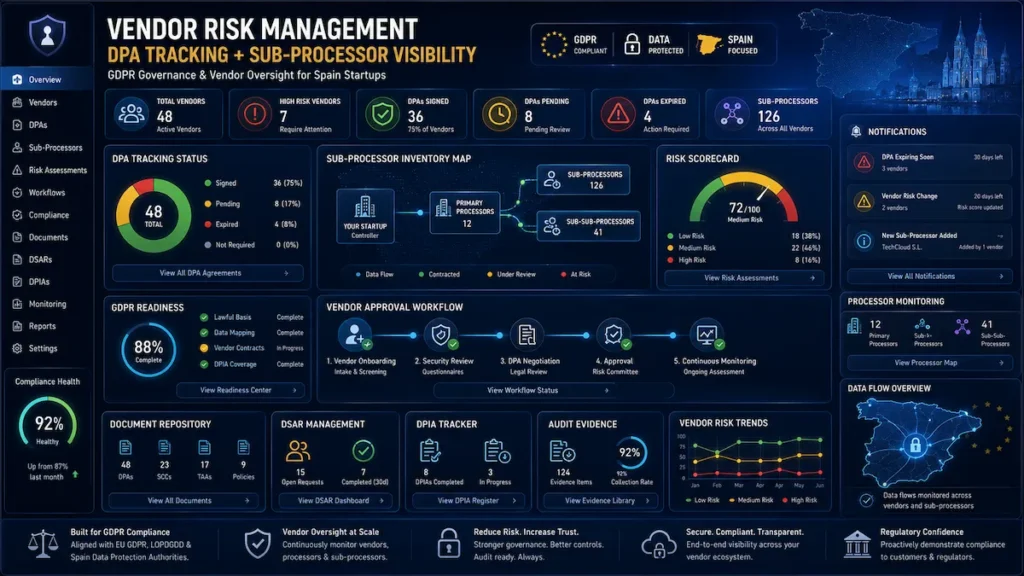
Vanta built its market position on SOC 2 automation and expanded into GDPR as its customer base moved into EU markets. For a Series A company running SOC 2 and GDPR simultaneously—the standard configuration for SaaS companies selling into both US enterprise and EU markets—Vanta’s dual-track capability reduces documentation overhead meaningfully. Its vendor management module supports DPA tracking with sub-processor visibility, which is relevant given the AEPD’s enforcement focus on controller responsibility for processor compliance failures, as evidenced in multiple enforcement decisions documented in the CMS GDPR Enforcement Tracker.
Where it falls short: LOPDGDD-specific obligations and the AEPD’s DPIA emphasis for AI systems are not explicitly mapped. Implementation runs four to eight weeks—longer than Sprinto or Kertos.
Who should NOT choose Vanta:
EU-only startups with no US investor base or SOC 2 requirement
Companies under 20 employees where implementation complexity exceeds current compliance needs
Teams prioritising cost efficiency above multi-framework capability
Best suited to: Series A companies (20–150 employees) with a US investor base requiring SOC 2 and EU customers requiring GDPR.
Scrut targets the compliance complexity that emerges at Series B: multiple frameworks running concurrently (GDPR, SOC 2, ISO 27001, NIS2), a vendor ecosystem of dozens of processors requiring active DPA management, and investor due diligence timelines demanding audit-ready documentation on short notice. Its sub-processor visibility capabilities are among the strongest in the mid-market segment—directly relevant given Spanish case law indicating that indemnity clauses in processor contracts do not substitute for active controller oversight, a position reinforced by AEPD enforcement decisions across the telecommunications and insurance sectors.
Where it falls short: Operationally heavy below 50 employees and priced accordingly. Implementation runs six to ten weeks.
Who should NOT choose Scrut:
Early Series A companies needing a fast, lightweight baseline
Startups with fewer than 50 employees where implementation overhead exceeds current compliance requirements
Teams with limited budget who need entry-tier pricing
Best suited to: Series B companies (50–300 employees) with multi-framework requirements and complex vendor ecosystems in or approaching a fundraising process.
User-centric
Usercentrics is a consent management platform, not a full GRC tool. It belongs in your compliance stack alongside one of the platforms above. Internet services accounted for 3,141 AEPD complaints in 2024—the second-highest enforcement category, according to the AEPD’s 2024 Annual Report—with cookie and consent management among the most common triggers. Usercentrics provides configuration options that can support alignment with AEPD consent expectations, with granular consent setup, balanced reject/accept UX, and downstream signal propagation to connected analytics tools. Implementation is measured in days, not weeks.
Who should NOT choose Usercentrics as a standalone tool:
Teams that need a complete GRC platform covering RoPA, DSAR, and vendor DPA management
Companies at Series B requiring multi-framework compliance management in one platform
Startups evaluating Usercentrics as a replacement for a full compliance programme
Best suited to: Any startup with a consumer-facing web product processing tracking data on Spanish or EU users — as a CMP layer alongside a full GRC platform.
What to look for: ✓ Equal prominence of accept and reject options · ✓ Granular purpose-level consent controls · ✓ Downstream analytics signal management · ✓ Consent audit log · ✓ Multi-language support for Spanish users
OneTrust
OneTrust is enterprise-grade and priced to match. Its LOPDGDD module is one of the more comprehensive off-the-shelf implementations designed to address Spain’s national law alongside EU GDPR. Its AI governance features are relevant as EU AI Act high-risk system obligations—which began applying on a phased basis from August 2024 per Regulation (EU) 2024/1689—roll out through 2026–2027. Implementation runs three to six months and requires dedicated compliance resources.
Who should NOT choose OneTrust:
Pre-Series B startups without dedicated compliance staff
Companies with fewer than 150 employees where implementation overhead is disproportionate
Teams needing to get compliant quickly without a multi-month implementation cycle
Startups where budget is constrained and cost efficiency is a primary factor
Best suited to: Post-Series B or pre-IPO companies (200+ employees) with enterprise sales requirements or public sector exposure in Spain.
<a name="choose"></a>
Choose in 60 Seconds
If you are…
Start here
10–30 employees, EU-focused
Kertos + Usercentrics
30–80 employees + SOC 2 required
Vanta + Usercentrics
50–150 employees, scaling fast
Sprinto + Usercentrics
100–300 employees, multi-framework
Scrut Automation
Enterprise / public sector exposure
OneTrust
Consent layer only, any stage
Usercentrics standalone
Every configuration above should include Usercentrics if your product has a consumer-facing web surface processing Spanish user data.
<a name="verdict"></a>
Comparison Verdict: Which Tool Wins by Scenario
Scenario
Winner
Why
Fastest implementation
Sprinto
RoPA templates operational in 2–4 weeks per published onboarding timelines
Best under 50 employees
Kertos
EU-native, external DPO built in, no SOC 2 overhead
Vanta vs. Sprinto vs. Kertos: Which Should Spanish Startups Choose?
These three tools are the most commonly evaluated by Series A startups entering the Spanish market. Here is how they compare across the dimensions that matter most.
Dimension
Sprinto
Kertos
Vanta
Fastest to compliant
✓ Winner
Close second
Slower
Cheapest at Series A
✓ Winner
Mid
Mid
Strongest EU regulatory fit
Second
✓ Winner
Third
Best for SOC 2 + GDPR
No SOC 2
No SOC 2
✓ Winner
Best long-term scalability
Mid
Mid
✓ Winner
External DPO support
Via legal
✓ Built in
Via legal
LOPDGDD explicit mapping
Partial
Strongest
Partial
Choose Sprinto when speed and cost are the primary constraints and legal support is available to bridge Spain-specific gaps. Best for founders who need a credible compliance program within weeks and are comfortable handling LOPDGDD specifics outside the platform.
Choose Kertos when EU-first regulatory fit matters more than speed, SOC 2 is not required, and you want DPO support built into the platform. Best for Barcelona-headquartered or EU-focused startups selling primarily to European enterprise buyers.
Choose Vanta when SOC 2 and GDPR must run simultaneously on a single platform. The strongest choice for dual-market startups with US investors requiring SOC 2 and EU customers requiring GDPR is accepting that LOPDGDD specifics will need supplementary legal input.
All three benefit from Usercentrics as a dedicated consent management layer. Our guide to AI security compliance tools for SaaS startups covers how these platforms interact with AI-specific compliance obligations.
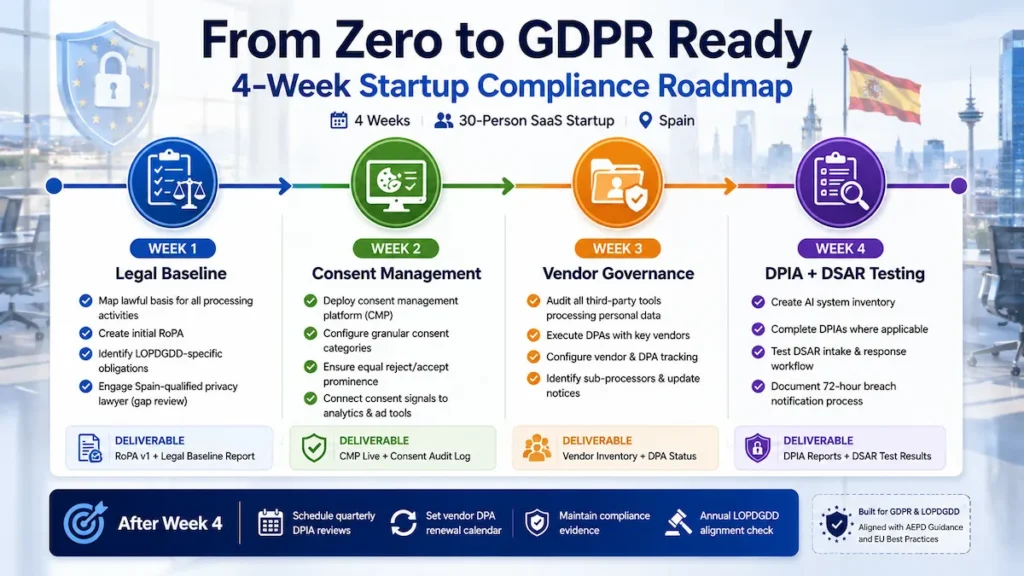
What does a practical GDPR compliance rollout look like for a typical Series A SaaS company operating in Spain? The following is an illustrative four-week baseline program using Sprinto or Kertos as the core platform, with Usercentrics for consent management.
Week 1 — Legal Baseline (Layer 1)
Map lawful basis for each data processing activity across product, CRM, HR, and analytics
Create initial RoPA using platform templates
Identify which processing activities fall under LOPDGDD-specific obligations
Engage Spain-qualified privacy lawyer for LOPDGDD gap review (one-time engagement)
Week 2 — Consent Management (Layer 2)
Deploy Usercentrics CMP across all web surfaces
Configure granular consent categories aligned with AEPD guidance
Verify equal prominence of accept and reject options
Connect consent signals to analytics and advertising tools
Week 3 — Vendor and Processor Governance (Layer 3)
Audit all third-party tools processing personal data (target: complete inventory)
Execute DPAs with top-priority processors
Configure vendor DPA tracking in platform
Identify any sub-processors requiring controller notification
Week 4 — DPIA and DSAR Testing (Layer 3 completion)
Create AI system inventory for any AI-powered product features
Complete DPIA documentation for applicable AI systems, referencing AEPD’s 2024 AI guidance
Set up DSAR intake workflow and test end-to-end response process
Document 72-hour breach notification procedure
After Week 4: Schedule quarterly DPIA review, set vendor DPA renewal calendar, and book annual LOPDGDD alignment check with legal counsel.
This four-week timeline is achievable for a team of two to three people — typically a technical co-founder or engineering lead, an external DPO, and a Spain-qualified privacy lawyer for the gap review in week one.
<a name="automation"></a>
Do Series A Startups Need GDPR Automation?
The short answer is yes—but the right question is which parts of GDPR you need to automate at Series A and which you can manage manually without meaningful risk.
Under 20 employees: Manual work.
A manual approach to RoPA (built from templates), a designated privacy contact, and a properly configured CMP covers the most material compliance exposure at this stage. DSAR volume is typically low enough to manage without a dedicated workflow tool.
20–50 employees: Automate these three things first.
First, DSAR handling. Volume becomes unpredictable at this headcount—a single media mention, competitor complaint, or user dispute can generate multiple simultaneous requests. Failure to respond within the thirty-day window specified under GDPR Article 12 is a clear compliance risk.
Second, vendor DPA tracking. A twenty-person SaaS company typically processes data through fifteen to thirty third-party tools. Tracking DPA status and subprocessor changes in a spreadsheet becomes a liability that surfaces during investor due diligence.
Third, consent management. Cookie and consent management is among the most consistently enforced areas in the internet services category, accounting for a significant share of the 3,141 internet services complaints received by the AEPD in 2024, according to the AEPD’s 2024 Annual Report.
Series A Compliance Starter Stack
✓ Sprinto or Kertos (GRC platform)
✓ Usercentrics (consent management)
✓ External DPO (contracted)
✓ Quarterly DPIA review calendar
✓ Vendor DPA tracker (platform-managed)
The automation investment — typically €500–1,500 per month — is proportionally small relative to a serious infraction starting at €40,001 under Spain’s enforcement tier structure. Compliance controls should complement — not replace — your broader AI cloud security solutions for startups.
<a name="spain"></a>
Why Spain Is Not Just “EU GDPR”
Most compliance content treats GDPR as a single-layer EU standard. For startups with meaningful Spanish exposure, that framing creates blind spots worth understanding before selecting tooling.
The dual-layer problem
Spain’s national law, the LOPDGDD (Ley Orgánica de Protección de Datos y Garantía de los Derechos Digitales, enacted December 2018), sits alongside EU GDPR and extends it in directions relevant to SaaS companies: digital rights, employee data monitoring restrictions, and the right to digital disconnection. The AEPD enforces both instruments simultaneously. Generic GDPR tooling built for an Irish or Dutch regulatory context may not surface LOPDGDD-specific obligations.
The enforcement picture
Spain has consistently ranked among the most active EU enforcement jurisdictions by GDPR sanction volume, according to the CMS GDPR Enforcement Tracker and AEPD annual reporting. Since 2018, the AEPD has issued over 1,021 penalties worth approximately €120.75 million. In 2025, according to CMS enforcement tracker data, the agency issued 299 fines totalling approximately €40 million — a 14% increase over the previous year. The AEPD’s enforcement pattern spans internet services companies, SaaS platforms, and SMEs, not just large enterprises.
The AEPD’s 2025–2030 Strategic Plan, published in July 2025, commits to proactive, technology-driven supervision—an approach expected to identify compliance gaps through monitoring rather than waiting for complaints.
The Catalonia dimension
Startups headquartered in Barcelona or working with Catalan public sector clients face an additional supervisory layer through the APDCAT. Research drawing on surveys of 107 Catalonian tech startups, published in the Journal of Small Business and Enterprise Development (2025), found that these companies navigate not just GDPR and LOPDGDD but also questions around how APDCAT authority interacts with AEPD enforcement. Barcelona startups with public sector clients should factor this into compliance planning from the outset.
The AESIA factor
Spain launched AESIA — the Agencia Española de Supervisión de Inteligencia Artificial — in June 2024, making it the first EU member state to establish a dedicated national AI supervisory authority. AESIA oversees compliance with the EU AI Act (Regulation (EU) 2024/1689), which entered into force on 1 August 2024 and began applying prohibitions on unacceptable-risk AI systems from February 2025, with high-risk system obligations rolling out through 2026–2027 per the Act’s phased implementation timeline. Teams deploying AI-powered workflows should review our guide to AI security compliance tools for SaaS startups.
<a name="aepd"></a>
What the AEPD Actually Targets: Your Risk Profile
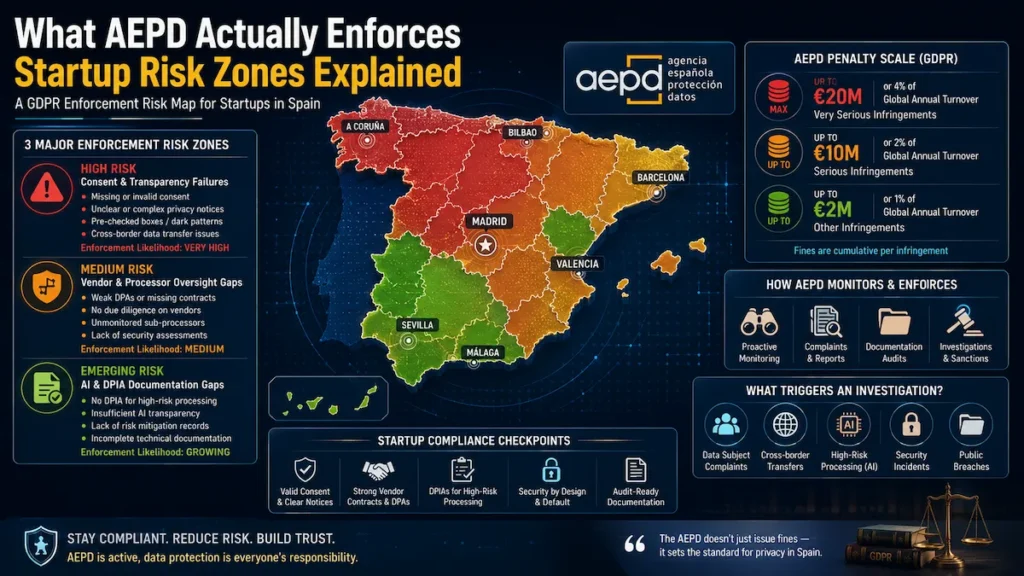
In FY24, the AEPD issued 10 fines exceeding €1 million — compared to only three in 2023, according to the Linklaters FY24 AEPD enforcement analysis. For SaaS startups, the most relevant enforcement category is internet services, which generated 3,141 complaints in 2024, up 8% year-on-year per the AEPD’s 2024 Annual Report. Common triggers include cookie and consent management failures, unlawful data use in marketing, DSAR response failures, and inadequate documentation for AI-related data processing.
Spain’s three violation tiers per the LOPDGDD and GDPR enforcement framework:
Minor infractions — up to €40,000
Serious infractions — €40,001 to €300,000
Very serious infractions — up to €20 million or 4% of global annual turnover
Two enforcement patterns most relevant to SaaS startups:
1. Controller liability for processor failures. A 2023 insurance sector case, documented in the CMS GDPR Enforcement Tracker, resulted in a €5 million fine after a breach exposed the data of over one million individuals through the company’s mediator network. The AEPD found the controller had failed to adequately supervise its processors. Spanish case law has indicated that indemnity clauses in processor contracts do not substitute for active controller oversight under GDPR Article 28. Every third-party tool processing personal data warrants review for DPA coverage and active supervision.
2. AI system documentation. The AEPD’s 2024 guidance—the Guía de adecuación al RGPD de tratamientos con IA—places strong emphasis on conducting DPI As for AI systems processing personal data, one may expect documentation beyond the minimum GDPR interpretation under Article 35. AI system inventories and DPIA documentation are commonly prioritized during AI-related compliance reviews where AI processing is involved, according to AEPD inspection practice guidance. Preparing these in advance is advisable.
<a name="costs"></a>
How Much GDPR Compliance Costs in Spain
Seed / Pre-Series A (under 20 employees)
GRC platform entry tier + CMP: €100–300 per month
One-time LOPDGDD gap assessment: €2,000–5,000
Estimated year-one total: €3,500–8,600
Series A (20–100 employees)
Full GRC platform: €400–1,200 per month
CMP: €50–200 per month
External DPO: €500–1,500 per month
Periodic legal review: €1,000–3,000 per quarter
Estimated annual total: €15,000–30,000
Series B (100–300 employees)
Multi-framework GRC platform: €2,000–5,000 per month
The relevant comparison is not compliance cost versus zero—it is compliance cost versus a serious infraction starting at €40,001 under Spain’s tiered enforcement structure or a very serious infraction reaching 4% of global turnover. Compliance tooling should be planned as part of your broader startup technology budget breakdown.
<a name="maturity"></a>
Estimated Compliance Maturity by Startup Stage
Based on editorial assessment of typical compliance program depth across growth stages. Directional estimates—Individual maturity varies significantly by founding team background, investor requirements, and product data intensity.
Stage
Estimated Compliance Maturity
Typical gaps
Seed
~20%
Missing RoPA, no DPA agreements, unconfigured CMP
Series A
~45%
Partial vendor coverage, manual DSAR handling, no AI DPIA
AI Act documentation, cross-border transfer mechanisms
Many Series A companies discover gaps in RoPA, vendor governance, or DSAR workflows during their first structured compliance review. The Spain GDPR Readiness Stack™ below is structured to help identify which maturity layer your startup is actually at, rather than which layer you assume you are at.
<a name="stack"></a>
Introducing the Spain GDPR Readiness Stack™
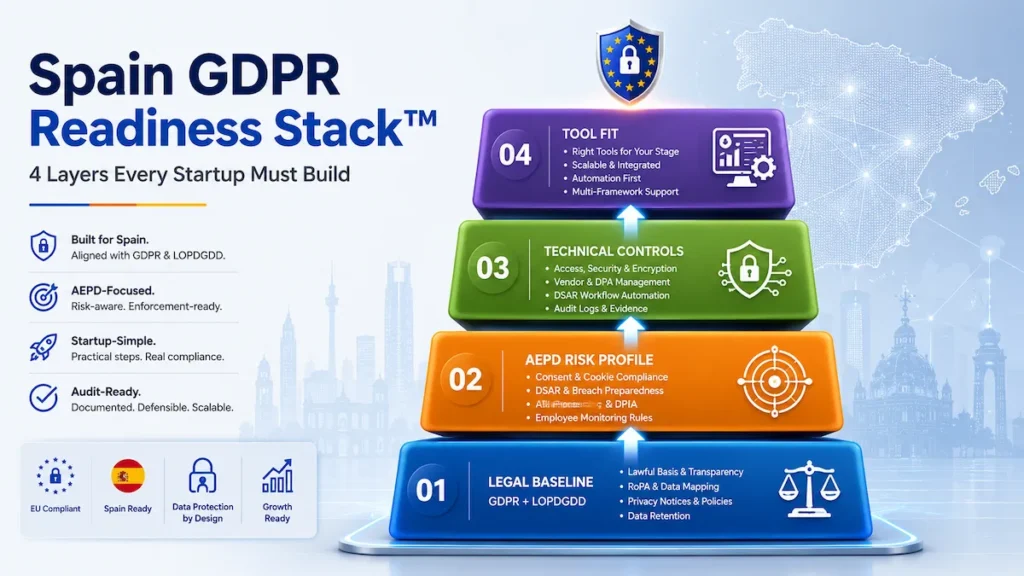
The Spain GDPR Readiness Stack™ is a four-layer compliance model for startups at the 10–300 employee range operating under AEPD jurisdiction. Each layer builds on the one below. Gaps at lower layers cannot be compensated for by tooling at higher layers.
Layer 1 — Legal Baseline
Dual compliance with GDPR and LOPDGDD, lawful basis mapping per processing activity, RoPA status, and privacy notice adequacy. GDPR Article 30(5) offers a narrow RoPA exemption only when three conditions are met simultaneously: processing must be occasional, unlikely to create risk, and must exclude special-category data. For most SaaS companies running continuous CRM systems, product analytics, and HR databases, these conditions are unlikely to apply.
Layer 1 checklist:
✓ Lawful basis documented per processing activity
✓ RoPA created and current
✓ Privacy notice reviewed against LOPDGDD requirements
✓ Data retention schedules defined
Layer 2 — AEPD Risk Profile
Understanding your specific enforcement exposure based on business model, data types, and product footprint.
Layer 2 checklist:
✓ Consent management configuration reviewed against AEPD guidance
✓ DSAR handling workflow documented and tested
✓ AI system inventory created
✓ Employee monitoring practices reviewed against LOPDGDD
Layer 3 — Technical Controls
DSAR automation, CMP configuration, breach notification workflows (72-hour notification window under GDPR Article 33), vendor DPA execution and review, and AI DPIA documentation. Compliance controls should complement — not replace — your broader cybersecurity tools for startups.
Layer 3 checklist:
✓ DSAR intake and response workflow automated
✓ CMP configured and reviewed against consent guidance
✓ Breach notification workflow documented
✓ Vendor DPAs executed and actively tracked
✓ AI DPIA documentation current and accessible
Layer 4 — Tool Fit
Matching compliance software to current headcount, funding stage, and multi-framework requirements. Over-tooling early wastes capital. Under-tooling at Series B creates due diligence exposure at exactly the moment when that exposure is most expensive.
[CTA: Score your startup across all four layers in under 20 minutes—download the Spain GDPR Readiness Stack™ Self-Assessment free when you join the trusteraai.com subscriber list.]
<a name="playbook"></a>
The AEPD Inspection Playbook
Step 1 — Admissibility review. The AEPD assesses whether the complaint falls within its jurisdiction and has reasonable grounds. Most misfiled or out-of-scope complaints are filtered at this stage.
Step 2 — Documentation request. If admitted, the AEPD typically contacts your designated privacy contact or organization directly, requesting documentation within one month. This is the decisive window.
Step 3 — Resolution or escalation. Organizations with pre-existing, organized compliance documentation—current RoPA, executed vendor DPAs, DSAR logs, AI DPIA files, and consent audit trails—are better positioned to resolve the inquiry without escalation to formal sanction proceedings. Organizations assembling documentation reactively tend to face a more extended process, according to AEPD inspection practice guidance.
AI system inventories and DPIA documentation are commonly prioritized during AI-related compliance reviews where AI processing is involved. For startups using AI-powered threat detection or automated security tooling, our guide to AI security compliance tools for SaaS startups covers the specific technical controls worth having in place.
<a name="faq"></a>
FAQ
Does GDPR apply to my startup if we are headquartered outside Spain but serve Spanish customers?
Yes. GDPR applies to any organization processing the personal data of individuals in the EU regardless of where the organization is based, per GDPR Article 3(2). Spain’s LOPDGDD and AEPD enforcement extend to your Spanish users specifically.
What is the LOPDGDD, and how does it differ from the GDPR?
The LOPDGDD (Ley Orgánica 3/2018) is Spain’s national data protection law, extending GDPR in areas including digital rights, employee monitoring restrictions, and the right to digital disconnection. The AEPD enforces both simultaneously.
Does my startup need a DPO in Spain?
A formal DPO appointment is mandatory under GDPR Article 37 only in specific circumstances involving large-scale systematic monitoring or special-category data. For most Series A SaaS companies, a formal appointment may not be mandatory—but in practice, many organizations designate a clear privacy or data protection contact regardless. Platforms like Kertos make this operationally straightforward through a contracted external DPO option.
What is the AEPD, and how significant is its enforcement activity?
Spain has consistently ranked among the most active EU enforcement jurisdictions by GDPR sanction volume, according to the CMS GDPR Enforcement Tracker. In 2025, the AEPD issued approximately 299 fines totalling €40 million. Its 2025–2030 Strategic Plan commits to increasingly proactive, technology-driven monitoring.
Which GDPR compliance tool is best for a 30-person SaaS startup in Spain?
Which GDPR compliance tool is best for a 30-person SaaS startup in Spain? At 30 employees, Sprinto or Kertos is the most appropriate full-platform choice, combined with Usercentrics for consent management. See our guide to GDPR compliance tools for startups for a broader comparison.
How long does GDPR compliance take for a startup in Spain?
Foundational documentation (Layer 1 and Layer 3) can typically be operational in two to six weeks for a company under 50 employees, based on published onboarding timelines from the platforms evaluated here. An AEPD risk profile assessment (Layer 2) generally requires a one-time engagement with a Spain-qualified privacy lawyer. Full program maturity typically takes three to six months from a standing start.
Is GDPR compliance software legally required in Spain?
No specific software product is legally mandated. Both GDPR and the LOPDGDD require appropriate technical and organizational measures demonstrating compliance—including RoPA maintenance under Article 30, DSAR handling under Articles 15–22, breach notification under Article 33, and DPIA documentation where applicable under Article 35. Compliance software is the most operationally efficient path to meeting those obligations without dedicated legal staff.
What happens during an AEPD inquiry or review?
The AEPD typically assesses jurisdiction first, then contacts the organization requesting documentation within one month. Having current, organized compliance records generally supports a faster resolution. The process varies by case; consult a qualified privacy lawyer for advice specific to your situation.
Can AI startups use software to help with DPIA documentation?
Yes, to a meaningful extent. Platforms including Vanta, Scrut, and Kertos offer DPIA workflow templates and documentation tools. The substantive risk assessment for a specific AI system requires human judgment and, for complex systems, qualified privacy specialist input. Software handles process structure and documentation management—it does not replace the underlying assessment.
Vanta vs. Sprinto vs. Kertos: Which is best for Spain?
Kertos leads on Spain-specific regulatory fit due to its EU-native architecture. Sprinto leads on speed to compliance and cost efficiency. Vanta leads when SOC 2 and GDPR must be handled simultaneously. See the full comparison section above for scenario-level guidance.
Spain does not penalize startups because they set out to violate GDPR. The pattern in enforcement cases is consistent: compliance was deferred, documentation was incomplete, and when a review was initiated, the records that should have existed were missing.
Start with Layer 1. Score your legal baseline — your RoPA, your lawful basis mapping, your LOPDGDD alignment — before evaluating tools. Most startups that work through the Spain GDPR Readiness Stack™ find their biggest exposure is not a missing software subscription. It is undocumented processing activities, unmanaged vendor relationships, or AI system documentation that was never created.
Fix the layer first. Then choose the tool that addresses it.
[CTA: Download the Spain GDPR Readiness Stack™ Self-Assessment—free when you join the trusteraai.com subscriber list. Score your startup across all four layers in under 20 minutes and know exactly where your exposure sits before you spend another euro on tooling.