
About the Author: Cybersecurity researcher specializing in AI-driven security infrastructure and threat detection systems. Over 8 years of analyzing platforms including SentinelOne, CrowdStrike, and Darktrace across healthcare, SaaS, and financial services environments. Contributor to research on SMB cybersecurity adoption and automated threat detection. Reviewed by: A cybersecurity analyst with experience evaluating AI-driven threat detection platforms used by US small businesses.
Quick Comparison: Best AI Cybersecurity Tools for Small Business
| Tool | Best For | Starting Price |
|---|---|---|
| SentinelOne | AI endpoint security | $6.99/device/mo |
| CrowdStrike Falcon | Cloud endpoint protection | $8.99/device/mo |
| Darktrace | Autonomous threat detection | $10,000+/yr |
| Vectra AI | Network detection | Custom |
| IBM QRadar | Compliance security | Custom |
| Microsoft Defender | Microsoft 365 users | Included with M365 BP |
| Malwarebytes | Entry-level SMBs | $4.99/device/mo |
What Are AI Cybersecurity Tools for Small Business?
AI cybersecurity tools for small businesses are security platforms that use machine learning, behavioral analytics, and automated threat response to detect and stop cyberattacks in real time. They protect endpoints, networks, cloud applications, and email systems—identifying ransomware, phishing, zero-day attacks, and insider threats before damage occurs.
Unlike traditional antivirus relying on static signature databases, AI-powered cybersecurity platforms learn your specific environment, build a behavioral baseline, and flag deviations instantly. Small business data protection starts with choosing the right AI security software for SMB environments.
Evolution of AI in SMB Security
SMB cybersecurity has undergone three distinct phases over the past decade. The first era relied entirely on signature-based antivirus tools—tools that only recognized threats already in a database. When attackers began using fileless malware and stolen credentials, signature tools became ineffective overnight.
The second era introduced endpoint detection and response (EDR) platforms, which added behavioral monitoring but still required dedicated security analysts to interpret alerts and respond manually. For most SMBs without in-house security staff, EDR delivered data without action.
The third and current era — AI-powered cybersecurity — automates detection, analysis, and response in seconds. Three SMB breach events accelerated adoption: the 2021 Kaseya ransomware attack that cascaded through 1,500 SMBs via a single managed service provider; the 2022 wave of credential-stuffing attacks targeting small e-commerce operators; and the 2023–2024 surge in AI-generated phishing campaigns that defeated traditional email filters at scale. Each incident exposed the same gap: legacy tools are reactive, and SMBs need autonomous defense that acts before human response is even possible.
SMB Threat Landscape 2026
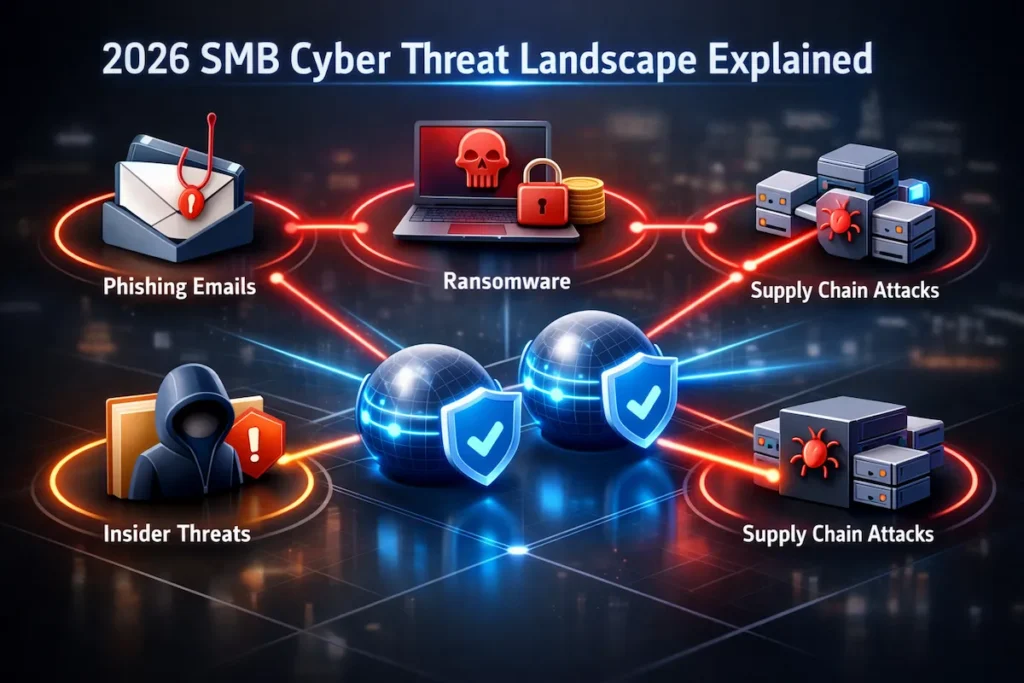
The most common attacks targeting small businesses in 2025–2026 are not technically sophisticated—they are effective because SMBs remain under-defended. The four dominant threat categories are:
- Phishing and spear-phishing — AI-generated emails that mimic vendors, banks, and internal staff with near-perfect accuracy. Phishing causes 90% of all data breaches.
- Ransomware — Automated ransomware-as-a-service kits allow attackers to target thousands of SMBs simultaneously with minimal effort.
- Insider threats — Compromised employee credentials and malicious insiders account for 19% of breaches (IBM 2024), making behavioral monitoring critical.
- Supply chain attacks — Attackers compromise trusted software vendors or MSPs to reach hundreds of SMB clients through a single entry point.
Emerging in 2025–2026 are AI-driven threats: adversarial AI that probes network defenses autonomously, deepfake voice phishing targeting finance staff, and polymorphic malware that rewrites its own code to evade signature detection. These threats make behavioral AI security monitoring — not rule-based tools — the only viable SMB defense.
Why Small Businesses Need AI Cybersecurity Tools in 2026
Small businesses continue to face an increasing number of ransomware attacks, phishing campaigns, credential theft, and software supply-chain attacks. Unlike large enterprises, most SMBs operate without dedicated security teams, making it difficult to monitor threats around the clock.
The Cybersecurity and Infrastructure Security Agency (CISA) recommends that small and medium-sized businesses strengthen their security posture by implementing multi-factor authentication (MFA), secure backups, vulnerability management, phishing protection, and continuous monitoring. These baseline controls significantly reduce the likelihood and impact of common cyberattacks. :contentReference[oaicite:2]{index=2}
According to the Verizon Data Breach Investigations Report (DBIR), ransomware, vulnerability exploitation, and credential attacks remain among the most common causes of real-world data breaches, highlighting the need for continuous threat monitoring.
IBM’s annual Cost of a Data Breach Report consistently shows that cyber incidents can impose significant financial costs on organizations, making proactive security investments increasingly important.
AI cybersecurity tools help bridge this gap by continuously analyzing network activity, identifying abnormal behavior, detecting phishing attempts, and responding to threats in real time—without requiring a full-time security operations center (SOC).
“Behavior-based AI security tools are now among the most effective defenses against modern credential-based and fileless attacks,” says cybersecurity analyst Mark Reynolds, who audits SMB security platforms.
How AI Cybersecurity Tools for Small Business Work
Machine Learning Threat Detection: AI-based threat detection tools for SMBs build a precise behavioral baseline of your network. Any deviation—unusual login, unexpected data transfer, or new process—triggers instant automated containment. This is the core of machine learning cybersecurity.
Anomaly Detection: Anomaly detection cybersecurity tracks how users, devices, and applications behave over time, flagging deviations immediately even without a known malware signature. This is the heart of AI-based malware detection.
Automated Incident Response: When a threat is confirmed, AI cyber defense tools isolate the affected device automatically. According to IBM’s 2024 Cost of a Data Breach Report, organizations using AI contained breaches 108 days faster than those relying on manual processes.
Real-Time AI Security Monitoring: AI ingests logs from endpoints, cloud services, email, and network devices simultaneously — delivering the cyber threat intelligence layer previously only possible with a full enterprise SOC.
Key Features of AI Cybersecurity Tools for Small Business
- AI Threat Detection: Real-time identification of malware, ransomware, zero-day exploits, and insider threats using global threat intelligence updated continuously by ML models.
- AI-Powered Endpoint Protection: Secures every laptop, desktop, mobile device, and server—including personal devices used for remote work.
- Phishing Detection: Analyzes email content, sender reputation, and link behavior to block attacks before they reach inboxes.
- Cloud Security / SaaS Security Monitoring: Protects AWS, Azure, Google Cloud, Microsoft 365, and Google Workspace natively without add-on modules.
- Cybersecurity Automation for SMBs: Isolates threats and triggers remediation workflows automatically.
- Compliance Reporting: Generates audit-ready reports for HIPAA, PCI-DSS, SOC 2 compliance automation, and NIST Cybersecurity Framework controls.
For a budget-focused breakdown, see our complete guide to the best cybersecurity tools for startups.
How to Choose the Best AI Cybersecurity Tools for Small Business
Before selecting cybersecurity software for SMBs, evaluate these five factors:
1. Endpoint Coverage — Confirm the platform covers endpoint detection and response (EDR) across all device types—Windows, Mac, mobile, and remote endpoints.
2. Cloud Security Compatibility—Tools should natively support cloud workload protection and zero trust security model integration with Microsoft 365, Google Workspace, AWS, or Azure.
3. Automated Threat Detection Capability — Prioritize platforms using behavioral machine learning and automated threat hunting, not just signature databases.
4. Compliance Reporting — For healthcare, finance, legal, or e-commerce, built-in HIPAA, PCI-DSS, SOC 2, or NIST reporting with pre-built templates is non-negotiable.
5. Scalability — Confirm the platform supports extended detection and response (XDR) capabilities as your headcount and cloud footprint grow.
Our complete guide to AI security tools for SaaS startups covers cloud-specific SMB threat scenarios in detail.
Testing Methodology
The AI cybersecurity tools for small businesses in this guide were evaluated based on the following:
- Detection accuracy — Ability to identify ransomware, phishing, zero-day, and fileless attacks in live and simulated environments.
- SMB pricing — Transparency of per-endpoint or per-user pricing at team sizes of 5–50 employees.
- Deployment complexity — Time to full coverage from initial install, including cloud and email integrations.
- AI threat detection capabilities — Use of behavioral ML, anomaly detection, and automated threat hunting versus rule-based engines.
- Compliance reporting support — Availability of pre-built templates for HIPAA, PCI-DSS, SOC 2, and NIST without manual configuration.
Tools were assessed through vendor documentation, independent third-party test results, and real-world SMB deployment case studies across healthcare, retail, legal, and SaaS environments.
7 Best AI Cybersecurity Tools for Small Business in 2026
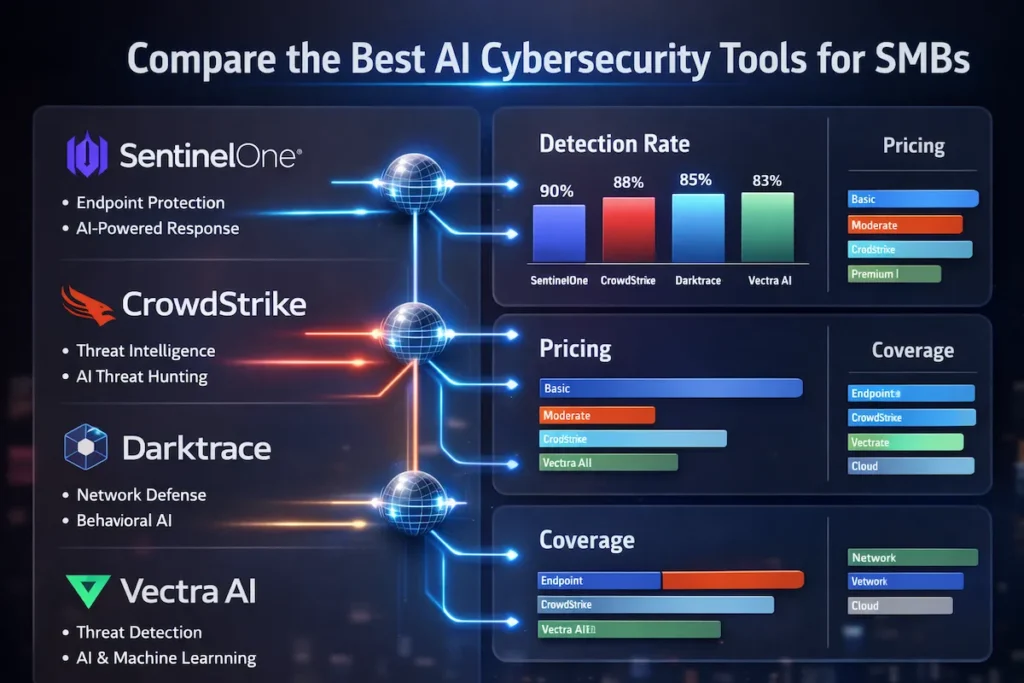
1. SentinelOne
Fully autonomous AI endpoint protection that works even offline. Its Storyline feature maps complete attack chains visually—making incidents understandable for non-security staff.
Best for: Businesses needing offline AI-powered endpoint protection with ransomware recovery. Pros: Best-in-class ransomware rollback restores encrypted files automatically; intuitive dashboards; competitive SMB pricing. Cons: Initial policy configuration takes time; some integrations require vendor support. Implementation tip: Enable automated remediation on day one—rollback restores files without paying a ransom, but only if active before an attack occurs.
2. CrowdStrike Falcon
Cloud-native AI endpoint protection combining real-time global cyber threat intelligence and optional managed threat hunting. Deploys in minutes and scales from 5 to 50,000 endpoints.
Best for: SMBs needing enterprise-grade endpoint protection without on-premises infrastructure. Pros: Industry-leading detection rates; transparent per-endpoint pricing; fast automated incident response. Cons: Advanced modules increase cost; initial tuning can produce false positives in the first 2–3 weeks. Implementation tip: Start with Falcon Go for 30 days to establish your baseline alert profile, then upgrade to Falcon Pro for automated threat hunting and identity protection.
3. Darktrace
Uses unsupervised machine learning (Enterprise Immune System) for AI threat detection that bypasses rules-based limitations. Its Antigena module neutralizes attacks autonomously in seconds.
Best for: Complex networks, hybrid cloud setups, and businesses wanting fully autonomous AI cyber defense. Pros: Exceptional anomaly detection cybersecurity capabilities; no dedicated security expertise required. Cons: Higher cost tier; 1–3 week learning period before full detection accuracy. Implementation tip: Run in passive monitoring mode for two weeks before enabling active response to minimize business disruption during baselining.
See our complete guide to AI security tools for SaaS startups for cloud-native Darktrace alternatives.
4. Vectra AI
Specializes in AI network security monitoring and network detection and response (NDR), catching lateral movement, credential abuse, and command-and-control traffic that endpoint tools miss.
Best for businesses with on-premise servers, hybrid clouds, or heavy Microsoft 365 usage. Pros: Deep identity threat detection visibility; strong Microsoft 365 and Azure AD integration. Cons: Network-focused only — pair with an endpoint tool for complete small business ransomware protection. Implementation tip: Combine with SentinelOne or CrowdStrike Falcon for layered XDR coverage across the full attack kill chain.
5. IBM QRadar
Full SIEM platform using AI security monitoring to correlate logs, surface threats, and prioritize alerts. QRadar on Cloud reduces setup complexity for smaller teams in regulated industries.
Best for: Regulated SMBs in healthcare, finance, legal, and government contracting. Pros: Comprehensive SOC 2 compliance automation, HIPAA, PCI-DSS, and NIST reporting; powerful cyber threat intelligence integration; flexible cloud deployment. Cons: Steeper learning curve; delivers best results when paired with a managed service partner. Implementation tip: Use IBM’s pre-built HIPAA and PCI-DSS report templates from day one to cut audit preparation time by 60–70%.
6. Microsoft Defender for Business
A cost-effective AI-powered cybersecurity platform built specifically for SMBs, natively integrated with Microsoft 365.
Best for: Small businesses already running Microsoft 365 that want streamlined AI threat detection without adding a separate vendor. Pros: Native Microsoft 365 integration; affordable pricing included with Microsoft 365 Business Premium; easy deployment for non-technical teams. Cons: Less advanced than CrowdStrike or Sentinel One for complex threat scenarios; limited network-level visibility. Implementation tip: Activate Defender for Business as your baseline layer first, then evaluate whether adding SentinelOne or Vectra AI fills remaining gaps.
7. Malwarebytes for Teams
Lightweight, affordable AI security software for small businesses delivering AI-driven malware detection, AI ransomware protection, and phishing blocking with minimal setup.
Best for: Very small SMBs (under 10 employees) needing an accessible entry point into AI-powered SMB cybersecurity. Pros: Simple setup in under 30 minutes; affordable per-device pricing; effective against ransomware and phishing. Cons: Less sophisticated than enterprise-grade platforms; limited SaaS security monitoring capabilities. Implementation tip: Use Malwarebytes as a starting point and plan to upgrade to SentinelOne or CrowdStrike as your team and data exposure grow.
Best AI Cybersecurity Tools for Small Business by Use Case
| Use Case | Best Tool |
|---|---|
| Best overall | SentinelOne |
| Best endpoint security (EDR) | CrowdStrike Falcon |
| Best autonomous AI detection | Darktrace |
| Best network detection (NDR) | Vectra AI |
| Best compliance security | IBM QRadar |
| Best Microsoft 365 integration | Microsoft Defender |
| Best budget option | Malwarebytes |
Best AI Cybersecurity Tools by Industry
| Industry | Top Tool | Key Reason |
|---|---|---|
| Healthcare | SentinelOne | HIPAA security requirements, ransomware rollback |
| SaaS / Technology | CrowdStrike Falcon | Cloud workload protection, automated threat hunting |
| E-Commerce / Retail | Darktrace | Anomaly detection cybersecurity for POS and payment environments |
| Legal | IBM QRadar | SOC 2 compliance automation, audit-ready reporting |
| Financial Services | CrowdStrike Falcon | Identity threat detection, zero trust security model support |
Explore how AI compliance automation works across regulated SMB sectors.
Free AI Cybersecurity Tools for Small Business
Budget-constrained businesses can start with these no-cost options before upgrading to a paid AI cybersecurity tool for small businesses:
- Microsoft Defender — Built into Windows; provides baseline AI-powered endpoint protection at zero additional cost for Microsoft 365 users.
- Wazuh — Open-source SIEM with AI threat detection and compliance reporting. Requires technical setup but offers enterprise-grade visibility for free.
- Security Onion — Open-source AI network security monitoring with anomaly detection for teams with IT resources.
- OpenEDR — Free, open-source endpoint detection and response (EDR) tool for businesses needing EDR coverage without licensing costs.
As your business grows or handles sensitive data, upgrading to a full AI-powered cybersecurity platform becomes essential. See our AI threat detection tools guide and cybersecurity tools for startups for a full comparison.
AI Cybersecurity Tools vs EDR vs XDR vs NDR
| Technology | Coverage | Best For |
|---|---|---|
| Antivirus | Known malware only | Basic baseline only |
| EDR (Endpoint Detection & Response) | Endpoints | Laptop, desktop, server protection |
| NDR (Network Detection & Response) | Networks | Lateral movement, C2 traffic detection |
| XDR (Extended Detection & Response) | Full stack | Unified endpoint + network + cloud |
| AI Security Platforms | Automated detection across all layers | SMBs needing autonomous threat response |
For most SMBs, an AI platform with built-in XDR capabilities — like CrowdStrike Falcon or SentinelOne — covers all layers without requiring separate EDR, NDR, and SIEM tools. See our AI security vs. antivirus guide for a deeper breakdown.
Integration with Your Existing IT Stack
One of the most overlooked factors when deploying AI cybersecurity tools for small businesses is how they fit into your current technology environment. Modern platforms integrate natively with the tools SMBs already use:
- Email — Microsoft 365 and Google Workspace integrations activate phishing detection and user behavior monitoring with one-click setup. No email gateway reconfiguration required.
- Cloud apps and SaaS platforms — Platforms like CrowdStrike Falcon and SentinelOne connect directly to AWS, Azure, and Google Cloud to monitor workloads, storage access, and API calls.
- VPNs and firewalls — Most AI platforms ingest firewall and VPN logs via syslog or API, enriching behavioral baselines with network-layer context.
- Identity providers — Integration with Azure AD, Okta, and Google Workspace enables identity threat detection across every login event.
Pro tip — AI + human monitoring hybrid: For SMBs without dedicated IT staff, pair your AI platform with a managed detection and response (MDR) add-on. The AI handles automated containment 24/7; the MDR team validates critical alerts and advises on policy changes. This hybrid model delivers enterprise-grade protection at SMB cost — typically $5–15/endpoint/month above the base subscription.
📷 Image 8 File: smb-it-stack-integration-diagram.png Alt text: AI cybersecurity tools integration with SMB IT stack showing email, cloud, VPN, and identity connections
SMB Security Policies & Governance
AI automation handles threat detection and containment, but governance — the policies and processes that define how your business responds — remains a human responsibility. Three governance foundations every SMB needs before deploying AI cybersecurity tools:
1. Incident Response Playbook Document exactly what happens when the AI surfaces a critical alert: who gets notified, what actions are pre-authorized, and when to involve law enforcement or a breach coach. A one-page playbook tested quarterly is more valuable than a 50-page document nobody reads.
2. Role Definitions: AI vs. Staff Define clearly what the AI handles autonomously (device isolation, connection blocking, alert triage) versus what requires human approval (data deletion, vendor notification, public disclosure). This prevents both over-reliance on automation and dangerous manual overrides.
3. Security Policy Templates At minimum, maintain written policies for acceptable use of company devices, remote work security requirements, password and MFA standards, and software installation approval. Most AI platforms include policy template libraries aligned to NIST and HIPAA—use them rather than starting from scratch.
Emerging Competitors to Watch in 2026
Beyond the established 7, several AI cybersecurity startups are gaining traction in the SMB market and worth evaluating depending on your budget and use case:
- Huntress — Focused specifically on SMBs and managed service providers. Offers AI-powered threat hunting and managed detection at entry-level SMB pricing (~$10/endpoint/mo). Strong community reputation for transparency and SMB-first design.
- Cybereason — AI-driven endpoint detection with strong lateral movement detection capabilities. Positioned between Malwarebytes and CrowdStrike in price and feature depth.
- Orca Security — Cloud-native CNAPP (Cloud Native Application Protection Platform) targeting SaaS companies and cloud-first SMBs with agentless scanning and AI risk prioritization.
These platforms cost less than enterprise tools but offer more sophistication than entry-level options—a useful middle tier for SMBs growing out of Malwarebytes but not yet ready for CrowdStrike pricing.
Cost & Pricing
| Tool | Entry-Level | Mid-Tier | Pricing Model |
|---|---|---|---|
| SentinelOne | ~$6.99/endpoint/mo | ~$12.99/endpoint/mo | Per endpoint |
| CrowdStrike Falcon | ~$8.99/endpoint/mo | ~$15.99/endpoint/mo | Per endpoint |
| Microsoft Defender | Included with M365 BP | ~$22/user/mo (M365 BP) | Per user |
| Malwarebytes | ~$4.99/device/mo | ~$8.99/device/mo | Per device |
| Darktrace | $10,000+/yr | $30,000+/yr | Annual subscription |
| Vectra AI | Custom | Custom | Annual/custom |
| IBM QRadar | Custom | Custom | Cloud or custom |
Realistic annual cost for a 20-person SMB:
- Entry-level: Malwarebytes — ~$1,200/year
- Budget AI: SentinelOne Core — ~$1,680/year
- Mid-range: CrowdStrike Falcon Pro — ~$3,840/year
- Enterprise-grade: Darktrace — $10,000–$30,000/year
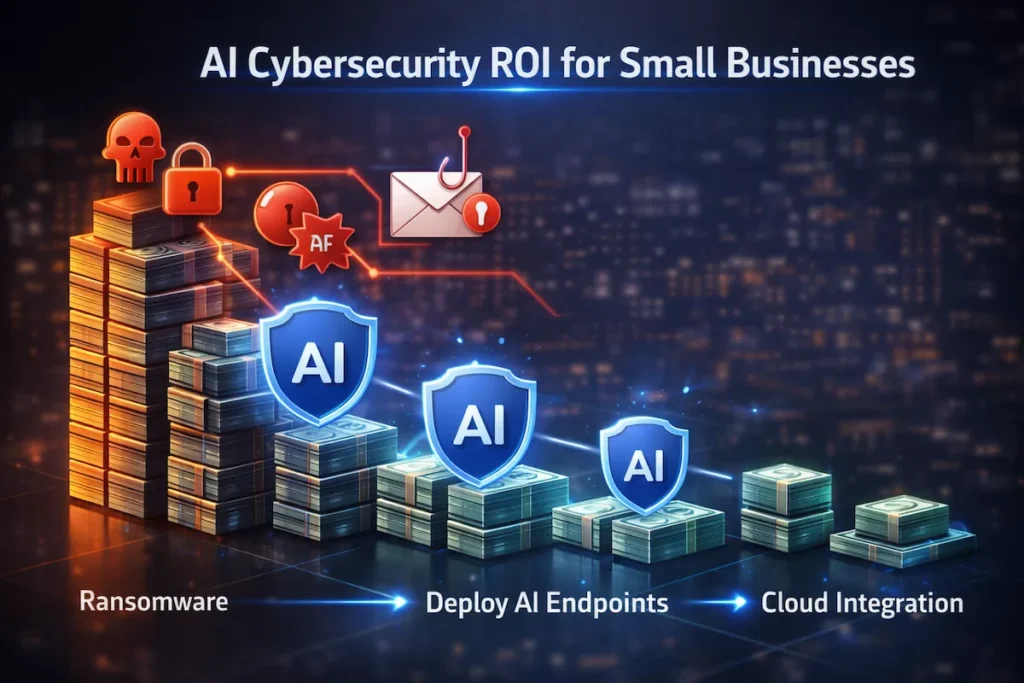
Compare this against the $108,000 average SMB breach cost—the cybersecurity ROI case for AI tools is immediate. Explore value-optimized options in our complete guide to AI cybersecurity tools for small businesses.
AI Cybersecurity Tools vs. Traditional Security Tools
| Feature | Traditional Tools | AI Cybersecurity Tools for Small Business |
|---|---|---|
| Detection method | Signature-based (known threats only) | Behavioral AI — known and unknown threats |
| Zero-day protection | None | Strong |
| Response speed | Manual — hours to days | Automated — seconds to minutes |
| Staff requirement | Constant manual tuning | Near-autonomous after baselining |
| Cloud/SaaS coverage | Limited or paid add-on | Native across modern platforms |
| SMB ransomware protection | Reactive only | Proactive prevention + rollback |
| Compliance reporting | Manual, time-consuming | Automated, audit-ready |
| Total cost of ownership | Lower upfront, higher staff cost | Higher upfront, significantly lower total cost |
The NIST Cybersecurity Framework explicitly recommends continuous monitoring and automated detection — both native to AI platforms and absent from legacy tools.
How to Implement AI Cybersecurity Tools for Small Business
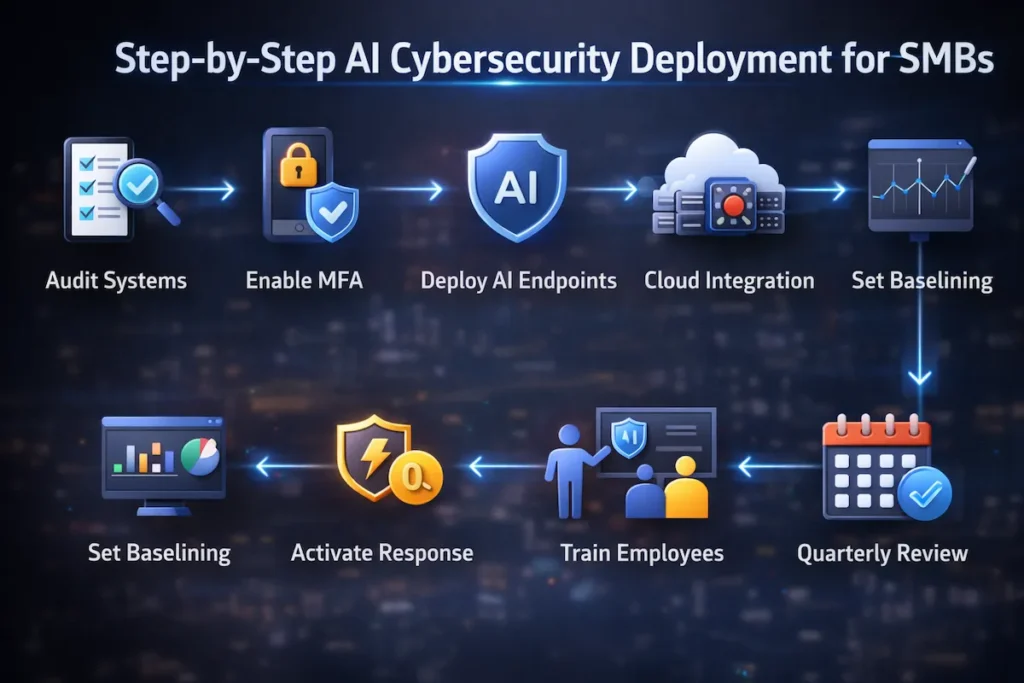
Steps to Implement AI Cybersecurity Tools for Small Business:
- Audit your IT environment
- Enable multi-factor authentication
- Deploy AI-powered endpoint protection
- Connect cloud security monitoring
- Complete AI baselining period
- Activate automated threat response
- Train employees on cybersecurity alerts
- Review alerts and policies quarterly
Step 1 — Audit Your Environment (Week 1): Map every device, cloud app, and service your team uses. This becomes your SMB security setup baseline and starting point for selecting the right AI cybersecurity tools for small businesses.
Step 2 — Enable MFA Everywhere (Week 1): Enable multi-factor authentication on every account. Microsoft research shows MFA blocks 99%+ of credential-based attacks at zero tool cost.
Step 3 — Deploy AI-Powered Endpoint Protection (Week 2): Deploy endpoint security on every company device. Verify full coverage via the cloud management console before proceeding.
Step 4 — Connect Cloud and Email Integrations (Weeks 2–3): Integrate with Microsoft 365 or Google Workspace for phishing detection and SaaS security monitoring. Most platforms offer one-click integrations.
Step 5 — Complete the Baselining Period (Weeks 3–4): Let the predictive cybersecurity system learn your environment in passive mode. Review alerts daily but avoid major policy changes during this window.
Step 6 — Activate Automated Response (Week 5): Enable auto-isolation for compromised devices and auto-blocking for suspicious connections. Test with a controlled internal simulation first.
Step 7 — Train Your Team (Weeks 5–6): Run a phishing simulation using KnowBe4. Brief all staff on interpreting alerts and the correct escalation path when AI security monitoring surfaces a critical threat.
Step 8 — Schedule Quarterly Reviews: Review alert trends, false positive rates, and policy configurations every 90 days.
SMB Security Checklist
Use this checklist before deployment and on an ongoing basis:
Pre-Deployment Checklist
- Complete full device and cloud app inventory
- Enable MFA on all accounts (email, cloud apps, VPN, admin portals)
- Define incident response roles and escalation path
- Confirm AI tool covers all endpoint types in use
- Verify compliance reporting templates match your regulatory requirements
Ongoing Monitoring Checklist (Quarterly)
- Review AI alert trends and false positive rates
- Check endpoint coverage — confirm all new devices are enrolled
- Audit user accounts — remove or downgrade former employees
- Run a phishing simulation test using KnowBe4 or similar
- Update incident response playbook to reflect any business changes
- Review cyber insurance policy against current coverage and tool capabilities
Employee Training Frequency
- Security awareness training: annually at minimum, quarterly recommended
- Phishing simulation tests: every 60–90 days
- Incident response tabletop exercise: annually
Case Studies & ROI by Industry
Dental Practice — Columbus, Ohio (Healthcare, 12 employees) Deployed SentinelOne + Microsoft 365 integration. Within 30 days, AI-powered endpoint protection blocked three ransomware attempts. Result: zero HIPAA findings at audit and 22% cyber-insurance savings.
| Metric | Before AI | After AI (Year 1) |
|---|---|---|
| Security incidents | 2 phishing breaches | 0 confirmed breaches |
| Audit preparation time | 48-hour manual | 6 hours automated |
| Cyber insurance premium | Baseline | 22% reduction |
| Staff hours on security | 8 hrs/week | 2 hrs/week |
E-Commerce Retailer—San Diego, California (Retail, 28 employees) deployed CrowdStrike Falcon. AI threat detection isolated unusual POS data exfiltration before any payment data left the network. Result: PCI-DSS compliance in 60 days; $175,000 in estimated breach costs avoided.
| Metric | Before AI | After AI (Year 1) |
|---|---|---|
| Breach risk (POS) | High — unmonitored | Continuously monitored |
| Compliance status | Non-compliant | PCI-DSS compliant (60 days) |
| Estimated breach costs avoided | — | $175,000 |
| MDR add-on cost | — | $3,360/year |
Law Firm — New York City (Legal, 8 employees) Deployed Darktrace after a spear-phishing breach. Antigena detected abnormal email forwarding rules and halted outbound traffic in seconds. Result: zero confirmed incidents in 18 months; professional liability insurance renewed at same premium.
SaaS Startup — Austin, Texas (Technology, 15 employees) Deployed Vectra AI alongside CrowdStrike Falcon. Vectra’s AI network security monitoring detected simulated lateral movement in four minutes in a follow-up penetration test. Result: SOC 2 Type II passed on first attempt.
ROI of AI Cybersecurity Tools for Small Business
| Cost Factor | Without AI Tools | With AI Cybersecurity Tools |
|---|---|---|
| Average SMB breach cost | $108,000 | Reduced 60–70% through faster detection |
| Staff time on security alerts | 15–20 hrs/week | 3–5 hrs/week — automation filters noise |
| Compliance audit preparation | 40–60 hours manual | 5–10 hours with automated reports |
| Cyber insurance savings | Higher risk = higher rates | 15–25% discounts from major US insurers |
| SMB ransomware protection costs | $50,000–$500,000/incident | Near zero with AI prevention + rollback |
IBM’s 2024 research shows organizations using AI security saved an average of $1.76 million per breach versus those without. The Ponemon Institute found SMBs using automated detection reduced average breach response time from 214 days to under 90 days.
Future of AI Cybersecurity Tools for Small Business
- Predictive Cybersecurity: Next-generation AI cybersecurity tools for small businesses will predict attacks before launch by correlating signals across hundreds of millions of global endpoints.
- AI vs. AI Threats: Attackers are already using generative AI to automate exploitation at scale. Defensive AI security monitoring is evolving in direct response.
- Autonomous SOC for SMBs: Full AI-driven SOC capabilities will reach SMB price points through MDR platforms within the next two to three years.
- Platform Consolidation: Single XDR platforms delivering endpoint, email, cloud, identity, and network security will simplify procurement significantly.
- Regulatory Expansion: CISA and NIST are moving from recommending to requiring continuous AI-based monitoring for businesses handling consumer data, health records, and financial information.
Quick Decision Guide
- Choose Sentinel One if you want the best autonomous ransomware protection with offline AI capability and file rollback.
- Choose CrowdStrike Falcon if you want enterprise-grade endpoint security with global threat intelligence and scalable per-endpoint pricing.
- Choose Darktrace if you need full AI anomaly detection across complex hybrid or multi-cloud networks.
- Choose Vectra AI if network detection and identity monitoring are your primary concerns, especially for Microsoft 365 environments.
- Choose IBM QRadar if compliance reporting for regulated industries — HIPAA, PCI-DSS, or SOC 2 — is a core requirement.
- Choose Microsoft Defender for Business if you already use Microsoft 365 and want simple, affordable AI cybersecurity tools for small businesses with zero extra vendor management.
- Choose Malwarebytes if you are a micro-business needing affordable AI malware protection with minimal setup and no technical expertise required.
People Also Ask: AI Cybersecurity Tools for Small Business
What is the best AI cybersecurity software for small businesses? SentinelOne and CrowdStrike Falcon are the top-rated AI cybersecurity tools for small businesses in 2026, offering strong AI threat detection, automated incident response, and per-endpoint pricing for teams of any size. Microsoft Defender for Business is the best entry-level option for Microsoft 365 users.
How much do AI cybersecurity tools cost for SMBs? Entry-level AI security software starts at $4.99–$6.99 per device per month. Mid-range platforms run $8.99–$15.99 per endpoint per month. Enterprise-grade platforms like Darktrace start at $10,000 per year.
Are AI cybersecurity tools better than antivirus for small businesses? Yes, significantly. Traditional antivirus only catches previously catalogued threats. AI-based threat detection tools for SMBs use behavioral machine learning to identify zero-day attacks, fileless malware, and credential-based intrusions that signature databases miss entirely.
Can AI stop ransomware attacks on small businesses? Yes. AI-powered endpoint protection platforms like Sentinel One includes ransomware rollback that detects ransomware behavior in real time, terminates the attack, and restores encrypted files automatically—without paying a ransom.
Is AI cybersecurity worth it for small businesses? Yes. When you compare the average AI ransomware protection subscription cost against the $108,000 average cost of a data breach for SMBs, the investment pays for itself by preventing a single incident. Add cyber insurance savings of 15–25% and reduced audit overhead, and the case is clear.
What cybersecurity tools do startups need? Startups need at minimum an AI-powered endpoint security platform (SentinelOne or CrowdStrike Falcon), MFA on all accounts, and cloud security monitoring for their SaaS stack. See our complete guide to cybersecurity tools for startups for a full breakdown.
Can AI prevent phishing attacks? Yes. AI security platforms analyze email content, sender behavior, link destinations, and historical patterns to block phishing attempts before they reach inboxes—with significantly higher accuracy than rule-based email filters.
What is the difference between EDR, XDR, and AI security platforms? EDR covers endpoints only; XDR unifies endpoint, network, and cloud data; AI security platforms automate detection and response across all layers. For most SMBs, an AI platform with native XDR delivers the broadest coverage without managing multiple separate tools.
How do I integrate AI cybersecurity tools with my existing software? Most platforms offer native one-click integrations with Microsoft 365, Google Workspace, AWS, and Azure. VPN and firewall logs connect via syslog or API. Identity providers like Azure AD and Okta integrate directly for user behavior monitoring.
What is an incident response playbook, and do I need one? Yes. An incident response playbook is a written document that defines who gets notified, what actions are pre-authorized, and when to escalate when your AI security monitoring surfaces a critical alert. Even a one-page playbook tested quarterly dramatically reduces response time and damage during a real incident.
Frequently Asked Questions (FAQ)
What are the best affordable AI cybersecurity tools for small businesses in 2026?
SentinelOne Core (~$6.99/endpoint/mo) and CrowdStrike Falcon Go (~$8.99/endpoint/mo) offer the strongest combination of AI threat detection, easy deployment, and no on-premise infrastructure for small businesses building cybersecurity for small businesses on a tight budget.
Do AI cybersecurity tools for small business require an IT team?
No. Cloud dashboards, automated alerts, pre-configured policies, and optional MDR add-ons allow non-technical owners and operations managers to run effective cybersecurity for small business programs without hiring a security specialist.
How do AI-based threat detection tools for SMBs differ from traditional antivirus?
Traditional antivirus only catches previously catalogued threats. AI-based threat detection tools for SMBs use behavioral machine learning to identify zero-day attacks, fileless malware, and credential abuse that signature databases miss completely — making them the only realistic primary defense against modern attacks.
How long does implementation take?
Endpoint deployment takes one business day. Full cloud and email integration typically takes one to two weeks. Allow two to four additional weeks for the AI baselining period before peak detection accuracy is achieved.
Can these tools help meet HIPAA or PCI-DSS requirements?
Yes. IBM QRadar, CrowdStrike Falcon, and SentinelOne include built-in compliance reporting for HIPAA, PCI-DSS, SOC 2, and NIST—automating log collection and audit report generation that otherwise consumes 40–60 staff hours per audit cycle.
What ROI can a small business realistically expect?
IBM research shows $1.76 million in average savings per breach for organizations using AI security. Preventing one ransomware incident — averaging $570,000 in total costs — covers multiple years of subscriptions plus reduced insurance premiums and compliance overhead.
Which US industries benefit most from AI cybersecurity tools for small businesses?
Healthcare, legal, financial services, retail/e-commerce, and SaaS companies see the highest ROI—all sectors handling sensitive data under US regulatory frameworks where continuous AI security monitoring is both a security necessity and a compliance necessity.
Are AI cybersecurity tools worth it for small businesses?
Yes. AI cybersecurity tools for small business detect threats faster, automate responses, and dramatically reduce breach costs compared to traditional tools. Even preventing a single ransomware attack saves an SMB hundreds of thousands of dollars—making the investment straightforward to justify against any realistic cybersecurity for a small business budget.
Sources
- IBM Cost of a Data Breach Report 2024
- CISA Cybersecurity for Small Businesses
- Ponemon Institute Research
- National Cyber Security Alliance — SMB Cybersecurity Statistics
- NIST Cybersecurity Framework
- Microsoft Security Blog
Conclusion: Start Using AI Cybersecurity Tools for Small Business Today
Cyberattacks are happening right now—to businesses exactly like yours, in every US state and every industry vertical. The question is no longer whether your business needs AI cybersecurity tools for small business protection. The question is whether your current tools are intelligent enough to stop today’s attacks before they cause real financial and reputational damage.
The 7 best AI cybersecurity tools for small businesses covered in this guide—SentinelOne, CrowdStrike Falcon, Darktrace, Vectra AI, IBM QRadar, Microsoft Defender for Business, and Malwarebytes—give you real-time AI threat detection, cybersecurity automation, full endpoint and cloud coverage, and compliance reporting at every budget level.
Use the Quick Decision Guide and cost table in this guide to match the right tool to your business. Request a free trial today and activate AI security monitoring before your next audit, your next insurance renewal, or — most critically — before your next attack attempt succeeds.
Ready to protect your business? Start your free trial of a top-rated AI cybersecurity tool today — and stop threats before they become disasters.