
Last Updated: July 2026
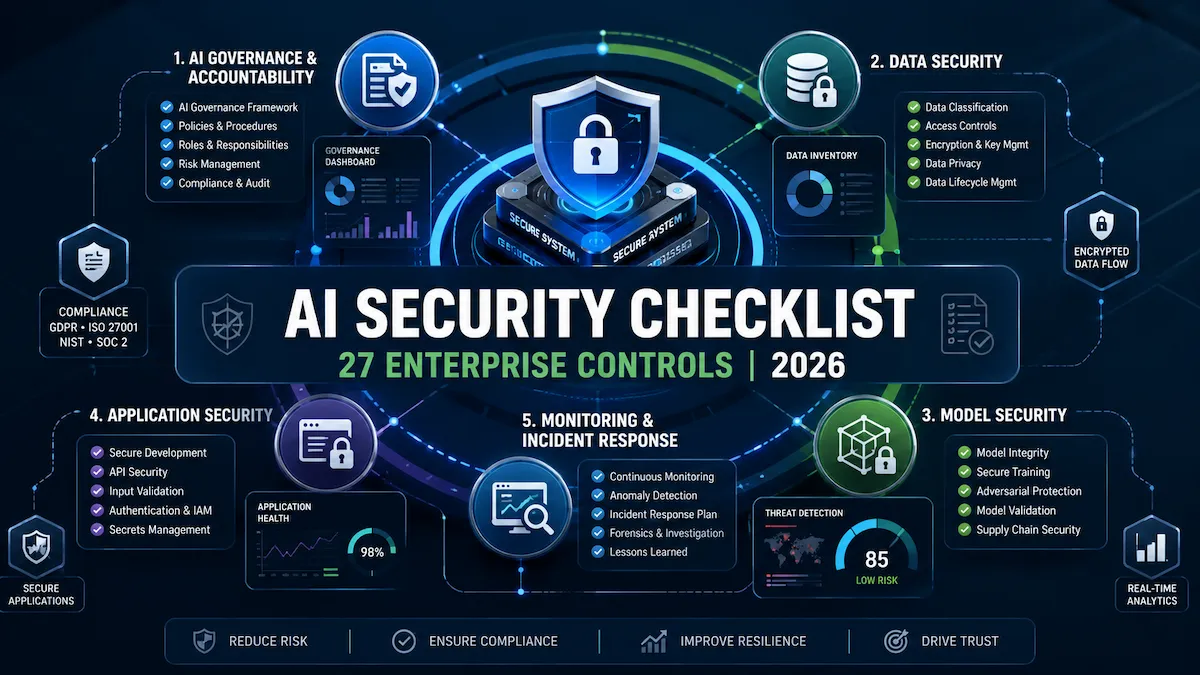
Quick Answer: An enterprise AI security checklist is a set of governance, data, model, application, and monitoring controls that help organizations identify and reduce risks from the AI systems they build or buy. It typically spans dozens of controls across five domains, with this framework organized into 27 practical controls, applied before procurement, before deployment, and on a recurring basis once a system is in production.
Executive Summary
Enterprise AI adoption is moving faster than most security programs can govern. An AI security checklist helps organizations close that gap as employees deploy AI assistants on their own initiative, teams integrate third-party models into existing products, and developers embed LLM capabilities before security teams have full visibility into what’s been built or connected. It’s a structured set of controls, governance practices, and technical safeguards applied across the lifecycle of every AI system an organization builds, buys, or integrates.
A checklist alone isn’t enough. It needs to be grounded in recognized frameworks—the NIST AI Risk Management Framework, ISO/IEC 42001, and the OWASP Top 10 for LLM Applications—then mapped to real threat categories, accountable owners, and audit evidence. This guide covers an enterprise AI security checklist, an AI risk assessment checklist, and an AI governance checklist in one place, including a ready-to-use control template, a real enterprise scenario, and the TrusteraAI Enterprise AI Security Framework™.
For the broader governance context this checklist sits inside, see our Enterprise AI Governance Framework Guide.
Why AI Security Is Becoming a Board-Level Priority
Quick Answer: AI security has become a board-level priority because organizations face growing risks from shadow AI, stricter regulations, third-party AI vendors, and new attack techniques such as prompt injection and model extraction. Executive oversight helps ensure AI is deployed securely, responsibly, and in compliance with evolving regulations.
AI adoption inside enterprises is outpacing the governance built to manage it. A Gartner survey of 302 cybersecurity leaders, conducted March–May 2025, found that 69% of organizations already suspect or have direct evidence of employees using prohibited generative AI tools. Gartner has also warned that unauthorized AI usage and shadow AI adoption are becoming significant enterprise security and compliance risks as AI adoption expands.
The cost of getting this wrong is measurable. IBM’s 2025 Cost of a Data Breach Report found that breaches involving shadow AI cost organizations roughly $650,000 more on average than standard data breaches and that one in five organizations has already experienced a breach linked to shadow AI usage.
A few reasons this now sits at the leadership level rather than purely with engineering:
- Regulatory exposure is expanding. The EU AI Act and evolving sector-specific and state-level AI rules increasingly require documented risk assessments as audit evidence.
- AI-specific attack surfaces are new. Prompt injection, model extraction, and training data poisoning aren’t addressed by the firewalls, endpoint protection, or standard AI security controls checklists borrowed from traditional IT.
- Vendor and third-party AI risk is growing. Most enterprises integrate third-party AI APIs and SaaS features rather than building models from scratch, which shifts part of the risk surface to procurement.
- Trust is now a commercial requirement. Enterprise buyers, particularly in regulated industries, increasingly require documented AI governance before signing.
Many enterprises now align AI-specific controls with Zero Trust principles and MITRE ATLAS threat intelligence, treating AI risk as a distinct discipline—sometimes called AI TRiSM (AI Trust, Risk, and Security Management)—that sits alongside, but isn’t identical to, the existing NIST Cybersecurity Framework program.
AI Security Checklist vs. Traditional Cybersecurity Checklist
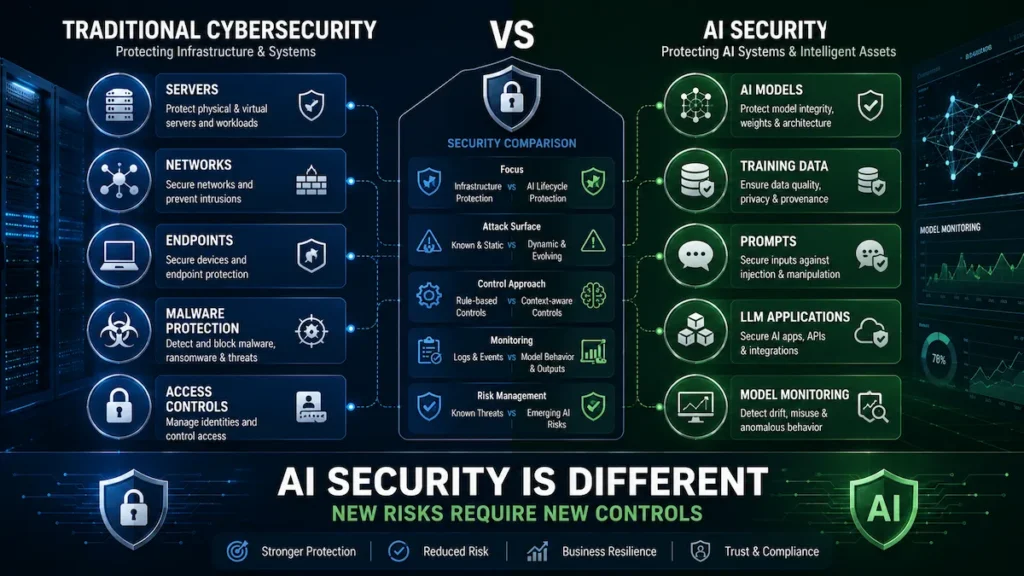
Quick Answer: An AI security checklist extends traditional cybersecurity by adding controls for AI-specific risks such as prompt injection, model extraction, data poisoning, AI governance, and model monitoring.
An AI security checklist builds on standard cybersecurity practice but isn’t a rebrand of it. The assets, threats, and monitoring approach are meaningfully different.
| Area | Traditional Cybersecurity Checklist | AI Security Checklist |
|---|---|---|
| Primary Assets | Servers, applications, endpoints | Models, training data, prompts, embeddings |
| Common Threats | Malware, phishing, unpatched vulnerabilities | Prompt injection, data poisoning, model extraction |
| Access Control Focus | User and system permissions | User, model, and plugin/tool permissions |
| Monitoring Focus | Logs and network traffic | Logs, output behavior, and model drift |
| Vendor Risk | SaaS security questionnaires | SaaS security + model training/data-handling review |
| Incident Response | Standard IR playbook | AI-specific IR playbook (hallucination, leakage, misuse) |
What Is an AI Security Checklist for Enterprises?
Quick Answer: An enterprise AI security checklist is a structured framework of governance, data security, model security, application security, and monitoring controls used to reduce AI-related risks throughout the AI lifecycle.
An AI security checklist is a living governance artifact—not a one-time form—that enumerates the technical, procedural, and compliance controls applied to AI systems across their lifecycle: design, data sourcing, training or fine-tuning, testing, deployment, monitoring, and decommissioning.
Who Needs an AI Security Checklist?
Quick Answer: Organizations that build, deploy, purchase, or manage AI systems—including CISOs, CTOs, compliance teams, AI governance leaders, and regulated businesses—should implement an AI security checklist.
CISOs and security leaders, AI governance teams, compliance officers mapping AI risk to GDPR, HIPAA, SOX, or sector rules, CTOs and AI architects embedding controls into the SDLC, risk managers, and IT directors managing AI infrastructure. Any organization whose AI systems touch customer data, business-critical decisions, or regulated processes needs this — not just AI-native companies.
When Should It Be Implemented?
Quick Answer: Organizations should apply an AI security checklist before AI procurement, before deployment, and continuously throughout production using scheduled reviews and monitoring.
Apply the checklist at three trigger points: before adopting a new AI tool (procurement gate), before deploying an internally built or fine-tuned model (release gate), and on a recurring cadence — quarterly or semi-annual — for AI systems already in production, since model behavior and the threat landscape both evolve.
The TrusteraAI Enterprise AI Security Framework™
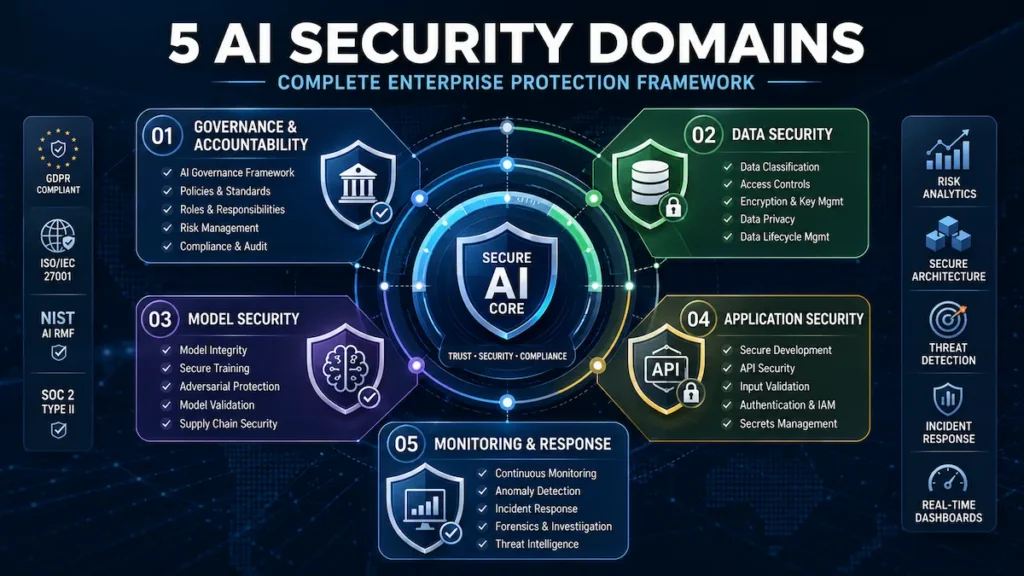
Quick Answer: The TrusteraAI Enterprise AI Security Framework™ organizes AI governance into five operational domains that simplify implementation while aligning with recognized industry guidance such as the NIST AI RMF, ISO/IEC 42001, and OWASP guidance.
Based on established guidance from the NIST AI RMF, ISO/IEC 42001, and the OWASP Top 10 for LLM Applications and OWASP GenAI Security Project, TrusteraAI organizes these requirements into five operational domains, helping enterprises implement controls consistently across the AI lifecycle rather than treating each framework as a separate compliance exercise.
| Domain | Focus | Primary Owner |
|---|---|---|
| Governance & Accountability | Policy, roles, approval workflows | AI Governance Team / CISO |
| Data Security | Training data, data lineage, data minimization | Data Security / Privacy |
| Model Security | Model integrity, adversarial testing, access control | AI Architects / Security Engineering |
| Application & Integration Security | Prompt handling, plugins, APIs, third-party tools | AppSec / Engineering |
| Monitoring & Incident Response | Drift detection, anomaly monitoring, AI-specific IR playbooks | SOC / Risk Management |
A system entering procurement is evaluated first against governance and data security. A system entering deployment is evaluated against model security and application security. A system already in production is continuously evaluated against monitoring & incident response.
AI Security Checklist Ownership Matrix
| Domain | Primary Owner | Supporting Teams |
|---|---|---|
| Governance | CISO / AI Governance Lead | Legal, Compliance |
| Data Security | Privacy Officer | Data Engineering |
| Model Security | AI Security Engineer | ML Engineers |
| Application Security | AppSec Team | Developers |
| Monitoring | SOC | Risk Management |
About This Framework: This framework was developed by TrusteraAI based on established AI risk management practices from the NIST AI RMF, ISO/IEC 42001, and OWASP GenAI security guidance. It’s designed for security and governance teams implementing practical, auditable AI controls rather than starting from a blank page across three separate standards.
Free Download
📥 Download the Free Enterprise AI Security Checklist (2026)
Implementing AI securely?
Download the Free Enterprise AI Security Checklist 2026 to access all 27 security controls, ownership guidance, audit evidence requirements, and a practical implementation roadmap for enterprise AI governance.
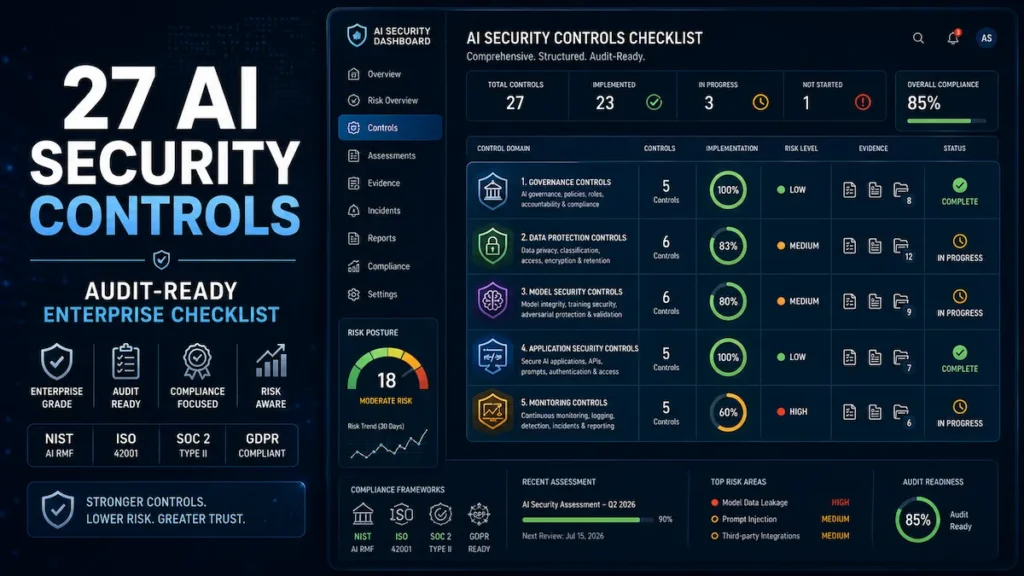
The Core AI Security Checklist (27 Controls)
Quick Answer: A comprehensive enterprise AI security checklist should include governance, data security, model security, application security, and continuous monitoring controls. This framework organizes those requirements into 27 practical controls that can be implemented before procurement, before deployment, and throughout the AI system lifecycle.
1. Governance & Accountability
- AI use cases are inventoried in a central register. Every AI tool in use — sanctioned or not — should appear in one register, including shadow AI discovered through SaaS spend review or network monitoring, since you can’t govern what you can’t see.
- A designated AI governance owner or committee approves new AI use cases. This is typically a cross-functional body (security, legal, privacy, and a business owner) with authority to approve, reject, or condition new AI deployments before they go live.
- Risk classification is applied to every AI system. Classify each use case as low, medium, or high impact based on the sensitivity of data involved and the consequence of an incorrect or leaked output, then apply proportionate controls.
- An AI security policy exists and is distributed to all employees. This should state which tools are approved, what data classes may never be entered into AI systems, and how to request approval for new tools—framed as enabling safe use, not just restricting it.
- Roles and responsibilities for AI risk are documented (RACI model). Ambiguity about who owns AI risk is one of the most common reasons controls exist on paper but aren’t enforced in practice.
- Legal and compliance review is required before high-risk AI deployment. High-risk systems — those touching regulated data or automated decision-making — should not reach production without a documented legal sign-off.
- Board or executive-level reporting on AI risk occurs on a defined cadence. Leadership visibility keeps AI governance funded and prioritized rather than treated as a side project inside the security team.
Free Resource: Download the Enterprise AI Security Checklist PDF—it includes all 27 controls, control owners, and the evidence each one requires for audit preparation.
2. Data Security
- Training and fine-tuning data sources are documented and reviewed for provenance. Maintain a data lineage record showing where each dataset originated, who approved its use, what privacy restrictions apply, and whether it introduces security or compliance risk.
- Sensitive data is identified before being used in training or prompts. PII, PHI, and financial data should be classified and flagged before it ever reaches a model — including third-party APIs where the enterprise has no control over downstream retention.
- Data minimization principles are applied to what is sent to AI models. Send only the fields a model actually needs to complete the task, particularly for third-party APIs that may log or retain inputs for training.
- Data retention and deletion policies apply to AI-related data, including logs and prompts. Prompt logs often contain the same sensitive data as the underlying system and need the same retention discipline.
- Data poisoning risk is assessed for any externally sourced or user-contributed training data. If a model is fine-tuned on user-submitted or scraped data, review the pipeline for a mechanism an attacker could use to inject malicious examples.
- Encryption is applied to data at rest and in transit across AI pipelines. This extends standard encryption practice to training data stores, vector databases, and model artifacts, not just production databases.
3. Model Security
- Model access is restricted using least-privilege principles. Not every engineer needs access to production model weights, fine-tuning pipelines, or evaluation datasets.
- Models undergo adversarial robustness testing before deployment. Red-team the model against known attack patterns—jailbreaks, adversarial inputs, and edge-case prompts—before it’s customer-facing.
- Model versioning and change control are in place. Every model update should be tracked and reversible, the same way code changes are, since model behavior can shift meaningfully between versions.
- Model outputs are evaluated for bias, safety, and accuracy prior to release. This should be a documented evaluation with defined pass/fail criteria, not an informal spot-check.
- Fine-tuned or custom models undergo security review distinct from base-model vendor assessment. Vetting the underlying provider (e.g., OpenAI, Anthropic, Google) does not cover risk introduced by your own fine-tuning data or configuration.
- Model extraction and inversion risks are assessed for exposed APIs. Rate limiting and query monitoring reduce the risk of an attacker reconstructing model behavior or inferring training data through repeated queries.
4. Application & Integration Security
- Prompt injection defenses are implemented for user-facing LLM applications. Treat user input to an LLM the way you’d treat any untrusted input—validate it and don’t let it directly override system-level instructions.
- Third-party plugins, tools, and function-calling integrations are reviewed for excessive permissions. An AI agent with tool access should follow the same least-privilege review as any service account.
- Output filtering is applied before AI-generated content reaches end users or downstream systems. This catches unsafe, non-compliant, or clearly hallucinated output before it reaches a customer or feeds an automated workflow.
- Vendor AI tools go through a formal AI vendor security assessment before integration. This should cover data handling, training-on-input policy, subprocessor list, and incident notification terms.
5. Monitoring & Incident Response
- Model performance and behavior drift are monitored continuously. Set baseline behavior metrics and alert when output patterns shift meaningfully, since model behavior can change even without a code deployment.
- Logging captures AI inputs and outputs sufficient for post-incident investigation. Without input/output logs, a suspected AI incident is nearly impossible to investigate after the fact.
- An AI incident response playbook exists, distinct from general IR procedures. This should cover hallucination-driven harm, data leakage through prompts, and misuse of AI-generated content, none of which map cleanly onto a standard breach playbook.
- Post-incident reviews feed back into the governance and model security domains. Every AI incident should update the risk register and, where relevant, trigger a re-review of the model or vendor involved.
Enterprise AI Security Checklist Template
For teams building an internal audit trail, each control needs an owner and a form of evidence — not just a checked box.
| Control Area | Owner | Evidence |
|---|---|---|
| AI use case inventory | Governance team | AI register / asset inventory |
| Data protection & minimization | Privacy / Data Security | Data classification report |
| Model testing & evaluation | Security / AI Architecture | Adversarial testing report |
| Vendor & third-party review | Procurement / Legal | Vendor security assessment |
| Monitoring & drift detection | SOC | Monitoring dashboards / logs |
| Incident response | Risk Management | AI-specific IR playbook + post-incident report |
This table doubles as the structure for an AI security audit checklist—each row is what an internal or external auditor will ask to see evidence for.
Download the Complete Enterprise AI Security Checklist PDF
Turn this framework into an actionable implementation plan.
Download the Free Enterprise AI Security Checklist 2026 to get the complete 27-point checklist, control ownership matrix, audit evidence requirements, and a practical roadmap for implementing secure AI governance across your organization.
Instead of creating your own checklist from scratch, use a ready-to-implement resource designed to help security, compliance, and AI governance teams standardize AI risk management.
Download the free Enterprise AI Security Checklist (2026) to access all 27 practical controls, audit evidence requirements, and implementation guidance.
Enterprise Scenario: Applying the Checklist
Quick Answer: An enterprise AI security checklist is most effective when applied to real business scenarios. For example, a healthcare SaaS company deploying an AI-powered patient support assistant can use the checklist to reduce data privacy risks, strengthen compliance, and implement secure AI governance before production.
Scenario: A healthcare SaaS company integrates a GPT-based customer support assistant into its patient portal.
| Risk | Control Applied |
|---|---|
| Patient data exposure in prompts | Data classification and redaction before prompts reach the model |
| Hallucinated or inaccurate answers | Human-in-the-loop review workflow for clinical or billing questions |
| Third-party AI vendor risk | Formal AI vendor security assessment before contract signature |
| Prompt injection via user input | Input validation and output filtering on the support interface |
| Regulatory exposure (HIPAA) | Legal and compliance sign-off before production release |
This is the same pattern that applies to Spain- and EU-facing SaaS companies managing GDPR exposure—see our Spain GDPR checklist for SaaS companies and AEPD inspection guide for the regulatory side of this same control set.
AI Threat Comparison Matrix
Quick Answer: Enterprise AI systems face unique threats—including prompt injection, data poisoning, model extraction, model inversion, shadow AI, and insecure third-party integrations—that require dedicated security controls beyond traditional cybersecurity practices.
| Threat Category | Description | Primary Control Domain |
|---|---|---|
| Prompt Injection | Malicious input manipulates model behavior or bypasses safeguards | Application Security |
| Data Poisoning | Corrupted or malicious training data skews model behavior | Data Security |
| Model Extraction | The attacker reconstructs model logic or weights via repeated queries | Model Security |
| Model Inversion | The attacker infers training data (including sensitive data) from outputs | Model Security / Data Security |
| Insecure Plugin/Tool Use | Overly permissive integrations allow unintended actions | Application Security |
| Shadow AI | Unapproved AI tools used without governance oversight | Governance |
| Supply Chain Risk | Vulnerabilities inherited from third-party models, datasets, or libraries | Governance / Vendor Risk |
| AI Attack Techniques (MITRE ATLAS) | Adversarial tactics targeting AI systems, cataloged by MITRE’s ATLAS framework | Model Security / Monitoring |
Compliance Framework Mapping
Quick Answer: Most enterprise AI security programs align their controls with recognized frameworks such as the NIST AI Risk Management Framework (AI RMF), ISO/IEC 42001, OWASP Top 10 for LLM Applications, the EU AI Act, and SOC 2 to improve governance, security, and audit readiness.
| Framework | Primary Focus | Relevance |
|---|---|---|
| NIST AI Risk Management Framework (AI RMF) | Risk-based lifecycle guidance | Foundational framework for identifying, assessing, managing, and governing AI risks across the AI lifecycle. |
| ISO/IEC 42001 | AI management system standard | Provides a formal certification path for establishing, implementing, maintaining, and continually improving AI governance. |
| OWASP Top 10 for LLM Applications | Application-level AI security risks | Maps directly to AI-specific threats such as prompt injection, insecure output handling, excessive agency, and sensitive information disclosure. |
| EU AI Act | AI risk classification and regulatory compliance | Establishes legal obligations for high-risk AI systems, transparency requirements, governance, and conformity assessments within the European Union. |
| GDPR | Data protection and lawful processing of personal data | Applies whenever an AI system processes personal data of EU or Spain-based users. Governs lawful processing, data minimization, transparency, security, and data subject rights alongside AI-specific controls. |
| SOC 2 | Security, availability, processing integrity, confidentiality, and privacy controls | Frequently extended to demonstrate AI governance, security controls, monitoring, audit evidence, and operational trust for AI-enabled services. |
For SaaS companies building out this compliance stack, our guide to AI security compliance tools for SaaS startups covers the platforms that automate much of this mapping, including a comparison of Vanta, Sprinto, and Kertos.
Mapping AI Security Controls to Security Frameworks
| AI Security Domain | NIST AI RMF | NIST Cybersecurity Framework |
|---|---|---|
| Governance | Govern | Govern |
| Data Security | Manage | Protect |
| Model Security | Measure | Protect |
| Monitoring & Response | Manage | Detect / Respond |
AI Security Maturity Matrix
| Level | Characteristics |
|---|---|
| 1 — Ad Hoc | No AI inventory; adoption unmanaged; no governance owner |
| 2 — Reactive | Policies exist but inconsistently enforced |
| 3 — Managed | The checklist and risk classification applied consistently |
| 4 — Integrated | AI security embedded in SDLC and procurement; continuous monitoring |
| 5 — Optimized | Metrics tracked; framework certified (e.g., ISO 42001); proactive threat modeling |
Implementation Roadmap
Quick Answer: Organizations should implement AI security in phases—starting with AI inventory and risk assessment, followed by governance, security controls, continuous monitoring, and regular audits to maintain long-term compliance and resilience.
| Phase | Timeframe | Key Activities |
|---|---|---|
| 1. Assess | Weeks 1–4 | Inventory AI use cases, classify risk, identify shadow AI |
| 2. Establish Governance | Weeks 3–8 | Assign ownership, draft AI security policy, define approval workflow |
| 3. Apply Controls | Weeks 6–16 | Implement data, model, and application security controls by risk tier |
| 4. Monitor | Ongoing | Deploy drift detection, logging, anomaly alerting |
| 5. Audit & Mature | Quarterly | Reassess maturity level, update the checklist, and report to leadership |
How AI Security Platforms Help Enterprises Operationalize These Controls
Quick Answer: AI governance and compliance platforms help organizations operationalize AI security by automating AI inventories, vendor assessments, evidence collection, policy workflows, and continuous monitoring across the AI lifecycle.
Most enterprises don’t build all 27 controls from scratch on spreadsheets. Enterprise teams commonly use AI governance and compliance automation platforms to maintain AI inventories, automate evidence collection, manage vendor assessments, and prepare for regulatory reviews. In practice, these platforms help operationalize the checklist by:
- Automating the AI use case inventory — discovering AI tools already connected to company systems, including unsanctioned ones.
- Standardizing vendor assessments — running AI-specific security questionnaires against a consistent rubric rather than ad hoc reviews.
- Collecting audit evidence continuously—pulling logs, policy acknowledgments, and testing reports into one place instead of assembling them manually before every audit.
- Managing policy workflows—routing new AI use case requests through the approval chain defined in the governance domain.
- Supporting monitoring dashboards — surfacing drift and anomaly signals that feed the Monitoring & Incident Response domain.
These platforms don’t replace governance decisions — the checklist and the ownership behind it still need to be defined first — but they reduce the manual overhead of keeping 27 controls current across a growing AI footprint. See our comparison of AI compliance automation platforms for SaaS teams for how these platforms stack up.
Start with the Free Enterprise AI Security Checklist
Before investing in governance platforms or compliance automation tools, establish a strong foundation with the Free Enterprise AI Security Checklist 2026.
The checklist helps your organization identify AI risks, define ownership, organize audit evidence, and implement practical controls aligned with leading AI security frameworks.
Common Mistakes Enterprises Make
- Treating AI security as a subset of general IT security without accounting for model-specific risks like drift or prompt injection.
- Ignoring shadow AI — Gartner’s 2025 data shows most organizations already suspect or have confirmed unsanctioned AI use internally, often without a governance program equipped to see it.
- Applying controls only at deployment, skipping data-sourcing and training-stage risk entirely.
- Treating vendor AI tools as outside the security perimeter, without a formal AI vendor security assessment.
- Having no incident response plan specific to AI failures.
Best Practices
- Build the AI inventory first — you can’t secure what you don’t know exists.
- Tie every control to an accountable owner, not just a policy document.
- Use risk-tiered controls: low-risk internal tools don’t need the same rigor as customer-facing, high-impact systems.
- Align the checklist to NIST AI RMF or ISO 42001 so it doubles as audit-ready evidence.
- Treat monitoring as continuous — model behavior changes over time even without code changes.
Key Takeaways
✅ AI security requires governance, not just technical controls.
✅ Maintain an inventory of all AI systems and third-party AI tools.
✅ Apply the 27 controls before procurement, deployment, and throughout production.
✅ Align AI security with NIST AI RMF, ISO/IEC 42001, and OWASP guidance.
✅ Continuously monitor AI systems for drift, misuse, and emerging threats.
Conclusion: Building an Enterprise AI Security Program
An AI security checklist is a starting point, not a finished program. AI security is lifecycle management—it starts before a model is chosen and continues for as long as the system is in production. A checklist gives you control of inventory; governance gives it an owner; continuous monitoring is what keeps it accurate as models, vendors, and usage patterns change.
The organizations that get this right treat the checklist as a living document tied to a named owner, reviewed on a fixed cadence, and backed by evidence an auditor could actually verify—not a one-time document that gets filed away after the first deployment.
Download the Free Enterprise AI Security Checklist (2026)
Turn AI security best practices into action with the Free Enterprise AI Security Checklist 2026.
Get instant access to 27 practical security controls, an ownership matrix, audit evidence requirements, and an implementation roadmap aligned with the NIST AI RMF, ISO/IEC 42001, and OWASP GenAI Security guidance.
Reviewed by TrusteraAI AI Governance Team
This guide was reviewed against the NIST AI Risk Management Framework, ISO/IEC 42001, and OWASP GenAI Security guidance.
Last reviewed: July 2026
Frequently Asked Questions
What should be included in an AI security checklist?
At minimum: an AI use case inventory, risk classification, data handling controls, model security testing, access management, continuous monitoring, and an AI-specific incident response plan.
What is an AI security checklist?
A structured set of governance, data, model, application, and monitoring controls used to assess and reduce risk across AI systems throughout their lifecycle.
Is an AI security checklist the same as a cybersecurity checklist?
No — it builds on standard cybersecurity controls but adds AI-specific risks like prompt injection, model extraction, and training data poisoning.
What is the difference between AI security and AI governance?
AI security focuses on protecting AI systems from threats—data, model, and application-level risks. AI governance is broader: it manages responsible use, compliance, accountability, and oversight of AI across the organization.
Can an AI security checklist replace an AI governance framework?
No. A checklist defines operational controls; a governance framework defines ownership, policies, decision processes, and accountability. The checklist is one output of a governance program, not a substitute for it.
Which framework should enterprises start with?
NIST AI RMF is one of the most widely referenced starting points in the US for organizations building risk-based AI governance programs. ISO/IEC 42001 is the right choice for organizations pursuing formal certification.
Who should own the AI security checklist?
Typically the CISO or a dedicated AI governance team, with input from compliance, legal, and engineering leadership.
How often should the checklist be updated?
At minimum quarterly, and immediately after any material change to AI use cases, vendors, or regulatory requirements.
Is this checklist aligned with ISO/IEC 42001?
Yes. The Enterprise AI Security Checklist is designed to complement internationally recognized AI governance practices, including ISO/IEC 42001. While it is not a certification standard itself, it helps organizations implement practical controls that support AI governance, risk management, and audit readiness.
How does this checklist support the NIST AI Risk Management Framework (AI RMF)?
The checklist aligns with the core principles of the NIST AI Risk Management Framework (AI RMF) by helping organizations govern AI systems, assess and manage risks, implement security controls, and continuously monitor AI throughout its lifecycle. It translates high-level guidance into practical, actionable steps.