
Last updated: July 2026
| Version | Date | Major Updates |
|---|---|---|
| 1.0 | July 2026 | Initial publication |
Resource Snapshot
Enterprise Resource
| Difficulty | Intermediate–Advanced |
| Reading Time | ~35 minutes |
| Updated | July 2026 |
| Frameworks Covered | NIST AI RMF, ISO/IEC 42001, EU AI Act, OWASP LLM Top 10 |
| Best For | CISOs, Security Teams, Compliance, SaaS Founders, AI Governance Teams |
Downloadables: PDF Checklist (Coming Soon) · Excel Workbook (Coming Soon) · Executive Summary (Coming Soon) · Self-Assessment (Available — see AI Governance Readiness Assessment)
Table of Contents
Start Here → Quick Wins → Before You Start → Choose Your Path → Download Center → At a Glance → Core Guide → Framework Mapping → Industry Guides → Roadmap → FAQs → Toolkit → Related Resources
Free AI Governance Readiness Assessment
Evaluate your organization’s AI governance maturity in less than 5 minutes using TrusteraAI’s interactive assessment based on NIST AI RMF, ISO/IEC 42001, and the EU AI Act.
Executive Summary
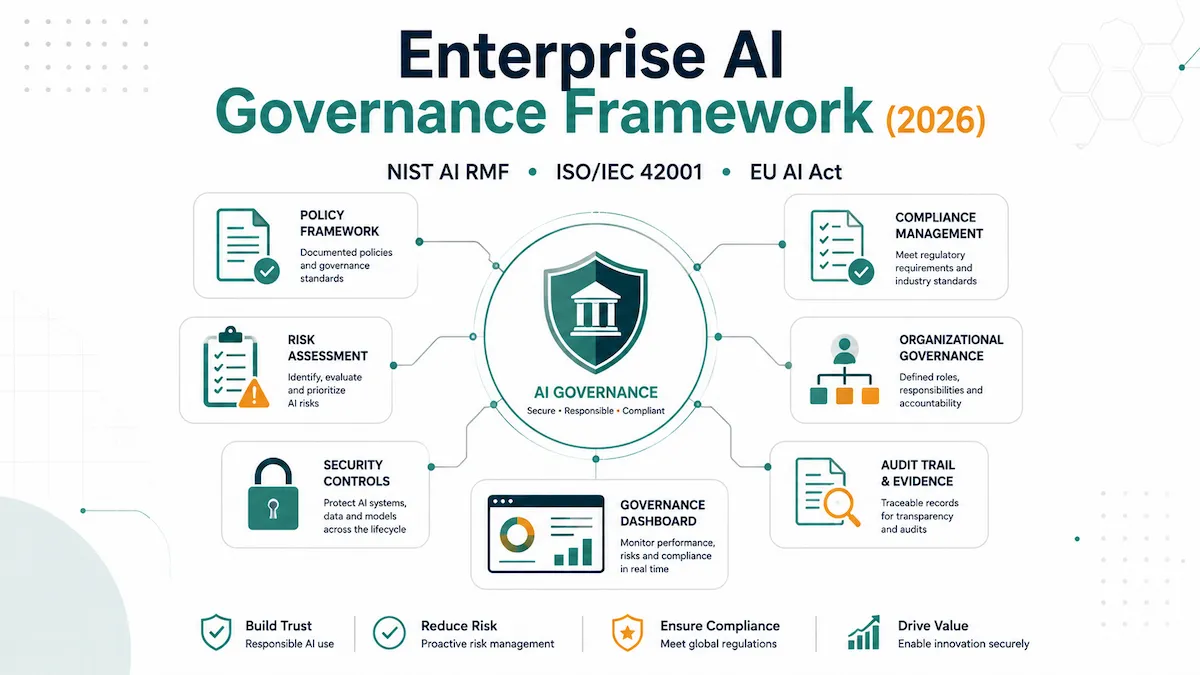
This enterprise AI governance framework provides a practical roadmap for implementing AI governance using NIST AI RMF, ISO/IEC 42001, and the EU AI Act.
An enterprise AI governance framework provides the policies, processes, and accountability organizations need to manage AI safely, securely, and in compliance with evolving regulations. As AI adoption accelerates across industries, enterprises must align governance with recognized frameworks such as NIST AI RMF, ISO/IEC 42001, and the EU AI Act. This guide explains how to build an enterprise AI governance framework that reduces risk, supports compliance, and prepares your organization for enterprise procurement, audits, and long-term AI governance maturity.
It includes the AI Governance Maturity Model™ (AGMM)—a five-stage model for assessing where your organization stands today—and the Enterprise AI Governance Readiness Stack™—a structured checklist system for moving from ad hoc AI use to certified, auditable governance.
This is a living resource, versioned and updated as NIST AI RMF profiles, ISO 42001 certification bodies, and EU AI Act enforcement guidance evolve.
Organizations should also establish a technical baseline using our AI Security Checklist (2026) before implementing governance controls.
At a Glance
These quick wins help organizations begin implementing an enterprise AI governance framework without waiting for a full governance program.
| If you need to… | Go to |
|---|---|
| Build AI governance from scratch | Step-by-Step Implementation |
| Prepare for ISO/IEC 42001 | Gap Assessment + Certification |
| Meet EU AI Act obligations | Framework Mapping + Industry Guides |
| Assess current maturity | AGMM, or take the Readiness Assessment |
| Prepare for an audit | Roles, Frequency & Evidence |
| Download templates | Download Center |
Quick Wins: 10 Actions You Can Complete This Week
☐ Inventory every AI tool currently in use, including browser extensions and embedded SaaS features.
☐ Disable or flag unauthorized AI apps discovered during inventory.
☐ Assign a named, temporary AI governance owner even before a formal committee exists.
☐ Draft a one-page interim AI acceptable use policy.
☐ List every AI vendor currently under contract.
☐ Identify which AI use cases touch regulated data (health, financial, biometric).
☐ Add “AI governance” as a standing agenda item in the next security or risk meeting.
☐ Check whether any current AI use case would qualify as high-risk under the EU AI Act.
☐ Draft a one-paragraph escalation path for AI-related incidents.
☐ Schedule the first cross-functional governance meeting with Legal, Privacy, and Security.
Before You Start
Before implementing an enterprise AI governance framework, make sure your organization has the foundational security and governance processes already in place.
This guide assumes you already have:
☐ Asset inventory (general IT, not AI-specific)
☐ Vendor inventory
☐ Existing security policies
☐ A risk register (even if AI isn’t in it yet)
☐ An executive sponsor
If you’re missing any of these, they’re worth building first—the AI-specific steps below assume they exist as a foundation.
Choose Your Path
Every enterprise AI governance framework should be tailored to how your organization develops, purchases, or uses AI technologies.
If you build AI products internally:
Start at Step 1 (Inventory) → follow the full NIST AI RMF sequence → prepare for ISO 42001 certification if selling to enterprise customers.
If you primarily buy AI tools from vendors:
Start at Step 5 (Vendor Review) → You can deprioritize model lifecycle governance → focus effort on procurement controls and the vendor review process.
If AI use is mostly internal productivity tools:
Start with the inventory → draft a lightweight policy → deliver basic staff training → set an annual review reminder. You likely don’t need a full gap assessment yet.
Download Center
The resources below are designed to help you implement this enterprise AI governance framework more efficiently.
| Resource | Format | Status |
|---|---|---|
| Enterprise AI Governance Checklist | Coming Soon | |
| AI Governance Audit Workbook | Excel | Coming Soon |
| AI Governance Policy Template | Word | Coming Soon |
| AI Governance Readiness Assessment | Interactive | Available |
| Executive Summary | Coming Soon |
Definitions
Understanding these terms will help you apply an enterprise AI governance framework consistently across your organization.
AI Governance: The organizational structures, policies, and processes that ensure AI systems are developed and used safely, ethically, and in compliance with applicable law.
AI Risk Management Framework (AI RMF): NIST’s voluntary framework (published 2023) is organized around four functions—Govern, Map, Measure, and Manage—for identifying and mitigating AI-specific risks.
ISO/IEC 42001: The first international, certifiable management system standard for AI, published in December 2023. It establishes requirements for an AI Management System (AIMS), similar in structure to ISO 27001 for information security.
EU AI Act: The European Union’s binding regulation classifying AI systems by risk tier (unacceptable, high, limited, minimal) with corresponding legal obligations. Entered into force August 2024, with phased enforcement through 2027.
AI Management System (AIMS): The formal system of policies, roles, and controls an organization operates to govern AI, as defined by ISO 42001.
Shadow AI: AI tools or features used within an organization without formal review, approval, or inclusion in the official AI inventory.
Who Should Use This Resource
- CISOs and CTOs building an AI governance function from scratch
- Compliance and privacy officers mapping AI use to GDPR, EU AI Act, or sector regulation
- SaaS founders preparing for enterprise procurement questionnaires that now include AI-specific security review
- AI governance teams operationalizing NIST AI RMF or pursuing ISO 42001 certification
- Risk managers building AI-specific entries into enterprise risk registers
Decision Point
If your organization develops AI models internally, prioritize model lifecycle governance (Steps 6–7 below). If you primarily purchase AI capabilities from vendors, prioritize procurement controls and vendor risk assessment (Step 5). Most enterprises need both, but the order matters for where to focus limited resources first.
Why This Topic Matters
An enterprise AI governance framework reduces operational, regulatory, and security risks while improving accountability for AI systems.
AI governance failures rarely start as security incidents. They start as a lack of ownership: no one owns the model inventory, no one reviews vendor AI tools before procurement, and no one has classified which AI use cases affect regulated data.
Three forces are converging to make this urgent in 2026:
- Regulatory deadlines. EU AI Act obligations for high-risk systems and general-purpose AI models are phasing in. If your organization also processes personal data under GDPR, see our Best GDPR Compliance Software for Spain SaaS Startups (2026) guide to evaluate platforms that can help support privacy compliance alongside AI governance. Penalties vary significantly by violation category and applicable provision — consult current European Commission guidance for figures relevant to a specific case rather than a single headline number.
- Procurement pressure. Enterprise buyers increasingly require evidence of AI governance — not just security certifications — before signing vendor contracts.
- Certification maturity. ISO 42001 now gives organizations a certifiable way to demonstrate AI governance externally, the way ISO 27001 did for information security.
Common Mistake
Assuming AI governance is solely an IT responsibility. Effective governance also requires legal, compliance, procurement, and business-unit stakeholders—without them, policies exist on paper but aren’t enforced at the point of purchase or deployment.
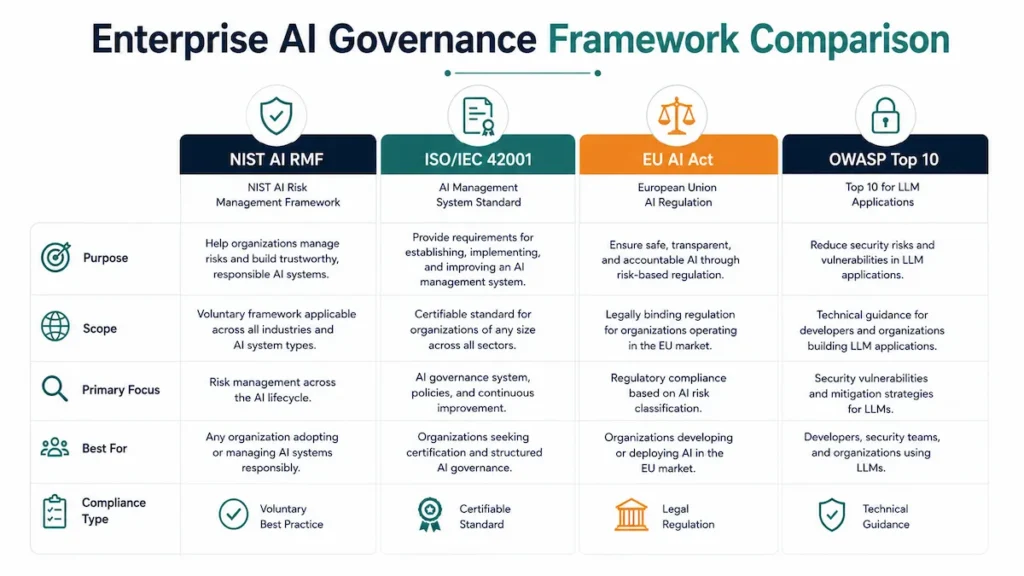
Regulatory & Standards Landscape (2026)
| Framework | Type | Scope | Enforceable? |
|---|---|---|---|
| NIST AI RMF | Voluntary framework | Any AI system, US-focused but globally referenced | No, but increasingly a procurement baseline |
| ISO/IEC 42001 | Certifiable management standard | Organizations operating an AIMS | No, but certification is auditable and third-party verified |
| EU AI Act | Binding regulation | AI systems placed on the EU market or affecting EU persons | Yes, penalties vary by violation category |
| OWASP Top 10 for LLM Applications | Technical guidance | LLM-specific application security risks | No |
| SOC 2 | Attestation | Trust service criteria are increasingly extended to cover AI controls | No, but commonly contractually required |
Distinguish clearly between these categories when advising internal stakeholders: NIST AI RMF and ISO 42001 are governance frameworks you choose to adopt; the EU AI Act is law you must comply with if it applies to you. For exact penalty figures by violation type, consult current European Commission guidance directly, as implementing detail continues to evolve.
Core Concepts
Every effective enterprise AI governance framework is built on clear governance principles, risk management, and continuous oversight.
The Four Functions of NIST AI RMF
- Govern: Establish policies, roles, and accountability structures before deploying AI.
- Map: Identify AI systems in use, their context, and the risks they introduce.
- Measure: Assess and track identified risks using appropriate metrics and testing.
- Manage: Prioritize and respond to risks, including decisions to modify, monitor, or decommission systems.
The ISO 42001 AIMS Structure
ISO 42001 requires organizations to define an AI policy, conduct AI impact assessments, maintain a documented AI system inventory, and run a continuous improvement cycle — structurally similar to ISO 27001’s Plan-Do-Check-Act model, but scoped to AI-specific risks like bias, explainability, and model drift.
EU AI Act Risk Tiers
- Unacceptable risk: Prohibited outright (e.g., social scoring by public authorities)
- High risk: Subject to conformity assessments, documentation, and human oversight requirements
- Limited risk: Transparency obligations (e.g., disclosing AI-generated content)
- Minimal risk: No specific legal obligations
The AI Governance Lifecycle
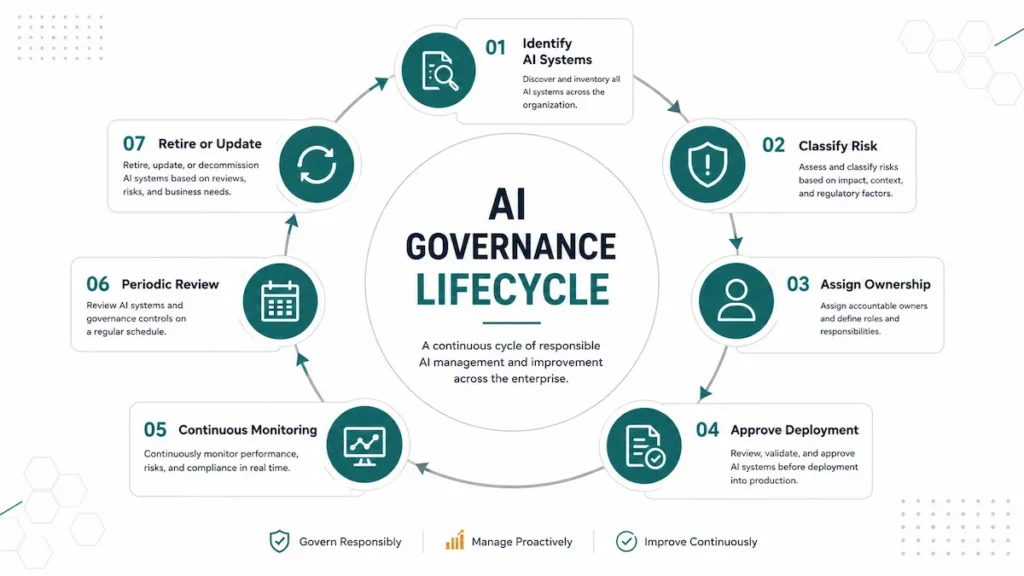
A continuous cycle rather than a one-time project:
Identify AI Systems → Classify Risk → Assign Ownership → Approve Deployment → Continuous Monitoring → Periodic Review → Retire or Update
Each stage feeds the next; systems that fail periodic review return to classification rather than exiting the cycle entirely.
Visual Suggestion: Governance lifecycle diagram showing this seven-stage loop.
The AI Governance Maturity Model™ (AGMM)
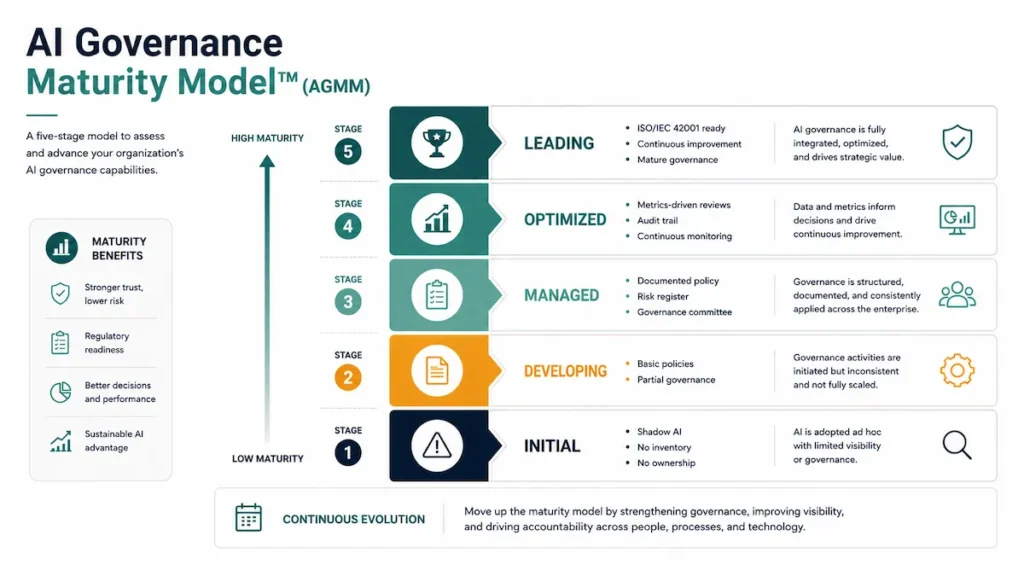
This enterprise AI governance framework uses the AI Governance Maturity Model™ (AGMM) to measure governance readiness and identify improvement opportunities.
An original framework for benchmarking organizational readiness. Each stage has a name, defining characteristic, and clear goal for advancement.
| Stage | Name | Characteristics | Goal to Advance |
|---|---|---|---|
| 1 | Initial | Shadow AI use, no formal inventory, no assigned ownership | Build a complete AI system inventory |
| 2 | Developing | Policies drafted but inconsistently enforced, ownership unclear | Assign a named accountable owner and enforce vendor review |
| 3 | Managed | Documented AIMS-aligned policy, formal risk register, cross-functional committee | Establish regular (quarterly) risk assessment cadence |
| 4 | Optimized | Metrics-driven reviews, audit trails, and automated inventory tracking | Pursue external validation (ISO 42001 gap assessment) |
| 5 | Leading | ISO 42001 certified or certification-ready, continuous improvement built in | Maintain via annual recertification and framework updates |
How to use this: Most enterprises without a dedicated AI governance function sit at Stage 1 or 2. The goal of the 90-day plan below is to reach Stage 3 as a defensible baseline. Not sure which stage you’re at? Take the AI Governance Readiness Assessment for a scored result.
Best Practice
Maintain a single AI inventory across all departments rather than separate inventories per business unit. A fragmented inventory is functionally the same as no inventory when an auditor or regulator asks for a complete list.
Roles, Frequency & Evidence
Defining responsibilities and maintaining evidence are essential components of an enterprise AI governance framework.
| Control | Owner | Frequency | Evidence |
|---|---|---|---|
| AI Inventory | IT/Security | Quarterly | Timestamped inventory export |
| Vendor AI Review | Procurement | Before purchase | Signed review record |
| Risk Register Update | Governance Committee | Quarterly | Meeting minutes, updated risk statuses |
| AI Policy Review | Legal + Governance Owner | Annual | Version-controlled policy document |
| Human Oversight Log | Business Unit Lead | Ongoing (per decision) | Approval/override log |
| ISO 42001 Internal Audit | Compliance/External Auditor | Annual | Audit report |
Implementation Priority, Effort & Cost
| Control | Priority | Effort | Cost |
|---|---|---|---|
| AI System Inventory | High | Low | Low |
| Named Governance Owner | High | Low | Low |
| Interim Acceptable Use Policy | High | Low | Low |
| Vendor AI Review Process | High | Medium | Low |
| AI Risk Register | High | Medium | Low |
| NIST AI RMF Gap Assessment | Medium | Medium | Medium |
| Human Oversight Procedures (high-risk systems) | Medium | Medium | Medium |
| ISO 42001 Certification | Medium | High | High |
Step-by-Step Implementation
Follow these implementation steps to build an enterprise AI governance framework that aligns with leading international standards and best practices.
Step 1: Inventory every AI system in use.
Include internally built models, third-party AI features embedded in SaaS tools, and generative AI tools used informally by employees. You cannot govern what you have not identified.
📥 Download: AI Inventory Spreadsheet (Coming Soon)
→ Next Step: Classify every inventoried system using the EU AI Act risk tiers.
Step 2: Classify each system by risk tier.
Use the EU AI Act’s tiers as a starting taxonomy even outside the EU—it is the most granular public risk classification available and maps well onto internal risk registers.
Step 3: Assign governance ownership.
Name a single accountable owner (often a CISO or dedicated AI governance lead) supported by a cross-functional committee including legal, privacy, security, and product.
Step 4: Draft an AI governance policy.
Cover acceptable use, vendor AI review requirements, human oversight thresholds for high-risk use cases, and incident escalation paths.
Step 5: Establish a vendor AI review process.
Require any new AI vendor or embedded AI feature to pass a documented review before procurement, covering data handling, model provenance, and applicable certifications. After completing your AI inventory, this review process is what prevents new shadow AI from re-entering through procurement.
📥 Download: Vendor AI Review Checklist (Coming Soon)
→ Next Step: Run a gap assessment to see what’s already covered by existing controls.
Step 6: Run a gap assessment against NIST AI RMF or ISO 42001.
Identify where existing security and privacy controls already satisfy governance requirements versus where new controls are needed.
Step 7: Build the AI risk register.
Track identified risks, mitigation status, and review cadence—treat it as a living document, not a one-time deliverable.
📥 Download: Risk Register Template (Coming Soon)
Step 8: Pursue certification if warranted.
ISO 42001 certification is most valuable for organizations selling AI-enabled products to enterprise or regulated customers, where it becomes a competitive differentiator in procurement.
Estimated Time to Complete
| Task | Owner | Time | Difficulty |
|---|---|---|---|
| Inventory AI systems | IT | 2–4 hours | Easy |
| Vendor review process (setup) | Procurement | 1–2 days | Medium |
| Draft governance policy | Compliance | 3–5 days | Medium |
| NIST AI RMF gap assessment | Governance | 1–2 weeks | Advanced |
| ISO 42001 readiness | Cross-functional | 3–12 months | Advanced |
Enterprise Best Practices
- Treat AI governance as a cross-functional program, not a security-only initiative—legal and privacy involvement is non-negotiable given regulatory exposure.
- Maintain a single source-of-truth AI inventory rather than letting each department track its own tools.
- Require human oversight checkpoints for any AI system materially affecting hiring, credit, healthcare, or legal decisions.
- Review vendor AI terms specifically for training-data usage rights, not just standard data processing terms.
- Align AI incident response with existing security incident response rather than building a parallel process.
Framework Mapping
This enterprise AI governance framework maps key governance controls to NIST AI RMF, ISO/IEC 42001, and the EU AI Act.
| Control Area | NIST AI RMF | ISO 42001 | EU AI Act |
|---|---|---|---|
| Risk identification | Map function | AI impact assessment | Risk classification (Art. 6) |
| Governance structure | Govern function | AIMS leadership requirements (Clause 5) | Provider obligations (Art. 16) |
| Ongoing monitoring | Measure/Manage functions | Performance evaluation (Clause 9) | Post-market monitoring (Art. 72) |
| Documentation | Supporting documentation | Documented information (Clause 7.5) | Technical documentation (Art. 11) |
| Human oversight | Manage function | Clause 8: Operational Controls | Art. 14 human oversight |
Compliance Considerations & Industry Mini-Guides
While every enterprise AI governance framework follows similar principles, implementation priorities vary across industries.
Healthcare
- Map AI systems touching patient data against HIPAA in addition to AI-specific frameworks.
- Assume clinical decision-support AI qualifies as high-risk under the EU AI Act and plan for conformity assessment early.
- Require explainability documentation for any AI influencing diagnosis or treatment recommendations.
- Include clinical staff, not just IT, in human oversight design—they identify failure modes engineers miss.
- Extend vendor AI review to medical device software with embedded AI components.
Finance
- Treat AI-driven credit scoring or fraud detection as high-risk by default under both the EU AI Act and existing model risk management regulation (e.g., SR 11-7).
- Maintain dual compliance tracking between AI governance and existing model risk frameworks to avoid duplicated audits.
- Document bias testing results for any AI system affecting lending or underwriting decisions.
- Require quarterly, not annual, review cadence for high-risk financial AI given regulatory scrutiny.
- Align AI incident escalation with existing financial services incident reporting obligations.
Manufacturing
- Inventory AI is used in predictive maintenance and quality control separately from office-productivity AI tools, as they carry different operational risks.
- Assess safety implications where AI influences physical equipment operation.
- Include OT (operational technology) teams in the AI governance committee, not just IT security.
- Document fallback procedures for AI-driven process control in case of model failure.
Education
- Classify AI used in student assessment or admissions decisions as higher-risk given potential for discriminatory impact.
- Ensure transparency obligations are met when AI-generated content or feedback reaches students.
- Include data protection review for any AI processing minors’ data.
Government
- Apply the strictest interpretation of EU AI Act prohibitions, including the ban on social scoring, given elevated public accountability.
- Prioritize transparency and public disclosure requirements beyond minimum legal obligations.
- Expect procurement processes to require AI governance documentation as a bid qualification criterion.
Retail
- Focus governance on AI used in dynamic pricing, personalization, and customer service automation.
- Review AI-driven personalization for consumer protection and transparency obligations regarding automated decision-making.
- Extend vendor AI review to marketing and e-commerce platform AI features.
SaaS/Technology
- Treat ISO 42001 certification as a procurement differentiator, directly addressing the AI governance questions increasingly embedded in enterprise security questionnaires.
- Maintain clear documentation distinguishing your own AI features from third-party AI embedded via API.
- Build vendor AI review into your own procurement process, not just your customer-facing certification story.
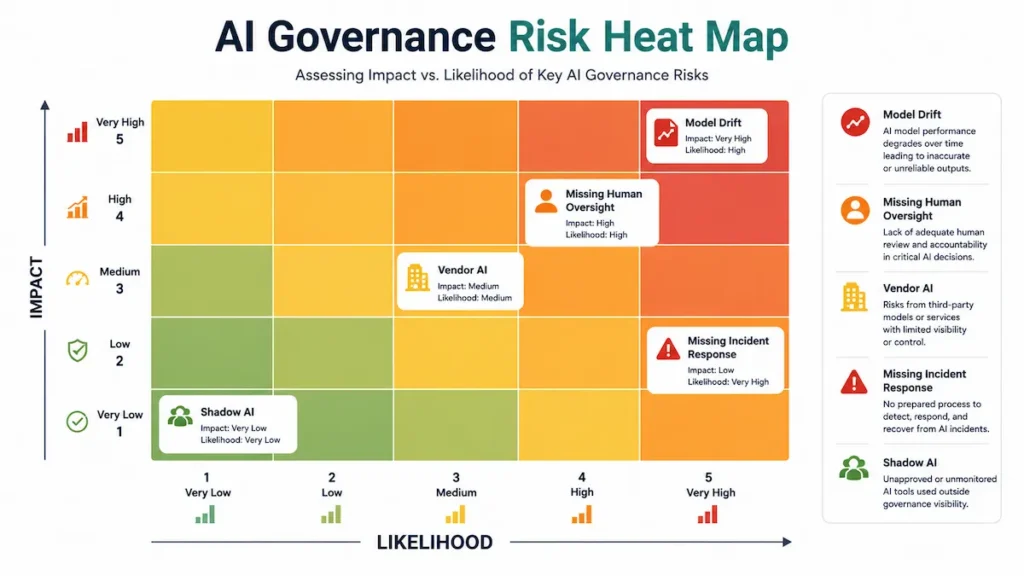
Risk Assessment Matrix
A structured risk assessment is a core element of every enterprise AI governance framework, helping organizations prioritize mitigation efforts.
| Risk Category | Likelihood | Impact | Priority |
|---|---|---|---|
| Shadow AI use (unapproved tools) | High | Medium | High |
| Vendor AI without governance documentation | High | High | Critical |
| High-risk AI system without human oversight | Medium | Critical | Critical |
| Model drift undetected post-deployment | Medium | Medium | Medium |
| Missing AI incident response plan | Medium | High | High |
Common Mistakes
Avoiding these common mistakes will strengthen your enterprise AI governance framework and improve long-term governance maturity.
- Treating AI governance as a subset of data privacy. Privacy compliance alone doesn’t address model bias, explainability, or drift.
- No inventory of embedded AI. Many AI risks enter through SaaS tools with AI features enabled by default, not through internally built models.
- Policy without enforcement. A written AI policy with no vendor review gate or audit trail won’t withstand regulatory or customer scrutiny.
- Delaying governance until deployment. Retrofitting governance onto already-deployed high-risk AI systems is significantly more costly than building it in during procurement or design.
Implementation Roadmap
This phased roadmap shows how to implement an enterprise AI governance framework over the first 30, 90, and 365 days.
30-Day Plan
☐ Complete a full AI system inventory across all departments.
Why: You cannot assess or classify risk for systems you haven’t identified.
☐ Assign a named AI governance owner.
Why: Accountability gaps are the most common reason governance initiatives stall.
☐ Draft an interim AI acceptable use policy.
Why: Closes the immediate gap while a full AIMS is built.
90-Day Plan
☐ Classify every inventoried AI system by EU AI Act-style risk tier.
☐ Establish a vendor AI review process for new procurement.
☐ Run a gap assessment against NIST AI RMF’s four functions. Organizations can use our AI Compliance Checklist to identify missing controls before beginning a formal gap assessment.
☐ Build the initial AI risk register with named mitigation owners.
Annual Review Checklist
| Activity | Monthly | Quarterly | Annual |
|---|---|---|---|
| Re-inventory AI systems | ✓ | ||
| Review risk register status | ✓ | ||
| Reassess risk tier classifications | ✓ | ||
| Audit vendor contract terms | ✓ | ||
| Governance committee review | ✓ | ||
| ISO 42001 internal audit (if certified) | ✓ |
Frequently Asked Questions
These frequently asked questions address the most common challenges organizations encounter when implementing an enterprise AI governance framework.
Is ISO 42001 mandatory?
No. It is a voluntary, certifiable standard, but it is increasingly requested during enterprise procurement as evidence of formal AI governance.
Does the EU AI Act apply to non-EU companies?
Yes, if the AI system is placed on the EU market or its output is used within the EU, regardless of where the provider is headquartered.
How is AI governance different from AI security?
Organizations operating in Spain or serving EU customers should also prepare for regulatory inspections. Our AEPD Inspection Guide (2026) explains the documentation and audit evidence regulators commonly request.
Do we need both NIST AI RMF and ISO 42001?
Many organizations use NIST AI RMF as the risk methodology and ISO 42001 as the certifiable management system structure—they are complementary, not competing.
What’s the first control most organizations are missing?
A complete, current AI system inventory, including AI features embedded in third-party SaaS tools rather than only internally built models.
Does ISO 42001 replace ISO 27001?
No. ISO 42001 governs AI-specific risks (bias, explainability, model lifecycle); ISO 27001 governs information security broadly. Organizations with both AI and traditional IT infrastructure typically need both, and many controls can be shared across the two management systems.
Can startups implement AI governance, or is this only for large enterprises?
Yes. A startup’s version can be lightweight—a spreadsheet inventory, a one-page policy, and a named owner—but the same four functions (identify, classify, assign ownership, and review) apply regardless of company size.
Who should chair the AI governance committee?
Most commonly the CISO or a dedicated AI governance lead, though at smaller organizations this may be the CTO or head of compliance. The chair should have enough organizational authority to enforce vendor review and policy compliance.
What is shadow AI?
AI tools or features used within an organization without formal review, approval, or inclusion in the official AI inventory — commonly employee-adopted generative AI tools or AI features enabled by default in existing SaaS products.
How often should the AI inventory be reviewed?
Quarterly at minimum, with an additional review triggered any time a new SaaS vendor or major software update is introduced, since AI features are increasingly added to existing tools without a formal announcement.
How do we govern open-source or self-hosted AI models?
Apply the same classification and risk assessment process as commercial models, with additional attention to patching cadence, provenance of training data where known, and internal responsibility for security updates that a vendor would otherwise handle.
What evidence do auditors typically expect?
Timestamped inventory exports, signed vendor review records, risk register meeting minutes, and documented human oversight logs for high-risk systems are all detailed in the Roles, Frequency & Evidence table above.
Does AI governance apply to AI used only for internal productivity, like drafting emails?
Yes, though the risk classification will typically be lower. Low-risk internal use still belongs in the inventory to maintain a complete picture and to catch cases where “internal productivity” use quietly expands into higher-risk territory.
What’s the difference between an AI policy and an AI governance framework?
The policy is one document within the broader framework; the framework also includes the risk register, committee structure, review cadence, and audit evidence trail.
How does AI governance intersect with GDPR?
Any AI system processing personal data must still satisfy GDPR’s lawful basis, data minimization, and data subject rights requirements—AI governance frameworks like ISO 42001 complement but do not replace GDPR compliance obligations.
Should AI governance be a subcommittee of an existing risk committee or standalone?
Either can work; the more important factor is that whoever chairs it has real authority over vendor approval and can enforce the policy, not just recommend it.
What’s a realistic timeline for a mid-size company to reach Stage 3 (Managed) on the AGMM?
Typically 90–180 days for organizations that dedicate a named owner and hold regular committee meetings, assuming no major internally built AI systems requiring extensive technical documentation.
Where can I find the exact EU AI Act penalty amounts for a specific violation?
Penalty amounts vary by violation category and are set out in the EU AI Act text itself; consult current European Commission guidance or qualified legal counsel for figures applicable to your specific situation, since implementing detail continues to be clarified.
Key Takeaways
The following takeaways summarize the most important principles of a successful enterprise AI governance framework.
- AI governance requires cross-functional ownership across security, legal, and privacy—it cannot sit with one team alone.
- NIST AI RMF, ISO 42001, and the EU AI Act serve different purposes: voluntary risk methodology, certifiable management system, and binding law, respectively.
- A complete AI inventory, including third-party embedded AI, is the essential first step before any framework can be applied.
- The AI Governance Maturity Model™ gives a practical way to benchmark the current state and set a realistic 90-day target.
Conclusion
Building an enterprise AI governance framework today prepares your organization for regulatory change, customer due diligence, and sustainable AI adoption.
Enterprise AI governance is moving from optional best practice to a procurement and regulatory requirement. Organizations that build a defensible governance baseline now — starting with a complete inventory and named ownership — will be far better positioned for EU AI Act enforcement, ISO 42001 certification opportunities, and enterprise customer due diligence than those retrofitting governance under deadline pressure.
For organizations beginning their governance journey, our Minimum Viable Security for a Startup provides a practical foundation before implementing advanced AI governance.
Continue building your knowledge with these resources that expand on key areas of this enterprise AI governance framework.
Continue Your AI Governance Journey
Looking to strengthen your AI governance program further? Explore these expert resources to improve AI governance, compliance, and security across your organization.
- AI Governance Readiness Assessment – Evaluate your organization’s AI governance maturity and receive personalized recommendations.
- AI Security Compliance Tools for SaaS—Compare leading compliance platforms including Vanta, Drata, Sprinto, and Scytale.
- AI Security Compliance Tools for SaaS Startups – Compare leading compliance platforms like Vanta, Drata, Sprinto, and Scytale to choose the right solution.
- AEPD Inspection Guide – Learn how organizations can prepare for AI and GDPR-related regulatory inspections.
- How to Secure a Startup with AI Tools – Learn practical steps to build a secure AI-powered startup from day one.