
Updated April 2026 · Written for U.S. Founders, SaaS Teams & Small Business Owners
What are AI security tools for startups? AI security tools for startups are cybersecurity platforms that use machine learning and behavioral analysis to detect, prevent, and respond to threats automatically — without requiring a full-time security team. Unlike traditional antivirus software, these platforms learn what normal activity looks like in your environment and flag anything that deviates from that baseline in real time.
TL;DR — Best AI Security Tools for Startups
| If you are… | Use this |
|---|---|
| Early-stage startup, lean team | SentinelOne |
| SaaS company, distributed team | CrowdStrike Falcon + Wiz |
| Running Microsoft 365 / Azure | Microsoft Security Copilot |
| Series A+ in a regulated industry | Darktrace |
| Cloud-native, AWS / GCP focused | Wiz |
You’re building something — a SaaS product, a fintech platform, an ecommerce brand. The last thing on your mind is a cyberattack. But attackers don’t care how early you are. They run automated tools that scan thousands of companies a day, looking for the easiest entry point. That entry point is almost always a startup that hasn’t invested in security yet.
This guide cuts through the noise and shows you exactly which best AI security tools for startups are worth your money in 2026 — with real pricing, honest trade-offs, and practical guidance for every stage and budget. Whether you’re researching AI cybersecurity tools for startups for the first time or comparing startup cybersecurity solutions for 2026, this is the guide that gives you a straight answer.
Bottom line up front: If you’re early-stage and just need a solid answer — start with SentinelOne. It’s the most accessible, most automated, and most forgiving for lean teams. Everything else in this guide helps you make a more nuanced call as you grow.
What Are AI Cybersecurity Tools for Startups, Really?
Understanding what separates the best AI security tools for startups from traditional software is the first step toward making a buying decision that actually protects your business. Traditional antivirus works from a list. It checks incoming activity against a database of known threats. If the attack pattern is new — which most modern attacks are — the tool misses it completely.
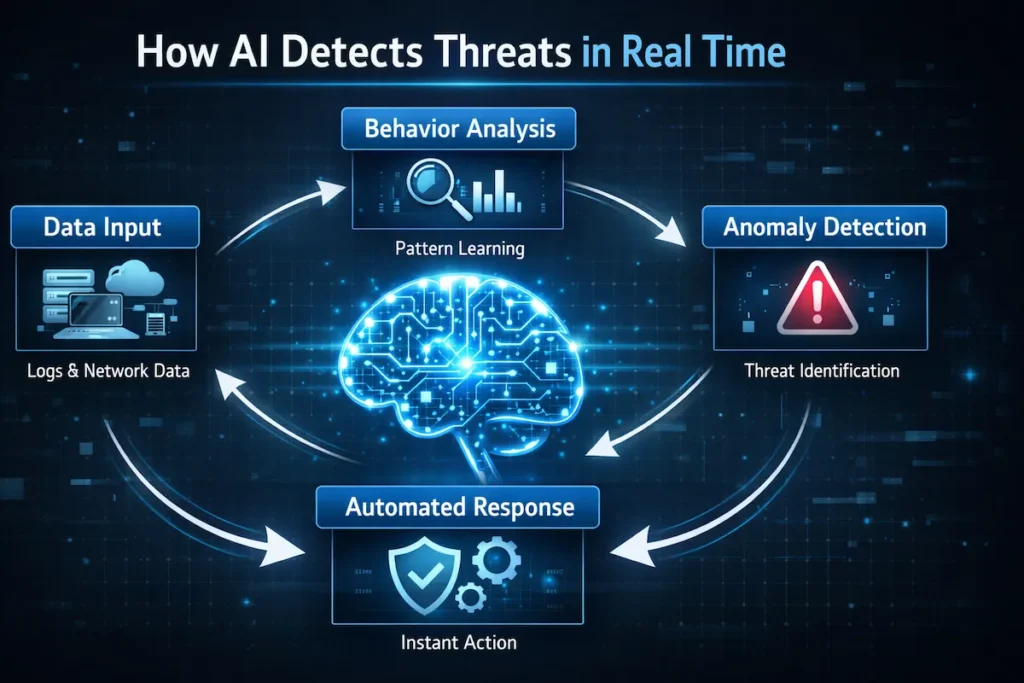
The best AI security tools for startups take a fundamentally different approach. Instead of matching signatures, they learn what normal looks like in your environment — normal login times, normal file access patterns, normal network traffic volumes. When something deviates from that baseline, the AI flags it and, in most cases, acts on it automatically.
That matters for startups for one simple reason: you don’t have an analyst watching screens 24/7. These AI-powered threat detection tools act as your security team when your actual team is asleep or focused on shipping product.
According to the Cybersecurity and Infrastructure Security Agency (CISA) in its cybersecurity guidance for small businesses, the most dangerous gap in startup security isn’t a lack of tools — it’s the lack of continuous monitoring. AI-powered platforms close that gap without requiring you to hire a full security operations center.
Why Startups Need the Best AI Security Tools in 2026
The threat landscape has shifted dramatically, and the best AI security tools for startups are no longer a luxury — they’re the baseline for any company that handles customer data.
Cybercrime in 2026 is not random. It’s automated, targeted, and fast.
Small businesses account for more than 46% of all breach victims — higher than enterprises. — Verizon Data Breach Investigations Report (DBIR)
AI-fueled phishing attacks have surged significantly, with attackers using language models to craft convincing, personalized messages at scale. The average time to detect a breach without AI monitoring is still measured in months — giving attackers weeks to move through your systems undetected.
Startups are easier targets than large enterprises. You’re moving fast, onboarding tools constantly, and adding team members who might not follow security best practices perfectly. One weak link — a reused password, an unsecured API key, a misconfigured S3 bucket — is all it takes.
The best AI security tools for startups solve this by handling the volume and speed that human teams simply cannot match alone. These startup cybersecurity solutions are designed specifically for lean teams that need maximum automation with minimum overhead.
The Best AI Security Tools for Startups in 2026 — Full Comparison
| Tool | Primary Use | Best For | Starting Price |
|---|---|---|---|
| SentinelOne | Autonomous endpoint + cloud | Lean teams, early-stage startups | ~$69.99/endpoint/yr |
| CrowdStrike Falcon | AI endpoint + threat intelligence | SaaS, distributed teams, fintech | $59.99–$184.99/device/yr |
| Microsoft Security Copilot | AI-powered security investigation | Microsoft 365 / Azure startups | Pay-per-session |
| Vectra AI | Network threat detection, alert triage | Teams overwhelmed by alerts | Custom quote |
| Secureworks Taegis | Managed cloud XDR | Cloud-native startups without in-house SOC | Custom quote |
| Darktrace | Self-learning network + cloud AI | Data-sensitive, regulated industries | ~$30,000+/yr |
| Wiz | Cloud infrastructure security | AWS / GCP / multi-cloud startups | Custom quote |
Which AI Security Tool Should You Choose? Quick Comparison
Choosing between the best AI security tools for startups comes down to your team size, your infrastructure, and how much automation you need from day one.
- Want the simplest setup and lowest cost? → SentinelOne
- Want deep threat intelligence and named adversary tracking? → CrowdStrike Falcon
- Want cloud infrastructure visibility and misconfiguration detection? → Wiz
- Running entirely on Microsoft tools? → Microsoft Security Copilot
- Need maximum autonomous protection in a regulated industry? → Darktrace
- Want managed detection without building an internal SOC? → Secureworks Taegis
- Drowning in alerts and need smart prioritization? → Vectra AI
1. SentinelOne — Best Overall AI Cybersecurity Tool for Startups
Rating: ★★★★★ | From ~$69.99/endpoint/yr
SentinelOne consistently ranks as one of the best AI security tools for startups because it delivers enterprise-grade protection without requiring an enterprise-grade security team to run it.
SentinelOne does something most endpoint security tools for startups don’t — it handles threats without waiting for a human to approve every action. When it detects ransomware starting, it stops it, rolls back encrypted files to their pre-attack state, and logs everything for your review. In real-world testing, this rollback completed in under two minutes.
What makes it especially startup-friendly is Purple AI — a natural language security assistant that lets any team member investigate alerts without writing complex queries. Type “show me all processes that connected to unusual IPs in the last 24 hours” and get a contextualized answer in seconds. No specialist required.
Among the best AI security tools for startups, SentinelOne is the most accessible for founders wearing multiple hats.
Best for: Early-stage startups, lean teams, anyone facing ransomware risk. Where this breaks down: Advanced identity protection and threat hunting require higher-tier plans.
2. CrowdStrike Falcon — Best AI Endpoint Security for Scaling Startups
Rating: ★★★★★ | $59.99–$184.99/device/yr
For startups that are past the early stage and need deeper threat intelligence, CrowdStrike Falcon is one of the best AI security tools for startups looking to scale their security posture alongside their headcount.
CrowdStrike Falcon is built around the Threat Graph — a cloud database processing billions of security events weekly across its entire customer base. When a new attack hits one company, every CrowdStrike customer benefits from that intelligence within minutes. For a startup without a dedicated threat intelligence team, that shared signal is enormously valuable.
Charlotte AI, CrowdStrike’s generative AI assistant, lets your team investigate threats and build automation workflows in plain language. CrowdStrike also tracks over 265 named adversary groups — when an alert fires, you often know who is behind it, not just what happened.
For a SaaS startup with 20 laptops, the base tier runs roughly $1,200 annually.
Best for: SaaS companies with distributed remote teams, fintech startups. Where this breaks down: Primarily endpoint-focused. Less network-layer depth than Darktrace or Vectra AI.
3. Microsoft Security Copilot — Best Value AI Security for Microsoft-Stack Startups
Rating: ★★★★☆ | Pay-per-session
Microsoft Security Copilot plugs directly into your existing Microsoft Defender, Azure, and Microsoft 365 security tools and lets any team member investigate incidents using conversational prompts. Summarize an alert, explain an attack timeline, surface indicators of compromise, recommend remediation steps — all in seconds, pulling from your actual environment data.
Among the best AI security tools for startups already in the Microsoft ecosystem, this delivers immediate value with near-zero setup friction. It’s also one of the most cost-effective startup cybersecurity solutions for teams that are already paying for Microsoft’s security stack.
Best for: Startups already running M365, Azure, and Defender. Where this breaks down: Not useful if you’re outside the Microsoft ecosystem. For teams already running on Microsoft infrastructure, Security Copilot is one of the best AI security tools for startups that want immediate value without adding a new platform to manage.
4. Wiz — Best Cloud Infrastructure Security for Cloud-Native Startups
Wiz earns its place among the best AI security tools for startups by solving a problem that endpoint tools completely ignore — the misconfigurations and permission gaps hiding inside your cloud infrastructure.
Rating: ★★★★☆ | Custom quote
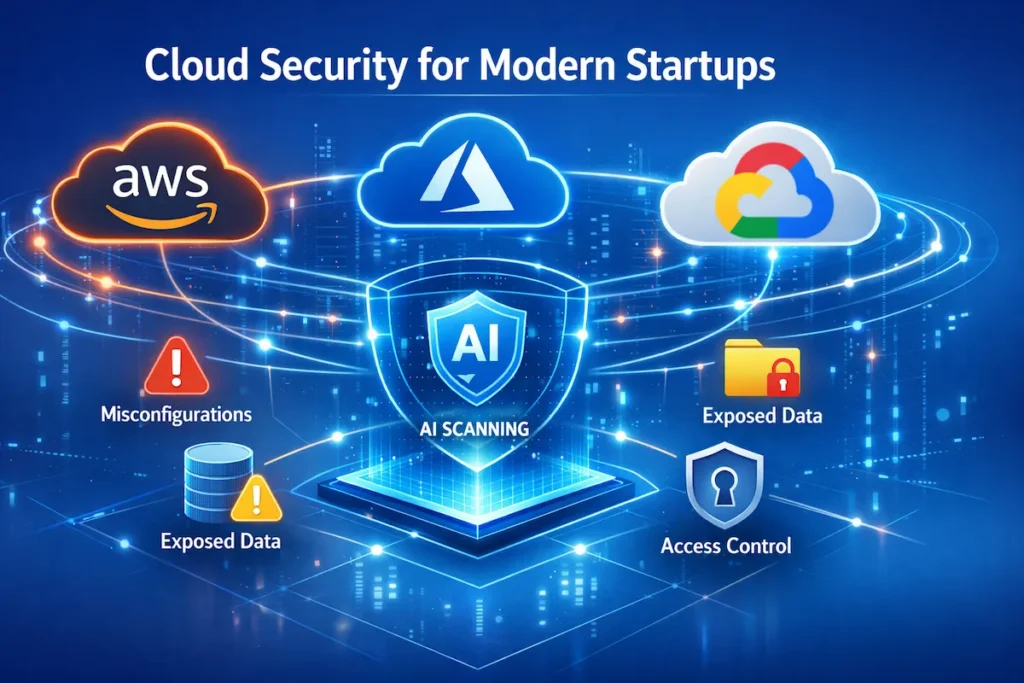
Wiz scans your entire cloud environment agentlessly, identifying misconfigurations, excessive IAM permissions, unpatched vulnerabilities, and exposed data across AWS, Azure, and GCP. A misconfigured S3 bucket or overly permissive role are attack surfaces that endpoint security tools for startups miss entirely — Wiz finds and prioritizes these by actual exploitability, not just severity score.
Now part of Google Cloud, Wiz continues to operate as an independent platform supporting all major cloud providers.
Best for: SaaS and cloud-native startups running on AWS or multi-cloud setups. Where this breaks down: Cloud infrastructure focused — pair it with endpoint protection rather than using it as a standalone solution.
5. Darktrace — Most Advanced AI-Powered Threat Detection for Data-Sensitive Startups
For startups in regulated industries where a single breach could be catastrophic, Darktrace offers the most autonomous and self-learning capabilities of any of the best AI security tools for startups in this guide.
Rating: ★★★★☆ | ~$30,000+/yr
Darktrace uses unsupervised machine learning to build a living model of normal behavior for every user, device, and workflow in your environment. When something deviates — even slightly — it flags it and can act in seconds: slowing a suspicious connection, isolating a device, blocking a specific file transfer, all without disrupting normal operations.
The investment is significant. But for a Series A+ company handling healthcare records or financial data where a breach would be existentially damaging, the cost calculus changes significantly.
Best for: Series A+ startups in regulated industries — health tech, fintech, legal tech. Where this breaks down: Requires 3–6 months of tuning. Not appropriate for early-stage budgets.
6. Vectra AI — Best for Cutting Through Alert Noise
Vectra AI stands out among the best AI security tools for startups specifically because it solves the alert fatigue problem that causes small security teams to miss the threats that actually matter.
Rating: ★★★★☆ | Custom quote
Vectra AI was built specifically for teams drowning in security alerts. Its Attack Signal Intelligence uses graph-based AI to correlate and prioritize alerts, reducing noise by up to 38x in documented deployments. Instead of flooding your inbox with 200 alerts a day, it surfaces the three that actually matter.
Vectra AI thinks like an attacker — it models how adversaries move laterally through a network after initial access and flags those behavioral patterns immediately. It integrates well with CrowdStrike and SentinelOne as a complementary detection layer.
Best for: Startups with small security teams overwhelmed by alert volume. Where this breaks down: Best deployed as a second layer on top of endpoint protection, not as a standalone tool.
7. Secureworks Taegis — Best Managed AI Security for Cloud-First Startups
For startups that want the protection of the best AI security tools without the overhead of managing them internally, Secureworks Taegis delivers both the platform and the expert team behind it.
Rating: ★★★★☆ | Custom quote
Secureworks Taegis gives you AI-powered detection plus a team of expert analysts monitoring your environment — without building that team yourself. The platform correlates data from endpoints, cloud workloads, and networks using machine learning, and Secureworks analysts investigate and respond to high-priority alerts on your behalf.
For cloud-first startups handling sensitive workloads on AWS, GCP, or Azure but without the headcount for an in-house SOC, this managed experience delivers the best of both worlds.
Best for: Cloud-native startups post-Series A that need compliance-ready managed detection. Where this breaks down: Requires a sales conversation for pricing. Not ideal for pre-revenue startups.
✅ Quick Takeaway: One well-configured AI security tool beats five half-configured tools every single time. Start focused, then layer.
How Startups Actually Use AI-Powered Threat Detection Tools in Real Life
The best AI security tools for startups aren’t just theoretical—here’s exactly how real teams use them to stop attacks before any damage is done. These are exactly the types of threats the best AI security tools for startups are designed to handle automatically — no analyst required.
The compromised npm package at 2 a.m. A developer installs a compromised open-source package during an evening sprint. SentinelOne detects the unusual process behavior within seconds, quarantines the endpoint, and rolls back file changes — all before anyone is woken up.
Credential-stuffing attack on the admin portal. Attackers run automated login attempts using leaked credentials from another breach. CrowdStrike Falcon detects the anomalous pattern — high-frequency attempts, multiple geolocations — and blocks access automatically. The full incident is logged for the PCI-DSS audit trail.
Terminated contractor reusing access. An ex-contractor uses cached credentials to access order export files three days after being offboarded. Vectra AI catches the lateral movement pattern — not the login itself, but what happens after — before any customer data leaves the environment.
Remote contractor’s home machine gets compromised. A contractor’s personal laptop is hit with malware through a phishing email. CrowdStrike Falcon isolates the device from the company network automatically, preventing the malware from reaching internal tools. No breach, no downtime.
The common thread in every scenario: the AI acted before a human could have responded, and the damage was contained or eliminated entirely.
Affordable Startup Cybersecurity Solutions for Early-Stage Budgets
The good news is that several of the best AI security tools for startups are priced accessibly enough for pre-revenue teams — if you know where to start.
Many of the best AI security tools for startups are genuinely accessible at early-stage budgets — if you prioritize correctly.
- Start with endpoint security for startups. SentinelOne’s Core tier starts around $69.99 per endpoint per year. For a 10-person team, that’s roughly $700 annually — less than most startups spend on Slack.
- Use your cloud provider’s native tools first. AWS Security Hub, Google Cloud Security Command Center, and Microsoft Defender for Cloud include AI-powered threat detection at low or no additional cost to your existing cloud bill.
- Close free security gaps before buying anything. Enforce MFA across all accounts, audit admin access, and rotate unused API keys. These free actions eliminate a large percentage of attack surface — and many startups skip them entirely while shopping for tools.
- Ask about startup programs. Both SentinelOne and CrowdStrike offer startup programs that can significantly reduce early-stage pricing. If you’re in a Y Combinator or Techstars cohort, ask what group pricing has been negotiated.
If your team is on the smaller side or you’re running a less technical operation, our guide on AI security tools for small businesses covers lightweight, budget-friendly platforms that don’t require any IT background to manage.
Key Features to Look For in AI Cybersecurity Tools for Startups
Not every platform delivers on its promises, so knowing which capabilities actually matter is essential when comparing the best AI security tools for startups.
Not every tool that says “AI-powered” delivers meaningful protection. When evaluating AI cybersecurity tools for startups, focus on these six capabilities and ask vendors to show you evidence — not just marketing copy.
| Feature | What to Look For | Why It Matters |
|---|---|---|
| Real-Time Threat Detection | Sub-minute detection, live dashboards | Attacks that run for hours cause exponentially more damage |
| Behavioral AI | Baseline modeling, not just signatures | Catches zero-days and insider threats that rules miss |
| Automated Response | Auto-isolate, auto-rollback | You can’t respond manually at 3 a.m. fast enough |
| Stack Integration | Native connectors to your cloud, IdP, SIEM | Gaps between tools create blind spots attackers exploit |
| Compliance Reporting | SOC 2, HIPAA, PCI-DSS audit logs built in | Retrofitting compliance logging after an audit is painful |
| Scalability | Price and feature tiers that grow with you | Avoid a full platform migration at 100 employees |
AI Security Tools vs. Traditional Cybersecurity: What’s Actually Different
To understand why the best AI security tools for startups outperform legacy software, it helps to see exactly how the two approaches compare side by side.
Even when using the best AI security tools for startups, it helps to understand precisely why they outperform legacy approaches — so you can make a confident case internally for the investment.
| Capability | Traditional Security | AI Cybersecurity Tools for Startups |
|---|---|---|
| Detection Method | Signature matching against known threats | Behavioral modeling — flags anything unusual |
| Zero-Day Protection | Weak — needs an existing signature | Strong — detects deviation from baseline |
| Response Speed | Manual — hours to days | Automated — seconds to minutes, 24/7 |
| Alert Volume | High false positive rate, significant noise | Filtered and prioritized — focuses on real risks |
| Insider Threats | Very weak — rules focused outward | Strong — behavioral baselines catch internal anomalies |
| Scalability | Harder as your infrastructure grows | Scales automatically without adding headcount |
The key shift: traditional security asks “does this match a known bad thing?” AI security asks “does this match how this person normally behaves?” The second question catches far more of what modern attackers actually do.
Common Mistakes Startups Make — Even With the Best AI Security Tools
Even teams that have deployed the best AI security tools for startups can still leave themselves exposed by making a handful of predictable operational errors.
Even when deploying the best AI security tools for startups, these common mistakes can still expose your business to serious risk.
- Treating security as a “Series A problem.” By the time you have customers, you’re already a target.
- Buying a tool and never opening it. AI security tools that aren’t regularly reviewed drift from your actual environment within months.
- Relying on a single tool for total coverage. Endpoint security for startups doesn’t protect cloud configuration. Layer your defenses across different attack surfaces.
- Ignoring third-party vendor access. Every SaaS tool with OAuth access to your systems is a potential attack vector. Audit and revoke anything unused.
- Skipping the incident response plan. Write a one-page plan before you need it. Most startups have nothing documented when an alert fires at 11 p.m.
- Giving AI full autonomy on day one. Start with human-approved responses. Expand automation gradually over 60–90 days as confidence in accuracy grows.
AI-Powered Threat Detection Trends Every Startup Should Watch in 2026
Staying ahead of emerging threats means understanding where the best AI security tools for startups are heading — not just where they stand today.
The best AI security tools for startups are evolving rapidly. The platforms you choose today will define your security posture for the next two to three years.
Predictive threat detection is moving from reactive to pre-emptive. The next wave of AI-powered threat detection tools will identify attack precursors — behavioral signals that a compromise is likely within 24–72 hours — before it actually begins.
Autonomous SOC automation is reducing the need for large analyst teams. SentinelOne’s Purple AI and CrowdStrike’s Charlotte AI are early versions of platforms that will handle complete incident investigation cycles with minimal human input.
AI pipeline and API security is an emerging category. As startups build AI-powered products and expose APIs to AI models, new attack classes are emerging — prompt injection, model inversion, and AI pipeline poisoning. Dedicated startup cybersecurity solutions for AI infrastructure will become essential within two years.
Zero trust as the default architecture. The National Institute of Standards and Technology (NIST) outlines the foundational principles in its AI Risk Management Framework — a useful reference for any startup integrating AI responsibly into both its products and its security posture.
Pros and Cons of AI Security Tools for Startups
Before committing to a platform, it’s worth weighing the full picture of what the best AI security tools for startups deliver against what they require from your team.
Pros
- Detects zero-day threats that signature-based tools miss entirely
- Automated response with no analyst needed at 3 a.m.
- Scales as you grow without adding security headcount
- Dramatically reduces alert fatigue through intelligent prioritization
- Audit-ready logs for SOC 2, HIPAA, and PCI-DSS compliance
- Natural language interfaces lower the security expertise bar for generalist founders
Cons
- Enterprise-grade platforms are expensive for pre-revenue startups
- Initial tuning period — expect noise for the first 60–90 days
- Requires ongoing configuration as your infrastructure changes
- Some platforms have opaque, quote-only pricing
- AI-powered threat detection tools don’t catch complex business-logic vulnerabilities
- Over-automation without human review creates blind spots of its own
FAQ: Best AI Security Tools for Startups
What are the best AI security tools for startups in 2026?
For early-stage startups, SentinelOne is the strongest starting point — affordable, autonomous, and operable without a dedicated analyst. Scaling SaaS companies should add CrowdStrike Falcon. Microsoft-stack startups get the best value from Microsoft Security Copilot. For cloud infrastructure, Wiz leads. Darktrace is best for post-Series A companies in regulated industries where data sensitivity justifies the investment.
Are AI cybersecurity tools for startups expensive?
Entry points vary widely. SentinelOne starts around $69.99 per endpoint per year — roughly $700 for a 10-person team. Your cloud provider’s native tools add AI-powered detection at near-zero cost. The better question: what does a breach cost you? That math almost always makes the tool investment look small.
Can startups run without a dedicated security team if they use the best AI security tools?
Yes — to a significant extent. SentinelOne was built for this exact scenario: a founder or developer wearing the security hat alongside everything else. The AI handles detection and initial response autonomously. What you still need is someone who reviews high-priority incidents quarterly — a part-time responsibility, not a dedicated hire.
Which AI security tool is best for SaaS cloud startups?
A two-layer approach works best: SentinelOne for endpoint and cloud workload protection, plus Wiz for cloud infrastructure posture management. On Azure, swap Wiz for Microsoft Defender for Cloud and add Security Copilot for AI-powered investigation.
What is the cheapest AI startup cybersecurity solution available?
Your cloud provider’s native security tooling — AWS Security Hub, GCP Security Command Center, or Microsoft Defender for Cloud — provides AI-powered detection within your existing cloud spend. The most affordable dedicated endpoint security for startups is SentinelOne Core at roughly $69.99 per endpoint per year.
Do AI security tools replace traditional cybersecurity practices?
No — they complement them. Security fundamentals still apply: enforce MFA, patch promptly, use least-privilege access, and train employees on phishing awareness. The best posture combines strong fundamentals with AI-powered threat detection tools layered on top.
How do AI cybersecurity tools for startups handle remote teams?
AI endpoint tools like CrowdStrike Falcon and SentinelOne run protection locally on each device — network quality doesn’t affect detection accuracy. Every device, whether in a corporate office or a coffee shop, is equally protected. For BYOD environments, these tools monitor at the behavioral level without requiring full MDM control of the device.
Are these startup cybersecurity solutions suitable for non-tech small businesses?
Absolutely. SentinelOne and Microsoft Security Copilot are both well-suited to small businesses that aren’t technology companies. The AI automation handles the complexity that non-technical owners can’t realistically manage manually, making them genuinely accessible AI security tools for small businesses and startups alike.
Quick Decision Guide
Use this quick decision guide to match the best AI security tools for startups to your specific stage, stack, and security priorities.
| What you want | Best choice |
|---|---|
| Simplest setup, lowest cost | SentinelOne |
| Deepest threat intelligence | CrowdStrike Falcon |
| Cloud infrastructure visibility | Wiz |
| Microsoft ecosystem integration | Microsoft Security Copilot |
| Maximum autonomous protection | Darktrace (Series A+) |
| Managed detection, no internal SOC | Secureworks Taegis |
| Alert noise reduction | Vectra AI |
Conclusion: Which AI Security Tool Is Right for Your Startup?
After reviewing every major option in this guide, the right choice among the best AI security tools for startups always comes back to one question: which tool will your team actually use and maintain consistently over time?
The best AI security tools for startups aren’t the most expensive or the ones with the slickest demo. They’re the ones your team will actually deploy, tune, and act on — consistently, over time.
Here’s the practical decision:
- Early-stage, tight budget? Start with SentinelOne on devices and your cloud provider’s native tools. Under $1,000 per year for a small team, covering your two biggest attack surfaces.
- SaaS startup scaling past Seed? CrowdStrike Falcon plus Wiz is the most effective two-tool combination for AI cybersecurity tools for startups at this stage.
- Running Microsoft 365 or Azure? Add Microsoft Security Copilot immediately — seamless integration, immediate value, no new platform to learn.
- Series A+ in a regulated industry? Darktrace or Secureworks Taegis alongside a dedicated security hire or managed service.
Most of these platforms offer free trials or proof-of-concept periods. Don’t overthink it — pick one, deploy it this week, and run a real scan. The insights you get in 24 hours will be more valuable than weeks of research. The best AI security tools for startups available right now are more capable, more accessible, and more affordable than anything that existed three years ago.
There’s no reason to leave your company unprotected while you wait for the right time. That time is now.