

Most startup founders think serious cybersecurity requires a serious budget. That assumption is quietly putting thousands of businesses at risk. Cybercriminals have figured out that early-stage companies are far easier to compromise than large enterprises — and they’re exploiting that gap aggressively. The encouraging reality is that today’s market offers genuinely affordable cybersecurity tools for startups that deliver real protection without consuming runway you can’t afford to lose.
Whether you’re running a two-person SaaS product or managing a 40-person team post-seed, this guide gives you the tools, the strategy, and the decision framework to build a strong security posture at a price that actually makes sense for where you are.
Why Startups Need Affordable Cybersecurity Tools for Startups From Day One
Why Hackers Target Startups and Why Affordable Cybersecurity Tools for Startups Matter
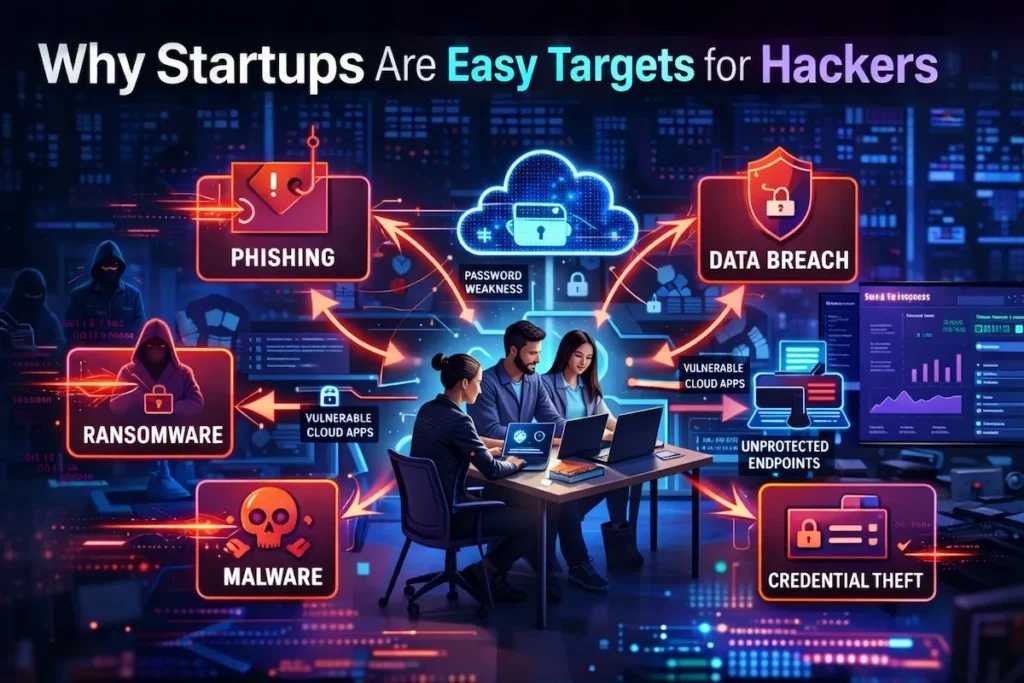
Here’s something most founders don’t realize until it’s too late: hackers don’t exclusively target large corporations. They target the easiest victims — and startups check nearly every box. Limited security budgets. No dedicated IT team. Cloud infrastructure scaled rapidly without security review. Remote teams accessing company tools from personal devices.
Cybercriminals have industrialized their attacks. Automated tools scan the internet constantly for vulnerabilities, and when they find an unprotected startup, they exploit it without hesitation. Ransomware attacks, phishing scams targeting your employees’ credentials, and malware threats delivered through SaaS integrations are all common attack vectors that hit small businesses every day. Understanding how AI cybersecurity tools for small businesses work can help founders get ahead of these threats before they escalate.
Implementing affordable cybersecurity tools for startups early closes these gaps before attackers discover them. Prevention is always cheaper than recovery.
The Financial Impact of Cyber Attacks on Startups and the Role of Affordable Cybersecurity Tools for Startups
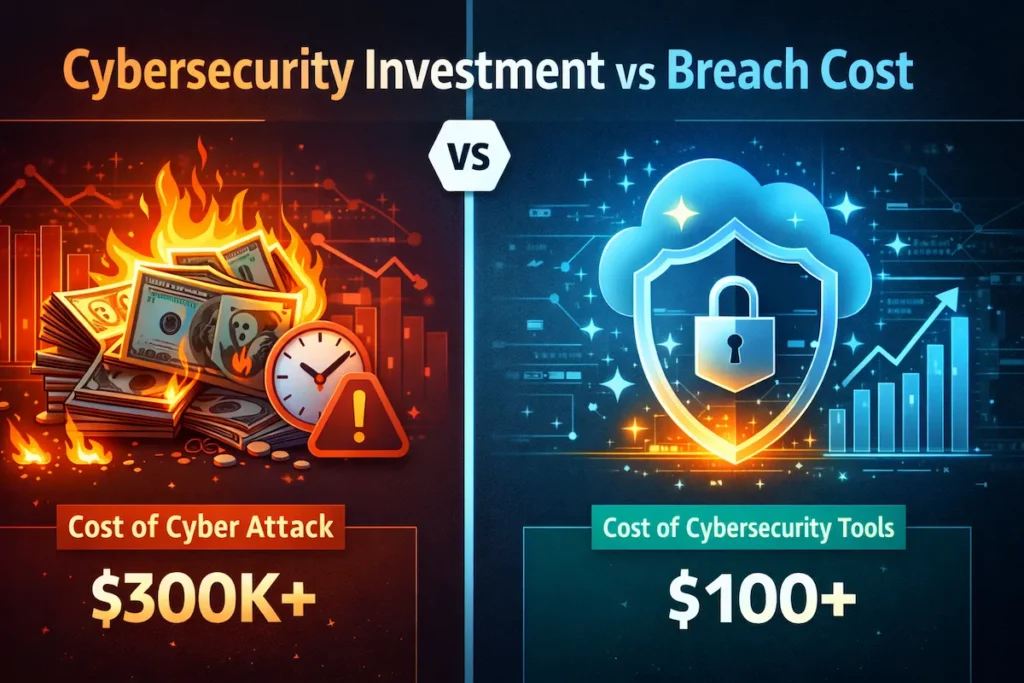
The financial consequences of a cyberattack on a startup are rarely survivable. IBM’s Cost of a Data Breach Report consistently places average breach costs in the millions — a figure that would end most early-stage companies entirely. Beyond direct financial losses, data breaches trigger regulatory penalties, legal liability, customer churn, and the kind of reputational damage that kills investor confidence permanently.
Consider what a single successful ransomware attack actually costs a startup: operational downtime, ransom demands, recovery expenses, potential data loss, and the weeks of engineering time needed to clean up and rebuild. Sophos research puts average SMB ransomware recovery costs at over $1 million.
Affordable cybersecurity tools for startups reduce both the probability of an attack occurring and the severity of any incident that does. You’re not spending money on security — you’re protecting the revenue, trust, and continuity that your business depends on.
- 60% of small businesses that suffer a major cyberattack close within six months
- Credential theft accounts for over 80% of hacking-related breaches
- Startups with documented security practices consistently raise funding more easily
How Affordable Cybersecurity Tools for Startups Help Small Teams Stay Protected
Modern security tools are built for teams that don’t have a full-time CISO. Unlike enterprise platforms that require complex deployment, dedicated analysts, and months of configuration, affordable cybersecurity tools for startups are designed to be operational within hours.
Most are cloud-based, which means no hardware, no on-premise servers, and no ongoing infrastructure maintenance. AI-powered threat detection automates the monitoring work that previously required a full security operations center. The result is enterprise-grade protection made genuinely accessible to a lean founding team. For a deeper look at how AI is reshaping startup protection, explore the best AI security tools for startups in 2026.
What Makes Affordable Cybersecurity Tools for Startups Truly Startup-Friendly
Low-Cost Security Solutions and Affordable Cybersecurity Tools for Startups
The best affordable cybersecurity tools for startups balance cost with actual coverage. Startup-friendly tools use tiered pricing, offer free trials, and increasingly provide dedicated startup programs through accelerators and cloud marketplaces. Many leading vendors offer 50–90% discounts to companies enrolled in programs like Y Combinator, Techstars, or AWS Activate.
When evaluating cost, think beyond the monthly subscription price. A tool that costs $15 per user per month but eliminates the need for a dedicated IT hire delivers extraordinary ROI for a team of ten.
Security Tip for Startups: Before buying any security tool, check whether the vendor has a startup program. Okta, CrowdStrike, and dozens of other major security vendors offer deeply discounted or free access to early-stage companies through accelerator partnerships.
Easy Deployment Without Dedicated IT Teams Using Affordable Cybersecurity Tools for Startups
Startup-friendly security tools account for the reality that most founders aren’t security engineers. They feature intuitive dashboards, automated onboarding flows, pre-configured policy templates, and responsive customer support that makes setup straightforward without specialized knowledge. If a tool requires weeks of professional services to deploy, it’s not built for a startup.
Cloud-Based Security Infrastructure and Affordable Cybersecurity Tools for Startups
Cloud-based security infrastructure is the default model for modern startup tools — and it’s the right one. No physical hardware, no server room, no maintenance overhead. Your endpoint protection, identity access management controls, and network monitoring live entirely in the cloud, scaling automatically as your headcount grows.
For distributed and remote teams, this architecture also ensures consistent protection regardless of where employees work or which devices they connect from. This is especially critical for SaaS companies — you can see how AI security tools for SaaS startups are purpose-built for this exact challenge.
AI-Powered Threat Detection Capabilities in Affordable Cybersecurity Tools for Startups
AI has fundamentally changed what small teams can accomplish in cybersecurity. AI cybersecurity tools continuously monitor your environment, build behavioral baselines, and identify anomalies that indicate a potential intrusion — faster and more accurately than any manual process. For a startup with no in-house security analyst, AI-driven threat detection functions as your always-on security operations center, covering everything from intrusion detection systems to real-time firewall protection monitoring.
7 Affordable Cybersecurity Tools for Startups That Deliver Real Protection
1. CrowdStrike Falcon – Endpoint Protection for Modern Startups Using Affordable Cybersecurity Tools for Startups
CrowdStrike Falcon is one of the most capable endpoint protection platforms available, and it’s increasingly accessible for startups through its tiered pricing model and partner programs.
Key Features: AI-powered endpoint detection and response (EDR), real-time threat intelligence, lightweight agent architecture, zero trust security support, automated threat investigation.
Pricing: Falcon Go starts around $59.99 per device per year. Startup discounts available through partner ecosystems.
Ideal For: Startups with distributed teams and multiple endpoints that need serious endpoint protection without a security operations team.
Limitations: Advanced features scale in price quickly. Some smaller teams find the dashboard more feature-rich than they need at the earliest stages.
2. Cloudflare – Website and Network Security Among Affordable Cybersecurity Tools for Startups
Cloudflare is one of the most powerful and accessible network security tools for startups, with a free tier that alone provides meaningful protection. DDoS mitigation, web application firewall capabilities, DNS security, and SSL/TLS encryption all come standard.
Key Features: DDoS protection, WAF, DNS security, bot management, CDN, zero trust network access via Cloudflare Access.
Pricing: Free tier available. Pro plans start at $20/month. Enterprise options available for scale.
Ideal For: SaaS startups, any company with public-facing APIs, and teams needing affordable cloud security for web infrastructure.
Limitations: Advanced WAF configuration requires technical familiarity. Higher-end security features require paid plans.
3. Bitdefender GravityZone – Cost-Effective Affordable Cybersecurity Tools for Startups
Bitdefender GravityZone Business Security delivers solid endpoint protection at a price point that makes sense for pre-seed and seed-stage startups. It covers anti-malware, ransomware protection, and device management from a single centralized dashboard.
Key Features: Anti-malware, anti-ransomware, advanced threat defense, patch management, centralized management console.
Pricing: Business Security starts around $77.69/year for three devices, scaling affordably for larger teams.
Ideal For: Budget-conscious startups needing reliable endpoint protection across Windows, Mac, and Linux devices.
Limitations: Less advanced EDR capability compared to CrowdStrike. Better suited for protection than deep forensic investigation after an incident.
4. Okta – Identity and Access Management Among Affordable Cybersecurity Tools for Startups
Identity is the new security perimeter, and Okta is the leading platform for managing it. Implementing single sign-on and enforcing multi-factor authentication across your entire SaaS stack dramatically reduces credential theft risk — the attack vector behind the majority of data breaches. According to CISA’s identity security guidelines, enforcing MFA is one of the single most impactful security steps any organization can take.
Key Features: Single sign-on (SSO), multi-factor authentication (MFA), adaptive authentication, lifecycle management, 7,000+ application integrations.
Pricing: Workforce Identity starts at $2/user/month for SSO. Okta for Startups offers free access for qualifying early-stage companies.
Ideal For: Any startup using multiple SaaS tools with a distributed team. Essential for zero trust security architectures.
Limitations: Pricing grows with headcount. Advanced adaptive MFA features require higher-tier plans.
5. LastPass – Password Security Among Affordable Cybersecurity Tools for Startups
Weak and reused passwords remain one of the top causes of data breaches for small businesses. LastPass centralizes password management across your entire team, generates strong credentials automatically, and includes dark web monitoring to alert you when company credentials appear in breach databases.
Key Features: Team password vault, strong password generation, dark web monitoring, MFA support, admin dashboard with security reporting.
Pricing: Teams plan starts at $4/user/month. Individual free tier available.
Ideal For: Startups wanting to eliminate password-related vulnerabilities quickly and at minimal cost.
Limitations: LastPass has experienced security incidents historically. 1Password and Bitwarden are strong alternatives worth evaluating.
Founder Takeaway: Password management delivers the highest ROI of any security investment for most startups. At $4/user/month, a ten-person team eliminates one of the most common attack vectors in cybersecurity for $40/month.
6. Snyk – Developer Security Among Affordable Cybersecurity Tools for Startups
If your startup ships software, Snyk is essential. It integrates directly into your development workflow and performs vulnerability scanning across your code, open-source dependencies, containers, and infrastructure-as-code — catching security vulnerabilities before they reach production. The NIST National Vulnerability Database documents thousands of new vulnerabilities every year, making automated scanning tools like Snyk non-negotiable for any software-shipping startup.
Key Features: Code scanning, open-source dependency analysis, container security, IaC scanning, native CI/CD integration.
Pricing: Free tier for individual developers. Team plans start at $25/month. Startup discounts available.
Ideal For: SaaS startups, developer-first teams, and any company building and shipping code on a regular cadence.
Limitations: Developer-side security focus — doesn’t replace endpoint or identity tools.
7. Darktrace – AI-Driven Threat Detection Among Affordable Cybersecurity Tools for Startups
Darktrace represents the most sophisticated AI cybersecurity capability on this list. Its self-learning AI builds a model of normal behavior across your environment and identifies deviations that indicate a threat — catching novel attacks that signature-based tools miss entirely. For small businesses looking to understand the broader landscape of AI-driven protection, this overview of AI security tools for small businesses provides helpful context.
Key Features: AI-driven threat detection, autonomous response, cloud security monitoring, SaaS security coverage, network monitoring.
Pricing: Custom pricing based on organization size. More accessible than traditional enterprise tools through startup programs.
Ideal For: Growth-stage startups with complex cloud and SaaS environments that need proactive threat intelligence and automated response.
Limitations: Premium pricing relative to other tools on this list. Best suited for post-seed or Series A companies with the budget to match.
How to Choose the Right Affordable Cybersecurity Tools for Startups
Choosing the right affordable cybersecurity tools for startups isn’t about picking the most popular tools—it’s about aligning your security stack with your risk level, business model, and team size. Most founders either overspend on unnecessary tools or underestimate their actual risk exposure.
This framework helps you make smarter, cost-effective decisions.
Budget vs Risk Framework for Affordable Cybersecurity Tools for Startups
Not all startups face the same level of cyber risk. Your security investment should match your exposure—not blindly follow industry trends.
Low Risk (Pre-Product / MVP Stage)
- Minimal customer data
- Small internal team
- Limited SaaS usage
Recommended Tools:
- MFA across all accounts
- Password manager
- Basic network protection (Cloudflare free tier)
👉 Focus on low-cost, high-impact affordable cybersecurity tools for startups
Moderate Risk (Early SaaS / Growing Team)
- Handling customer data
- Multiple SaaS tools
- Remote employees
Recommended Tools:
- Endpoint protection (Bitdefender or CrowdStrike)
- Identity access management (Okta)
- Phishing protection training
👉 At this stage, affordable cybersecurity tools for startups should prioritize identity and endpoint security
High Risk (Scaling / Handling Sensitive Data)
- Payment data, APIs, integrations
- Larger team
- Complex infrastructure
Recommended Tools:
- Advanced threat detection (Darktrace or similar)
- Developer security (Snyk)
- Continuous monitoring + SIEM
👉 Here, affordable cybersecurity tools for startups evolve into a full security stack
Founder Takeaway:
Don’t overspend early—but don’t underprotect critical assets. Match your tools to your actual risk.
SaaS vs Non-SaaS Business Models and Affordable Cybersecurity Tools for Startups
Your business model directly impacts your security priorities.
SaaS Startups
- High exposure to API attacks
- Cloud infrastructure risks
- Frequent code deployments
Focus Areas:
- Cloud security
- vulnerability scanning
- API protection
👉 Tools like Snyk and Cloudflare become essential affordable cybersecurity tools for startups
Non-SaaS Businesses (eCommerce, Agencies, Local Businesses)
- Customer data protection
- payment security
- employee access control
Focus Areas:
- endpoint protection
- password management
- phishing protection
👉 Simpler stacks of affordable cybersecurity tools for startups are often enough
Team Size Considerations When Selecting Affordable Cybersecurity Tools for Startups
The size of your team determines how complex your security stack should be.
1–10 Employees
- Keep it simple
- Focus on:
- MFA
- password manager
- basic endpoint security
👉 Avoid over-engineering your affordable cybersecurity tools for startups
10–50 Employees
- Increased risk from internal access
- More SaaS tools
Add:
- identity access management
- device monitoring
- structured access policies
50+ Employees
- Requires formal security processes
- higher compliance expectations
Add:
- threat detection platforms
- centralized monitoring
- employee security training programs
Startup Security Insight:
Security complexity should grow with your team—not before it.
How to Build a Complete Stack Using Affordable Cybersecurity Tools for Startups
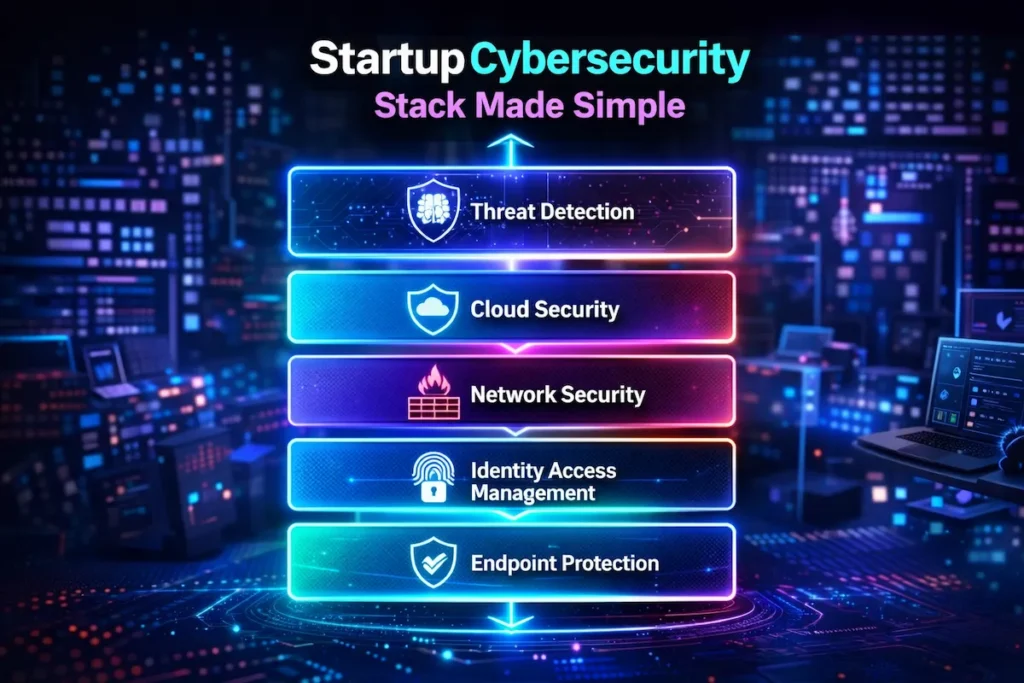
Selecting individual tools isn’t enough. The real value comes from assembling affordable cybersecurity tools for startups into a coherent security stack that covers every major attack surface. Here’s the framework, layer by layer.
Endpoint Protection Layer and Affordable Cybersecurity Tools for Startups
Start here. Every device your team uses needs endpoint protection. Deploy CrowdStrike Falcon or Bitdefender GravityZone across all company devices, configure automatic updates, and enable automated threat response policies. This layer blocks malware threats and ransomware attacks at the device level before they can spread laterally through your environment.
Identity and Access Management Layer Using Affordable Cybersecurity Tools for Startups
Implement Okta for single sign-on across all SaaS applications and enforce multi-factor authentication for every user without exception. Pair this with LastPass or 1Password for team password management. This combination eliminates credential theft as a viable attack vector for most phishing scams targeting your team.
Network and Website Security Layer With Affordable Cybersecurity Tools for Startups
Deploy Cloudflare in front of your website and APIs. Configure WAF rules, enable DDoS protection, and use Cloudflare Access to enforce zero trust network access for remote employees. This layer protects your public-facing infrastructure and blocks a significant portion of automated attacks before they ever reach your servers.
Cloud and SaaS Security Layer Using Affordable Cybersecurity Tools for Startups
Audit all SaaS applications connected to your environment. Revoke unused OAuth permissions, review third-party integrations, and create a formal approval process for new SaaS tools. If you’re building software, integrate Snyk into your CI/CD pipeline to catch vulnerability scanning issues before they ship to production. Refer to NIST’s Cybersecurity Framework for a structured approach to managing SaaS and cloud security risk.
Threat Monitoring and Detection Layer Using Affordable Cybersecurity Tools for Startups
As you scale, add continuous monitoring. Darktrace or comparable AI cybersecurity tools provide the threat intelligence and detection capability to identify attacks that bypass perimeter defenses. Even at early stages, setting up basic intrusion detection systems, SIEM (Security Information and Event Management) logging, and centralized log monitoring gives your team the visibility it needs to respond before damage occurs.
Startup Security Insight: Don’t try to build all five layers on day one. Start with endpoints and identity — they cover the highest-probability attack vectors for early-stage startups. Add layers as your team and budget grow.
Step-by-Step Implementation Plan for Affordable Cybersecurity Tools for Startups
Building a security stack is far more manageable when you follow a structured sequence. Here’s a practical implementation plan any startup can execute:
- Enable MFA across all company accounts — Start immediately. This single step blocks the majority of credential-based attacks.
- Deploy a team password manager — Roll out LastPass or 1Password across the entire team and enforce strong, unique passwords for every account.
- Install endpoint protection — Deploy CrowdStrike Falcon or Bitdefender GravityZone on all company devices before your team scales further.
- Secure your website and APIs with Cloudflare — Enable DDoS protection, WAF rules, and zero trust network access.
- Integrate developer security scanning — Add Snyk to your CI/CD pipeline so vulnerabilities are caught before they ever reach production.
- Implement identity and access management — Deploy Okta for SSO and enforce consistent access policies across your entire SaaS stack.
- Add AI-driven threat detection as you scale — Bring in Darktrace or a comparable platform once your environment has grown complex enough to warrant continuous monitoring.
Common Cybersecurity Mistakes Startups Make Without Affordable Cybersecurity Tools for Startups
Ignoring Security Until an Attack Happens Without Affordable Cybersecurity Tools for Startups
This is the most common and most costly mistake. Founders deprioritize security because it feels invisible — until it isn’t. Waiting until after a ransomware attack or data breach to implement affordable cybersecurity tools for startups is the equivalent of buying fire insurance after the building burns down.
Proactive security always costs less than reactive recovery. Build security into your infrastructure from the day you launch a product or bring on your first team member.
Overcomplicating the Security Stack With Affordable Cybersecurity Tools for Startups
The opposite mistake is equally damaging. Founders who try to implement every possible security tool simultaneously create a stack so complex that no one on the team actually manages it properly. A three-tool stack that’s properly configured and actively monitored beats a ten-tool stack that’s essentially running on autopilot with no oversight.
Start simple. Cover endpoints, identity, and network security. Build from there as your security maturity grows.
Failing to Train Employees Against Phishing Despite Using Affordable Cybersecurity Tools for Startups
The most sophisticated security tools in the world cannot protect a startup if an employee clicks a malicious link in a phishing email. Human error remains the leading cause of data breaches globally, and phishing protection is fundamentally a people problem, not just a technology problem.
Run regular phishing simulations, provide cybersecurity awareness training during employee onboarding, and establish a clear process for reporting suspicious emails. Tools like KnowBe4’s Security Awareness Training or Proofpoint make this process affordable and manageable for small teams.
Pros and Cons of Using Affordable Cybersecurity Tools for Startups
| Advantages | Limitations |
|---|---|
| Affordable monthly pricing designed for early-stage teams | Free and entry-level tiers often lack advanced features |
| Cloud-based deployment — no hardware or infrastructure required | Some tools have limited dedicated support on lower plans |
| Scales naturally with team growth | Complex multi-tool stacks require management discipline |
| AI-driven threat detection requires minimal manual oversight | Employee training must accompany technical tools |
| Protects remote and distributed teams consistently | Not all tools integrate seamlessly without configuration |
| Covers multiple attack surfaces in a single coordinated stack | Budget must be planned even for low-cost security solutions |
| Improves investor confidence and compliance posture | Premium features require upgrading to higher-cost plans |
Final Thoughts on Choosing the Best Affordable Cybersecurity Tools for Startups
Cybersecurity isn’t a problem you solve once. It’s an ongoing practice — and the tools available today make that practice genuinely manageable for startups at every stage.
Here’s a practical budget framework for choosing affordable cybersecurity tools for startups based on where you are:
Pre-Seed / Bootstrapped: Start with Cloudflare’s free tier, LastPass, and mandatory MFA on all accounts. Estimated cost: under $50/month for a ten-person team.
Seed Stage: Add Bitdefender or CrowdStrike for endpoint protection and Okta for identity management. Estimated cost: $200–$500/month depending on team size.
Series A and Beyond: Add Snyk for developer security, Darktrace or comparable AI threat detection, and formalize your security policies with documented procedures. Estimated cost: $1,000+/month depending on stack depth.
The right tools at each stage reduce your risk dramatically without demanding budget that belongs in product or growth. Industry guidance suggests allocating 3–5% of your operational budget to cybersecurity — at a $100,000 monthly burn rate, that’s $3,000–$5,000/month to protect everything you’ve built.
The goal isn’t perfection. It’s meaningful, cost-appropriate protection that grows alongside your startup.
Frequently Asked Questions About Affordable Cybersecurity Tools for Startups
What Affordable Cybersecurity Tools for Startups Should You Implement First?
The first affordable cybersecurity tools for startups to implement are:
Multi-factor authentication (MFA) across all company accounts
A team password manager (LastPass, 1Password, or Bitwarden)
Endpoint protection on all company devices (CrowdStrike or Bitdefender)
Cloudflare in front of all public-facing websites and APIs
These four steps alone eliminate the majority of common attack vectors for early-stage startups.
Are Free Affordable Cybersecurity Tools for Startups Safe Enough?
Yes — with important caveats. Free tiers from reputable vendors like Cloudflare, Snyk, and Bitwarden provide genuine protection appropriate for very early-stage startups. However, free tiers typically lack advanced features, SLA commitments, and dedicated support. As your startup handles more sensitive customer data, investing in paid tiers becomes the responsible choice.
How Much Should Startups Spend on Affordable Cybersecurity Tools for Startups?
The standard guidance is 3–5% of your IT or operational budget. For most early-stage startups, this translates to $200–$1,000/month depending on team size and data sensitivity. The critical principle is not spending zero — even a minimal investment in affordable cybersecurity tools for startups provides dramatically better protection than operating with no tools at all.
What Security Layer Matters Most When Choosing Affordable Cybersecurity Tools for Startups?
If you can only prioritize one layer, most cybersecurity professionals point to identity and access management. Compromised credentials are the root cause of the majority of data breaches globally. Implementing MFA and a password manager, combined with basic phishing awareness training, addresses the most common and damaging attack vector for startups and small businesses alike.
Do Affordable Cybersecurity Tools for Startups Scale With Business Growth?
Absolutely. Most tools on this list use per-user or per-device pricing that scales naturally as your team grows. Cloud-native platforms like Okta, CrowdStrike, and Cloudflare are designed to support organizations from five users to fifty thousand. You won’t need to replace your security stack as you scale — you’ll simply upgrade tiers within the platforms you already know and trust.
Protect your startup before attackers find it. The tools exist. The pricing is accessible. The only variable is when you start.