
Introduction
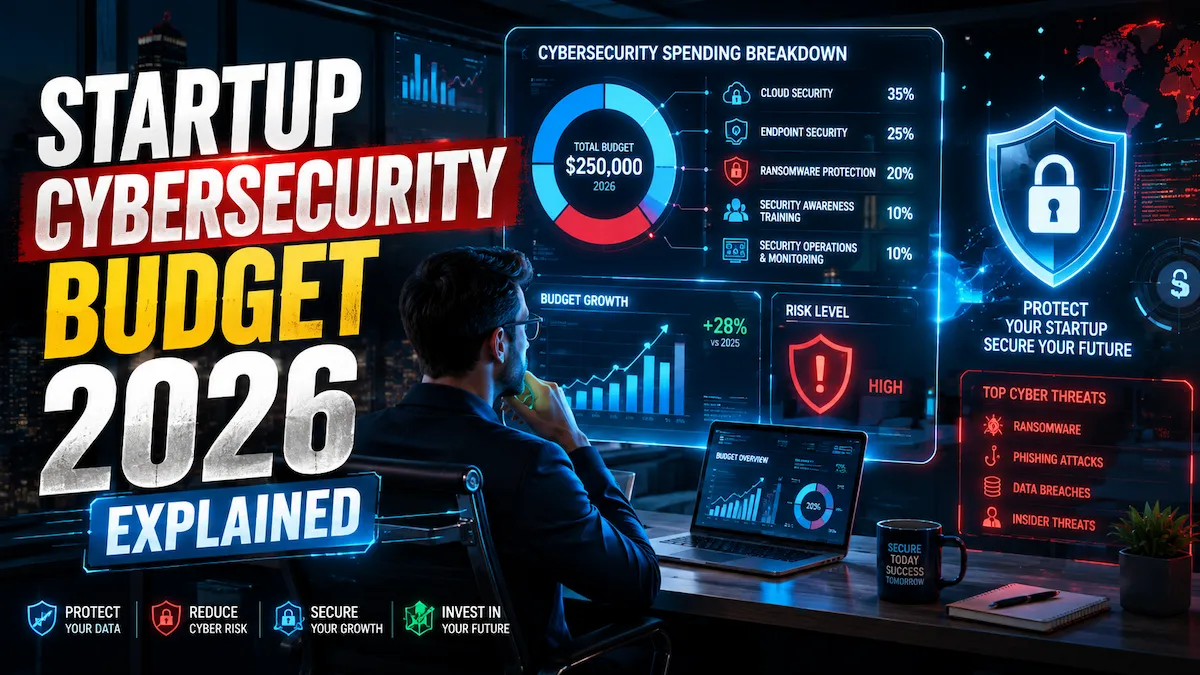
“Startup Cybersecurity Budget: How Much to Spend?” is one of the most important questions founders face in 2026 because security investment decisions directly affect growth, resilience, and customer trust.
Here’s the direct answer: Most early-stage startups should allocate 7–15% of their IT budget to cybersecurity—roughly $500–$2,000 per employee per year depending on industry and risk profile. For a 10-person SaaS startup, that’s $5,000–$20,000 annually as a baseline.
But that number alone is misleading without context.
The average cost of a data breach reached $4.88 million in 2024, up 10% year-over-year, according to IBM’s Cost of a Data Breach Report—and for small businesses, out-of-pocket ransomware recovery averaged $1.85 million. For most early-stage startups, that’s not a setback. That’s a shutdown.
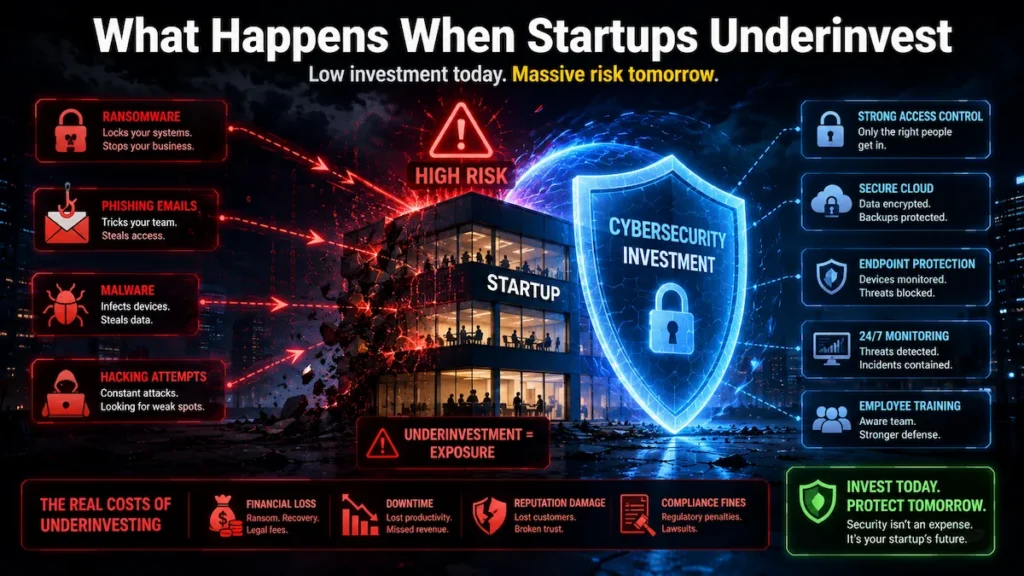
Before you skip ahead to the numbers, understand what’s at stake: underinvestment in cybersecurity isn’t a cost-saving strategy. It’s a deferred liability with compounding interest. This guide gives you the frameworks, 2026 benchmarks, and decision tools to build a security budget proportionate to your real risk — not just a guess.
If you’re starting from zero, the minimum viable security checklist for startups is a good companion read alongside this article.
Startup Cybersecurity Budget Snapshot (2026)
Stage Annual Spend Top Priority Pre-revenue $2,000–$5,000 MFA + backups Under $1M ARR $5,000–$15,000 EDR + awareness training $1M–$10M ARR $15,000–$60,000 Monitoring + pen test $10M+ ARR $60,000–$200,000+ Governance + MDR or vCISO These are directional ranges. Regulated industries (FinTech, Healthcare) should expect to spend 30–50% more at each stage.
Who This Guide Is For
This guide explains startup cybersecurity budget “how much to spend” decisions for founders, CTOs, and startup operators.
This guide is written for:
- SaaS, FinTech, Healthcare, and E-commerce startup founders
- CTOs and engineering leads making first security decisions
- Startups between pre-revenue and $50M ARR
- Anyone responsible for a first cybersecurity budget
This guide is not designed for:
- Large enterprises with mature security programs
- Federal contractors with specific CMMC or FedRAMP obligations
- Organizations with a dedicated CISO already in place
If you’re in a later-stage or heavily regulated environment, use this as a directional baseline — your actual requirements will be more complex.
How Much Should a Startup Spend on Cybersecurity?
Understanding startup cybersecurity budget how much to spend—starts with evaluating revenue, risk exposure, and security maturity.
Budget by Startup Stage
The “Startup Cybersecurity Budget: How Much to Spend” framework changes as startups move through growth stages.
| Startup Stage | Annual Revenue | Recommended Security Budget |
|---|---|---|
| Pre-revenue / Seed | $0–$500K | $3,000–$10,000 |
| Early Stage | $500K–$2M | $10,000–$40,000 |
| Growth Stage | $2M–$10M | $40,000–$150,000 |
| Scale-up | $10M–$50M | $150,000–$500,000 |
Revenue-Based Benchmarks
Revenue benchmarks provide another way to estimate a startup cybersecurity budget, how much to spend, without relying only on headcount.
- General startups: 0.5–1% of gross revenue
- SaaS startups handling customer data: 7–15% of IT budget
- FinTech/Healthcare: 10–20% of IT budget
- E-commerce: 5–10% of IT budget
The critical variable is data sensitivity, not headcount. A 5-person FinTech processing financial transactions faces a higher risk profile than a 50-person content agency.
A note on budgeting models: This article references three different ways to size a security budget—percentage of IT spend (7–15%), percentage of gross revenue (0.5–1%), and cost per employee ($500–$3,500). These are not contradictory; they’re different lenses on the same number. Use the revenue or per-employee model as your starting estimate, then sanity-check it against the IT budget percentage. If the numbers diverge significantly, your IT budget itself may be under- or over-sized relative to your business. Pick one primary model for internal planning and use the others to pressure-test it.
Cost Per Employee (2026)
Cost-per-employee calculations simplify startup cybersecurity budgets How Much to Spend: Planning for Early-Stage Teams.
| Company Size | Annual Security Cost Per Employee |
|---|---|
| 1–10 employees | $1,500–$3,500 |
| 11–50 employees | $1,200–$2,500 |
| 51–200 employees | $900–$2,000 |
Costs per employee decrease with scale due to volume licensing and shared infrastructure — not because the risk decreases.
My Recommended Startup Security Budget Model (2026)
This model turns “Startup Cybersecurity Budget: How Much to Spend” into practical investment decisions.
After reviewing hundreds of startup security postures, here’s the decision framework I’d recommend for founders who need clarity, not complexity:
| Stage | Security Priority | Estimated Annual Spend |
|---|---|---|
| Pre-Revenue | Secure identity + backups only | $2,000–$5,000 |
| Under $1M ARR | Add endpoint and awareness training | $5,000–$15,000 |
| $1M–$10M ARR | Add monitoring + annual pen test | $15,000–$60,000 |
| $10M+ ARR | Add governance + vCISO or MDR | $60,000–$200,000+ |
The underlying logic: protect what exists today, add controls as your attack surface grows. Startups that reverse this — buying enterprise platforms before establishing basics — waste budget and create false confidence.
At a Glance: What to Spend and Where
This quick summary shows startup cybersecurity budget: how much to spend across startup maturity levels.
| If You Are… | Spend… | Prioritize… | Avoid… |
|---|---|---|---|
| Pre-seed | $2,000–$5,000 | MFA + encrypted backups | Compliance tools you don’t need yet |
| Seed | $5,000–$15,000 | EDR + security awareness training | Building an in-house team |
| Series A | $15,000–$60,000 | MDR monitoring + annual pen test | Over-investing in compliance before basics |
| Growth / Scale | $60,000+ | Governance, vCISO, SOC 2 Type II | Relying solely on outsourced coverage |
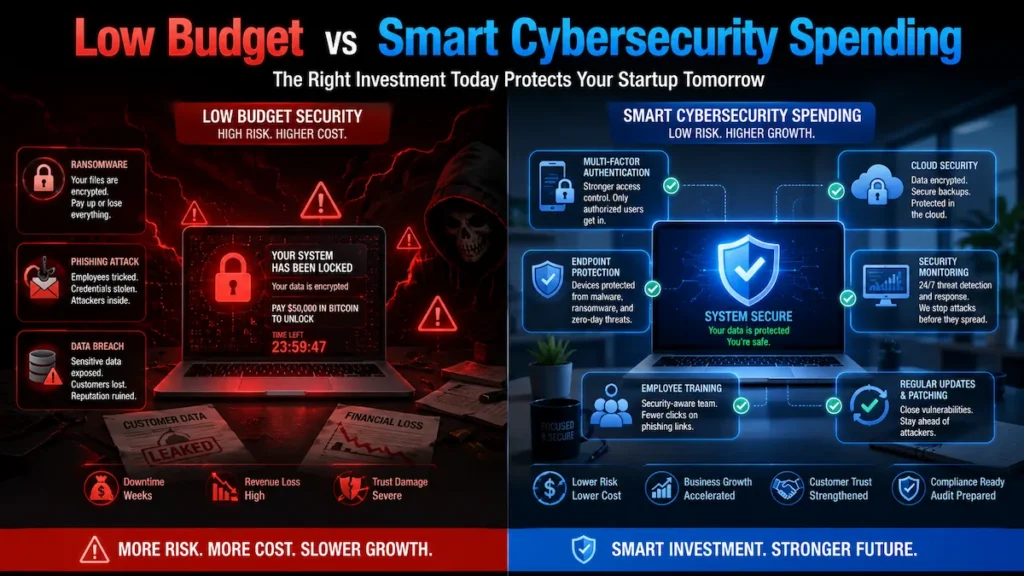
Why Hackers Target Startups (And Why This Changes Your Budget Logic)
Threat exposure directly influences Startup Cybersecurity Budget How Much to Spend decisions.
There’s a persistent myth that hackers only target large enterprises. In practice, startups are preferred targets because:
- Weak defenses, high-value data. A seed-stage startup may have minimal security but already hold customer PII, payment credentials, or proprietary IP.
- Credential-based entry is cheap. With remote-first teams using 20–40 SaaS tools, phishing and credential stuffing succeed at far higher rates than in hardened environments.
- Ransomware economics favor small targets. Ransomware groups target startups because they’re more likely to pay quickly to avoid disruption and can’t absorb the PR and legal cost of prolonged recovery.
According to Verizon’s 2024 Data Breach Investigations Report, over 68% of breaches involved a human element — phishing, stolen credentials, or social engineering. That’s the attack surface your training budget directly addresses.
Founders and executives are the highest-value targets through business email compromise (BEC). That’s not a reason to panic — it’s a reason to prioritize identity security above almost everything else.
The Startup Security Budget Pyramid
The security pyramid helps visualize Startup Cybersecurity Budget how much to spend on priorities.
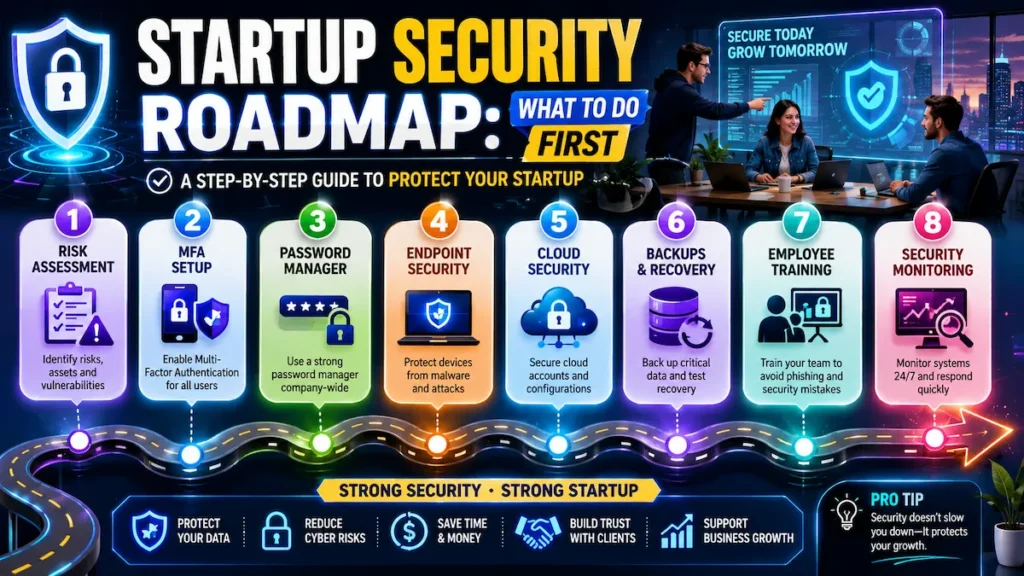
Think of your security spend as a pyramid: each layer depends on the one beneath it. Skipping layers to buy more advanced tools is the most common budget mistake in early-stage security.
        [Layer 5] Optimization & Compliance
       [Layer 4] Monitoring & Detection
      [Layer 3] Endpoint & Cloud Security
     [Layer 2] Training & Phishing Defense
    [Layer 1] MFA + Passwords + Backups ← Start here
Most startups under $1M ARR should spend 80%+ of their security budget on Layers 1 and 2. The controls at the base are cheap, high-ROI, and eliminate the majority of real-world attack vectors. See the full startup cybersecurity checklist for 2026 for implementation details on each layer.
Budget Breakdown: Where the Money Actually Goes
This breakdown explains startup cybersecurity budgets: how much to spend across major security categories.
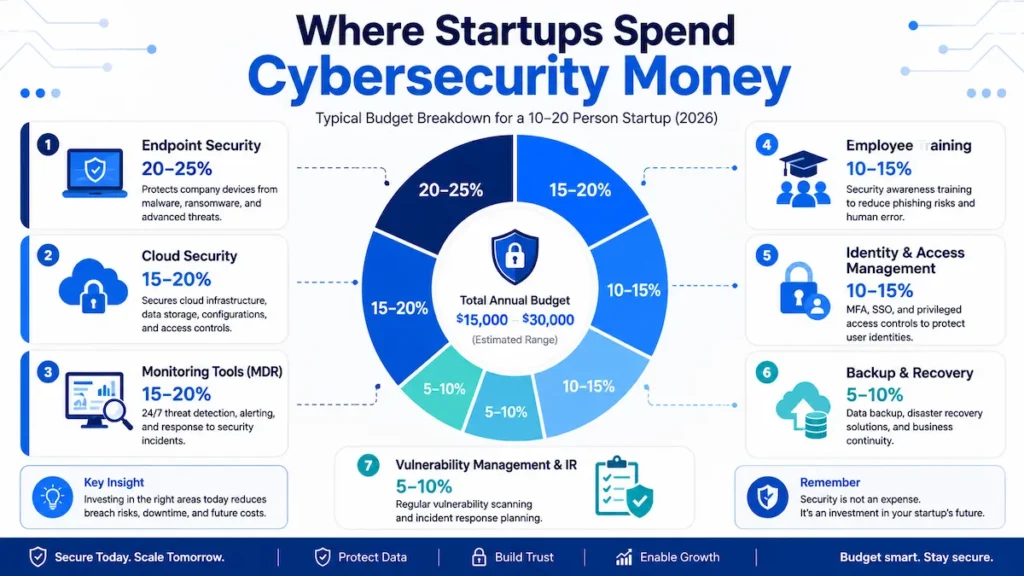
Here’s how to allocate your security spend across critical categories for a 10-person startup:
| Category | % of Budget | Typical Annual Cost |
|---|---|---|
| Endpoint Security (EDR) | 15–20% | $1,500–$4,000 |
| Identity & Access (MFA, SSO) | 10–15% | $1,000–$3,000 |
| Cloud Security & Configuration | 15–20% | $2,000–$5,000 |
| Employee Security Training | 10–15% | $1,000–$2,000 |
| Security Monitoring (MDR) | 20–25% | $3,000–$8,000 |
| Backup & Disaster Recovery | 10–15% | $1,500–$3,000 |
| Vulnerability Management | 5–10% | $500–$2,000 |
| Incident Response Retainer | 5–10% | $1,000–$3,000 |
Total estimated range (10-person startup): $11,500–$30,000/year
The Three Controls That Deliver the Most ROI
High-ROI controls improve Startup Cybersecurity Budget How Much to Spend outcomes.
Multi-Factor Authentication (MFA) MFA is among the highest-ROI security controls available to any startup. Microsoft’s research found it blocks over 99.9% of automated credential attacks. Cost: $3–$15/user/month via Okta, Duo, or Microsoft Entra ID. Very few security investments return this much value at this price, which makes it the right first move for almost every startup.
Endpoint Detection and Response (EDR) Endpoints are the most common breach entry point. Consumer-grade antivirus doesn’t detect behavioral threats — it only catches known malware signatures. For early-stage startups, Microsoft Defender for Business at ~$3/user/month is a cost-effective starting point. For teams handling sensitive data, SentinelOne or CrowdStrike Falcon Go provide stronger detection at a higher price point. A full comparison of AI security tools by startup budget tier can help you evaluate the trade-offs.
Security Awareness Training Given that 68%+ of breaches involve human error, a $25–$35/user/year training platform like KnowBe4 or Proofpoint may be the highest-ROI line item in your entire security budget. Run quarterly phishing simulations. Make training mandatory, not optional.
Contrarian Take: Why Most Startups Overspend on Compliance and Underspend on Recovery
Avoiding unnecessary spending improves Startup Cybersecurity Budget How Much to Spend on Efficiency.
Here’s the pattern I see repeatedly: a startup spends $40,000 preparing for SOC 2 certification before implementing basic incident response capabilities. They pass the audit — and then suffer a breach with no documented response plan.
Compliance frameworks like SOC 2 and NIST CSF describe what a mature security program looks like. They don’t prioritize what to do first when you have limited resources. The result: startups check compliance boxes while leaving their most critical gaps unaddressed.
The smarter sequence:
- Establish the controls that prevent the most likely attacks (MFA, EDR, training)
- Build incident response capability so a breach doesn’t destroy the company
- Then pursue compliance certifications that enable enterprise sales
SOC 2 is a growth enabler. But it’s not a substitute for operational security. A startup with a zero incident response plan and a SOC 2 Type I report is more dangerous than one with strong operational controls and no certification.
Industry-Based Spending: What Your Sector Actually Requires
Industry requirements significantly influence Startup Cybersecurity Budget how much to spend on planning.
SaaS Startups
Multi-tenant environments, API integrations, and customer data create a broad attack surface. Key priorities: cloud security posture management, identity federation, and API security.
Typical budget: 7–12% of IT budget. SOC 2 Type II is the de facto entry requirement for enterprise sales.
FinTech Startups
PCI-DSS, GLBA, and potentially SOX create a regulatory floor. Fraud detection, privileged access management, and transaction monitoring are non-negotiable.
Typical budget: 12–20% of IT budget.
Healthcare Startups
HIPAA’s Security Rule mandates administrative, physical, and technical safeguards for any startup handling Protected Health Information (PHI). Penalties reach $1.9 million per violation category annually.
Typical budget: 10–18% of IT budget. Every vendor touching PHI requires a Business Associate Agreement (BAA).
E-commerce Startups
Web application vulnerabilities (SQLi, XSS), account takeover, and payment fraud are the primary risks. A Web Application Firewall (WAF) and bot protection are essential alongside PCI-DSS compliance.
Typical budget: 5–10% of IT budget.
Cybersecurity Budget Calculator
Use this calculator to estimate a startup cybersecurity budget: how much to spend based on operational reality.
Use this framework to generate a first-pass estimate.
Formula:
Annual Security Budget = (Employees × Cost Per Employee) + Compliance Overhead + Tool Licensing
Example: 15-Person SaaS Startup Targeting Enterprise
| Component | Annual Cost |
|---|---|
| Endpoint Security (EDR) — 15 users × $5/mo | $900 |
| Identity Management (Okta) — 15 users × $8/mo | $1,440 |
| Security Awareness Training — 15 × $25/yr | $375 |
| MDR / Security Monitoring | $12,000 |
| Backup & Disaster Recovery | $2,400 |
| Annual Penetration Test | $8,000 |
| SOC 2 Preparation (Year 1) | $25,000 |
| Total | ~$50,115 |
At $1.5M ARR, this is roughly 3.3% of revenue — within the recommended range for a SaaS startup pursuing enterprise contracts.
Scaling trigger: When any of the following occur, revisit your budget immediately:
- Headcount crosses 25 or 50
- You start handling regulated data (health, financial, EU personal data)
- You sign your first enterprise contract with security questionnaire requirements
- You raise a Series A (increased regulatory scrutiny and investor expectations)
How Your Cybersecurity Budget Changes After Series A
Series A growth changes Startup Cybersecurity Budget How Much to Spend expectations.
Raising a Series Change your security requirements in ways most founders don’t anticipate until they’re already in a sales cycle or due diligence process.
Investor Expectations Shift
Institutional investors — particularly those with portfolio companies in regulated sectors — increasingly include security posture in their due diligence. They’re not expecting a fully mature security program at Series A, but they do expect evidence of basic hygiene: MFA enforced, no unpatched critical vulnerabilities, an incident response plan, and ideally SOC 2 readiness underway. Gaps at this stage can delay or complicate a funding close.
Enterprise Procurement Requirements
The moment your startup pursues mid-market or enterprise contracts, security becomes a sales-process variable. Enterprise procurement teams issue security questionnaires — often 100–300 questions covering access controls, encryption, backup procedures, incident response, and compliance certifications. Without documented answers and supporting evidence, deals stall.
SOC 2 Type II is the most commonly requested certification in B2B SaaS. It signals to buyers that your security controls have been independently verified over time—not just point-in-time. Starting this process before Series A typically puts you 6–12 months ahead of where you need to be for enterprise sales.
What to Budget for Post-Series A
| New Requirement | Typical Cost |
|---|---|
| SOC 2 Type II audit (Year 1) | $30,000–$80,000 |
| Compliance automation platform | $7,000–$20,000/year |
| Annual penetration test | $8,000–$20,000 |
| vCISO engagement (part-time) | $24,000–$60,000/year |
| Vendor security review process | $2,000–$5,000 (tooling + time) |
The total incremental cost of Series A–level security readiness typically runs $50,000–$120,000 in Year 1, depending on your existing baseline. Factor this into your post-raise operating plan — it’s a frequent budget surprise for teams that haven’t planned for it.
Third-Party and Vendor Risk Becomes Non-Negotiable
Enterprise buyers will ask which vendors have access to their data and what your vendor risk management process looks like. A startup with 30 SaaS integrations and no documented vendor review process will struggle to answer that credibly. Establishing a lightweight vendor security review — SOC 2 reports required, API permissions audited quarterly — becomes an operational requirement rather than a nice-to-have.
For teams building out monitoring to support this, AI network security monitoring tools designed for small teams have matured significantly and are now a practical option at this stage.
Compliance Frameworks and What They Actually Cost
Compliance obligations affect Startup Cybersecurity Budget How Much to Spend requirements.
SOC 2
The B2B SaaS standard. Enterprise buyers routinely require SOC 2 Type II before signing contracts.
- Type I (point-in-time): $15,000–$50,000 all-in
- Type II (6–12 month period): $30,000–$80,000 all-in
- Compliance automation platforms (Vanta, Drata, Secureframe) at $7,000–$20,000/year can reduce audit prep time by 50–70%
GDPR
Applies to any startup handling EU resident personal data, regardless of where the company is based. Key requirements: consent management, 72-hour breach notification, data minimization.
Estimated compliance cost: $5,000–$50,000 depending on data volume and existing systems.
HIPAA
Any startup touching PHI must comply. BAAs are required with all vendors handling that data.
Estimated annual compliance cost: $50,000–$200,000+ depending on scope.
NIST Cybersecurity Framework
The NIST CSF organizes security activities across five functions: Identify, Protect, Detect, Respond, and Recover. Not a regulatory requirement for most startups, but increasingly requested in enterprise vendor security reviews. Mapping your controls to NIST CSF is a low-cost way to demonstrate security maturity.
The CIS Controls Implementation Group 1 (the first 6 controls) provides an even more practical starting point for resource-constrained startups.
Cost Optimization: How to Do More With Less
Cost optimization improves startup cybersecurity budgets How Much to Spend on Efficiency.
DIY vs. MSSP vs. In-House: Which Model Fits Your Stage?
| Approach | Typical Annual Cost | Complexity | Best For |
|---|---|---|---|
| DIY (open-source + built-in tools) | $0–$5,000 | High — requires internal expertise | Pre-seed, no customer data yet |
| MSSP / MDR (outsourced monitoring) | $8,000–$40,000 | Low — provider handles operations | Seed through Series A |
| In-house security hire | $120,000–$180,000+ | High — recruiting, retention, tooling | $10M+ ARR, enterprise sales motion |
| Hybrid (MDR + part-time vCISO) | $30,000–$80,000 | Medium | $3M–$15M ARR, compliance-driven |
Most startups under $5M ARR get better security outcomes from the MSSP/MDR model than from attempting in-house coverage with an understaffed team.
Start with your existing tools. Microsoft 365 Business Premium and Google Workspace both include substantial built-in security capabilities that most startups never activate—device management, conditional access, and advanced email filtering. Audit what you’re already paying for before buying new tools.
Outsource security operations before hiring. A full-time security engineer costs $120,000–$180,000/year. A Managed Detection and Response (MDR) provider delivers 24/7 monitoring, threat hunting, and incident response for $8,000–$40,000/year. For most startups under $5M ARR, the MDR model tends to deliver stronger security outcomes per dollar than attempting in-house coverage. Teams with no dedicated IT staff can learn how to approach this in our guide to cybersecurity for startups with no IT team.
Leverage open-source where operational capacity exists. Wazuh (SIEM/EDR), OpenVAS (vulnerability scanning), and pfSense (firewall) are enterprise-grade and free. The caveat: they require in-house expertise to configure and maintain. For startups without security staff, commercial tools with managed support often deliver better actual security outcomes despite higher licensing costs. Our roundup of free and low-cost AI cybersecurity tools for startups covers vetted options across both categories.
Build Zero Trust from day one. Zero Trust is not a product — it’s a security architecture principle: never trust, always verify. For startups, implementation means MFA on everything, least-privilege access policies, and continuous verification of device health before granting access. Startups that embed these principles early avoid costly retrofitting later and satisfy the security architecture questions that come up in enterprise procurement.
The Five Budget Mistakes That Cost Startups the Most
Understanding common mistakes leads to better startup cybersecurity budget “how much to spend” decisions.
1. Treating security as insurance to minimize risk. The ROI on preventing a single ransomware attack versus the cost of one is routinely 40–100x. The math favors spending, not cutting.
2. Buying tools without operationalizing them. A startup paying for 6–8 security platforms that generate alerts no one reviews is less secure than a startup with 2 well-operated tools. Security effectiveness is determined by your ability to act on signals, not the volume of tools generating them.
3. Skipping incident response planning. Many startups have tools but no documented process for what to do when something goes wrong. Without a plan, response time is measured in days — and response time is the most important variable in breach cost.
4. Ignoring vendor and third-party risk. Major supply chain attacks have repeatedly compromised organizations through trusted vendors. Audit vendor access quarterly. Require SOC 2 reports from data-handling vendors. Limit API permissions to the minimum required. Automated network monitoring tools built for small teams are increasingly effective at detecting anomalous third-party behavior.
5. No formal detection capability. The average breach dwell time—from intrusion to detection—was 194 days in 2024, according to IBM. Without monitoring, you won’t know you’ve been compromised until it’s too late to contain the damage. Machine learning-based intrusion detection is now accessible to startups at a fraction of what enterprise systems cost.
FAQ
These answers support readers researching startup cybersecurity budgets How Much to Spend.
What’s the minimum viable security budget for a pre-revenue startup?
When evaluating startup cybersecurity budgets, how much should be spent? Most pre-revenue startups can begin with $3,000–$6,000 per year. This budget typically covers essential controls such as MFA, endpoint protection, encrypted backups, and a password manager. These foundational investments substantially reduce the most common cyber risks without creating unnecessary overhead.
When should a startup hire a dedicated security person?
At $10M–$20M ARR, when pursuing enterprise contracts requiring security audits, or in regulated industries. Before that threshold, an MSSP or MDR provider delivers better ROI. Your first hire should be a security engineer focused on execution—not a CISO focused on strategy.
Does cyber insurance replace a security budget?
No. Insurers increasingly require specific controls (MFA, EDR, and tested backups) before issuing policies and deny claims when those controls aren’t in place. Insurance transfers risk; it doesn’t reduce it.
How often should a startup run a penetration test?
Annually at minimum, with additional tests after significant architecture changes or product launches. External network pen tests cost $5,000–$15,000. Web application tests range from $8,000–$25,000 for startup-scale engagements.
What metrics should I report to the board?
Track: security budget as % of IT spend (target: 7–15%), MFA adoption rate (target: 100%), critical vulnerability patch rate (target: 100% within 72 hours), mean time to detect/respond, and security training completion rate.
How should founders determine the right cybersecurity budget?
The best approach to Startup Cybersecurity Budget How Much to Spend is to assess data sensitivity, regulatory requirements, customer expectations, and business growth plans. Startups handling financial, healthcare, or customer data generally require larger investments than companies with limited sensitive information. A risk-based budgeting model usually produces better outcomes than relying solely on revenue or headcount benchmarks.
Does startup size determine cybersecurity spending requirements?
Not always. While company size influences costs, Startup Cybersecurity Budget How much to spend is more closely tied to risk exposure than employee count. A small FinTech startup processing financial transactions may need a larger security budget than a much larger business with minimal sensitive data. Security investment should align with the value of the assets being protected rather than workforce size alone.
Implementation Roadmap
This roadmap converts “Startup Cybersecurity Budget: How Much to Spend” into execution.
Tier 1 — Immediately (cost: $0–$2,000/year) Enable MFA on all accounts. Deploy a company-wide password manager. Activate built-in security features in your cloud provider and Microsoft/Google Workspace. Establish encrypted, offsite backups.
Tier 2 — Within 6 months (cost: $3,000–$8,000/year) Deploy EDR on all company devices. Launch mandatory quarterly security awareness training. Conduct a cloud infrastructure configuration audit.
Tier 3—Within 12 months (cost: $8,000–$25,000/year) Engage an MDR provider for continuous monitoring. Commission an annual penetration test. Begin SOC 2 readiness if you’re selling to enterprises.
Tier 4 — Scale as you grow (cost: $25,000+/year) Formalize a documented incident response plan. Achieve SOC 2 Type II certification. Implement a formal vulnerability management program. Engage a vCISO.
Before Finalizing Your Security Budget, Ask These 5 Questions
These final questions help validate startup cybersecurity budget how much to spend choices before implementation.
Most cybersecurity budget decisions are made on benchmarks alone. The founders who build the most effective programs use benchmarks as a starting point, then pressure-test the result against these questions:
1. What data would hurt most if it were exposed? Customer PII, payment data, health records, and proprietary IP each carry different breach costs and regulatory consequences. Your highest-risk data category should determine your spending floor — not your headcount.
2. Could you detect an attack happening right now? If your honest answer is “probably not,” your monitoring and detection investment is underweight relative to your current risk. Many startups discover this only after a breach.
3. Could you recover your critical systems within 24 hours? Test your backup restoration process. If you’ve never run a recovery drill, you don’t yet know whether your backup strategy works. Detection and recovery capability often matter more to business survival than prevention alone.
4. Which three controls would reduce the most risk for your dollar? Not all controls are equal. For most startups, MFA, EDR, and security awareness training cover the majority of real-world attack vectors at a fraction of the cost of more advanced tooling. Prioritize by impact-per-dollar, not by what vendors recommend.
5. What security requirement is most likely to block your next growth milestone? If you’re targeting enterprise customers, it’s probably SOC 2. If you’re in healthcare, it’s HIPAA. If you’re raising your next round, it may be investor due diligence readiness. Align your next security investment to the requirement that directly unlocks revenue or capital.
These questions don’t replace a budget—but they ensure your budget reflects your actual risk posture rather than an industry average that may not apply to your situation.
The startups that treat cybersecurity as a foundational operational discipline—not a compliance checkbox or a line item to minimize—protect their customers, close enterprise deals faster, and survive the incidents that end their competitors.
Your security budget isn’t a sunk cost. It’s a growth enabler.
Statistics cited reflect publicly available research, including the IBM Cost of a Data Breach Report 2024, Verizon DBIR 2024, Microsoft Security research, and CIS/NIST framework documentation. Cost ranges are estimates based on current vendor pricing and should be validated for your specific environment before budgeting.