By a cybersecurity consultant specializing in SaaS startup security, cloud infrastructure protection, and SOC 2 readiness.
Introduction to Startup Cybersecurity Software Comparison
If you’re building a startup in 2026, cybersecurity probably sits somewhere below fundraising, hiring, and product roadmap on your priority list. That’s understandable — but it’s exactly the mindset attackers count on.
This startup cybersecurity software comparison exists to cut through that. The security software market is overcrowded, confusing, and genuinely difficult to navigate without a technical background. Founders waste weeks evaluating tools that don’t fit their infrastructure, budget, or team size.
Whether you’re a pre-revenue founder, a SaaS CTO, or an IT manager at a growing tech company, this guide gives you everything you need to make a confident, informed decision — without needing a security background to understand it.
Why Startups Need Cybersecurity Software in This Startup Cybersecurity Software Comparison
Every honest startup cybersecurity software comparison starts with the same uncomfortable truth: startups are not too small to be targeted, and the assumption that they are is exactly what attackers exploit.
The most dangerous assumption in startup security is: “We’re too small to be a target.” That logic stopped being true years ago. Today, automated attack tools don’t discriminate by company size — they scan the entire internet for exposed systems, weak credentials, and misconfigured cloud environments around the clock.
Startups are actually more attractive targets in some respects. You hold valuable intellectual property, early customer data, and financial credentials — but typically lack the layered defenses of an established enterprise. That gap is an open door.
Common Cyber Threats Covered in a Startup Security Tools Comparison
Before diving into tool recommendations, any reliable startup cybersecurity software comparison must first map the real threats that are actively hitting startups in 2026.
Understanding the threat landscape is the foundation of any useful cybersecurity tools for startups evaluation. Here’s what’s actually hitting startups right now:
Ransomware has evolved from a nuisance into a business-ending weapon. Modern ransomware groups don’t just encrypt your files — they exfiltrate data first and threaten to publish it if you don’t pay. According to Verizon’s Data Breach Investigations Report, ransomware remains one of the top attack patterns across organizations of all sizes.
Phishing and social engineering remain the #1 entry vector for breaches worldwide. A convincing email tricks one employee into entering credentials, and suddenly your entire Google Workspace, GitHub organization, or AWS account is exposed.
SaaS vulnerabilities are a growing blind spot unique to modern startups. Tools like Notion, Slack, Salesforce, and GitHub hold enormous amounts of sensitive business data — misconfigured permissions, overly broad OAuth integrations, and shared links expose that data constantly.
Cloud misconfigurations are alarmingly common and often go undetected for months. An S3 bucket left public, a Kubernetes cluster on default credentials, a database with no authentication — these aren’t edge cases. They’re routine findings in startup security audits.
Cost of Security Breaches: What Every Startup Security Software Evaluation Must Consider
One of the most important findings any startup cybersecurity software comparison surfaces is just how financially devastating a breach can be — even for a company with fewer than 50 employees.
The financial math is stark. IBM’s Cost of a Data Breach Report puts the global average breach cost at over $4.88 million. That number alone can end a startup overnight.
But even smaller incidents carry serious consequences most founders underestimate:
- Financial loss hits from multiple directions simultaneously — regulatory fines, legal fees, incident response costs, and lost revenue during downtime. A $150,000 incident at seed stage can wipe out six months of runway.
- Operational downtime compounds the damage. When systems go offline, engineering stops shipping, sales pipelines freeze, and customer support collapses. A ransomware attack can halt operations for days or weeks.
- Reputational damage is the most lasting consequence. For B2B SaaS startups pursuing enterprise clients, a publicized breach can kill deals that took months to develop. Rebuilding customer and investor trust takes far longer than recovering your systems.
Key Features to Look for in a Startup Cybersecurity Software Comparison
When conducting a startup cybersecurity software comparison, the single most important first step is knowing which features actually matter for a company your size — because enterprise checklists rarely apply to a 20-person startup.
Not every security tool is built for startups. Enterprise platforms can be over-engineered and overpriced for a 20-person company. This section of the startup security software evaluation identifies what actually matters.
Endpoint Protection for Startup Devices in Any Cybersecurity Tools for Startups Evaluation
In every solid startup cybersecurity software comparison, endpoint protection consistently ranks as the most immediate priority — covering every device that touches your environment, from developer laptops to mobile phones.
Endpoint protection covers every device connecting to your environment — employee laptops, developer workstations, mobile phones, and servers. In a startup where remote work is the norm and personal devices often touch company systems, this is your most immediate line of defense.
Strong endpoint protection in any startup security tools comparison should include:
- Real-time malware protection with behavioral detection (not just signature databases)
- Automated threat response that acts without waiting for a human
- Cross-platform support for Mac, Linux, and Windows
- Device risk scoring and visibility dashboards
For startups watching their budget, this breakdown of affordable cybersecurity tools for startups covers solid endpoint protection options without enterprise pricing.
Cloud Security for SaaS Startups in This Startup Cybersecurity Software Comparison
Cloud security is where startups most consistently leave themselves exposed, which is why it features so prominently in any thorough startup cybersecurity software comparison targeting SaaS or cloud-native companies.
Cloud security is where startups most consistently leave themselves exposed. If your infrastructure runs on AWS, GCP, or Azure — and in 2026, it almost certainly does — you need continuous monitoring watching for misconfigurations, unusual access patterns, and data exfiltration attempts.
A strong cybersecurity tools for startups evaluation for cloud-native companies should include:
- Cloud Security Posture Management (CSPM) to catch misconfigurations automatically
- SaaS access visibility and OAuth permission auditing
- Identity threat detection across cloud accounts
- Container and Kubernetes workload security
If you’re a SaaS startup, this deep-dive on AI security tools for SaaS startups in 2026 covers cloud-focused options in detail.
AI-Powered Threat Detection in a Startup Security Software Evaluation
No startup cybersecurity software comparison in 2026 is complete without evaluating AI-powered threat detection — because modern attacks move faster than human analysts can respond, making automation a necessity rather than a luxury.”
Modern attacks move faster than human analysts can respond. AI-powered threat detection closes that gap. By processing behavioral signals across endpoints, networks, and cloud environments simultaneously, AI flags anomalous activity in real time — a login from an unusual geography, a process making unexpected outbound connections, a user accessing files outside their normal pattern.
In 2026, AI threat detection is no longer a premium feature. It’s a baseline expectation. For a broader look at how AI is reshaping startup security, see our guide on the best AI security tools for startups in 2026.
Real-Time Security Monitoring in a Startup Cybersecurity Software Comparison
Every startup cybersecurity software comparison worth reading will assess real-time monitoring capabilities, because knowing something is wrong before it becomes a crisis is what separates prepared startups from vulnerable ones.
Real-time monitoring means knowing something is wrong before it becomes a crisis. This includes continuous log analysis, behavioral alerting, and Security Information and Event Management (SIEM) functionality.
For lean startup teams without a dedicated security operations center, the best tools surface actionable, prioritized alerts rather than generating noise nobody has time to process. Look for:
- Tunable detection rules that reduce false positives
- Clean alert context explaining why something is flagged
- Dashboard views readable by non-security specialists
- Integration with Slack or PagerDuty for fast notification
Compliance and Data Protection in Any Startup Security Tools Comparison
Any comprehensive startup cybersecurity software comparison must address compliance — because for startups selling to enterprise buyers or operating in regulated industries, it isn’t optional, it’s a sales requirement.
If you’re selling to enterprise buyers or operating in a regulated industry, compliance isn’t optional — it’s a sales requirement. SOC 2 Type II is the standard most B2B SaaS startups need to close enterprise deals. GDPR applies to any startup handling EU resident data. HIPAA governs healthcare data. CCPA covers California consumers.
According to NIST’s Cybersecurity Framework, a structured approach to security controls is the most reliable path to demonstrating compliance readiness. Your security software should actively support that — generating audit logs, access reports, and control evidence that compliance auditors actually need.
Startup Cybersecurity Software Comparison: Top Tools Reviewed
This is the core of the startup cybersecurity software comparison — a detailed, practical breakdown of the five platforms most relevant to startup environments in 2026, evaluated on the criteria founders and CTOs actually care about.
Here is a detailed startup security tools comparison of the five most relevant platforms for startup environments in 2026.
CrowdStrike Falcon
In virtually every startup cybersecurity software comparison at the growth stage, CrowdStrike Falcon appears near the top — and for good reason.
Overview: CrowdStrike is the gold standard in enterprise endpoint security. Its Falcon platform has become increasingly accessible to growth-stage startups through mid-market licensing tiers.
Key Features: AI-powered threat detection, zero trust network access, cloud workload protection, identity threat detection, managed detection and response (MDR), and threat intelligence feeds.
Advantages: Best-in-class detection accuracy, deep threat intelligence network, and strong compliance tooling for SOC 2 environments. Scales cleanly from 50 to 5,000 employees.
Disadvantages: Premium pricing makes it a difficult sell for pre-seed or seed-stage startups. Full value requires dedicated personnel to manage alerting and investigation workflows.
Best Startup Use Case: Series A and beyond — especially startups handling sensitive customer data, pursuing enterprise sales, or working toward SOC 2 certification.
SentinelOne
SentinelOne stands out in this startup cybersecurity software comparison for its AI-first approach to autonomous detection and response — a critical advantage for lean startup teams without a dedicated security operations center.
Overview: SentinelOne takes an AI-first approach to security. Its Singularity platform offers autonomous detection and response — threats are identified and neutralized without requiring human intervention at every step.
Key Features: Behavioral AI engine, fully automated threat response, cloud workload protection, Kubernetes and container security, identity security, and a developer-friendly API layer.
Advantages: Highly autonomous — ideal for startups that can’t staff a full security team. Competitive mid-market pricing. Excellent Mac and Linux support. Strong API integrations with modern DevOps toolchains.
Disadvantages: Threat intelligence breadth is slightly narrower than CrowdStrike at the largest enterprise scale. Some advanced modules require higher licensing tiers.
Best Startup Use Case: Technical startups and SaaS companies with small IT teams who need strong automation and cross-platform endpoint protection. See how it compares in our AI cybersecurity tools for small business 2026 breakdown.
Sophos Intercept X
For early-stage startups prioritizing ransomware defense above all else, Sophos Intercept X consistently earns high marks in any startup cybersecurity software comparison targeting SMB-friendly pricing.
Overview: Sophos built its reputation by making enterprise-grade security accessible to organizations that can’t staff large security teams. Intercept X is their flagship endpoint product, powered by deep learning malware detection.
Key Features: Deep learning threat detection, ransomware file rollback, exploit prevention, web filtering, and an optional Managed Detection and Response (MDR) service.
Advantages: Exceptional ransomware defense including file rollback — one of the few tools that can actually undo ransomware damage. Easy to manage via a centralized cloud console. Strong value at SMB price points.
Disadvantages: Less suited to cloud-native and containerized infrastructure. MDR capabilities lag behind CrowdStrike and SentinelOne at enterprise scale.
Best Startup Use Case: Early-stage startups that need reliable, affordable protection against ransomware and malware without significant configuration overhead.
Bitdefender GravityZone
Bitdefender GravityZone earns its place in this startup cybersecurity software comparison by delivering layered, enterprise-quality protection at a price point that genuinely works for budget-conscious early-stage teams.
Overview: Bitdefender GravityZone is a layered security platform combining endpoint protection, patch management, risk analytics, and encryption management in a unified dashboard.
Key Features: Risk analytics scoring, automated patch management, network attack defense, anti-exploit technology, full-disk encryption management, and sandbox analysis.
Advantages: Consistently high detection rates in independent lab testing. Competitive pricing well-suited to budget-conscious startups. Intuitive interface that non-security specialists can navigate comfortably.
Disadvantages: Cloud-native integrations require additional configuration. MDR and managed service offerings are less mature than top-tier competitors.
Best Startup Use Case: Budget-conscious startups that need solid all-around endpoint security and patch management without enterprise-level spend.
Microsoft Defender for Business
For startups already running Microsoft 365, Microsoft Defender for Business is arguably the highest-value entry in this startup cybersecurity software comparison — delivering enterprise-grade endpoint security at a fraction of standalone platform costs.
Overview: Microsoft Defender for Business brings enterprise-grade endpoint security to small and medium-sized organizations at a price point that’s hard to argue with — especially for teams already running Microsoft 365.
Key Features: Threat and vulnerability management, automated investigation and response, seamless Microsoft 365 and Azure integration, simplified onboarding wizard, and attack surface reduction rules.
Advantages: Extremely cost-effective for Microsoft-ecosystem startups. No additional agent installation if M365 is already deployed. Strong compliance evidence generation. Microsoft’s security documentation provides unusually thorough setup guidance.
Disadvantages: Significantly less effective in non-Microsoft environments. Advanced cloud security requires additional Azure services. Customization depth lags behind dedicated security platforms.
Best Startup Use Case: Startups already operating within the Microsoft 365 ecosystem who want strong baseline endpoint protection without adding vendor complexity or cost.
Startup Cybersecurity Software Comparison Table
The following startup cybersecurity software comparison table gives you a fast, side-by-side view of all five platforms across the dimensions that matter most for startup purchasing decisions.
–$
| Software | Best For | Key Features | Pricing Tier | Ease of Use |
|---|---|---|---|---|
| CrowdStrike Falcon | Scaling startups, SOC 2 readiness | AI detection, threat intel, cloud security, MDR | $$$ | Moderate |
| SentinelOne | Automation-first teams, SaaS startups | Behavioral AI, autonomous response, container security | Easy–Moderate | |
| Sophos Intercept X | Early-stage, ransomware defense | Deep learning, ransomware file rollback, MDR add-on | $$ | Easy |
| Bitdefender GravityZone | Budget-conscious startups | Risk analytics, patch management, encryption | $$ | Easy |
| Microsoft Defender | Microsoft 365 startups | M365 integration, automated investigation & response | –$ | Very Easy |
Best Cybersecurity Software for Different Startup Needs in This Comparison
Every startup cybersecurity software comparison should account for the fact that different startups have fundamentally different infrastructure, team sizes, risk profiles, and budgets — so this section maps the right tool to the right situation.
Different startups have fundamentally different infrastructure, team sizes, risk profiles, and budgets. This section maps the right tool to the right situation.
Best Budget Cybersecurity Tool for Startups in This Startup Security Software Evaluation
For founders running a tight budget, this startup cybersecurity software comparison points clearly to two options that deliver serious protection without requiring enterprise-level spend.
Winner: Bitdefender GravityZone or Microsoft Defender for Business
For pre-revenue or early-stage startups where every dollar is accountable, Bitdefender GravityZone delivers serious endpoint protection and risk visibility at an accessible price point. Microsoft Defender is the strongest pick if you’re already paying for Microsoft 365 — you get enterprise-grade endpoint security effectively included in what you’re already spending.
For a comprehensive breakdown of cost-effective options, our guide on affordable cybersecurity tools for startups goes deeper on pricing tiers and what you actually get at each level.
Best AI-Powered Security Platform in This Cybersecurity Tools for Startups Comparison
When evaluating AI-powered security in this startup cybersecurity software comparison, SentinelOne is the standout choice for startups that need automation to compensate for a small or non-existent security team.
Winner: SentinelOne
SentinelOne’s behavioral AI engine leads the mid-market in autonomous threat detection. For startups without a dedicated security operations center, its ability to identify and neutralize threats without requiring human sign-off at every step is a major operational advantage. Our analysis of AI security tools for small businesses provides useful context on how AI platforms compare across different organization sizes.
Best Cloud Security Solution for SaaS Startups in This Comparison
For SaaS startups running complex cloud infrastructure, this startup cybersecurity software comparison points to CrowdStrike Falcon as the strongest cloud security option available at the mid-to-enterprise tier.
Winner: CrowdStrike Falcon
CrowdStrike’s cloud workload protection, Kubernetes security, and identity threat detection make it the strongest option for SaaS startups running complex cloud infrastructure. If you’re operating microservices on AWS or GCP, Falcon gives you the visibility and control your environment demands.
Best All-in-One Startup Security Platform in This Startup Cybersecurity Software Comparison
For startups that want a single platform covering endpoint, cloud, identity, and threat intelligence without juggling multiple vendors, this startup cybersecurity software comparison recommends SentinelOne Singularity as the most cohesive solution.
Winner: SentinelOne Singularity
For startups that want endpoint protection, cloud workload security, identity management, and threat intelligence under one platform — without managing multiple vendors — SentinelOne Singularity delivers the most cohesive experience. It integrates cleanly with modern DevOps workflows and scales gracefully as headcount and infrastructure grow.
Open Source vs Paid Security Tools: A Critical Look for Startup Security Software Evaluation
This startup cybersecurity software comparison wouldn’t be complete without addressing the open source question — it comes up constantly in early-stage startup conversations, and the honest answer is more nuanced than most articles admit.
This question comes up constantly in early-stage startup conversations — and the honest answer is more nuanced than most articles admit.
Open source tools like Wazuh, Suricata, and OpenVAS are genuinely powerful. Wazuh in particular can function as a capable SIEM and endpoint monitoring platform. For startups with strong engineering talent and bandwidth to operate security infrastructure, open source can cover significant ground at near-zero licensing cost.
The real cost, however, is operational. Open source security tools require configuration, tuning, ongoing maintenance, and someone with the expertise to interpret what they’re telling you. For most startups, that engineering time has enormous opportunity cost — a founder spending 20 hours configuring Wazuh is a founder not building product.
Paid platforms absorb that burden. You get managed updates, professional threat intelligence, vendor support, and in many cases automated response — at the cost of a subscription.
The practical recommendation: use open source tools to supplement paid platforms once security basics are covered, not as a replacement in your early stage.
Common Mistakes Startups Make in Cybersecurity — Lessons for Any Startup Security Tools Comparison
One of the most valuable outputs of a thorough startup cybersecurity software comparison is understanding not just which tools to buy, but which mistakes to avoid — because the right tool purchased for the wrong reasons still leads to preventable breaches.
Understanding what goes wrong helps you avoid the same traps:
Treating security as a one-time setup. Installing endpoint protection and never reviewing alerts, updating policies, or testing response capabilities creates dangerous false confidence.
Buying tools nobody manages. A CrowdStrike license that nobody monitors is expensive shelfware. Match the sophistication of your tool to the capacity of your team to operate it.
Ignoring identity security. Most breaches in 2026 start with compromised credentials. Multi-factor authentication, least-privilege access policies, and identity threat detection should be non-negotiable from day one.
Deferring compliance until a deal forces your hand. Starting SOC 2 preparation six months before you need it is stressful. Starting it two weeks before a contract deadline is a crisis. Build compliance-supporting controls into your security stack early.
Skipping security for SaaS tools. Your GitHub, Slack, Notion, and Google Workspace hold enormous amounts of sensitive data. Misconfigured sharing settings and overly permissive OAuth apps are breaches waiting to happen.
Startup Cybersecurity Stack Example: Build Your Foundation
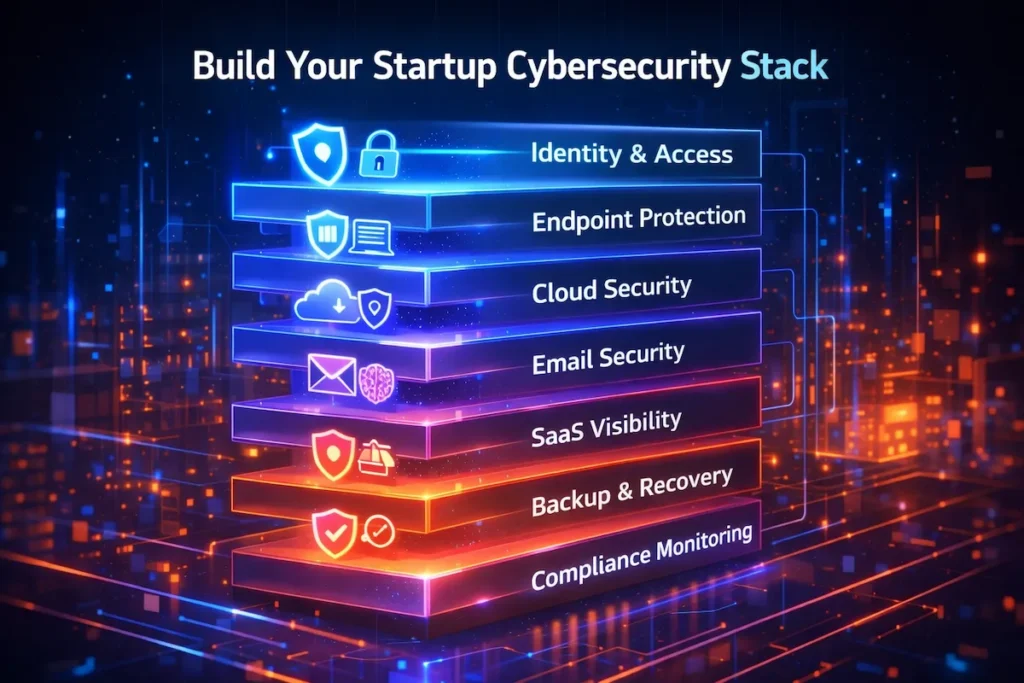
The most actionable takeaway from any startup cybersecurity software comparison isn’t a single tool recommendation — it’s a layered security stack that fits your company’s current size and scales with your growth. The diagram above shows a practical, layered security stack for a 15–50 person SaaS startup. Here’s how each layer breaks down in practice:
Identity & Access (Foundation Layer): Okta or Microsoft Azure AD with enforced MFA across all tools. Least-privilege access policies. Regular access reviews quarterly.
Endpoint Protection: SentinelOne for Mac/Linux-heavy engineering teams. Microsoft Defender for Business for Microsoft 365 shops. Bitdefender for budget-constrained teams.
Cloud Security: Native cloud provider security tools (AWS Security Hub, GCP Security Command Center) plus CSPM from your endpoint platform for misconfiguration detection.
Email Security: Google Workspace or Microsoft 365 built-in filtering, supplemented with dedicated anti-phishing where needed.
SaaS Visibility: A SaaS Security Posture Management (SSPM) tool to audit OAuth integrations and permission sprawl across your SaaS stack.
Backup & Recovery: Immutable, offsite backups tested quarterly. This is your last line of defense against ransomware.
Compliance Monitoring: Drata, Vanta, or Secureframe to automate SOC 2 evidence collection across your stack.
According to CISA’s guidance for small businesses, a layered approach combining endpoint protection, strong identity controls, and regular backups dramatically reduces breach risk even with limited security staffing.
How Startups Should Choose Cybersecurity Software in This Comparison
The most practical outcome of any startup cybersecurity software comparison is a clear decision framework — not just a ranked list of tools, but a repeatable process for matching the right platform to your specific infrastructure and growth stage.
Audit your infrastructure first. What cloud provider are you on? What identity system do you use? How many endpoints do you manage? Are employees using personal devices? Your infrastructure determines which tools integrate without friction.
Verify integrations before committing. Your security software should connect cleanly to your cloud provider, identity provider, ticketing system, and communication tools. Gaps in integration create blind spots.
Compare total cost of ownership honestly. Most vendors don’t publish transparent per-seat pricing. Get quotes for your actual headcount and model growth over 24 months. Factor in renewal price increases — they’re common.
Use free trials aggressively. CrowdStrike, SentinelOne, and Sophos all offer trial periods. Run them in a real environment, generate some test alerts, and evaluate alert quality, dashboard usability, and how much time the tool requires from your team.
Plan for the team you’ll have, not just the team you have now. A tool that works for 15 employees needs to still make sense operationally at 150. Evaluate licensing models and feature tiers with growth in mind.
Pros and Cons of Cybersecurity Software for Startups in This Comparison
Every startup cybersecurity software comparison should offer a balanced view — because no platform is perfect, and understanding the real trade-offs is what leads to smart purchasing decisions rather than buyer’s remorse.
Pros:
- Dramatically reduces the risk and impact of breaches
- Automates detection and response, reducing the security team burden
- Supports SOC 2, GDPR, and HIPAA compliance efforts
- Generates audit evidence that enterprise sales require
- Scales with company growth without rebuilding your security stack
Cons:
- Quality platforms carry real subscription costs — budget planning is essential
- Some tools have steep learning curves for non-technical founders
- Alert fatigue without proper tuning can paradoxically create blind spots
- Vendor lock-in can become a constraint as your architecture evolves
- Compliance coverage and depth varies significantly between platforms
No tool is perfect. But the risks of operating without adequate protection in 2026 are far greater than the downsides of any platform in this guide.
Future of Startup Cybersecurity in a Startup Security Tools Comparison
Any startup cybersecurity software comparison you conduct today should factor in where the threat landscape and tooling are heading over the next two to three years — because the platform you choose now needs to still make sense as these trends mature.
The threat landscape is evolving faster than most startups realize. Here’s where the next generation of security is heading:
AI-driven security is shifting from reactive detection to proactive prediction. The next wave of platforms will forecast likely attack vectors based on your environment’s specific risk profile — before any attack begins.
Zero trust architecture is becoming the default model, especially for distributed remote-first startups. The principle is straightforward: never trust, always verify. Every user, device, and connection is treated as potentially compromised until verified. NIST’s Zero Trust Architecture guidelines (SP 800-207) provide a practical framework for implementation regardless of your stack.
Automated SOC monitoring is democratizing capabilities that once required large, expensive security teams. Startups can now access enterprise-grade managed detection and response at a fraction of the historical cost.
Cloud security innovation continues to accelerate alongside multi-cloud adoption. Expect new tooling focused on cross-cloud visibility, cloud-native application protection platforms (CNAPP), and AI-powered misconfiguration detection across complex environments.
FAQ: Startup Cybersecurity Software Comparison
The questions below represent the most common decision-making blockers founders encounter when running their own startup cybersecurity software comparison — answered directly and without vendor bias.
What is the best cybersecurity software for startups?
There’s no universal answer — the right tool depends on your infrastructure, team size, and budget. For growth-stage startups, SentinelOne and CrowdStrike Falcon offer the strongest combination of protection and scalability. For early-stage or budget-constrained startups, Bitdefender GravityZone and Microsoft Defender for Business are strong starting points. Our full guide on best AI security tools for startups in 2026 goes deeper on AI-first options.
How much does cybersecurity software cost for startups?
Budget platforms like Bitdefender and Microsoft Defender start around $3–$8 per user per month. Mid-range options like SentinelOne and Sophos typically run $15–$30 per endpoint. Enterprise platforms like CrowdStrike can exceed $50 per endpoint depending on modules. Always request custom quotes based on your actual headcount and projected 24-month growth.
Do early-stage startups need cybersecurity tools?
Yes — even pre-revenue. If you’re handling customer data, running cloud infrastructure, or using SaaS tools like GitHub, Slack, or Google Workspace, you have assets worth protecting. A breach at seed stage doesn’t just cost money — it can cost your next funding round.
What security features should startups prioritize?
Start with endpoint protection, multi-factor authentication, and cloud security monitoring. Add threat intelligence and compliance tooling as you scale toward enterprise customers and SOC 2 readiness. Identity security — enforcing least-privilege access and auditing OAuth integrations — should be implemented from day one regardless of budget.
What is zero trust security and does my startup need it?
Zero trust is a security model requiring verification for every user, device, and connection — nothing is trusted by default, including traffic inside your own network. For remote-first startups in particular, zero trust principles are increasingly essential. Start with a strong identity provider, enforce MFA everywhere, and apply least-privilege policies. Many modern endpoint and cloud security platforms support zero trust implementation natively.
Conclusion: Making the Right Call in Your Startup Cybersecurity Software Comparison
This startup cybersecurity software comparison has covered threats, tools, features, pricing, common mistakes, and future trends — all with one goal: helping you make the right security decision for your company’s specific stage and infrastructure.
The right outcome of this startup security software evaluation isn’t finding the tool with the most features or the highest analyst rating. It’s identifying the platform that fits your infrastructure, your team’s capacity, your budget, and your 24-month growth trajectory.
For early-stage startups on tight budgets: start with Bitdefender GravityZone or Microsoft Defender for Business — both deliver serious protection without serious overhead. For technical SaaS startups that need AI-powered automation: SentinelOne Singularity is your strongest option. For scaling companies handling sensitive data or pursuing enterprise clients: CrowdStrike Falcon is worth the investment.
The worst decision in any cybersecurity tools for startups evaluation is no decision. Cybersecurity isn’t a problem you solve once and forget — it’s an ongoing practice that needs to grow with your company. Build the habit early, choose tools that scale with you, and treat security as a competitive differentiator rather than a cost center.
Start your startup security evaluation now. Don’t wait for a breach to make it urgent.
Disclaimer: Pricing and product features referenced in this article are accurate as of 2026 and subject to change. Always verify current offerings directly with vendors before purchasing.